Sheffield Resources identifies new Red Bull nickel targets

THE DRILL SERGEANT: Sheffield Resources (ASX: SFX) has identified of three new nickel-copper-cobalt anomalies while conducting a program of regional aircore drilling at the company’s Red Bull nickel-copper project in July this year.

The Red Bull project is located 20 kilometres south of the Nova/Bollinger nickel-copper deposit of Sirius Resources (ASX: SIR), in the Fraser Range region of Western Australia.

The three anomalies have been named the Earlobe, Stud and Sleeper prospects and are collectively known by Sheffield as the ‘Northern Targets’.
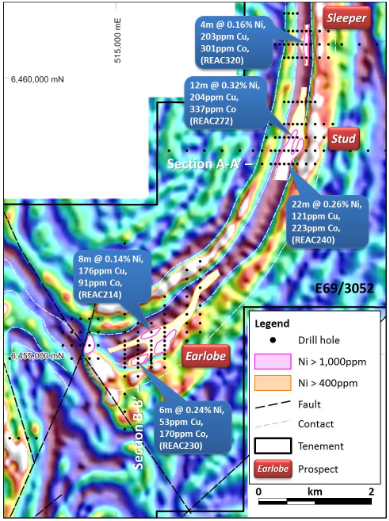
 

Northern Targets aircore drill plan on aeromagnetic image showing
contours of maximum nickel in hole and selected intervals at the
Earlobe, Stud and Sleeper prospects. Source: Company announcement


All three targets occur within an 8km strike length of a layered mafic-ultramafic complex in the northern part of the Red Bull project.

The company indicated the anomalies remain open, with 3km of prospective strike yet to be tested by aircore drilling.

Results from each prospect include:

Stud

–    22 metres at 0.26 per cent nickel, 121ppm copper, 223ppm cobalt, 7.5ppb platinum from 32 metres, including 8 metres at 0.41 per cent nickel, 170ppm copper, 350ppm cobalt, 6.8ppb platinum from 32 metres;
 
–    12m at 0.32 per cent nickel, 204ppm copper, 337ppm cobalt, 8 ppb palladium from 37m; and

–    8m at 0.15 per cent nickel, 400ppm copper, 261ppm cobalt, 14.5ppb palladium, 14.5ppb platinum from 22m;

Earlobe

–    6m at 0.24 per cent nickel, 53ppm copper, 170ppm cobalt, from 52m.

Sleeper

–    4m at 0.16 per cent nickel, 203ppm copper, 301ppm cobalt from 44m.

“These results are highly encouraging and demonstrate the potential for significant nickel-copper mineralisation at Red Bull,” Sheffield Resources managing director Bruce McQuitty said in the company’s announcement to the Australian Securities Exchange.

“We have identified a discrete, eight kilometre long unit within a mafic-ultramafic complex, which displays strong nickel, copper and cobalt anomalism.

“Elevated palladium and platinum values are a further indication that we are in the right setting for a magmatic nickel sulphide system.

“The tenor of anomalism is similar to that found in the halos to nickel deposits.

“The next phase of work will include an examination of disseminated sulphides observed in end-of-hole samples to determine if they are of magmatic origin.”
Phoenix Gold increases Castle Hill Resource

THE DRILL SERGEANT: Phoenix Gold (ASX: PXG) has announced a 75 per cent increase to the Mineral Resources for Stage 1 at the company’s Castle Hill gold project.

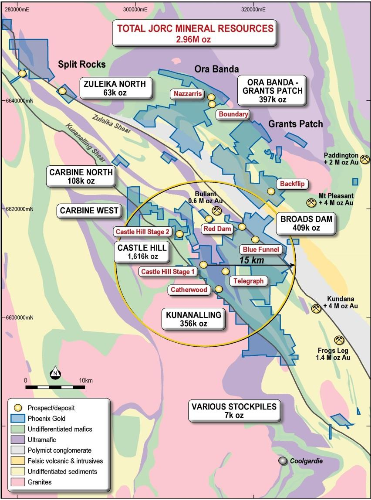
The project is located on the Kunanalling shear zone in the heart of the Western Australian Goldfields, less than 50 kilometres from Kalgoorlie in Western Australia.


Phoenix tenements, project location and Total Resource summary. Source: Company announcement


The company’s updated September 2013 Mineral Resource for Stage 1 contains 21.79 million tonnes at 1.6 grams per tonne gold for 1,137,000 ounces (at a 0.8g/t lower cut-off grade).

Phoenix Gold indicated that over 70 per cent of contained metal is now in the Indicated Resource category.
 
The combined Resource for Castle Hill now comprises 30.95 million tonnes at 1.6g/t gold for 1,616,000 ounces, representing a 37 per cent increase in contained metal with 52 per cent in the Measured and Indicated Resource categories.

The Resource has a maximum depth from surface of 190metres.

“Further validation of the size and quality of the Castle Hill gold deposit comes from this independently verified resource update for Stage 1,” Phoenix Gold managing director Jon Price said in the company’s announcement to the Australian Securities Exchange.

“It clearly demonstrates the robust nature of the mineralisation that is conducive to large scale low cost open cut mining from surface, has excellent metallurgy and is in close proximity to the major mining centre of Kalgoorlie-Boulder.

“As we continue to grow the resource along strike and at depth of Stage 1, Stage 2 and beyond, the updated geological model will be the subject of an independent open pit reserve study.

“This will deliver an updated reserve position, mining schedule and development plan as part of the definitive feasibility study on track for completion in December 2013.”

Triton Minerals hits high-grade graphite at Cobra Plains

THE DRILL SERGEANT: Triton Minerals (ASX: TON) has received results of drilling undertaken at the company’s is Balama North project in Mozambique.

The drilling targeted a three kilometre-long graphite mineralised zone known as Cobra Plains.


Overview of the intrepreted distribution of graphite prospects of Cobra
Plains and Nicanda Hill on the Balama North project in relation to Syrah
Resources’ Balama deposit. (approximate extent shown). Source: Company
announcement


Triton said it had encountered a number of drill hole intersections of high-grade graphite the Cobra Plains prospect during its July drilling program, these included:

–    44 metres at 6 per cent Weighted Average Graphite Carbon (WAGC) from 23 metres;

–    17m at 9.8 per cent WAGC from 2m;

–    23m at 6.6 per cent WAGC from 44m; and

–    12m at 7.4 per cent WAGC from 12m, including 2m at 16.2 per cent Graphite Carbon.

“At this early stage of the drilling program these are very positive results which are helping the company to develop a better understanding of the composition of the north-east-trending graphite zone of approximately 3km in length, identified on the Cobra Plains prospect in the Balama North project,” Triton Minerals managing director Brad Boyle said in the company’s announcement to the Australian Securities Exchange.

“In many countries around the world, two per cent total graphitic carbon is considered economic to mine, so intercepting numerous very high grades of graphitic mineralisation with grades of up to 16.2 per cent total graphitic carbon, in our secondary target is an exceptional result.

“The initial wide space drilling program consisting of four drill sections spaced approximately one kilometre apart, has intersected numerous high and medium grade graphite zones, extending over the three kilometre area.

“This is a very positive outcome and the results demonstrate the potential for the company to delineate a large volume of high-grade graphitic mineralisation and increases the overall general potential of the Balama North project.”

Triton said the first phase of RC drilling it has completed demonstrated the potential of the Cobra Plains prospect to host both cumulative and continuous drilled widths of graphite mineralisation and zones of relatively high graphitic carbon grades.

The company is now preparing to undertake further RC and diamond drilling to test the strike continuity and tenor of the graphite mineralization within and beyond the current 3km long zone.

Segue Resources reviews Pardoo project

THE DRILL SERGEANT: Segue Resources (ASX: SEG) has commissioned a review and evaluation of the company’s Pardoo nickel-copper project, located in the Pilbara region of Western Australia.

Segue has appointed mineral exploration consultants, OMNI GoeX to undertake the review, which has completed an initial review of historical exploration data Segue has available across the Pardoo project area.

This includes gravity and airborne magnetic surveys, geological mapping and drilling results.

The review has concluded that the Pardoo project is prospective for the discovery of new magmatic sulphide nickel and copper deposits associated with a series of mafic-ultramafic intrusions.

It also concluded the company’s existing Highway nickel-copper deposit is likely the result of structural remobilisation and detachment of sulphides within the Pardoo Fault zone.

A previously reported JORC compliant inferred resource of 50million tonnes at 0.3 per cent nickel and 0.13 per cent copper has been established at the Highway Deposit.


Highway deposit Mineral Resource. Source: Company announcement


So far the review has:

–    Interpreted a large mafic-ultramafic intrusive body(s), part of which has been caught up in the Pardoo Fault Zone, from drilling, gravity and magnetic data;

–    Concluded the presence of the Highway nickel-copper deposit clearly demonstrates the presence of a significant mineralising nickel and copper system that may be associated with the mafic-ultramafic intrusions; and

–     Identified the interpreted basal unit as the priority area for the next phase of evaluation;

As a result of the review and initial geological interpretation Segue has applied for an additional exploration licence covering 225 square kilometres adjacent to the northern boundary of the company’s existing tenement E45/1866.

Segue said it expects to be notified of the outcome of the application in 4Q 2013.

The next phase of evaluation will include a review and re-modelling of existing airborne and ground based electromagnetic data, and a program of field work the company anticipates to have completed by the end of September 2013.

Mincor Resources replenishes 52 per cent of 2013 nickel production

THE DRILL SERGEANT: Mincor Resources (ASX: MCR) has been able to replenish Ore Reserves at the company’s Kambalda nickel operations in Western Australia.

The company has announced an updated Mineral Resource and Ore Reserve Statement showing drilling completed throughout the year has 52 per cent of all the nickel it mined during the 2013 financial year.

Mincor said most of the additions come from drilling programs it completed at the company’s Miitel nickel mine.

Mincor’s updated Ore Reserve and Mineral Resource inventory now stands at:

Total Ore Reserves: 673,000 tonnes at 3.2 per cent nickel for 21,300 tonnes nickel-in-ore; and

Total Mineral Resources: 3,557,000 tonnes at 3.7 per cent nickel for 117,000 tonnes nickel-in-ore.


Cumulative nickel production and Year-End Reserves 2001-2013. Source: Company announcement


The N30 orebody at South Miitel also kicked in to deliver an initial Ore Reserve of 208,000 tonnes at 2.6 per cent nickel for 5,370 tonnes of contained nickel.

Mincor explained that after depleting Miitel’s June 2012 Ore Reserve for production during the past year, this represents a doubling of the Ore Reserve for Miitel, adding approximately two years to its mine life.

Elsewhere at South Miitel, the N31 and N32 Mineral Resources remain outside Ore Reserves due to insufficient drill density, as well as the emerging new discovery known as the N34.

Mincor indicated however, these are likely to become important targets for the coming year with one, possibly two underground drill rigs to be used for most of the year to infill these Resources and, if viable, convert them to Ore Reserves.

Mincor also intends mobilising a surface diamond drilling rig in order to implement a deep-drilling step-out strategy, as it did at South Miitel during 2009-11.

This will involve deep diamond drilling of parent and daughter wedge holes, aimed at defining a further five years of potential reserves at South Miitel, beyond current Ore Reserves.

The company was not able to add to Ore Reserves at Mariners during the year due to a lack of drilling, which it put down to a lack of suitable underground drill positions.

Mincor explained it has now advanced the Mariners decline to the point where good drill positions have become available, and two drill rigs are currently drilling.

Mincor said the underground and surface drilling programs at both the Miitel and Mariners operations, combined with its nearby gold targets meant the company was entering a phase of focused exploration activity at Kambalda.

“We did well during 2013 to replenish more than half of our nickel production in what was a fairly challenging period with a constrained budget and limited drilling positions at Mariners,” Mincor Resources managing director David Moore said in the company’s announcement to the Australian Securities Exchange.

“The updated Mineral Resource and Ore Reserve position represents a creditable result and lays the foundations for an expanded drilling program in the coming year, aimed at sketching out, at least in ‘rough draft’, another five years of production beyond our current notional two-year mine life.”

Mithril Resources kicks off NT drill program

THE DRILL SERGEANT: Mithril Resources (ASX: MTH) has commenced a 3,000 metre RC drilling program at the company’s East Arunta project area in the Northern Territory.

The drilling is targeting economic high-grade copper mineralisation and will test five outcropping copper targets, including: Mini Me West, El Gordo, Ivana, Harry Creek, and Red Rock Bore.

The company said it will also be testing a buried geophysical anomaly, known as Coles Hill North.


East Arunta project area – location of copper drill targets and MMG nickel work area. Source: Company announcement


Mithril prioritised the targets from systematic work it has completed over the last 6 to 12 months.

The Mini Me West, Ivana and Coles Hill North targets have never been subjected to drilling, while only shallow drilling has been undertaken on the remaining targets.

The first target to be drilled will be Mini Me West, where Mithril has identified an 800metre-long combined VTEM and IP geophysical anomaly, overlain by sporadically outcropping zones of copper mineralisation.

The company has previously released rock chip results from Mini Me West of up to 1.91 per cent copper.

Mini Me West, El Gordo and Ivana are subject to a joint venture between Mithril (80 per cent and operator) and Sammy Resources (20 per cent), a wholly-owned subsidiary of Cazaly Resources (ASX: CAZ).

Both parties are funding the upcoming drilling on these targets on a pro-rata basis.

The remaining targets are 100 per cent Mithril-owned.

“The commencement of copper drilling signals the start of a very active period for the company, with an additional 2,500 metre nickel RC drilling program being sole-funded and managed by Mithril’s nickel JV partner – MMG Limited, scheduled to commence in October 2013,” MithrilResources said in its ASX announcement.

“The company looks forward to providing further drilling updates with first copper drill results expected by mid–late September.”

Lamboo Resources confirms graphite at McIntosh

THE DRILL SERGEANT: Lamboo Resources has completed geological mapping at the company’s McIntosh flake graphite project in Western Australia.

Lamboo said the mapping has confirmed the presence of coarse flake graphite at Target 5, which is one of at least five graphitic schist horizons it has identified at the project.

“The recognition of coarse flake further enhances the prospectivity of the project,” Lamboo Resources said in its ASX announcement.

The company claims RC drilling and geological mapping have confirmed the presence of a graphitic schist horizon extending over 1200 metres and up to 35 metres wide at Target 5.
 
Target 5 RC results include:

17 metres at 5.77 per cent total graphitic carbon (TGC) from 26m, including 5m at 10.73 per cent TGC from 29m.

Lambooo said the mapping of Target 5 has been supported by petrographic analysis, indicating the presence of coarse flake graphite up to 500 microns in surface samples.
 

Geological mapping conducted at Target 6 has also supported previous RC drilling with the presence of 100m-thick flake graphite horizons.


Location of flake graphite target areas including Targets 5 and 6 at the McIntosh project. Source: Company announcement

“Geological mapping at Target 5 has been followed up by a preliminary RC drilling program to show that the target flake graphite schist extends over a strike length of 1200 metres,” Lamboo said.

“It is up to 35 metres wide and extends to a depth of at least 100 metres (limit of drilling).

“The graphitic schist horizon occurs within a high-grade metamorphic stratigraphy that includes para-amphibolite with minor marble and calc-silicate horizons flanked by granite.

“Petrographic analysis of surface samples have confirmed the presence of coarse flake graphite occurring as clumps and aggregates.

“These results are supported by TGC analyses up to 11.4 per cent TGC in the 6 rock chip samples analysed.”

Lamboo has completed geological mapping at Target 6 in preparation of an upcoming RC drilling program planned to commence this quarter.

The company said geophysical IP surveying has indicated potential for broad graphitic schist horizons, which has been confirmed by mapping and preliminary RC drilling in late 2012.

Mapping has shown the presence of a northerly plunging anticline containing two major graphitic schist horizons with an aggregate width up to 150m and extending over a strike length of 1000m.

Brazilian Metals Group drills copper with every hole

THE DRILL SERGEANT: Brazilian Metals Group (ASX: BMG) has intersected copper in all holes during while conducting its maiden drill program at the Laxia prospect.

The Laxia prospect is situated within the company’s Black Pine project in Cyprus.

The company said the recent drilling had expanded its exploration target area to more than 50 kilometres.

BMG said each hole it has drilled at the prospect located has intersected a 20 to 40 metre wide sulphide mineralisation zone.

The company considers the results to have confirmed exposed mineralisation extends to depth and contains copper, gold and cobalt grades.

Drilling results for the first seven holes include:

4.25 metres at 2.53 per cent copper from 30.75 metres;

4.18m at 1.72 per cent copper, 1.18 grams per tonne gold and 0.15 per cent cobalt from 33.1m; and

3.58m at 1.74 per cent copper, 0.28g/t gold and 0.05 per cent cobalt from 112.9m.

Assays are pending for the remaining six holes.

BMG said the drilling had also highlighted the potential of the western portion of the Laxia prospect, indicating the mineralised zone may extend for at least 400 metres to the west.

“The drilling has highlighted the potential of the western Laxia segment to deliver more consistent widths and grades of sulphide mineralisation,” Brazilian Metals Group managing director Bruce McCracken said in the company’s announcement to the Australian Securities Exchange.

“In addition the revised exploration model indicates over 50 kilometres of highly prospective ground within the Black Pine Project area.

“The completed drilling has greatly improved our technical understanding of the system and our chances of identifying additional mineralised zones with the potential to deliver an economic resource base.”

Exploration continues at the Black Pine project and has commenced at the company’s other prospects targeting large-scale volcanic-hosted massive sulphide copper and gold deposits.

Bligh Resources upgrades Bundarra Resource estimate

THE DRILL SERGEANT: Bligh Resources (ASX: BGH) has had a Mineral Resource estimate calculated at the Bundarra gold project, located in the Leonora region of Western Australia.

Bligh owns 42.9 per cent of SR Mining, which owns the Bundarra project.

The total Bundarra gold project Mineral Resource has increased by 54 per cent from 318,000 ounces estimated in November 2012 to 489,000 ounces of gold.

The new Mineral Resources comprise 3,972,000 tonnes at 2.2grams per tonne gold containing 276,000 ounces of gold in the Measured and Indicated categories.

There is also a further 3,510,000 tonnes at 1.9g/t gold containing 213,000 ounces of gold in the Inferred category.

The company explained the Mineral Resource estimate has been updated from previous estimates for the Wonder North and Celtic deposits, and incorporates new estimates for the Wonder West and Celtic South deposits that had not been previously reported by Bligh.

Bligh has taken confidence from the upgrade saying it provides the company with additional exploration upside potential existing at both its Bundarra and Leonora projects.


Bundarra project Location. Source: Company announcement


“This significantly increased resource estimate, which was achieved at minimal cost provides further confirmation of the development potential at Bundarra, and bolsters the mine life potential and economics of the project,” Bligh Resources chief executive officer Robert Benussi said in the company’s announcement to the Australian Securities Exchange.

“After the encouraging results from the scoping study completed in May 2013, Bligh is well positioned to advance its objective of becoming a gold producer at Bundarra.

“As mentioned previously, Bligh’s mining schedule focuses on maximising cash flow, with grade controlled ore at the base of the Celtic pit providing an immediate cash injection once production commences.

“Bligh and project partner SR Mining are encouraged by this substantial milestone, which adds significant value to the Bundarra gold project through the detailed compilation of historical data and will continue to work towards the implementation of a structured development strategy.

The company will now focus on progressing a maiden Ore Reserve statement and a revised Scoping Study based on the updated resource models.

“The existing Mineral Resources at Bundarra offer Bligh a near term gold production opportunity in the Eastern Goldfields of Western Australia.”

Tawana Resources receives environmental permit for Mofe Creek

THE DRILL SERGEANT: Tawana Resources (ASX: TAW) has received an Environmental Permit for the exploration phase of the company’s 100 per cent-owned Mofe Creek iron ore project in Liberia.

“This marks an important step forward in the company’s ongoing efforts to evaluate the Mofe Creek iron ore project in an environmentally sustainable manner commensurate with the Laws of Liberia,” Tawana Resources managing director Len Kolff said in the company’s announcement to the Australian Securities Exchange.

“The EPA approval allows us to now commence exploration drilling at Mofe Creek.

“Drill access is now underway and a rig will be mobilised in the next few weeks.

“The upcoming program is designed to deliver a maiden JORC resource at Mofe Creek and also to test the exciting new Zaway discovery for potential blind DSO; similar to the historic Bomi Hills mine 20 kilometres along strike to the east.”

Tawana is in process of securing the same multipurpose reverse circulation (RC) and diamond core (DD) drill rig for drilling at site it used to carry out its maiden 2,500m RC drill program.
 

The company expects the drill rig to arrive on site within the next few weeks, from when it will commence exploration diamond drilling at Zaway followed by resource/metallurgical DD and RC drilling at the Gofolo and Koehnko prospects.


Prospect areas showing drilling completed to date at Gofolo and
Koehnko, access roads and tracks (in white) and Zaway target area.
Source: Company announcement


The diamond and RC drilling planned for this program is designed to deliver a maiden JORC-compliant resource at the Gofolo and Koehnko prospects in addition to exploration drilling at Zaway.

Pending initial results at Zaway, it too may be included within the resource model for the Mofe Creek project.

“Drilling is expected to be completed within three months and although we will be drilling through the rainy season, we are confident of achieving the drilling timeline given the good all-year-round access the project affords and previous drilling experience by the drill contractor on the project site,” Kolff said.