Cassini Resources drilling confirms West Musgrave prospectivity

THE DRILL SERGEANT: Cassini Resources (ASX: CZI) recently received all remaining assay results for its initial Reverse Circulation (RC) drilling program at the Pandora target within the company’s 100 per cent-owned West Musgrave project in Western Australia.

The company said the assays for the five remaining holes had confirmed a wide copper and nickel anomalism and down‐hole intervals continuous over 400 metre strike length.

The strongest anomalism intersected:

7 metres at 0.1 per cent copper and 635ppm nickel from 48m and 1m at 0.14 per cent copper and 0.11 per cent nickel from 78m.

Cassini believes the coincident anomalous sulphur assays are evidence base metals are present in sulphide form.

Cassini Resources managing director Richard Bevan spoke with The Roadhouse at the RIU Melbourne Resources Roundup. Watch here.


Analysis of down-hole geological and geophysical data has indicated the massive magnetite intersected over down‐hole intervals is the source of the observed surface and airborne electromagnetic geophysical anomaly.

Cassini said the assays reinforce the company’s contention that Giles Complex magmatism, prospective for nickel‐copper sulphide, extends into its project area and represents a large and previously unexplored extension of the West Musgrave mineralised province.

The company said the recent work it has conducted the West Musgrave project has achieved a number of important milestones that have reduced the exploration risk of the project.

Cassini affirms the program has confirmed that:

The nickel-copper‐Cu sulphide prospective geology of the exposed parts of the western Musgrave Province continues under cover into the project area;

Magnetic anomalies in the project area are sourced by mafic intrusive bodies;

Magmatic sulphides are forming in these rocks and the right type of highly‐dynamic metal‐concentrating magmatic processes are occurring;

The prospective basement in the project area occurs at relatively shallow depths and has not been significantly weathered, improving the chances of geophysical detection of sulphide mineralisation;

Electro‐magnetic (EM) surveying techniques are effective for detecting sulphide mineralisation within the project area where palaeo‐drainage pathways are not present; and

The area of the Project surveyed to date does not host stratigraphic conductors that would generate false‐ positive anomalies in EM surveys. This is similar to the exposed parts of the west Musgrave province further east and reduces the technical risk in future exploration.

Investigator Resources prepares for Paris Resource calculation

THE DRILL SERGEANT: Investigator Resources (ASX: IVR) has received the final assays for a recently-completed round of drilling at the company’s Paris silver project.

The latest assays are for the remaining 41 diamond and 8 reverse circulation (RC) holes of the completed drilling.

Results include:

Western Zone

8 metres at 2,703 grams per tonne silver from 48 metres downhole depth including 1.2 metres at 1.7 per cent silver from 52.5 metres;

29.4m at 251g/t silver from 58m, including 1.1m at 3,840g/t silver from 82.9m;

4.5m at 594g/t silver from 52.7m;

Northeastern Zone

12m at 241g/t silver from 47m;

Southeastern Zone

5.9m at 222g/t silver from 95.3m and 8.7m at 257g/t silver from 102.4m;

42.2m at 123g/t silver from 8m;

35.65m at 118g/t silver from 12m;

25.5m at 191g/t silver from 86m;


Drilling update plan showing new reported holes only and interpreted targeting elements. Source: Company announcement

Investigator said the results would be incorporated into the project’s pending maiden Inferred Resource estimate.

 “Work on the resource estimate is nearing completion,” Investigator Resources managing director John Anderson said in the company’s announcement to the Australian Securities Exchange.

“We have now delineated a mineralised area at Paris of at least 1,100 metres by about 400 metres.

“The exciting volcanic crater and breccia geology is new in South Australia and has the potential for internal expansions and along strike extensions that will not be included in the first instance within the maiden resource.

“The pleasing aspects of this latest drilling are continuing high-grade silver intersections and the shallow nature of the deposit.

“The style of mineralisation – breccias, clays, sulphides so near to surface – does suggest the potential for a low cost, free dig open-pit mining method to be considered in future studies.”

Cazaly Resources eager to progress multi-element portfolio

THE DRILL SERGEANT: Cazaly Resources (ASX: CAZ) recently released results from pre-collar RC drilling recently completed at the company’s Mt Angelo North copper deposit located in the Kimberley region of Western Australia.
 

In all, Cazaly conducted 10 pre-collar RC and 9 diamond tails totalling 1,115 metres of RC and 681 metres of diamond drilling for this particular program.


The Roadhouse spoke with Cazaly Resources joint managing director Clive Jones at the RIU Melbourne Resources Roundup. Watch here.


The RC drilling was largely conducted to facilitate diamond core drilling principally aimed at exploring the extent of the recently discovered ‘Feeder Zone’, which was previously reported from the company’s initial diamond core drilling program in June this year.

The company explained that some of the pre-collars were positioned to also test for eastern extensions of the upper massive sulphide blanket.

Of the nine pre-collars drilled on the eastern flank, eight were successful in extending this mineralisation.

Highlights included:

27 metres at 2.86 per cent copper equivalent;

21m at 1.95 per cent copper equivalent; and

18m at 1.6 per cent copper equivalent.

Cazaly said it had been encouraged by the discovery of the feeder zone as it considers it could lead to the discovery of further high-grade mineralisation at Mount Angelo North.

The company said multi-element data and structural information collected from the drilling will targeting other massive sulphide lenses as well as extensions to the blanket and feeder mineralisation defined to date at the Mt Angelo North copper deposit.

The Halls Creek copper project is located in the Kimberley region of Western Australia is subject to an agreement with 3D Resources Limited (ASX: DDD) whereby Cazaly may earn up to a 75 per cent interest in the project.

Northern Star highly-encouraged by Titan drilling

THE DRILL SERGEANT: Northern Star Resources (ASX: NST) is confident drilling results from the recent Titan gold discovery at the company’s Paulsens project in Western Australia have highlighted its potential.

The latest results from Titan include:

–    1.4 metres at 14.2 grams per tonne gold from 488 metres;

–    0.7m at 41.6g/t gold from 352m; and

–    0.8 at 14g/t gold from 407m.

Northern Star said the vast majority of the drilling it has completed so far at Titan has contained large intersections of quartz up to 22m true-width, which the company considers to be important because all the known mineralisation at Paulsens is contained within the quartz host rock.

The latest drilling at Paulsens has also intersected more high-grade gold in the Voyager 1 and Voyager 2 lode.


Long section view (looking North) of significant drill results for Voyager 1 and 2. Source: Company announcement


Results from Voyager 1 include (uncut):

–    5.1m at 31.7g/t gold (true width 2.5m) from 413m;

–    1m at 37.5g/t gold (true width 0.9m) from 431m;

–    9.7m at 17.8g/t gold (true width 1.7m) from 430m;

–    4.5m at 15.2g/t gold (true width 3.5m) from 473m;

–    3m at 15.2g/t gold (true width 2m) from 430m;

–    2.5m at 10.2g/t gold (true width 2.52) from 447m; and

–    8.2m at 8.7g/t gold (true width 5.5m) from 429m;

Results from Voyager 2 include (uncut):

–    1.1m at 51.7g/t gold (true width 0.4m) from 417m;

–    1m at 39.9g/t gold (true width 0.6m) from 395m;

–    0.9m at 26.6g/t gold (true width 0.9m) from 431m;

–    2m at 13.6g/t gold (true width 1.1m) from 507m; and

–    4.7m at 8.7g/t gold (true width 4m) from 426m;

“These results provide more firm evidence of the continuity of the high-grade mineralisation, which in turn underpins the consistent production, low costs and strong cashflow enjoyed by Northern Star,” The company said in its ASX announcement.

“Ore development is now underway at Voyager 2 as part of the strategy to mine the Voyager lodes in parallel, providing scope for further cost savings.

“The next round of drilling at Titan will be underway shortly with a view to defining the extremities of the quartz rock and then will progress to narrowing down to find where the mineralisation sits inside the quartz.

“The Titan discovery has potential to add substantial value to Northern Star due to its strong grade and location just 100 metres from the existing Paulsens mine.”

Enigma drilling delivers for Sipa Resources

THE DRILL SERGEANT: Sipa Resources (ASX: SRI) has completed three diamond drillholes for 410.9 metres of RC precollar and 941.6 metres of core at two Sub-prospects within the Enigma Secondary Copper Blanket at the company’s 100 per cent-owned Thaduna copper project, located in the Gascoyne region of Western Australia.

The company explained the aim of the program was to discover substantial thicknesses of primary copper sulphides, which may be part of the source, or sources, of the extensive – some 5 kilometres by up to 2 kilometres – Secondary Copper Blanket.

“We believe that this aim has now been achieved in two areas about 1.5 kilometres apart,” Sipa Resources said in its ASX announcement.

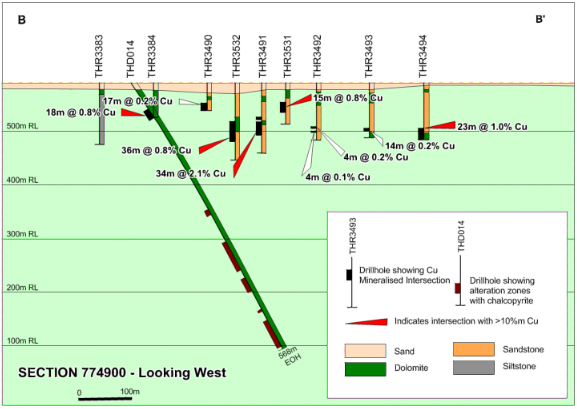
“Holes THD012 and 013 to the northeast and THD014 to the southwest.
 

“Analytical results for all of holes THD012 and 013 have been received, as have results from the precollar of THD014. The core from THD014 is still being cut.”


Cross Section B-B for THD014. Source: Company announcement


Results achieved from the drilling program include:

–    THD012 precollar – 63 metres at 1.1 per cent copper from 90 metres (reported 2 September 2013);

–    THD013 core – 29m at 1.1 per cent copper from 82m, followed by 11m at 0.2 per cent copper from 120m, 8m at 0.3 per cent copper from 135m and 6m at 0.4 per cent copper from 146m.

Sipa considers this result has confirmed the THD012 precollar intersection.

–    THD014 precollar – 18m at 0.8 per cent copper from 55m, including 5m at 1.9 per cent copper from 56m, within the Enigma Secondary Copper Blanket (core is still being cut).

“Whilst no metre samples of cut core are likely to return percent levels of copper in THD014, the alteration and widespread primary copper sulphide mineralisation between 278 metres and end of hole – some 288 metres – is the best indication to date, in fresh unweathered rock, of the very large ‘primary copper mineralised system’ that we are searching for,” Sipa said.

The company indicated its next phase of exploration at Enigma will be down hole Electromagnetic geophysical surveying (DHEM) of holes THD 012, 013 and 014.

DHEM is used to attempt to detect electrically conductive sulphide bodies, within around 100 metres of the hole being surveyed.

Sipa said such information would be critical in the planning of the next holes at Enigma.

Tawana Resources hits further Mofe Creek mineralisation

THE DRILL SERGEANT: Tawana Resources (ASX: TAW) has claimed the discovery of high-grade itabirite mineralisation over a two kilometre strike at the Gofolo NE target and within 2.5km from the Gofolo Main prospect.

Both are located within the company’s 100 per cent-owned Mofe Creek iron ore project in Liberia.

Tawana has drilled a total of 259 holes along the Gofolo NE target with 62 holes intersecting iron formation.

The company has received 30 results to date with a further 32 results pending and augering ongoing.

The Gofolo NE hand auger hole program is part of Tawana’s ongoing regional exploration program, which is being conducted to define mineralisation footprints for future drilling.

The work so far has identified a friable itabirite footprint over a 2km strike at Gofolo NE in addition to high-grade outcropping coarse grained itabirite similar to the drilled Gofolo main target.


Prospect areas showing drilling completed to date at Gofolo and
Koehnko, main access roads and tracks (in white) and Gofolo / Gofolo NE /
Zaway target cluster. Source: Company announcement


Surface auger holes average 32 to 35 per cent iron with individual results up to 41.4 per cent iron over the south western half of the anomaly.

Assay results are pending for the north-eastern half.

“This adds another exciting discovery to the Mofe Creek project; given the similarity in mineralisation and proximity to the Gofolo Main prospect,” Tawana Resources managing director Len Kolff said in the company’s announcement to the Australian Securities Exchange.

“A cluster of high-priority prospects is developing within less than five kilometres potential trucking distance from each other with similar high-grade, coarse grained itabirite as intersected in drilling at Gofolo; providing confidence in a readily beneficiable plus-60 per cent iron product.”

Tawana indicated it has a nine hole RC drill program planned for Gofolo NE on completion of the current resource drilling program, which is due to commence in the coming weeks.

The Mofe Creek project hosts a 95 million tonnes high-grade plus-45 per cent iron friable itabirite exploration target within a global exploration target of greater than 500 million tonnes of friable itabirite and intermixed itabirite/amphibolite.

AusQuest identifies Peruvian porphyry targets

THE DRILL SERGEANT: AusQuest Limited (ASX: AQD) has identified priority drill targets for porphyry copper-style mineralisation and iron oxide copper gold (IOCG) targets at a further three prospect areas within the company’s portfolio of copper-gold exploration projects in Peru.

These targets and are owned 100 per cent by AusQuest are in addition to others the company has already defined within the Lana and El Jaguay-Azucar prospects, which it reported in its June 2013 Quarterly report.

“We are very encouraged with what we are seeing over our extensive land package in Peru,” AusQuest Limited managing director Graeme Drew said in the company’s announcement to the Australian Securities Exchange.

“In particular the drill targets at the Cardonal, Puite and Cerro de Fierro prospects are very large and sit in one of the world’s best locations for copper exploration.

“AusQuest looks forward to commencing drilling operations in the near future, across what it considers to be a number of highly prospective, and potentially company making projects.”

The Cardonal, Puite and Cerro de Fierro prospects are subject to a Joint Venture Agreement with Cliffs Natural Resources Exploration (CNRE), a wholly-owned subsidiary of New York-listed company, Cliffs Natural Resources.

Under the joint venture, should CNRE elect to proceed with further evaluation of one or more of these prospects, it is required to sole-fund further evaluation (drilling) of the selected prospect(s) up to US$4 million to secure a 70 per cent interest in each prospect.

If CNRE elects not to proceed with further evaluation of a prospect, ownership of the prospect will revert 100 per cent to AusQuest.

Metallica Minerals passes environmental milestone

THE DRILL SERGEANT: Metallica Minerals (ASX: MLM) has had an Environmental Authority (EA) issued by the Queensland Department of Environment and Heritage Protection for the company’s Mining Lease Application (MLA 20669).

The Mining Lease Application covers the Urquhart Point zircon-rutile HMS project.

The project is located three kilometres southwest of Weipa on the western coast of Cape York Peninsula, Queensland and has a JORC Code 2012 Indicated Resource of 2.7 million tonnes at 6.53 per cent HM.

“This paves the way for the MLA to be submitted to the Queensland Minister for Natural Resources and Mines for consideration to grant the Mining Lease,” Metallica Minerals managing director Andrew Gillies said in the company’s announcement to the Australian Securities Exchange.

“The MLA is held 100 per cent by Oresome Australia Pty Ltd, a wholly owned subsidiary of Metallica and incorporates high-grade mineral sands from surface to a depth of three metres.

“Subject to the Mining Lease being granted and funding obtained by the end of calendar 2013, Metallica will target zircon-rutile HMS production for the third quarter of 2014.”

Corazon Mining set to return to TUR

THE DRILL SERGEANT: Corazon Mining (ASX: CZN) is readying to recommence its exploration of the company’s Top Up Rise project (TUR), located in the Gibson Desert region of Western Australia.

Drilling at TUR is set to kick off again as soon as possible with a drill rig still on site from the company’s initial program with drilling crews plus additional equipment now being organised and mobilised to the TUR site.

Drill targets are being reviewed, incorporating information acquired during the earlier drilling.

“The results from the first round of drilling added enormously to the prospectivity of Corazon’s TUR project.” Corazon Mining managing director Brett Smith said in the company’s announcement to the Australian Securities Exchange.

“To date, we have drilled in only four areas, within what is a very large geophysical anomaly, and have intersected sulphide mineralisation in each hole.

“We are looking forward to the next phase of full-funded exploration, which should commence next week with geophysics and drilling.”

Corazon said the results from the first phase of drilling suggest the large TUR gravity anomaly has a coincidental geochemical anomaly, including a robust base and precious metal association.

Extensive low tenor sulphide mineralisation, including copper sulphide, has been intersected in all holes drilled to date over a large area.

Cleveland converts Brazilian MOU to binding Option Agreements

THE DRILL SERGEANT: Cleveland Mining Company (ASX: CDG) has converted the Memoranda of Understanding (MOU) held over three iron-ore projects in Brazil into binding Option Agreements.

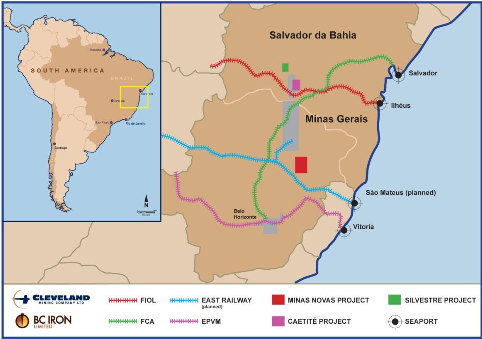
Cleveland explained the Option Agreements allow the company’s recently-formed alliance with BC Iron (ASX: BCI) to acquire up to 80 per cent of the projects from private Brazilian company, Bahmex through earn-in agreements based on staged payments and key project milestones.

The transaction does not require upfront payments prior to drilling.

The Cleveland/BC Iron alliance looked at more than 50 South American iron-ore projects, ranging in stages from exploration to producing mines.

It ultimately selected three projects, comprised of 81 tenements that were packaged together by the vendor, Bahmex.

Cleveland said the projects were selected for further work based on criteria including: geology, community attitudes towards mining, and options for port and rail logistics.

The projects are located in the Brazilian states of Salvador da Bahia (the Caetite and Silvestre projects) and Minas Gerais (the Minas Novas project), covering 272 square kilometres and 1,064sqkm respectively.


Source: Company announcement


“Bahmex and mining consulting firm Coffey Mining have identified significant exploration potential for the Caetite concessions based on detailed geological mapping, airborne geophysical data interpretation, ground magnetometric surveys, as well as trenching, sampling, chemical analyses and concentration tests,” Cleveland Mining Company said in its ASX announcement.

Cleveland indicated its intentions to commence exploration fieldwork at the Caetite project, estimating two months of detailed mapping, sampling and logistics preparation will be undertaken prior to drilling.

First pass drilling will be carried out with the aim to confirm the depth extend of the highest priority targets, with up to 2000m to be drilled in each state.

The start of fieldwork at the Minas Novas project will be largely determined by timetables for Caetite.

Government aeromagnetic data covering most of the project will be correlated with work already completed by Bahmex.