Drake and Panoramic start drilling at Nordgruva

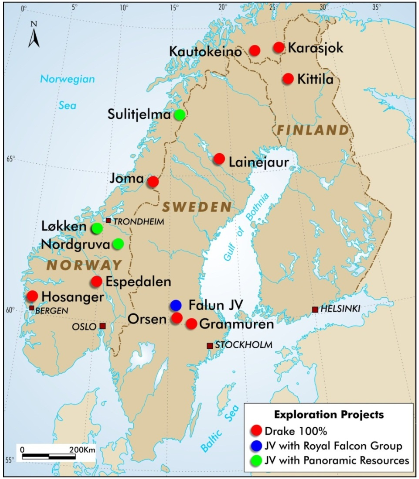
THE DRILL SERGEANT: Drake Resources (ASX: DRK), in league with its Joint Venture partner Panoramic Resources (ASX: PAN), has commenced diamond drilling and down hole geophysics at the Nordgruva copper zinc prospect.

The prospect is part of the JV’s Nordgruva project, located in central Norway.


Drake has a number of assets prospective for copper, nickel, gold
and iron across the Nordic region. Source: Company announcement


Panoramic Resources has advised a single diamond drill hole to a depth of approximately 600 metres will target one of five targets, which were identified from a detailed airborne electromagnetic (VTEM) survey flown by Drake in 2012.

The JV considers these targets to have a similar geophysical signature to high-grade historic copper mines in the district.

The Nordgruva project is part of the Røros mining district in central Norway, which Drake explained has a copper/zinc mining history extending back over 300 years from multiple sites.

“The planned hole is targeting one of the most extensive modelled plates near Kongens with dimensions in the order of 1500 metres by 750 metres,” Drake Resources said in its ASX announcement.

“The target is interpreted to be in the stratigraphic position of the main mineralisation in this well-endowed, historical copper mining district.
 
“Results are expected in November.”

Red Mountain Mining kicks off Batanga Scoping Study

THE DRILL SERGEANT: Red Mountain Mining (ASX: RMX) has commenced an independent Scoping Study at the company’s Batangas project, located south of Manila in the Philippines.

Red Mountain indicated the Scoping Study will examine the viability and high-margin potential of the Batangas mining and processing project.

The Scoping Study will initially be based on the project’s current JORC code-compliant Indicated and Inferred mineral resources, which total 5.78 million tonnes at 2.2 grams per tonne gold and 3.3g/t silver, containing 408,000 ounces of gold and 606,000 ounces of silver at a lower cut-off grade of 0.85g/t gold.


Batangas gold project, Lobo, with Mineral Resources. Source: Company announcement


The company said it will continue to target high-grade near surface mineralisation at its Japanese Tunnel and Pica prospects and any new results from its current drilling campaign will be added to the mineral resource estimate and Scoping Study inventory.

All current mineral resources are contained within granted Mineral Production Sharing Agreements (MPSA’s – the Philippines equivalent of Mining Leases) and the majority of the near surface mineral resources at Southwest Breccia (SWB), Lobo, and Kay Tanda, Archangel, are in the Indicated Resource category.

“The commencement of the Scoping Study represents a significant milestone for Red Mountain shareholders,” Red Mountain Mining managing director Jon Dugdale said in the company’s announcement to the Australian Securities Exchange.

“With our near surface, high-grade mineralisation at Lobo we are targeting a high early cash flow project and we are looking forward to the Scoping Study confirming our expectations.”

Latin Resources identifies ten new Peru targets

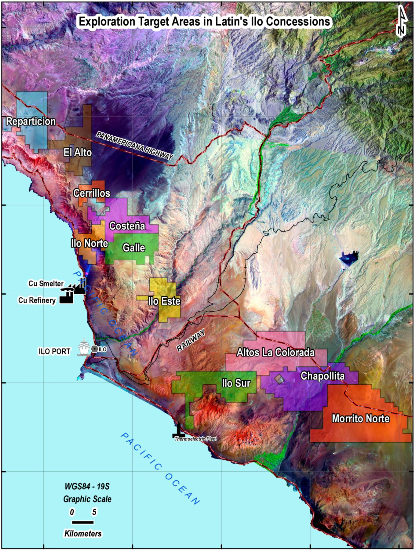
THE DRILL SERGEANT: Latin Resources (ASX: LRS) has reported the identification of ten new IOCG/Porphyry copper target areas in the company’s 100 per cent-owned concession holdings in the coastal IOCG/Porphyry copper belt of Southern Peru.

Latin has reported two previously-identified targets within this part of the belt that have been partly drill tested to date.

These are the Mariela iron/copper project and Ilo Norte, where drilling by Latin in 2011 uncovered the edge of an IOCG/Skarn replacement system.

Latin followed up that drilling with additional geochemistry and geophysics, which identified a new target that is now fully permitted and ready to drill.


Ten new target areas identified in Latin’s 100 per cent-owned
concessions in Peru’s Southern Cordillera and the Ilo Norte project.
Source: Company announcement


The company said the ongoing exploration being carried out at both Mariela and Ilo Norte has provided its geologists with deeper knowledge of the mineralisation in the region, which they have applied to identify new exploratory targets.

A revision carried out over the last 12 months of the geological, geochemical, geophysical and spectral data available to the company, has led to the identification of the ten new prospective targets for IOCGs and porphyry copper deposits.

Latin said it is currently in discussions with several potential Joint Venture partners to continue drill testing these targets in the region.

“The generation of ten new targets is testimony to the prospectivity of this important mineral belt and with discussions underway with potential JV partners over these targets, Latin is well placed to proceed quickly towards drill testing and discovery,” Latin Resources managing director Chris Gale said in the company’s announcement to the Australian Securities Exchange.

“The company is looking to capitalise on our commanding mineral rights position in Southern Peru backed up by our established good relationships with local stakeholders thanks to our successful permitting work on our drill ready Ilo Norte IOCG project.”

Rox Resources continues high-grade run at Teena

THE DRILL SERGEANT: Rox Resources (ASX: RXL) has reported further high-grade zinc results from drilling currently underway at the Teena prospect, which forms part of the company’s Reward zinc project located in the Northern Territory.
 
Rox indicated the high-grade mineralised zone at Teena has been extended by the third diamond drill hole of the program, which has intersected a zone of zinc and lead mineralisation of greater than 20m in thickness downhole.

Results from hole TNDD011 include:

–    20.3 metres at 13.9 per cent zinc plus lead from 901 metres, including 16.3 metres at 16.5 per cent zinc plus lead from 905 metres, including 14.2 metres at 18.4 per cent zinc plus lead from 907.1 metres; and

–    5.7m at 8.6 per cent zinc plus lead, including 1.7m at 13.2 per cent zinc plus lead from 937.3m.

According to Rox this intersection, together with the results from the previous two holes has extended the strike length of the high-grade mineralisation to over 700m.


Teena drill hole intercept locations. Historic hole intercepts
(horizontal position above subsurface intersection) are shown in red.
Intercepts from drill holes in the current program are shown in yellow
(horizontal position above subsurface intersection). The map shading
represents interpretation of outcropping geology. The intersections in
holes Teena 2DD and Teena 6 are about 1.3km apart, while the
intersections in holes Teena 2DD and Teena 4DD are about 800m apart.
Source: Company announcement


“Previous historic drilling indicates that the mineralised zone extends further along strike, so the overall strike length of the higher grade mineralisation could exceed 1.6 kilometres,” Rox Resources managing director Ian Mulholland said in the company’s announcement to the Australian Securities Exchange.

“Additionally, historic results from drill holes Teena 2DD and Teena 4DD demonstrate that the mineralisation also extends a significant distance north-south of at least 800 metres.”

Rox previously reported holes TNDD009 and TNDD010 both intersected high-grade mineralisation of greater than 20m downhole thickness.

Additional assays of hole TNDD010 have demonstrated further zones of zinc and lead mineralisation over a wide mineralised section from 908.8m to 1255.0m, with an overall thickness of almost 350m.

Highlights of the additional mineralisation in hole TNDD010 include:

–    7.8m at 8.7 per cent zinc plus lead, including 6.2m at 10.5 per cent zinc plus lead, including 3.2m at 12.7 per cent zinc plus lead from 988.8m;

–    9.7m at 5.7 per cent zinc plus lead from 1124m, including 2.9m at 10.4 per cent zinc plus lead from 1125.4m;

–    22m at 3.9 per cent zinc plus lead from 1169m; and

–    19.8m at 2.7 per cent zinc plus lead from 1212.2m.

“The extensive zone of mineralisation and metal content in drill hole TNDD010 is quite remarkable,” Mulholland said.

“It tells us that we have a very strong mineralised system here at Teena.

“The main section of mineralisation above the 2.5 per cent zinc plus lead lower cut-off starts at 908 metres and ends at 1255 metres, an interval of some 347 metres down hole.”

Artemis Resources gains confidence from early drill results

THE DRILL SERGEANT: Artemis Resources (ASX: ARV) has reported progress from a recently-commenced 15 hole, 3,000 metre reverse circulation (RC) drilling program currently underway at the company’s Eastern Hills antimony-lead deposit, located in the Ashburton region of Western Australia.

Artemis indicated the first five holes to be completed have all intersected sulphide mineralisation, and in doing so have confirmed and extended the company’s geological model of the deposit.

Artemis claims its on-site geologist identified sulphide mineralisation visually in the field, which was supported by a portable X-ray Fluorescence (pXRF) device, confirming the existence of antimony in the sulphide mineralisation.

The sulphide mineralisation in four of the holes completed to date has been intersected within the Main Lode (or Southern Conductor) target zones as expected from in-house modelling of previous drilling carried out by Taipan Resources.

Artemis considers the sulphide mineralisation intersected in the fifth hole, also confirms the recently-identified new Northern electro-magnetic (EM) conductor is also mineralised.


Eastern Hills EM conductors and drill hole plan. Source: Company announcement


This zone is not yet included in the current 1.25 million tonnes at 1.5 to 1.9 per cent antimony and 2.1 to 2.7 per cent lead for 410,000 tonnes exploration target.

“To have intersected mineralisation, as modelled, in the first five drill holes of the program is validation of the work completed by our technical team in defining the simplicity of the antimony mineralisation at Eastern Hills,” Artemis Resources executive director Guy Robertson said in the company’s announcement to the Australian Securities Exchange.

“The field results seen to date are highly-encouraging and bode well for achieving our stated aims of extending the Eastern Hills antimony-lead mineralisation both along strike and down dip, as well as establishing a maiden JORC-compliant resource.”

Sirius Extends Polar Bear god zone

THE DRILL SERGEANT: First pass reconnaissance drilling being conducted by Sirius Resources (ASX: SIR) has extended a zone of gold anomalism at the first gold targets being tested on the company’s 100 per cent-owned Polar Bear project.

Sirius has extended the main gold anomaly at Polar Bear several hundred metres, taking its strike extent to approximately 1.6 kilometres with a maximum width of about 800 metres.

Individual 4 metre drill samples grade up to 3.64 grams per tonne gold and the supergene anomaly is still open to the northeast and southwest.

Intersections from the latest reconnaissance drilling include:

–    12 metres at 0.85g/t gold from 32metres, including 4 metres at 2.41g/t gold from 40 metres;

–    12m at 0.65g/t gold from 40m, including 4m at 1.16g/t gold from 40m;

–    16m at 0.68g/t gold from 48m, including 8m at 1.05g/t gold from 52m; and

–    15m at 0.62g/t gold from 48m, including 8m at 0.99g/t gold from 52m.

The company explained this recent round of drilling was the third of several stages of reconnaissance drilling it has planned to test a number of targets within the Polar Bear project area, which is surrounded by the Norseman, St Ives and Higginsville gold camps that collectively host approximately 25 million ounces of gold.


Polar Bear project, showing aircore drillhole locations and current targets. Source: Company announcement


“Broad spaced aircore drilling (400 metre x 40 metre) is used to define anomalous zones (defined by a threshold of greater than 0.1g/t, or 100ppb, gold) as a prerequisite to more detailed and deeper drilling of specific mineralised zones,” Sirius Resources said in its ASX announcement.

“It is particularly encouraging to extend mineralised zones with high concentrations of gold over such broad areas at this early stage of the program.

“Extension drilling is currently underway with first pass drilling of untested targets scheduled to commence following Heritage clearance later in the year.”

The company has also completed two diamond drillholes testing the Yardilla electromagnetic (EM) target it announced in July, which have intersected graphite and minor pyrrhotite (iron sulphide) at the target depth.

Sirius has completed a down hole EM (DHEM) survey, which it claims to have confirmed the EM conductor had been tested and the EM response was due to the presence of graphite and pyrrhotite.

The company indicated it intends, over the next several months, to continue with drilling to explore the Nova and Bollinger horizons within the Eye, the as yet undrilled Eyelet intrusion and the recently-defined Conductor 7 within the Mining Lease application area.

An electromagnetic (EM) survey is due to commence at the 100 per cent Sirius-owned Buningonia intrusion where anomalous nickel, copper, cobalt, platinum and palladium has already been confirmed in soil sampling.

TNG identifies new McArthur River targets

THE DRILL SERGEANT: TNG Limited (ASX: TNG) has identified a large geochemical zone with coincident geophysical targets at the company’s McArthur River project in the Northern Territory located 60 kilometres south of the McArthur River zinc mine.

The identification of the anomaly follows the completion of a review of historical exploration data from the McArthur River project by the company.

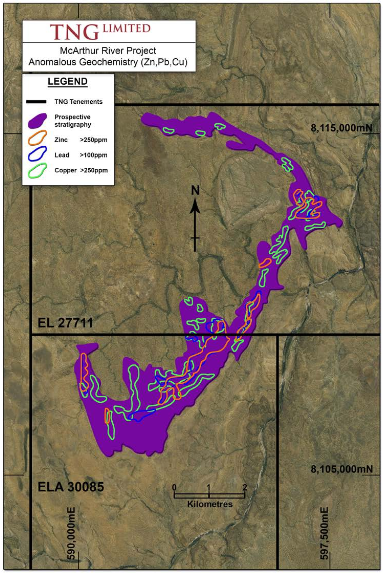
The newly-identified targets include a large central continuous geochemical anomaly extending over a strike length of three kilometres and up to 450m wide, containing laboratory analytical values of up to 1,400ppm zinc and 670ppm lead from soil samples.

TNG said two other zones had been identifies of strong surface geochemical anomalism, with existing coincident geophysical targets from Induced Polarisation surveys.
 
TNG has subsequently applied for additional tenure adjacent to its existing McArthur River tenements, increasing its total land-holding in the region to 223 square kilometres.

The recent review work conducted by TNG has included 50 years of previous exploration data, which the company said has outlined prospective lithologies with geophysical anomalism and anomalous base metal geochemistry recorded, exposed over some 17km of strike.


Location of prospective stratigraphy and geochemical anomalies in
the central McArthur River project area. Source: Company announcement


“The internal review work we have completed in recent months has revealed a hidden exciting opportunity within historic data from a highly-prospective and under-explored area, adding value to our McArthur River project,” TNG Limited managing director Paul Burton said in the company’s announcement to the Australian Securities Exchange.

“It ticks a lot of boxes given the geological location and proximity to structures that run through it, and the strong coincident geophysical and geochemical results we have identified.

“We will continue to conduct strategic reviews of this nature to add value to our exploration tenure followed by low-cost reconnaissance exploration activity before considering the best way to move the project to the next stage.

“This includes our existing reviews of the extensive position we hold in the emerging prospective Arunta region where our Mt Hardy, Sandover and Wallabanba projects are located.

“Our focus remains on completing the current Feasibility Study on the Mount Peake strategic metals project.”

Helix Resources earns in to Canbelego Joint Venture with Straits Resources

THE DRILL SERGEANT: Helix Resources (ASX: HLX) has secured a 70 per cent equity interest in the Canbelego Joint Venture with Straits Resources (ASX: SRQ) after completing earn-in requirements.

Straits have subsequently notified Helix, which is to act as the manager of the project, it will contribute to the joint venture in line with its 30 per cent equity interest.

The Canbelego Joint Venture is located in the Cobar Region of New South Wales and includes the 1.5 million tonnes at 1.2 per cent copper inferred resource Canbelego Mine prospect and the recently drilled Caballero prospect, which lies 2.5 kilometres south of the Canbelego Mine prospect on the same geological trend.

Both JV partners have agreed to Phase 1 of a Forward Work Program.

Helix recently completed a drilling program at both the Canbelego Mine and Caballero prospects.

The company said RC and diamond drilling carried out at Canbelego had intersected stringer and breccia veined copper sulphides and it is now waiting on the assay results.

The single RC hole to be drilled so far at Caballero returned:

–    12 metres at 0.9 per cent copper, including 4 metres at 1.4 per cent copper and 4 metres at 1.1 per cent copper within the oxidized zone above an EM conductor.

This intersection occurred within a broader zone of:

–    68m at 0.4 per cent copper (single metre re-split drilling assays are still pending).

“The JV partners have agreed to drill a second deeper RC hole at Caballero targeting sulphide mineralisation below the initial intersection, which is coincident with a high copper in soils anomaly (up to 0.3 per cent copper) and a 500 metres long fixed loop EM conductor,” Helix Resources said in its ASX announcement.

“The hole is expected to be drilled in the week commencing 16th September 2013.

“The remainder of the agreed Forward Work Program will include additional fixed loop EM and down-hole EM surveys in the recently drilled holes, infill augur soil geochemistry and further drilling.”

Kogi Iron kicks of scoping study at Agbaja iron ore project

THE DRILL SERGEANT: Kogi Iron Limited (ASX: KFE) has commenced a detailed scoping study for a first stage 5 million tonne per annum iron ore operation at the company’s 100 per cent-owned Agbaja iron ore project located in Kogi State, Republic of Nigeria, West Africa.

Kogi describes the Agbaja project as a shallow, flat lying channel iron deposit that is positioned close to existing, underutilised rail and port infrastructure.

The company’s stated vision is to establish a mining and beneficiation operation on the Agbaja plateau initially producing 5Mtpa of iron ore concentrate.


Source: Company announcement


The Agbaja deposit consists of shallow, friable channel iron deposits, which Kogi considers to lend itself to a mining operation utilising surface miners, which it anticipates will reduce the mining operating costs compared to a conventional hard rock iron ore operation requiring drill and blast.

Kogi said it expects to commence mining ore, at a grade of around 42 per cent iron, which will be crushed and further milled and fed to a beneficiation plant, producing a final upgraded iron ore concentrate of 55 to 56 per cent iron.

“There have been tremendous achievements to date with drilling and the establishment of a significant JORC-compliant resource at Agbaja, which has the potential to support a profitable iron ore operation,” Kogi Iron Limited managing director Iggy Tan said in the company’s announcement to the Australian Securities Exchange.

“In addition, there have been excellent studies to identify an optimal transport solution for the first stage of the project, as well as geological and metallurgical testwork to lay the foundations for the viability and feasibility of the project.

“Based on this background work and studies, the company is now in the position to launch a detailed Scoping Study on a very firm mining, production and transport scenario.

“Subject to feasibility, and funding, the company intends to commence iron ore concentrate production at Agbaja at the rate of 5 million tonnes per annum.

“In addition to the technical and commercial feasibility of the project, the Scoping Study will also address potential markets for the Agbaja iron ore.”

Western Areas doubles Spotted Quoll Mineral Resource

THE DRILL SERGEANT: There has been some action at the Spotted Quoll mine of Western Areas (ASX: WSA) with the company achieving a doubling of the Mineral Resource for the Spotted Quoll North Zone and the establishment of a maiden underground Ore Reserve.

The Mineral Resource for Spotted Quoll north has been doubled to 11,520 nickel tonnes with 80 per cent in the Indicated Category, consisting of an Indicated Resource of 113,500 tonnes at 9.3 per cent nickel for 10,573 nickel tonnes and an Inferred Resource of 21,520 tonnes at 11 per cent nickel for 2,367 nickel tonnes.

The maiden underground Ore Reserve has come in at 168,000 tonnes at 5.7 per cent nickel for 9,600 nickel tonnes, which the company claims to represent one of the highest grade nickel ore reserves in the world.

Western Areas explained the Ore Reserve in the North Zone replenishes approximately one year’s low cost production from the Spotted Quoll mine, extending the estimated mine life to now exceed10 years.


Long section showing Spotted Quoll and Spotted Quoll North. Source: Company announcement


“The high-grade Reserves and Resources announced today from Spotted Quoll North reaffirm the world class quality of this asset,” Western Areas managing director Dan Lougher said in the company’s announcement to the Australian Securities Exchange.

“The latest upgrades from the extensions to the northern lode confirm our belief that Spotted Quoll has significantly more upside than the existing mine life which is already in excess of 10 years.

“The Ore Reserve…represents approximately one year’s additional production, and due to the significantly higher grade will facilitate a lower cash cost to mine compared to the already low cost of the main lode.”

“In addition, access to the northern lode is straight forward given the decline infrastructure is already established below the North reserve.

“When the company was mining the Spotted Quoll open pit we were mining grades of up to 11 per cent in the northern lode of the orebody.

“Ultimately the entire open pit yielded a grade of six per cent.

“We are starting to see our disciplined approach to near mine exploration be rewarded with the release of the maiden Ore Reserve for Spotted Quoll North and the recent announcements regarding the high-grade intersections at New Morning, a mere 2.8 kilometres away from the existing infrastructure at Spotted Quoll.”

Western Areas said it was currently working on an updated Mineral Resource for the Spotted Quoll main lode, the results of which it anticipates releasing in the company’s September quarterly report.