Crater Gold Mining commences HGZ adit evaluation

THE DRILL SERGEANT: Crater Gold Mining (ASX: CGN) has begun a detailed evaluation of the High Grade Zone (HGZ) at the company’s Crater Mountain project in Papua New Guinea.

The company has completed a total of 55 metres of adit driving completed and is about to commence an underground drilling program to evaluate the extent of the HGZ.

Crater Gold indicated it has already encountered several zones of crosscutting gold with gold grades of up to 70 grams per tonne gold being returned in channel samples while instances of coarse visible free gold have been recorded during mapping of the underground development.
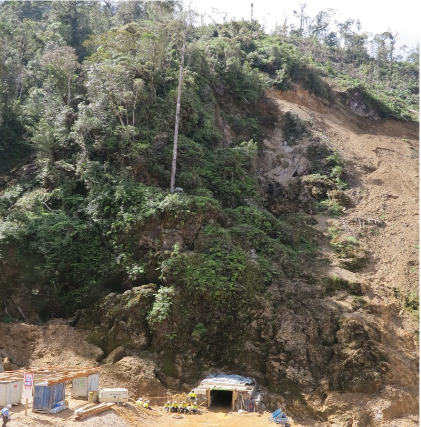
 

High Grade Zone portal entrance. Source: Company announcement


“By developing and exploring underground we can rapidly and cost-effectively evaluate the HGZ,” Crater Gold Mining exploration director Peter Macnab said in the company’s announcement to the Australian Securities Exchange.

“Being able to directly map the fresh exposures in the adit and crosscuts will provide us with a better understanding of the controls to mineralisation.

“The opportunity to drill from underground has enormous advantages compared to costly and difficult drilling from surface.”
 
Crater Gold Mining said the detailed geological mapping and sampling of the adit, cross‐cuts and drill core will allow it to develop a comprehensive understanding of the mineralisation than is possible from mapping and drilling from the surface.

The company has obtained a variation of the terms of its EL 1115 Exploration Licence work program to drive an adit with crosscuts and underground drilling in order to target potential gold deposit beneath the surface gougings and shallow underground workings left by local village miners.

When it has completed the current development and drilling at the HGZ, Crater Gold Mining anticipates it will have produced enough data to meet the requirements for the grant of a mining lease – which includes being able to demonstrate it is an economic resource.

At this stage the company said it will apply for a Mining Lease under the PNG Mining Act.

Crater Gold Mining explained the adit and associated crosscuts, currently being developed to initially identify future production zones, will also be used in the mining phase.

This, it expect, will result in the transition from the current development phase to the mining phase with the least additional cost and in the shortest time frame.
BMG confirms Cypriot copper

THE DRILL SERGEANT: Brazilian Metals Group (ASX: BMG) has received assay results confirming further high-grade copper intercepts from a maiden drilling program recently completed at  the company’s Laxia prospect in Cyprus.

A total of 13 holes were completed at the Laxia prospect, each of which intersected a 20 to 40 metre wide mineralised zone containing massive to semi-massive, stringer, vein and disseminated sulphides.

Brazilian Metals said the drilling had confirmed the presence of high-grade copper-gold-cobalt sulphide mineralisation at the Laxia prospect.

The company indicated the results combined with previous high-grade copper-nickel-gold-cobalt results from the nearby Pevkos prospect to demonstrate potential for high-grade sulphide mineralisation in the Black Pine project area.
 
Brazilian Metals claims to hold all of the most prospective ground in the Black Pine project area under granted, 100 per cent-owned licence.

Work is continuing to locate sulphide accumulations around known prospects and also to identify new prospects within the Black Pine project in conjunction with other exploration work concentrating on VHMS deposits within the company’s licences.

“Intersecting our highest grade sample at 18 per cent copper is fantastic and complements our previous copper intercepts of over 10 per cent in drill hole LMD002,” Brazilian Metals Group managing director Bruce McCracken said in the company’s announcement to the Australian Securities Exchange.

“For a maiden drilling program to encounter mineralisation in every hole, some with exceptionally high copper grades, is a great outcome.

“It is also very encouraging to observe some excellent cobalt and gold grades in the recent results.

“BMG has now completed its first phase of exploration in Cyprus and our geological team is progressing the next phase of the program with active exploration of the broader Black Pine area and our VHMS projects.”

Blackham Resources identifies new gold at Matilda

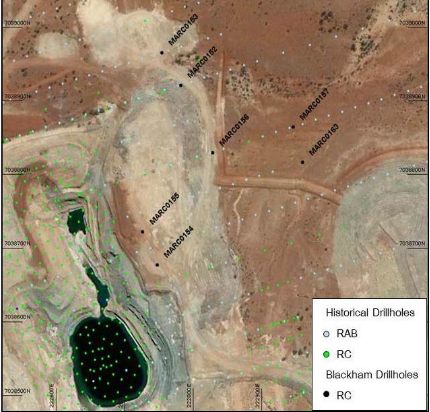
THE DRILL SERGEANT: Blackham Resources (ASX: BLK) has received results from 18 hole, 3,454 metres RC program recently conducted at the company’s Matilda gold project in Western Australia.

The drilling was carried out to test potential new lode positions at the M1, M2, M3 and M4 deposits at the Matilda Mining Centre.


M4 North and M2 hole locations. Source: Company announcement


The company said it had been encouraged by the results, in particular those from the M4 North and M2 areas.
 
Results from the M4 North area returned mineralisation at much shallower depths than Blackham was expecting.

Best results include:

–    6 metres at 3.31 grams per tonne gold from 42 metres, including 1 metre at 14.3g/t gold; and

–    4m at 2.64g/t gold from 29m.

Drilling conducted during the program was the first deeper drilling underneath the M2 deposit.

Blackham explained the M2 deposit is characterised by broad zones of lower-grade mineralisation within the oxide zone, however recent investigations have suggested that higher-grade mineralisation may exist in fresh rock, similar to the high-grade shoots that extend beneath the M1 and M4 Deposits.

The company has interpreted these shoots to plunge northwards from beneath the pit floor.

Only two holes were drilled as part of this program with a best result of:

–    7m at 3.38 g/t gold from 197m.

“Unfortunately the hole did not reach target depth due to unstable ground conditions and failed to test all potential lode positions,” Blackham Resources said in its ASX announcement.

“However, the result does provide proof of concept and encouragement for further depth testing that may identify potential underground extensions to mineralisation.”

Results from M1 and M3 confirmed the presence of interpreted lode positions with M3 demonstrating mineralisation continuity.

Blackham said this provided it with some confidence new resources can be found between M2, M3 and M4.

Further interpretation of drill results and planning of future programs is underway.

“Open pit targets are currently being prioritized, however the company believes vast potential remains for discovering new deep deposits that could sustain a long-lived mining operation,” Blackham said.

“The exploration focus has also broadened beyond the immediate mining centre and planning is underway for regional exploration programs designed to discover new deposits.”

Preparations are also well advanced for the company’s maiden drilling program to be conducted at the Williamson Mine.

Blackham indicated this drilling will test for extensions of mineralisation beneath the existing open pit that would facilitate a cut-back.

Blackham’s resource inventory at the Matilda gold project is currently 25 million tonnes at 1.9g/t gold for 1.5 million ounces of gold.

The company has taken the Matilda Mining Centre resource from 68,000 ounces from its acquisition in November 2011, to 14 million tonnes at 1.8g/t gold for 784,000 ounces of gold.


MOD Resources reaches 60 per cent of Sams Creek

THE DRILL SERGEANT: MOD Resources (ASX: MOD) has earned a 60 per cent interest in the Sams Creek gold project in New Zealand from Oceana Gold Corporation (ASX: OCG).

OceanaGold has accepted the increase of MOD’s interest in Sams Creek from 40 per cent to 60 per cent after the completion of MOD’s Stage 2 drilling program.

To earn 60 per cent, MOD was required to complete an infill drilling program to convert at least 550,000 ounces of the one million ounce Inferred Mineral Resource at Sams Creek into the Indicated Mineral Resource category.

The revised Stage 2 Mineral Resource estimate includes a JORC Code-compliant Indicated Mineral Resource of 575,000 ounces of gold, based on 10 million tonnes at 1.77 grams per tonne using a 0.7g/t cut-off grade.

MOD’s Stage 2 drilling program intersected several wide, high-grade gold zones including:

–    19.6 metres at 6g/t gold;

–    16.2m at 5.2g/t gold;

–    31.1m at 3.6g/t gold; and

–    63m at 2.4g/t gold, including 11m at 4g/t gold.


Geology of Sams Creek showing Stage 2 Mineral Resource within a one
kilometre portion of the porphyry dyke. Source: Company announcement


The company said its 60 per cent interest in Sams Creek has been submitted for consent to New Zealand Petroleum & Minerals and Oceana Gold has lodged the formal transfer documents.

Consent was obtained for the terms of earn-in agreement last year.

MOD considers the earning of 60 per cent of Sams Creek represented a significant milestone for the company since it negotiated its agreement with Oceana Gold in October 2011 to earn up to 80 per cent of Sams Creek by sole-funding staged exploration programs.

“Having earned 60 per cent of Sams Creek we can now focus our efforts on the Stage 3 drilling program, which aims to test for extensions down-dip and along strike from the Main Zone gold deposit,” MOD Resources managing director Julian Hanna said in the company’s announcement to the Australian Securities Exchange.

“The porphyry dyke which hosts the gold mineralisation at Sams Creek extends for about seven kilometres over the Sams Creek and adjoining Barrons Flat permits, so we have only tested part of the potential of what could be a large gold system.”

MOD has commenced its Stage 3 drilling program and this program, which has already extended gold mineralisation at the Main Zone to approximately 350m below surface, with grades of up to 3m at 7.27g/t gold.

Cradle Resources receives final Panda Hill assays

THE DRILL SERGEANT: Cradle Resources (ASX: CXX) has received the validated final assay results from the final four holes (PHDH008, 011, 012, and 013) of a 13 hole drill program recently conducted at the company’s Panda Hill niobium project in Tanzania.

Cradle explained the drill program was designed to confirm the grade and geology that had been indicated by historical drilling at the project, from which the current 56 million tonnes at 0.5 per cent niobium inferred JORC resource had been defined.

The drilling was also planned to obtain representative metallurgical samples for testing.

Highlights from the final assays include:

–    68 metres at 0.52 per cent niobium (PHDH008);

–    67m at 0.43 per cent niobium (PHDH011);

–    61m at 0.61 per cent niobium (PHDH012); and

–    72m at 0.48 per cent niobium (PHDH013).


Local geology of Panda Hill showing the location of the 2013 drill holes (red). Source: Company announcement


“We are pleased with the results from the last 4 holes,” Cradle Resources managing director Grant Davey said in the company’s announcement to the Australian Securities Exchange.

“These holes continue to confirm that the historical drilling results can be repeated and, in the case of Hole PHDH013, dramatically extended.

“This 13 hole drill program has supported our belief that there is significant resource upside potential available at depth and within the poorly drilled regions of the carbonatite deposit.

“The significant intercepts of the 2013 drill program clearly indicate that this is a world class niobium resource with significant economic potential.”

Highfield Resources welcomes Spanish maiden

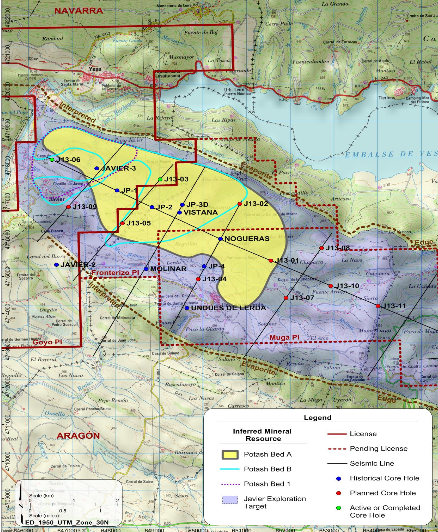
THE DRILL SERGEANT: Highfield Resources (ASX: HFR) has reported a maiden JORC Inferred Mineral Resource estimate for the company’s 100 per cent-owned Javier potash project in Northern Spain.

The independently-prepared JORC Code-compliant Inferred Mineral Resource estimate has come in at 163.2 million tonnes of sylvinite at 10.9 per cent potassium oxide (17.3 per cent potassium chloride).
 

Highfield said it considers there to be further potential upside for Javier claiming the JORC Mineral Resource estimate represents a fraction of the total Exploration Target of 250 to 400 million tonnes of sylvinite ranging in grade between nine per cent and 12 per cent potassium oxide.


Javier Inferred Mineral Resource and Exploration Target areas. Source: Company announcement


“The maiden JORC Mineral Resource estimate is an important milestone in the development of the company’s potash projects and demonstrates a real mining opportunity at Javier,” Highfield Resources managing director Anthony Hall said in the company’s announcement to the Australian Securities Exchange.
 
“We are highly encouraged by the initial resource, especially as it only encompasses a small portion of the Exploration Target area.

“We expect the current drilling at Javier to increase the resource, which will ultimately be reflected in any mining studies.”

Highfield added that it expects to present JORC Code-compliant Mineral Resource estimates for its two additional 100 per cent-owned Spanish potash projects, Sierra del Perdón and Pintano over the coming months.

St George ready to move on priority targets

THE DRILL SERGEANT: St George Mining (ASX: SGQ) has prioritised six nickel targets at the company’s East Laverton property in the NE Goldfields of Western Australia.

St George Mining recently reclaimed 100 per cent ownership of all nickel prospects at the East Laverton property after BHP Billiton (ASX: BHP) pulled out of the Project Dragon Joint Venture.

The company considers the identification of the six priority targets to be the launch of a new nickel exploration program over the best nickel prospects across the entire property.

“Our technical team has reviewed the nickel targets across the entire East Laverton property and selected six priority prospects,” St George Mining executive chairman John Prineas said in the company’s announcement to the Australian Securities Exchange.     

“Our exploration is now unconstrained by third party interests and we can expedite the exploration work to test the best targets.

“This is the first time we have been able to execute a nickel exploration program on a property‐wide scale and we are very excited at these new opportunities.”

St George explained its next phase of exploration at these targets will involve ground electro‐magnetic (EM) surveys, which it expects will identify any conductors that may represent  massive nickel sulphides at depth.

These would then be tested by drilling.

Previous work has already identified EM anomalies at Cambridge and St George anticipates the implementation of new, more powerful EM technology will further validate these conductors, and better define the drill sites to test for massive sulphide bodies.

The company also has a fixed loop EM (FLEM) survey planned for specifically selected areas of the Cambridge dunite body.


The priority nickel targets are shown over aeromagnetics (TMI) at the East Laverton property. Source: Company announcement


The six priority targets identified are:

Cambridge:  A large lenticular dunite body located on the Stella Range Ultramafic Belt. Drilling at Cambridge in 2012 identified minor amounts of nickel sulphides associated with PGE (Platinum Group Elements.

Desert Dragon North: An area on the Stella Range Ultramafic Belt immediately south of Cambridge, situated on a NE‐SW lineament called the Churchill lineament, which St George believes may be a control on mineralisation.

Desert Dragon ‐ Windsor: Covers over 10 strike kilometres of ultramafic along the Stella Range Belt. Drilling in 2012 identified disseminated nickel sulphides in two holes, returning 6 metres at 0.48 per cent nickel, and 4m at 0.57 per cent nickel.

Bristol: Presents as a large and strong TMI (Total Magnetic Intensity) response on the Central Ultramafic Belt with an extensive strike over 7 strike kilometres of moderate to high manganese oxide ultramafics.

Drilling in 2012 identified minor amounts of nickel sulphides and anomalous levels of PGE.

Athena: Located along the north of the major regional Minigwal Belt and on the Churchill lineament and displays a strong TMI (Total Magnetic Intensity) response.

Cambridge North:  Interpreted from the strong Total Magnetic Intensity (TMI) response as a thick ultramafic zone covering over 3 strike kilometres on the northern extension of the Stella Range Belt. No drilling has been completed at this time.

The northern part of Cambridge as well as Desert Dragon North, Bristol, Athena and parts of the Desert Dragon‐Windsor prospect were previously within the Project Dragon JV with BHP.

All these targets are now owned 100 per cent by St George.


Disclaimer: The Roadhouse holds St George Mining shares

Arc Exploration starts drilling Trenggalek with Anglo American

THE DRILL SERGEANT: Arc Exploration (ASX: ARX) has commenced drilling on the Trenggalek project in East Java with its Joint Venture partner, Anglo American, which is fully funding the program.

The Trenggalek project is located in the Southern Mountains Province of East Java, which also contains the Tumpangpitu porphyry copper-gold deposit in the Tujuh Bukit district.


Arc Exploration-Anglo American projects in Indonesia showing known porphyry deposits. Source: Company announcement

Arc said the current program has been planned to test a number of geophysical targets associated with possible porphyry copper-gold systems located beneath large near-surface alteration features.

The geophysical targets were generated from an airborne magnetics/radiometrics survey.

“We are very pleased to report that drilling has now started at Trenggalek,” Arc Exploration managing director Dr Jeffrey Malaihollo said in the company’s announcement to the Australian Securities Exchange.

“This is the first drilling program to test the porphyry copper-gold targets identified alongside our JV partner, Anglo American.

“Drilling has commenced at the Jerambah prospect, one of several targets identified on the Exploration IUP.

“Further interpretative and field work is also underway with the aim of firming up a pipeline of other targets for drill testing.

“Previous drilling at Trenggalek has identified several shallow epithermal gold-vein and breccia systems.

“This exciting new phase of exploration is testing for deeper porphyry copper-gold systems associated with geophysical anomalies detected beneath large near-surface alteration features.”

Arc indicated the first target to be tested will be the recently-identified Jerambah prospect, located about 2 km southwest of the Buluroto epithermal gold-breccia prospect on the southern side of the Trenggalek tenement.

Previous drilling at Buluroto returned narrow epithermal gold intercepts, including 2 metres at 8.7 grams per tonne gold.

Copper sulphide mineralisation was also intersected in another hole, returning a broad gold-copper-molybdenum intercept of 24.5m at 0.51g/t gold, 0.21 per cent copper and 16ppm molybdenum from 138.5m depth.

Arc said the first hole in the current program will test a recently identified large silica-clay-pyrite alteration zone (+2.5 km by 1km) centred on quartz diorite/quartz feldspar porphyry intrusions.

The company has completed geophysical modelling of the airborne magnetics and radiometric data, which highlighted a geophysical target beneath this large outcropping alteration zone.

Plymouth Minerals ties up Spanish tungsten project

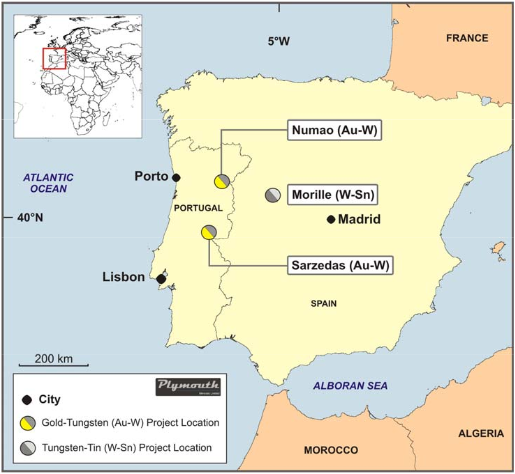
THE DRILL SERGEANT: Plymouth Minerals (ASX: PLH) has secured an agreement to acquire an 80 per cent beneficial interest in the Morille tungsten-tin project in Spain.

Plymouth has negotiated to acquire a 100 per cent holding in Spanish company, Castilla Mining, which has an 80 per cent beneficial interest the Morille project from Aurum Mining.

The Morille project comprises five Investigation Permits covering multiple historic underground and open pit tungsten and tin mines covering a contiguous area of over 57 square kilometres.

Over 50 mineral occurrences/workings have been documented within the tenements, the majority of which were small artisanal workings operated during fragmented tenure ownership.

The larger of these historical mines within the project area are known as the; Alegria, Claudina, Mundaca and Anarbellas tungsten mines.

Plymouth described the project as a brownfields exploration and development opportunity.

It is located in the Salamanca Province, within the Castilla y León Region, in central Spain.

Plymouth said it views the project to be an excellent opportunity, which produced a sought-after, high-quality tungsten concentrate until its closure in 1985 due a rapid decline in the tungsten price.

The company aims to commence exploration activities in the near future, and plans to explore for extensions of known mineralisation, repeats and new discoveries.

A first phase of drilling is planned for late 2013 or early 2014.

“The Morille project brings together the specialty metal and development skills of the Plymouth Board and management and combines them with an advanced tungsten project in a tungsten producing region,” Plymouth Resources managing director Adrian Byass said in the company’s announcement to the Australian Securities Exchange.

“The tungsten price is robust with strong fundamentals going forward.

“This acquisition complements other projects currently under review by Plymouth in the region and is further evidence of the company’s growing regional focus in the Iberian Peninsula.


Location of Morille project in relation to other Plymouth
projects under review in the Iberian region. Source: Company
announcement


“We consider the acquisition has exciting potential to deliver a solid tungsten project in a mining friendly district, and the company remains well funded to acquire the project.

“We look forward to working with our partner, Aurum Mining PLC in advancing this project as rapidly as possible.”

Kidman Resources hits deep copper on Main Lode

THE DRILL SERGEANT: Kidman Resources (ASX: KDR) has intersected high-grade copper, approximately 420 metres below surface while conducting deep diamond drilling on the Main Lode at the company’s Home of Bullion (HOB) project in the Northern Territory.

Hole HDD044 intersected:

–    9.7 metres at 3.4 per cent copper, 0.83 per cent lead, 2 per cent zinc, 40.7 grams per tonne silver, and 0.47 grams per tonne gold from 466.7 metres downhole.

This included a zone of 4.4m at 7.3 per cent copper, 1.6 per cent lead, 3.7 per cent zinc, 1.6g/t silver, and 1g/t gold from 472m.

“This is the first deep drillhole targeting a strong conductor on the Main Lode and has intersected high-grade copper mineralisation more than 400 metres below the surface,” Kidman Resources managing director Shane Mele said in the company’s announcement to the Australian Securities Exchange.

“This intercept gives us a lot of confidence for the down-plunge potential of the Home of Bullion deposit.”

Kidman claimed the mineralised intersection consists of a high-grade zone of massive sulphides containing abundant halcopyrite and pyrrhotite in the footwall, followed by disseminated sulphides and another narrow zone of massive sulphides in the hangingwall.

The company has interpreted the latest intersection to be close to true width and is located more than 100m below and a significant step-out from a previously reported result from hole DD034 of 5.9m at 3.4 per cent copper, 1.6 per cent lead, 6 per cent zinc, 54.4g/t silver.


Home of Bullion aerial photo showing copper lodes and HDD044 drill intersection. Source: Company announcement


Kidman had identified the conductor tested by HDD044 by way of downhole-electromagnetic (DHEM) surveys from HDD034.

The company has conducted further DHEM surveys from HDD044, which it said has indicated this conductor remains open down-plunge and will be the focus for the current drill program.

The deep drilling program is designed to test both the Main and Southern Lodes to approximately 600m below surface.

Ongoing DHEM surveys are being utilised to define new zones of copper mineralisation as the drill program progresses.

Drill core is currently being processed and has been submitted for analysis.