White Cliff Minerals claims new copper-gold discovery

THE DRILL SERGEANT: White Cliff Minerals (ASX: WCM) has claimed a new copper and gold discovery at the Chanach project Joint Venture (WCM 57%) in the Kyrgyz Republic.

The new discovery, called Aucu, occurs two kilometres of the Chanach copper deposit.
According to White Cliff, rock chip and trench channel sampling has identified copper and gold zones from the 701 samples collected by the JV in late 2013.

White Cliff explained the mineralisation at Aucu occurs in three zones and is hosted in highly altered limestone and felsic porphyry units, which consists of quartz veining and associated alteration impregnated with sulphides including pyrite and chalcopyrite.

The three mineralised zones identified by trench sampling consist of:

7 metres at 3.83 per cent copper and 30.1 grams per tonne gold;

10m at 1.73 per cent copper including 1m at 106g/t gold; and

9m at 6.03g/t gold.


Geological map showing location of new copper and gold discovery on
the outer edge of a much larger alteration zone (blue oval) and strong
phyllic alteration (purple hatch) outcropping in the centre of the
alteration. Source: Company announcement


The rock sampling was mainly concentrated over the western half of the Chanach lease to follow up anomalous 2010 gold rock chip results and satellite ASTER alteration targets identified in 2011 but not previously explored.

White Cliff said the JV’s initial geological interpretation indicates the new results are part of a much larger mineralised system greater than one kilometre diameter centred 500m to the west of the mineralised zones.

“The new copper-gold discovery continues to expand the scale of the Chanach project and demonstrates that the project has the potential to host multiple large scale copper-gold resources,” White Cliff Minerals managing director Todd Hibberd said in the company’s announcement to the Australian Securities Exchange.

“The current exploration has barely scratched the surface and a lot more sampling and drilling is warranted.”

Email: info@wcminerals.com.au

Website: www.wcminerals.com.au
Castle Minerals hits gold at Kpali

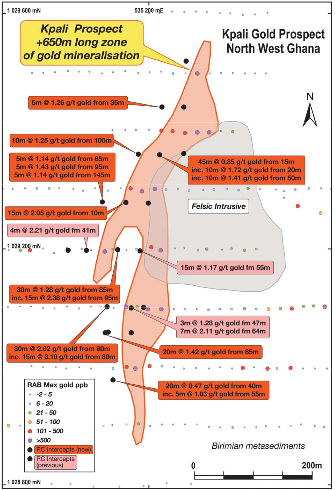
THE DRILL SERGEANT: Castle Minerals (ASX: CDT) has finished a program of RC drilling, which it claims has resulted in the discovery of a new gold zone at the company’s 100 per cent-owned Kpali prospect in Ghana.

Castle completed 16 RC holes in December 2013, which were designed to test a 650 metre gold anomaly it had previously defined through soil geochemistry and RAB drilling.

Gold intercepts of note include:

30 metres at 2.02 grams per tonne gold from 80 metres, including 15m at 3.10 g/t gold from 80m; (13SWRC049)

35m at 0.91g/t gold from 75m, including 20m at 1.42g/t gold from 85m; (13SWRC053)

30m at 1.28g/t gold from 85m, including 15m at 2.38g/t gold from 95m; (13SWRC054)

15m at 2.05g/t gold from 10m; (13SWRC057)

10m at 1.72g/t gold from 20m; (13SWRC059)

10m at 1.41g/t gold from 50m; and (13SWRC059)

10m at 1.25g/t gold from 100m. (13SWRC060)


RC drill hole location plan showing significant gold intercepts. Source: Company announcement


“This work confirms Kpali as an exciting new gold discovery for the company,” Castle Minerals managing director Mike Ivey said in the company’s announcement to the Australian Securities Exchange.

“These are the best drill results received from our exploration work in the southern part of our Wa project and greatly enhance the prospectivity of our large unexplored land holding in this area.”

The RC holes were drilled nominally on 80m sections and designed to test gold mineralisation to a depth of approximately 100m.

Castle said the drilling had shown gold mineralisation to be hosted within altered Birimian shales and sediments with associated silica ‐pyrite alteration.

Email: info@castleminerals.com

Website: www.castleminerals.com

Laconia Resources expands Peru copper system

THE DRILL SERGEANT: Laconia Resources (ASX: LCR) has identified additional high-grade copper-gold-silver results at the Rosita prospect, located 150 metres north of the Fortuna prospect within the company’s Huaco Cucho project, adjacent to its main Rasuhuilca project in Peru.

The data has been gleaned during an ongoing review Laconia is carrying out of historic exploration at the Rasuhuilca and Huaco
Cucho projects.

Two diamond drill holes were completed by the project’s previous owners Buenaventura Ingenieros SA during 2002.

The first hole (SDB 04 2002) was drilled to test mineralisation of the Huaco Fault, returning three small anomalous intersections, and a large zone of fracturing was also logged.

Although no intersection returned enough to identify a large zone of high-grade mineralisation in the Huaco Fault, there were low-grade results returned.

Because of this sampling conducted was not continuous down the entire hole, despite logging identifying disseminated pyrite throughout the hole.

Drill hole SDB 06 2002 was drilled to test the east-west trending veins at Rosita prospect, and was oriented from the north towards the south.
The hole intersected four zones of silicified and brecciated veining, which Laconia explained is a cross-section of the Rosita prospect.
Surface sample results from Rosita include:

0.3 metres at 5.63 per cent copper, 2.36 grams per tonne gold, 132 grams per tonne silver and 421 grams per tonne tellurium; and

0.5m at 1.62 per cent copper, 16g/t gold, 220g/t silver and 394g/t tellurium.
 
Underground adit channel sample results returned from the Rosita 4730
Level include:

0.3m at 4.5 per cent copper, 1.11g/t gold, 288g/t silver, 0.11 per cent zinc and 92g/t tellurium;

1m at 2.9 per cent copper, 4.58g/t gold, 46.6g/t silver and 96g/t tellurium; and

1.5m at 1.3 per cent copper, 1.43g/t gold, and 49.6g/t silver.

Diamond drill hole results from hole SDB 06 2002 at the Rosita prospect include:

7.7m at 0.44 per cent copper, 0.11g/t gold and 5.99g/t silver g from 20.3m, including 1.7m at 1.06 per cent copper, 0.14g/t gold and 7.18g/t silver from 24.7m; and

8m at 1.12 per cent copper, 0.26g/t gold and 12.76g/t silver from 73m, including 0.75m at 8.9 per cent copper, 1.57g/t gold and 104.15g/t silver from 80.25m.


Plan View of the Rosita Prospect with the 4730 adit, showing
surface and adit sample locations (coloured by copper content) and the
drill hole locations. Source: Company announcement


“The company is extremely encouraged by the identification of further strong copper-gold-silver grades from our flagship Peruvian project,” Laconia Resources managing director Ian Stuart said in the company’s announcement to the Australian Securities Exchange.

“The Ccarhuaraso Volcanic system that is within the Rasuhuilca and Huaco Cucho projects is clearly a large, highly mineralised system and our knowledge of the wider system continues to grow through the systematic processing and follow up of the excellent historical data.

“The presence of significant high-grade copper, in conjunction with the gold and silver epithermal veins already identified, adds significantly to the potential of Laconia’s project interests.”

Email: info@laconia.com.au

Website: www.laconia.com.au

Triton Minerals confirms Nicanda Hill graphite

THE DRILL SERGEANT: Triton Minerals (ASX: TON) has received assay results from an initial two hole diamond drill program conducted on the Nicanda Hill prospect at the company’s Balama North project in Mozambique.

Downhole intersections include:

14.7 metres at 18.7 per cent weighted average graphite carbon (WAGC) from 3.3 metres, including 1 metres at 24.9 per cent graphite and 1 metres at 28.6 per cent graphite;

40m at 14.2 per cent WAGC from 88.1m, including 7m at 18.9 per cent graphite and 10m at 20.1 per cent graphite;

12.3m at 12.3 per cent WAGC from 19.3m, including 1m at 25.5 per cent graphite; and

15.5m at 11.2 per cent graphite from 33.8m.


Location of holes TMBD0005 and TMBD0006 drilled on the Nicanda Hill
prospect, relative to the drilling completed earlier this year on the
Cobra Plains prospect and the generalised extents of the Black Hills and
Charmers prospects. Source: Company announcement


Triton claimed these results have confirmed multiple zones of high-grade graphitic material over substantial widths.

The drilling also identified mineralisation intersections of grades up to 28.6 per cent graphite near to surface.

“These are tremendous initial drilling results from the Nicanda Hill prospect, confirming Triton’s belief in the overall prospectivity of the Balama North project,” Triton Minerals managing director Brad Boyle said in the company’s announcement to the Australian Securities Exchange.

“These drilling results follow on from the previously announced rock chip sample results obtained from the Nicanda Hill prospect, which identified high-grade large flake graphitic mineralisation, with graphite flake sizes up to one millimetre, and continue to support Triton’s belief that the Balama North project has the potential to host multiple world-class graphite deposits.”

Triton said the pleasing aspect of the drilling were that the company was only able to access the southern edge of the main target area of the Nicanda Hill prospect as it rushed to complete the program before the wet season hit.

The company indicated it is now working on a more detailed exploration and drilling program, which it hopes will further delineate the graphite mineralisation on the Nicanda Hill prospect.

Website: www.tritonmineralsltd.com.au

Chesser Resources confirms and improves Kestanelik gold numbers

THE DRILL SERGEANT: Chesser Resources (ASX: CHZ) has received further results from a drill program conducted late last year at the company’s Kestanelik gold project in Turkey.

The company has received drill results for a further 12 diamond and 27 RC holes out of the 89 completed drill holes comprising the Phase 1 program.

According to Chesser the results have confirmed, and in some cases improved on existing results with the new intersections revealing potential to expand the footprint of near surface high-grade shoots in the company’s model for the project.


Cross section showing the position of high grade intercepts on
the K3 and K3-hangingwall ore bodies. Source: Company announcement


New intersections include:

41.7 metres at 4.36 grams per tonne gold from 111.5 metres, including 11.1 metres at 13.51 grams per tonne gold;

20.1m at 4.73g/t gold from 149m, including 3.4m at 23.08g/t gold;

12m at 5.03g/t gold from surface, including 4m at 14.02g/t gold;

35m at 2.07g/t gold from 60.4m, including 1.5m at 16.5 g/t gold;

37.1m at 1.24g/t gold from 31.5m, including 1.7m at 8.58g/t gold and 1.6m at 9.95g/t gold;

5m at 4.2g/t gold from 34m, including 1m at 10.8g/t gold; and

2m at 20.95g/t gold from 180m, including 1m at 39.9g/t gold.

“The phase one program was completed on schedule and will deliver a large number of new intercepts both inside and outside the existing resource,” Chesser Resources managing director Dr Rick Valenta said in the company’s announcement to the Australian Securities Exchange.

“We continue to be encouraged about the large number of intercepts which are proving to be better than the modelled resource at the corresponding location, increasing our confidence about the robust nature of the resource, along with its cost and infrastructure advantages.

“We are continuing to make good progress on the studies associated with the PFS and the EIA permitting process, and expect to provide more detail on key milestones associated with these activities as they arise.”

Chesser indicated it will use the results to complete a JORC resource for release in the June Quarter of2014, the timing of which will be dependent on the receipt of assays and subsequent modelling.

The updated JORC resource will be a key input to the Kestanelik PFS.

Email: info@chesserresources.com.au

Website: www.chesserresources.com.au

Goldphyre Resources samples high-grades at Laverton Downs

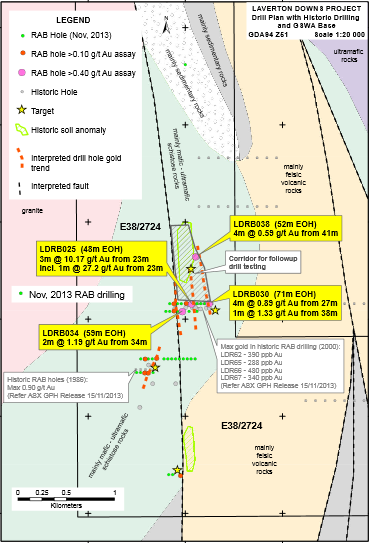
THE DRILL SERGEANT: Goldphyre Resources (ASX: GPH) is feeling encouraged after receiving one metre sample gold results from a recently completed RAB drilling program at the company’s 100 per cent-owned Laverton Downs project, north of Laverton in Western Australia.

Goldphyre said the drilling was undertaken to target historic drill-hole gold anomalies, recent elevated basemetal geochemistry values and a prospective north trending structure.


Laverton Downs project with one metre sample results and planned drill area Source: Company announcement


The results are from one metre sampling of recent composite gold intervals from a reconnaissance drilling program carried out in November 2013.

Highlights of the sampling included:

3 metres at 10.17 grams per tonne gold from 23 metres, including 1 metres at 27.2 grams per tonne gold from 23 metres; (LDRB025)

2m at 1.19g/t gold from 34m; (LDRB034)

4m at 0.89g/t gold from 27m; and (LDRB030)

1m at 1.16g/t gold from 23m. (LDRB024)

“The one metre results from the first pass drilling boosts the gold prospectivity at Laverton Downs,” Goldphyre Resources technical director Brenton Siggs said in the company’s announcement to the Australian Securities Exchange.

“The shallow, high-grade gold intercept in LDRB025 is open at depth and along trend to the north for over 600 metres.

“The followup drill testing along this corridor is a high priority and a great start for Goldphyre in 2014 as we focus on our exciting exploration opportunities at our Lake Wells and Laverton Downs projects.”

Goldphyre said it has a 38 hole program of RAB drilling planned to commence at the Laverton Downs project in the coming weeks.

Email: info@goldphyre.com.au

Website: www.goldphyre.com.au

Havilah Resources claims copper discovery at Croziers Dam

THE DRILL SERGEANT: Havilah Resources (ASX: HAV) has claimed drilling conducted by its Joint Venture partner MMG Exploration has discovered copper mineralisation at the Croziers Dam prospect.

Corziers Dam lies roughly half way between the company’s Portia and Kalkaroo deposits in South Australia.

The best intersection achived by diamond drillhole BNG13DDOO1 was 12.5 metres at 0.46 per cent copper from 213.5 metres depth.

Havilah explained the drillhole was designed to follow up copper indications encountered by earlier shallow aircore drilling.

The hole demonstrated copper anomalism for almost its entire length.


Skarn rocks in drillcore from Croziers Dam prospect, with
abundant sulphide minerals including chalcopyrite (copper ore),
magnetite (grey), pyrrhotite (bronze) and other dark greenish
calc-silicate minerals. Source: Company announcement


“Apart from the untested potential at the Croziers Dam prospect, there are extensive areas of granite contact on Havilah’s exploration licences that could potentially spawn similar mineralisation,” Havilah Resources managing director Dr Chris Giles said in the company’s announcement to the Australian Securities Exchange.

“The indications of IOCG style alteration are also significant because they are evidence that such mineralised systems were possibly active on the Benagerie Ridge, warranting further drilling of likely targets.”

Havilah highlighted another four diamond drillholes carried out by MMG, which has also located red hematite alteration, which it said is often associated with hydrothermal brecciation (fragmented and shattered rocks).

The company said these geological features are commonly observed in alteration zones marginal to iron oxide copper gold (IOCG) deposits, citing those in the vicinity of the Olympic Dam deposit as an example.
 
One of these four drillholes intersected minor associated copper mineralisation including 1.2m at 0.55 per cent copper and 0.1 grams per tonne gold from 249m depth.

 
Email: info@havilah-resources.com.au

Website: www.havilah-resources.com.au

Tawana Resources confirms 68% iron product at Mofe Creek

THE DRILL SERGEANT: Tawana Resources (ASX: TAW) has received encouraging results from metallurgical testwork conducted on RC drilling samples from the company’s 100 per cent-owned Mofe Creek iron ore project in Liberia, West Africa.

The company said the work demonstrated, with a coarse crush to one millimetre, it is possible for Tawana to generate plus-63 per cent to 68 per cent iron product grades at 58 per cent to 68 per cent mass recovery with low contaminants.

This could potentially result in premium quality products being produced from the project’s Gofolo Main and Koehnko deposits.

“Results are extremely encouraging given the exceptionally high grade iron product produced and the superior mass recoveries achieved,” Tawana Resources managing director Len Kolff said in the company’s announcement to the Australian Securities Exchange.

“With no fine grinding required, the potential exists for a very simplistic gravity beneficiation circuit to generate a premium quality product at potentially very low capital intensity.

“The coarse grained, hematitic and friable characteristics of the mineralisation provide very favourable properties for iron upgrade, as demonstrated by the results of the testwork.”

Tawana said the results have confirmed the potential at Mofe Creek for the design and development of a low capital intensity process plant with simple gravity beneficiation equipment.

The company explained it has made visual drill core observations at the Zaway prospect which have suggested it contains similar material to the Gofolo Main deposit and therefore should upgrade and beneficiate in a similar manner.


Typical high-grade itabirite outcrop material at Gafolo Main
(left) and Koehnko (right), and recent drill core at Zaway prospect all
showing similar textures and grain size. Source: Company announcement


“Initial RC and diamond drill core observations at Zaway suggest a similar material type and lithology to Gofolo Main and Koehnko,” Kolff said.

“This provides additional confidence for further resource extensions and a potential simple early start-up process design capable of generating a premium grade iron product.”


Email: admin@tawana.com.au

Website: www.tawana.com.au

Midas Resources hits copper north and south at Overlander

THE DRILL SERGEANT: Midas Resources (ASX:MDS) has announced further high-grade copper results from reverse circulation (RC) drilling conducted at the Overlander North and Overlander South prospects, situated within the company’s 100 per cent-owned Mount Isa project in Northwest Queensland.

Midas claims the drilling on the two prospects, which was carried out in December 2013, has confirmed further high-grade copper zones, which remain open at depth.


Overlander North drill plan, showing the Overlander North
shear–hosted mineralisation and Overlander IOCG target. Source: Company
announcement


Best results from the drilling included:

14 metres at 2.62 per cent copper, 0.12 grams per tonne gold and 575ppm cobalt from 76 metres, including 6m at 3.73 per cent copper, 0.13g/t gold and 262ppm cobalt from 80m in hole OVRC002 at Overlander North. (announced 1in December 2013);

9m at 2.58 per cent copper, 0.22g/t gold and 421ppm cobalt from 49m (OVRC004) at Overlander North;

7m at 2.24 per cent copper, 0.09g/t gold and 648ppm cobalt from 121m (OVRC012) at Overlander North;

9m at 1.83 per cent copper and 1065ppm cobalt from 155m (OVRC013) at Overlander North; and

12m at 1.2 per cent copper, 0.09g/t gold and 568ppm cobalt from 31m (OVRC010) at Overlander South;

“We are very pleased with the results from the first drilling program at Mount Isa,” Midas Resources executive director Alex Hewlett said in the company’s announcement to the Australian Securities Exchange.

“Although we did not complete the testing of all the targets planned before the end of the year, Overlander North and Overlander South are shaping up as significant potential sources of high-grade sulphide copper resources to boost Midas’s existing resource at Kalman.”

The Overlander prospect is located six kilometres west of Midas’s Kalman copper-gold-molybdenum-rhenium deposit, which the company has interpreted to form part of a mineralised shear zone extending northwards for 6km from the known Andy’s Hill iron oxide copper-gold (IOCG) prospect in the south, through the Overlander South prospect to Overlander North.

Email: info@midasresources.com.au

Website: www.midasresources.com.au

Renaissance Minerals re-commences drilling at Okvau

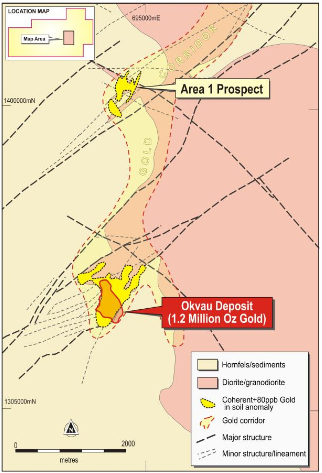
THE DRILL SERGEANT: Renaissance Minerals (ASX: RNS) has recommenced drilling at the company’s Okvau gold project in Cambodia after sitting out the annual wet season.

Renaissance said the drilling will be targeting extensions outside of the current Indicated and Inferred resource estimate of 1.2 million ounces it has already defined at the Okvau gold deposit.

Its main focus for the current program will be shallow strike extensions to the north-east of approx. 100 metres vertical depth, which will be tested where previous reverse circulation (RC) drilling intersected mineralisation including:

8 metres at 7.3 grams per tonne gold from 6 metres;

2m at 5.8g/t gold from 42m;

9m at 9.3g/t gold from 37m; and

10m at 2.5g/t gold from 29m.

“Approximately 1,500 metres of RC and diamond drilling has been planned for this north eastern area initially,” Renaissance Minerals said in its ASX announcement.

“Following this drilling the rig will be remobilized to the Area 1 prospect, situated approximately three kilometres to the north of the Okvau gold deposit.”


Area 1 location map. Source: Company announcement


Renaissance indicated the program will also include the drilling of other regional prospects, including Rhyolite Ridge and the broader Area 6 prospect.

It is anticipated this will be scheduled to follow Area 1 drilling.

The company said it would be drilling program would be carried out in a methodical manner, suited to the current market conditions.

As such it will re-prioritise drill targets following results from the Okvau and Area 1 drilling.

Email: admin@renaissanceminerals.com.au

Website: www.renaissanceminerals.com.au