Electric Vehicles Driving Nouveau Commodity Rush

COMMODITY CAPERS: While scientists debate whether climate change is a real/false, natural/man-made phenomenon, countries with large populations have realised opening a window does not necessarily provide its people with fresh air.

Keeping people breathing has become a major concern for the larger countries, China is the first that comes to mind.

It’s extremely rare to see vision of a Chinese populace going about their daily routines without seeing high numbers wearing face masks to minimise the effects of the air pollution the country endures.

But the Hidden Kingdom is not alone as many European and North American centres also move to diminish the effects of long-term air pollution.

Electric Vehicles (EVs) have become the touchstone of the new environmental times and are expected to dominate the market sooner, rather than later, due mainly lower costs for battery manufacturing and commitments from car companies to establish themselves as market leaders.

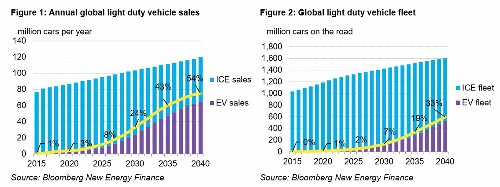
In its Electric Vehicle Outlook 2017 report, Bloomberg New Energy Finance noted just how quickly EVs will start to dominate the global car market.

“By 2040, 54 per cent of new car sales and 33 per cent of the global car fleet will be electric,” Bloomberg said.

“Falling battery prices will bring price-competitive electric vehicles to all major light-duty vehicle segments before 2030, ushering in a period of strong growth for electric powertrain vehicles.

“While EV sales to 2025 will remain relatively low, we expect an inflection point in adoption between 2025 and 2030, as EVs become economical on an unsubsidized total cost of ownership basis across mass-market vehicle classes.”
Green politicians may have struggled to capture voter attention of late, but the green economy is running at a much faster pace.

Speaking at the recent 2018 RIU Explorers Conference in Fremantle, Patersons senior resources analyst Simon Tonkin said the Green economy has been a key driver for resources over the past 12 months.

Tonkin went all the way back to 2014, when, he said, China announced it wanted to reduce pollution and it wanted 20 per cent of its energy needs to come from renewables by 2030.

“China’s energy needs are currently around 13 per cent renewables, but it is amazing how much China is building in terms of the world’s solar panels,” he said.

“It is installing two-thirds of the world’s solar panels and around half of the world’s wind turbines.

“There are currently 3.5 million clean-energy jobs in China and this is expected to grow to 10 million jobs by 2020.”

Like the Chinese, it didn’t take Tonkin long to set his sights on the EV and associated lithium-ion battery market, where he indicated technology was gaining traction, noting that Tesla, and others, are currently building giga-factories.

“There is a shift to new-age metals, such as lithium, nickel, cobalt, manganese and graphite – we could also add vanadium and zinc into the mix,” he said.

“Australia has plenty of these metals to supply to the world.”

According to Tonkin, the best performing commodities over the past 12 months is dominated by the battery metals of cobalt and lithium with those trailing the pack being the sector stalwarts of iron ore, silver, and gold.

The importance of lithium batteries to modern living has increased with their use in such high-demand devices, such as phones and computers and the growing EV market.

A lithium-ion battery lives in a category of itself with around four diverse types of batteries in use, utilising a mixture of commodities, including aluminium, cobalt, manganese, graphite and nickel

Demand for these commodities is expected to increase exponentially over the next ten years to meet the increased demand for batteries and EVs towards 2030

“Our (Patersons’) view on lithium with the emergence of electric vehicles, we are going to see a significant increase for lithium demand as soon as the mid-2020s,” Tonkin said.

“However, in the short-term we could see supply outstrip demand as the spodumene producers ramp up.”

Tonkin is not alone in his view of a possible lithium glut.

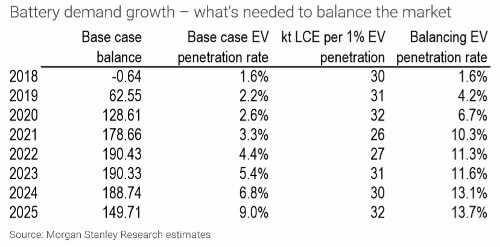
In its recent report – Lithium: The long-term pain of new supply, Morgan Stanley suggested that should the current pipeline of planned projects goes ahead the result will be substantial, and sustained, market surpluses from 2019 onwards.

“We forecast 2018 to be the last year of global lithium market deficit,” Morgan Stanley analysts said.

“Beyond that, we expect global lithium prices to correct as the market moves into a period of sustained surplus.”

Morgan Stanley noted that the Chilean Economic Development Agency (Corfo) has granted additional production quota to SQM.

Another lithium producer, Albemarle also requested an uplift to its quota for production from La Negra in late2017.

The analysts have forecast these expansions to add 200,000 tonnes per annum to Chile’s lithium output by 2025, bringing the country’s total output to 255,000 tonnes LCE – a third of global supply.
“We’ve also increased our supply forecasts for Australia and Argentina,” Morgan Stanley said.

“Combined we forecast cumulative supply growth of 3.9 million tonnes from 2019-2025 (vs. our previous estimate of 2.9 million tonnes supply additions, a change of +35 per cent).”

Although lithium powerhouse SQM intends to increase lithium production by four to six times, it is likely to take years to eventuate and will come at a much higher cost than current production, possibly making it less competitive.

Australia has the third largest lithium reserves behind that of China and Chile – a position the country is starting to exploit with production coming on line from companies such as Pilbara Minerals and Pioneer Resources as well as lithium extraction technology plays such as Lithium Australia and Neometals.


Calidus Resources Hilghlights Warrawoona Gold Potential

THE DRILL SERGEANT: Calidus Resources (ASX: CAI) completed a Regional Target Generation Study over the company’s East Pilbara greenstone assets.

Calidus Resources said the study had identified more than 45 high‐priority exploration targets at its Warrawoona project area that will be ranked and evaluated throughout 2018

The company geologists are following up the highest priority targets conducting mapping and geochemistry programs in advance of RAB and RC drilling planned for quarters two and three this year.

High priority targets include KET 14 and KET 15 in the southwestern part of the project area.

Calidus indicated these targets highlight a strong, northeast trending, +1 km long soil‐rockchip‐shallow drill hole gold anomaly, with broad, low grade gold (up to 0.5g/t gold) intercepts recorded.

“Whilst the main focus has been on the extensive Klondyke Shear zone over the last six months and increasing the overall resource by 74 per cent to its current 712,000 ounces, we have not forgotten about the significant exploration potential within our portfolio,” Calidus Resources managing director Dave Reeves said in the company’s announcement to the Australian Securities Exchange.

“This comprehensive regional study across Warrawoona has generated numerous high conviction prospects with several priority drill targets already identified.

“We are actively exploring these high‐quality targets and are currently accelerating our 50,000 metre drill program for the year.

“We look forward to providing ongoing details as results come to hand.”


Website: www.calidus.com.au


Blackham Resources Claims Record Gold Production Month

THE BOURSE WHISPERER: Blackham Resources (ASX: BLK) has overcome recent trying times to declare a month of record gold production at the company’s Matilda-Wiluna gold operation in Western Australia.

Blackham Resources presented an update on the operation to the market for the month of February, which declared that having accessed high-grade zones in the M4 and Galaxy pits late in the December 2017 had enabled the company to record monthly gold production in both January and February 2018 of 6,498 and 6,713 ounces of gold, respectively.

The company attributed the upswing to February’s open pit mining stripping ratio of 1.5:1 (waste:ore) compared to January’s 18: 3.6:1.

Blackham said the low stripping ratio and increased gold production resulted in a record low monthly All In Sustaining Costs (AISC) in February of $912 per ounce ($1,158 per ounce – Jan’18), in comparison to an average realised gold price during the month of $1,670 per ounce, continuing its high margin production for the quarter to date.

The company endured rainfall and lightning events during the month, which restricted mining operations, however, the operation has increased high-grade stockpiles, which currently total 144,000 tonnes at 1.7 grams per tonne gold.

The company anticipates milled grade and gold production to continue to improve during March with the increasing grade of the mill feed stockpiles.

“February’s operational results demonstrate a continued improvement of the turnaround that commenced in December 2017,” Blackham Resources executive chairman Milan Jerkovic said in the company’s announcement to the Australian Securities Exchange.

“Record production and further reduced costs from the operation underpinned another month of strong cashflow, whilst maintaining stockpiles with increased grades.

“We remain confident that 2018 will be a transformational year that will generate significant cash flows and value for Blackham and its shareholders.”


Email: info@blackhamresources.com.au

Website: www.blackhamresources.com.au


Nusantara Resources Extends Awak Mas Deposit

THE DRILL SERGEANT: Nusantara Resources (ASX: NUS) completed an exploration drilling program on the Awak Mas Highwall, part of the company’s 100 per cent-owned Awak Mas gold project located in South Sulawesi, Indonesia.

Nusantara Resources said the exploration program was designed to confirm the geological model and potential for extensions to the existing Mineral Resources at the 1.72 million ounce Awak Mas and 0.18 million ounce Salu Bulo deposits.

The company said the results from the six-hole program support potential for exploration upside along the untested two-kilometre Mine Corridor between the Awak Mas and Salu Bulo deposits.

Nusantara said it had received assay results from the first three holes that confirm gold mineralisation in the eastern projected extension of the Awak Mas deposit, validating the geological model.

Highlights include:

HWD002
45 metres at 1.3 grams per tonne gold from 257m, 8m at 2g/t gold from 308m, 41m at 0.9g/t gold from 384m and 4m at 2.5g/t gold from 421m.

RTD023
6.3m at 2.1g/t gold from 179m and 6 m at 3.9g/t gold from 237.6m.

“The extremely positive results returned from this program have validated Nusantara’s geological model by proving that the gold mineralisation is not restricted to the immediate current footprint of the Awak Mas deposit.” Nusantara Resources managing director and CEO Mike Spreadborough said in the company’s announcement to the Australian Securities Exchange.

“This provides confidence that further mineralisation in the immediate eastern Highwall area can be expected from the remaining three drill holes, all of which have strong visual indications, and supports our belief of significant exploration upside along the untested Mine Corridor between the Awak Mas and Salu Bulo deposits.”


Email: info@nusantararesources.com.au

Website: www.nusantararesources.com.au


Azure Minerals Resumes Drilling at Sara Alicia

THE DRILL SERGEANT: Azure Minerals (ASX: AZS) has commenced a second diamond drilling campaign on the company’s 100 per cent-owned Sara Alicia gold and cobalt project in the northern Mexican state of Sonora.

Azure Minerals said the drilling is being carried out to follow up on the company’s 2017 maiden drilling program, in which all six drill holes intersected high-grades of gold and cobalt mineralisation at shallow depths.

The previous program included a best intersection of:

26.2 metres at 9.5 grams per tonne gold and 1.26 per cent cobalt from 0.60m depth, including 12.6m at 16.8g/t gold and 6.35m at 3.57 per cent cobalt.

Azure explained that the first phase of this current campaign will comprise 10 to 12 diamond core holes and is expected to take about six weeks to complete.

The drilling has been designed to target along-strike and down-dip extensions of the high-grade mineralisation intersected in the 2017 program.

Based upon anticipating further success, the company is already planning a second phase of drilling over the mineralised body.

“The Sara Alicia mineralised zone consists of carbonate rocks intruded by a porphyry,” Azure Minerals said in its ASX announcement.

“This intrusive event caused strong alteration and mineralising reactions in the limestones to form a skarn body which hosts massive and semi-massive sulphides containing the cobalt and gold mineralisation.

“The mineralised body has a strong and identifiable magnetic signature extending over an area of approximately 300 metres by 150 metres.

“Encouragingly, modelling of the magnetic data indicates that the magnetic body which represents the mineralisation has considerable vertical depth extent, particularly to the north and northeast, providing excellent down-dip targets to extend the gold and cobalt mineralisation in those directions.”


Website: www.azureminerals.com.au

Alloy Resources Expands Horse Well Ground

THE BOURSE WHISPERER: Alloy Resources (ASX: AYR) struck an agreement with Jindalee Resources (ASX: JRL), under which the company can acquire an Option to purchase Exploration Licence Application (ELA) 53/1962.

Alloy Resources explained ELA 53/1962 to be located within the highly prospective Millrose Greenstone Belt and adjacent to the company’s Horse Well gold project in Western Australia.

Horse Well and the ELA are located in the north eastern goldfields adjacent to Northern Star Resources’ (ASX: NST) Jundee gold mine.

The projects are located on a major mineralised structure called the Celia Shear which extends down the eastern margin of the Millrose Greenstone Belt and, according to Alloy, is emerging as a highly prospective target for new gold discoveries.

The company said the new ELA surrounds the principal prospect at Millrose, which has an Inferred Mineral Resource of 309,000 ounces of gold.

“We are very pleased to be able to secure this new area at a time when companies in the area are making new discoveries,” Alloy Resources executive chairman Andy Viner said in the company’s announcement to the Australian Securities Exchange.

“We have recently regained control of the Horse Well gold project which we believe is one of the best early stage gold exploration properties in the Goldfields with a shallow high-grade Inferred Mineral Resource of 75,000 ounces at 2.76 grams per tonne gold and numerous prospects at various stages of exploration.

“We think the new ELA area significantly enhances the potential for Alloy to make new gold discoveries as it expands our coverage of the mineralised Celia Shear from 60 to 80 strike kilometres.

“One of our most intriguing targets is the Celia Shear extensions to Overland Resources new high-grade surface quartz vein discovery at Coralie Jean which has only emerged in the last quarter.

“Our understanding of this new discovery is that it opens up new concepts for the location of mineralisation along this shear which we can now apply to the Millrose ELA.

“Another reason for excitement is the location of the ELA only eight kilometres east of Northern Star’s Ramone discovery, which is also showing the untapped potential of this area.”


Email: info@alloyres.com

Website: www.alloyres.com


Excelsior Gold Making Headway at Kalgoorlie North Gold Project

THE DRILL SERGEANT: Excelsior Gold is currently drilling a multi-faceted program aimed at the conversion of Resources to Reserves and exploring for new discoveries over the company’s 100 per cent-owned Kalgoorlie North gold project (KNGP).

Excelsior Gold has completed an infill drilling program at Zoroastrian and is anticipating receipt of assay results from the remaining six holes within the next couple of weeks.

The company said all data from the infill program will be incorporated into a new open pit resource model due for completion in April.

“This process will again use the Localised Uniform Conditioning (LUC) modelling technique, which was successfully adopted for the recently completed Zoroastrian Central open pit mine,” Excelsior Gold said in its ASX announcement.

“The Zoroastrian Central LUC model predicted the tonnes, grade and overall gold metal within acceptable limits during the mining and reconciliation process for the last phase of mining activities.”

Once the open pit resource estimate has been completed, Excelsior will remodel the deposit for underground mining using the ordinary kriging estimation technique.

The company expects this will lead to a higher grade, lower tonnage estimate.

“Once the two resource models have been completed, mine design and scheduling work with costings will be carried out to optimise anticipated financial returns,” Excelsior said.

“The updated Zoroastrian model will also allow deeper, down-plunge extensional drilling to be designed, targeting the high-grade lodes at depths of more than 350 metres below surface.”

Excelsior has re-wireframed its eponymous Excelsior open pit deposit utilising updated in-pit mapping, historical reports and data from several diamond holes which had been re-assayed to confirm the new interpretation.

Grade estimation will be carried out using LUC modelling, which estimates into small SMU sized blocks, allowing for more selectivity which can be achieved during mining.

“The modelled tonnes and grades are therefore more likely to be achieved during mining and will assist in providing refined mine scheduling and cashflow forecasting as mine planning is undertaken,” Excelsior said.

“The new resource model is due for completion in April with the reserve model scheduled for completion in June.”

Excelsior Gold detailed exploration programs to be carried out in order to test for new discoveries along the Bardoc Tectonic Zone (BTZ) using a detailed geological and drilling database the company assembled from past and present exploration and mining activities within the KNGP.

Database reviews highlighted further anomalous results that will be followed up with reconnaissance drilling.

The company has flagged a 3,500m aircore program due to commence in early April on the northern extent of the Black Flag Fault (BFF) in the vicinity of the interpreted intersection between the BTZ and the BFF.

This program is designed to close in on exploration targets with RC and diamond drilling to follow as required.


Website: www.excelsiorgold.com.au

Ausgold Intersects Southern Extension of Jinkas Deposit

THE DRILL SERGEANT: Ausgold (ASX: AUC) released results of reverse circulation (RC) drilling carried out on Jinkas South at the company’s 100 per cent-owned Katanning gold project (KGP) in Western Australia.

Ausgold said the RC drilling, completed 340 metres south along strike from the Jinkas Resource, has intersected a broad zone of gold mineralisation which remains untested for a further extension of 300m along strike.

The first eight RC holes drilled at Jinkas South – a recently identified trend south of the current Jinkas Resource – intersected a broad zone of gold mineralisation with intercepts including:

BSRC0759
10 metres at 2.09 grams per tonne gold from 84m, including 1m at 15.05g/t gold from 93m;

BSRC0761
7m at 2.09g/t gold from 69m, including 4m at 3.15g/t gold from 71m;

BSRC0763
8m at 2.01g/t gold from 96m, including 4m at 3.29g/t gold from 100m; and

BSRC0759
2m at 3.32g/t gold from 58m.

Ausgold commenced its RC drill program at the start of February, with 32 holes having been completed over the Jinkas South, Fraser, Lukin, Jackson and Olympia prospects.

The current round of RC drilling is testing targets identified during recent air core (AC) drilling and geophysical programs.

“RC drilling results from Jinkas highlight the progress we have made using systematic exploration and our improved geological understanding to underpin our work on this project,” Ausgold chief executive officer Matthew Greentree said in the company’s announcement to the Australian Securities Exchange.

“The Jinkas South drilling has tested a relatively simple target along strike from known mineralisation and is one of many significant gaps which previous exploration drilling has failed to test.

“The large areas previously left untested by earlier exploration work have the potential to significantly increase the Resource base at the Katanning gold project.

“We plan to rapidly expand the KGP’s mineral inventory through these near-Resource additions as well as further discoveries elsewhere along the project’s currently identified 17 kilometre strike length.”


Email: info@ausgoldlimited.com

Website: www.ausgoldlimited.com


Comet Resources Claims Western Australia High-Grade Graphite Discovery

THE DRILL SERGEANT: Comet Resources (ASX: CRL) claimed a new graphite discovery at the company’s Springdale graphite project, east of Hopetoun in Western Australia.

Comet Resources said the new high-grade graphite discovery, along with the Western Zone, discovered in 2016, and the Eastern Zone, discovered in 2017, demonstrates the prospectivity of the Springdale project.

The company completed a reverse circulation (RC) drill program consisting 93 shallow, reconnaissance style, RC holes designed to test aeromagnetic targets.

The drilling was carried out between December 2017 and February 2018, resulting in the discovery of a new high-grade graphite horizon in the northern fold closure, known as the Northern Zone.

Highlights from the drilling to date include:

HR0057
9m at 5.9 per cent TGC (total graphitic carbon) from 3m;

HR0060
20m at 19.3 per cent TGC from 30m, including 13m at 25.8 per cent TGC and 2m at 19.3 per cent TGC mineralised to end of hole;

HR0061
7m at 16.3 per cent TGC from 15m, including 3m at 35.1 per cent TGC; and
15m at 7.3 per cent TGC from 24m, including 2m at 23.1 per cent TGC and 2m at 16.1 per cent TGC;

HR0062
6m at 6.1 per cent TGC from 4m; and
14m at 7 per cent TGC from 23m, including 2m at 17.3 per cent TGC and 2m at 15.5 per cent TGC; and

HR0063
10m at 10.1 per cent TGC from 29m, including 2m at 18.2 per cent TGC, 1m at 17.2 per cent TGC and 2m at 17.8 per cent TGC.

“Numerous assay results are expected over the coming weeks and will be announced after interpertation has been completed,” Comet Resources explained in its ASX announcement.

“The discovery demonstrates the potential for the Springdale project area.”

Comet outlined its plans to progress the assessment of the graphite and graphene at the Springdale project, including a geological/structural interpretation – that will review drill results with aeromagnetic data to identify the most prospective stratigraphic horizons.

The company expects this will generate new targets and focus drilling on existing targets.

A diamond drill program will be planned to follow up high-grade intersection to provide samples for metallurgical testwork and information to move the geological understanding forward.

Metallurgical testwork will continue on existing and newly generated diamond core as the company develops a better understanding of the amenability of the graphite at Springdale to convert to graphene or be used in battery and other technologies is an integral part of understanding and realising its commercial value.


Email: comet@cometres.com.au

Website: www.cometres.com.au


Sunstone Metals Identifies Ecuadorian Drill Targets

THE DRILL SERGEANT: Sunstone Metals (ASX:STM) reported the defining of large drilling targets from 3-D modelling of heli-magnetic data results taken at the company’s Bramaderos gold-copper project in Ecuador.

Sunstone Metals said this was the first 3-D modelling of a subset of recently collected heli-magnetic data over the Bramaderos Main and nearby targets and demonstrated these targets have considerable vertical extent.

The company currently has 3-D modelling of the Limon and West Zone targets underway with results expected shortly.

The company explained that a large magnetic body has been modelled at Bramaderos Main with a vertical depth of one kilometre and a surface expression that coincides with the areas of best historical drilling and gold anomalism defined by a recent trenching program.

Historical drill hole CURI03, and recent trench BM02, both intersected widths of gold and copper mineralisation and the recent model indicates the main magnetic area has not been drill tested and occurs just beyond the highest assay results from historical hole CURI03, which included 30.2 metres at 0.8 grams per tonne gold and 0.2 per cent copper at the bottom of the hole.

Sunstone said the modelling also enhanced the Porotillo target by providing context for areas of gold-in-soil anomalies, and historical drilling which it appears may have been drilled on the periphery of the magnetic target zone.

The Porotillo target is located 1.5km south of Bramaderos Main and was previously considered a lower-ranked target due to historical drilling that delivered sporadic gold mineralisation.

However, this 3-D modelling has defined a large magnetic body, which evolves near surface into a cluster of magnetic bodies – a magnetic pattern is seen in other porphyry systems.

“The 3-D modelling results provide more strong evidence of the huge potential of the Bramaderos Main and Porotillo targets,” Sunstone Metals managing director Malcolm Norris said in the company’s announcement to the Australian Securities Exchange.

“The modelled magnetic bodies sit adjacent to, and extend below, the drill holes which intersected copper and gold, and are located below the extensive gold anomaly we have outlined.

“This work increases our confidence yet again in the robustness of the targets and starts to deliver a sense of scale to these targets.

“Additional 3-D modelling is currently underway over the Limon and West Zone targets.”


Email: info@sunstonemetals.com.au

Website: www.sunstonemetals.com.au