Galena Mining Releases World-Class Resource for Abra Lead-Silver Project

THE DRILL SERGEANT: Galena Mining (ASX: G1A) claimed a new world-class Resource at the company’s 100 per cent-owned Abra lead-silver project located in the Gascoyne Region of Western Australia.

Galena Mining said the Resource grade and size confirms Abra to be one of the largest undeveloped lead-silver projects in the world.

The company indicated the high-grade resource would be integrated into a Pre-Feasibility study.

The company also noted that extensive copper and gold mineralisation at depth within the project was not included in this resource estimate.

The combined JORC 2012 resource estimate for the Abra project breaks down as follows:

Indicated Resource of 5.3 million tonnes at 10.6 per cent lead and 28 grams per tonne silver and an Inferred Resource of 5.9 million tonnes at 9.7 per cent lead and 29g/t silver (using a 7.5% lead cut-off)

For a combined:

11.2 million tonnes at 10.1 per cent lead and 28g/t silver.

Within an Indicated Resource of:

13.2 million tonnes at 7.9 per cent lead and 19g/t silver and an Inferred Resource of 23.5 million tonnes at 6.9 per cent lead and 17g/t silver (using a 5.0% Pb cut-off).

For a combined:

36.6 million tonnes at 7.3 per cent lead and 18g/t silver.

“These resource numbers have exceeded our expectations and confirm Abra as a truly world class asset with global significance in the lead market,” Galena Mining CEO Ed Turner said in the company’s announcement to the Australian Securities Exchange.

“What is even more exciting for the company and its shareholders is that this looks like just the beginning of a much bigger project and that potential upside exists in and around where we have drilled to date.

“We have a clear strategy to bringing Abra on line as one of Australia’s next base metals producers and our focus now is progressing a robust Pre-Feasibility Study over the coming months.”


Email: admin@galenamining.com.au

Website: www.galenamining.com.au


Ardea Resources Updates KNP Cobalt Zone Resource to Over 100Mt

THE DRILL SERGEANT: Ardea Resources (ASX: ARL) released an update to the cobalt Resources at the company’s Kalgoorlie nickel project (KNP) in the Eastern Goldfields of Western Australia.

Ardea Resources has increased the Resource for the KNP Cobalt Zone to 108.3 million tonnes at 0.10 per cent cobalt and 0.79 per cent nickel.

In total the KNP Cobalt Zone contains over 108,000 tonnes of cobalt metal and over 856,000 tonnes of nickel metal.

The major contributor to the upgrade was the Cobalt Zone at the Goongarrie nickel cobalt project (GNCP), which has been defined at 83.1 million tonnes at 0.1 per cent cobalt and 0.81 per cent nickel.

The corresponding contained metal estimates are 81,700 tonnes cobalt metal and 672,300 tonnes nickel metal.

The Resource includes mineral resources at Goongarrie South, Big Four, and Scotia Dam which occur within a continuous mineralised zone extending over 16 kilometres in strike length north to south and over one kilometre wide.

Ardea declared the Goongarrie nickel cobalt project as the company’s prime development project and the subject of a forthcoming pre-feasibilty study (PFS).

The company is focused on the development of the deposits of the Goongarrie camp where mining schedules have highlighted the cobalt-rich and nickel-rich portions of the deposits which correspond to the Cobalt Zone at Goongarrie.

The company explained the Resource upgrade was not the result of additional drilling results or remodelling exercise.

The upgrade stemmed from a reappraisal of the focus of mining at Goongarrie during the development of the PFS and a substantial hike in metal prices.

The company reported previous resource estimates in 2017 using a 0.08 per cent cobalt cut-off only, ensuring capture of much high-grade nickel mineralisation.

However, the PFS has progressed and metals prices improved, positively impacting modelling of mining schedules, highlighting blocks containing high-grade nickel mineralisation with moderate cobalt grades (of less than 0.08 %) as volumetrically and fiscally important component of the deposits.

“The net effect is that 40 million tonnes of moderate to high-grade nickel / moderate cobalt mineralisation (reporting < 0.08% cobalt and > 0.5% nickel) have been added to the resource as continuity of mining blocks has improved,” Ardea Resources said in its ASX announcement.

“Most of this mineralisation is within the Cobalt Zone at Goongarrie but was not previously reported in the June 2017 Ardea announcement.

“In these areas, higher nickel grades often correspond to moderate cobalt.

“The effect of this updated reporting is that overall cobalt grade is not significantly diminished, and nickel grade is maintained.

“This newly included mineralisation is integral to the resource and indeed to the modelling and planning of the of the mining project, hence the Mineral Resource reporting for Goongarrie has been updated to reflect this.”


Email: ardea@ardearesources.com.au

Website: www.ardearesources.com.au

Magmatic Resources Acquires Mt Venn Copper-Nickel-Cobalt Project

THE BOURSE WHISPERER: Magmatic Resources (ASX: MAG) has entered into a binding agreement with Montezuma Mining Company (ASX: MZM) to acquire a key landholding at the Mt Venn Intrusion, east of Laverton in WA

Magmatic Resources will assume 100 per cent-ownership of E38/2961, an acquisition the company said represents the commencement of a clear and defined strategy to build a portfolio of Australian based assets that complement its East Lachlan tenements, with a focus on gold and base metals.

Magmatic’s Mt Venn project sits immediately along strike from the recent Mt Venn discovery by Great Boulder Resources (ASX: GBR) that yielded wide zones of primary copper-nickel-cobalt sulphide mineralisation.

The company indicated that E38/2961 accounts for over 60 per cent of the Mt Venn Intrusion currently being explored by Great Boulder Resources.

Previous exploration at E38/2961 highlighted numerous copper–nickel–cobalt prospects.

Sampling of Mt Venn gossan outcrop by previous explorers returned best grades of 24 per cent copper, 13.2 per cent copper, 8.3 per cent copper, and 6.7 per cent copper.

Detailed ground EM and heliborne VTEM surveys by previous explorers also identified multiple conductors, some of which remain untested, or with minimal follow-up and sit along seven kilometres of prospective strike.

Magmatic believes that E38/2961 represents a decisive, near-term exploration opportunity where it intends to commence fieldwork to build on the previous exploration datasets.

Magmatic plans to complete initial fieldwork, reprocess EM and VTEM data, and then complete an RC drilling program.

“We are all very excited about the Mt Venn copper – nickel – cobalt project acquisition,” Magmatic Resources managing director David Richardson said in the company’s announcement to the Australian Securities Exchange.

“The project complements our existing portfolio of gold and base metals project in the East Lachlan.

“The opportunity to explore the Mt Venn Intrusion, especially having secured over 60 per cent of the complex, gives Magmatic immediate access to what is considered one of the best areas in Australia to explore for copper, nickel and cobalt.

“The work that Great Boulder Resources have already done on the southern section of the Mt Venn Intrusion has yielded outstanding results that we are keen to add to.”


Website: www.magmaticresources.com.au


Intermin Resources Updates Anthill Gold Resource

THE DRILL SERGEANT: Intermin Resources (ASX: IRC) released an updated Mineral Resource Estimate for the company’s 100 per cent-owned Anthill gold project, located northwest of Kalgoorlie in Western Australia.

The JORC Code 2012- compliant Mineral Resource for Anthill now stands at 1.42 million tonnes at 1.72 grams per tonne gold for 78,000 ounces of gold (>1.0g/t Au lower grade cut-off).

Intermin Resources explained the update to th Resource stemmed from drilling completed in 2017.

This included diamond drillhole AHD1701, which the company said was drilled to validate the mineralisation model, examine the mineralisation and vein orientations and obtain samples for metallurgical and physical properties testing.

The results from this hole confirmed Intermin’s geological model whereby mineralisation consists of a discrete steeply plunging quartz stock work zone developed within a folded and altered pillow basalt unit within the Zuleika Shear.

Shallow downhole RC intercepts from the 2017 program included:

AHRC17027
41m at 2.63 grams per tonne gold from 69m;

AHRC17024
30m at 2.98g/t gold from 73m;

AHRC17039
11m at 3.72g/t gold from 46m ;

AHRC17035
29m at 1.84g/t gold from 49m;

AHRC17032
15m at 2.26g/t gold from 32m ;

AHRC17028
7m at 4.58g/t gold from 37m and 43m at 1.46g/t gold from 54m;

AHRC17031
19m at 2.22g/t gold from 39m and 27m at 2.17g/t gold from 98m;

AHRC17029
19m at 1.5g/t gold from 32m and 38m at 1.48g/t gold from 86m; and

AHRC17020
18m at 2.8g/t gold from 48m and 11m at 4.91g/t gold from 90m.

Deeper downhole RC intercepts included:

AHRC17043
17m at 5.37g/t gold from 137m;

AHRC17032
6m at 11.15g/t gold from 110m ; and

AHRC17039
11m at 6.22g/t gold from 157m and 3m at 6.48g/t gold from 187m.

“The successful drilling at Anthill in 2017 has confirmed the company’s geological interpretation and the initial Mineral Resource is an excellent base on which to grow the project,” Intermin Resources managing director Jon Price said in the company’s announcement to the Australian Securities Exchange.

“Intermin takes a very conservative and economic approach to resource estimation and typically applies higher cut-off grades as we commence initial development studies.

“We now look forward to the upcoming extensional and new discovery drill program planned for the June Quarter and believe Anthill and new targets identified within the project area have the potential to be a significant part of our future production pipeline.”


Email: iadmin@intermin.com.au

Website: www.intermin.com.au


Metalicity Set to Commence Yerrida Cobalt Project Drilling

THE DRILL SERGEANT: Metalicity (ASX: MCT) reported recent activities at the company’s Yerrida cobalt project, located in the Yerrida Basin of Western Australia.

Metalicity said it has generated new targets at the project and that further field work and an approximate four-hole diamond and/or RC drilling program is set to commence at the project.

The company claims to have developed an exploration model for Yerrida with characteristics compatible to the geological setting of the prolific central African copper-cobalt belt.

Previous exploration undertaken by Metalicity demonstrated a geological setting considered amenable to hosting structural/stratigraphic-controlled copper-cobalt mineralisation and nickel-cobalt mineralisation.

Previous exploration by Metalicity at Yerrida identified a high priority target area over approximately seven square kilometres, which includes widespread surface geochemical anomalies including up to 6,400ppm cobalt and 1,500ppm cobalt, while drilling intersected primary stratigraphic controls on mineralisation or a halo to regional base metal transport over a 8 to 12m thick zone containing anomalous cobalt at the K1 target.

“Recent drilling intersected stratabound intervals of geochemically anomalous copper and cobalt mineralisation which are interpreted to indicate primary stratigraphic controls on mineralisation or a halo to regional base metal transport,” Metalicity managing director Matt Gauci said in the company’s announcement to the Australian Securities Exchange.

“A deeper hole is planned to test the potential for high-grade mineralisation associated with deeper structures from the underlying ‘red bed’ sandstones at K1, while a further three regional targets have been generated associated with an interpreted northwest-striking fault at K2-K4 for field work and drilling to test for leakage and cobalt mineralisation.”


Website: www.metalicity.com.au

Cazaly Resources Commences Drilling at Bungonia Cobalt Project

THE DRILL SERGEANT: Cazaly Resources (ASX: CAZ) started its inaugural drilling program on the Avanti prospect, one of nine prospects within the company’s Bungonia cobalt project in New South Wales.

Cazaly Resources said the drilling program of approximately 80 holes will mostly be focused at the Avanti prospect, which is currently measuring at least 700 metres long and remains open along strike and up to 150m wide.

The company explained that work undertaken previously at the Bungonia cobalt project defined several areas of cobalt and nickel mineralisation, some of which were historically mined as early as the 1890s.

Cobalt mineralisation at the project occurs as flat lying residual on hills extending for several hundred metres associated with manganiferous deposits.

“The deposits typically contain relatively rich cobalt values, with minor nickel and copper credits, and have been worked historically with high cobalt recoveries,” Cazaly Resources said in its ASX announcement.

“The areal extent and assay results from historic work, and now work by Cazaly, points to significant potential to extend known deposits as well as make new discoveries within the project area.

“The potential is highlighted by the results of rock chip grades from this programme along with historic mining from several locations.”

Cazaly highlighted the current strength of the global cobalt price (approximately USD$84,000 per tonne) and the recent developments in the Democratic Republic of Congo (which produces approximately 60% of the world’s cobalt), whereby new legislation has increased the royalty on cobalt.


Email: admin@cazalyresources.com.au

Website: www.cazalyresources.com.au


Venture Minerals Identifies nickel-copper-cobalt mineralisation at Caesar Project

THE DRILL SERGEANT: Venture Minerals (ASX: VMS) received results from the first hole drilled at the company’s Caesar project in Western Australia.

Venture Minerals conducted the drilling, co-funded by WA State Government’s Exploration Incentive Schem, targeting nickel-copper-cobalt sulphide mineralisation.

The company claimed the drill hole (CSD01) intersected minor disseminated sulphides throughout a zone of dolerite located in the hole and had verified the presence of nickel, cobalt and copper within the intersected sulphides.

Venture declared the results to confirm the mafic rocks (dolerite and gabbro) at Caesar host nickel-copper-cobalt sulphide mineralisation.

On the back of the results Venture has now applied for a further 70 square kilometres of tenure immediately to the north it believes to contain interpreted extensions of the same dolerite and gabbro units.

In addition, CSD01 returned an 18-metre intersection that included: one metre at 1.8 grams per tonne gold, 4.6g/t silver, 806ppm copper, 655ppm zinc and 578 ppm lead.

“The potential for gold mineralisation at the Caesar project is now being evaluated through interpretation of arsenic assay results from the previous surface sampling,” Venture Minerals said in its ASX announcement.

“This work has already highlighted several additional gold targets within the Caesar project.”

Venture Minerals indicated that the drilling of CSD01 did not test the strongest surface geochemical response within the project area, which means follow-up drilling will be designed to re-test the target.

To fully evaluate the potential for gold mineralisation occurring within the project area the company will re-analyse previously collected surface lag samples for gold.

Once the new land application to the north has been granted, a surface geochemistry (lag sampling) program will be initiated to test for extensions of the same dolerite and gabbro units already identified at Caesar.


Email: info@ventureminerals.com.au

Website: www.ventureminerals.com.au


Comet Resources Extends Springdale Eastern Zone Mineralisation

THE DRILL SERGEANT: Comet Resources announced results from drilling carried out on the Eastern and Northern zones of the company’s 100 per cent-owned Springdale graphite project, located east of Hopetoun in Western Australia.

Comet Resources completed a detailed aeromagnetic survey over the Springdale graphite project last year that delineated 26 kilometres of stratigraphy the company deemed to be prospective for graphite mineralisation.

Amongst these high-priority targets was a 1.5km long magnetic low associated with previously encountered high-grade mineralisation from drillhole HD018.

The recent drilling has extended this mineralisation over 800 metres of strike that is open along strike and at depth.

High-grade graphite mineralisation (>20% TGC) was defined for a strike of 500m.

Assay highlights include:

HR0036
12 metres at 12.2 per cent total graphitic carbon (TGC) from 26m, including 5m at 23.1 per cent TGC (160m north of HD018);

HR0069
6m at 9.5 per cent TGC from 38m, including 2m at 16.2 per cent TGC and 6m at 18.3 per cent TGC from 47m, including 5m at 21.7 per cent TGC (320m south of HD018);

HR0064
5m at 11.3 per cent TGC from 24m, including 4m at 13.7 per cent TGC and 16m at 10.8 per cent TGC from 42m, including 7m at 17.5 per cent TGC; and

HR0065
18m at 5.4 per cent TGC from 1m, including 1m at 15.5 per cent TGC and 5m at 13.6 per cent TGC from 69m, including 3m at 20 per cent TGC and 3m at 19.8 per cent TGC from 82m and 2m at 6.1 per cent TGC from 89m.

Comet identified the Northern Zone through previous reconnaissance RC drill testing of an interpreted fold closure.

The Northern Zone is also open at depth and along strike.

Latest assay highlights include:

HR0057
9m at 5.9 per cent TGC from 3m;

HR0060
20m at 19.3 per cent TGC from 30m, including 13m at 25.8 per cent TGC mineralised to end of hole;

HR0061
7m at 16.3 per cent TGC from 15m, including 3m at 35.1 per cent TGC and 15m at 7.3 per cent TGC from 24m, including 2m at 23.1 per cent TGC and 2m at 16.1 per cent TGC;

HR0062
6m at 6.1 per cent TGC from 4m and 14m at 7 per cent TGC from 23m, including 2m at 17.3 per cent TGC and 2m at 15.5 per cent TGC; and

HR0063
10m at 10.1 per cent TGC from 29m, including 2m at 18.2 per cent TGC and 1m at 17.2 per cent TGC and 2m at 17.8 per cent TGC.

“The extension of high graphite mineralisation in the Eastern Zone for a strike of 500 metres and the new discovery of high-grade graphite mineralisation at the Northern Zone further confirms the potential of the Springdale project area,” Comet Resources said in its ASX announcement.


Email: comet@cometres.com.au

Website: www.cometres.com.au


Corazon Mining Intersects Further Widespread Mineralisation at Lynne Lake

THE DRILL SERGEANT: Corazon Mining (ASX: CZN) completed its latest phase of drilling at the Fraser Lake Complex (FLC), located five kilometres south of the company’s 100 per cent-owned Lynn Lake nickel-copper-cobalt mining centre in Canada.

Corazon Mining completed three holes at the FLC and two holes at targets closer to the Lynn Lake mining centre targeting large, untested geophysical anomalies that were identified during the company’s 2017 field season at Lynn Lake.

The company indicated the latest drilling has intersected widespread disseminated to heavy net-textured sulphide mineralisation from surface and throughout all holes within the FLC, adding that the initial results appear to be consistent with mineralisation intersected in the 2017 drilling program.

Samples from this drilling have been submitted for laboratory analysis.

“Drilling at the FLC continues to deliver positive results which strengthen Corazon’s geological model for the target, and belief that the FLC has the potential to host significant nickel-copper-cobalt sulphide deposits,” Corazon Mining said in its ASX announcement.

“It is noted, though, that the feeder zone(s) for this mineralisation have not yet been identified.

“With this aim in mind, the results of the recent drilling will enable the company to further refine its targeting and interpretation processes for on-going exploration.”

Corazon said it has commenced work for the re-estimation and up-grade of Resources within the Lynn Lake mining centre.

The company expects these Resources will be used to complete mining studies for the re-establishment of mining at Lynn Lake.

“The price of nickel has risen strongly in the past 12 months and the forecast demand outlook is similarly positive, factors which add weight to the potential economic viability of mining at Lynn Lake,” Corazon said.


Email: info@corazonmining.com.au

Website: www.corazonmining.com.au


Old Campaigners on Standby for EV Revolution

COMMODITY CAPERS: Some analysts suggest that EV sales will be responsible for around 25 per cent, and more, of total vehicle sales by the end of 2035 from the current levels of around one per cent.

Coming off a relatively low base the projected growth could have a significant effect on markets for certain commodities.

Nickel and copper are two traditional commodities that have found the running comfortable with the upsurge in interest for battery metals.

Although lithium and cobalt have been sneaking away with the bulk of the headlines, nickel and copper are also integral parts of the lithium-ion battery make-up, and as such are enjoying some new-found fame.

In his presentation to the 2018 RIU Explorers Conference, ANZ senior commodity strategist Daniel Hynes said investors have woken up to the impact lithium-ion batteries have had on these two markets.

“Environmental issues have evolved from being secondary policy targets to one of the top priorities for many countries over the past few years,” Hynes said.

“Certainly, China has been quite important in driving this dynamic over the past few years and clearly all the headlines have been focused on sectors such as the Electric Vehicle market and what that can do for commodity demand.
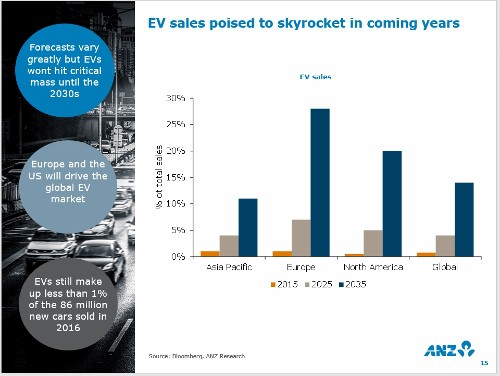
“No-one really knows the level of adoption that the market place will take.

“That certainly has been a big reason behind the rebound of nickel prices, even though the volumes are going to be relatively low.

“It is interesting to note the differences in the amounts of copper used in a conventional car as opposed to a battery EV.

“Essentially nine times the amount of copper is used.

“The dynamics are quite strong, and we do expect to see the markets turning.”

Currently, the EV/ lithium-ion battery chatter is creating a strong global market interest for nickel, which is receiving support, albeit in the short-term by higher stainless-steel production.

Australian mine production is expected to fall to 176,000 tonnes in 2017–18 before recovering slightly to 183,000 tonnes in 2018–19 while the country’s nickel export earnings are expected to fall slightly to $2.1 billion in 2017–18, before rebounding to $2.3 billion in 2018–19.

In a metals&ROCK research note released in April, Morgan Stanley noted that the main driver to global nickel demand to be, “any change in the level of activity in China’s stainless steel industry”.

Seventy per cent of the world’s primary nickel supply is gobbled up by Chinese smelters as they produce 54 per cent of the world’s total 46 million tonnes of stainless steel.

“And so far in 2017, China’s SS-output rate’s up (+23 per cent year-on-year, Jan-Feb),” Morgan Stanley reported.

“Roughly in line with the general lift in output of its +820 million tonnes per annum carbon-steel industry – buoyed by Q1’s credit surge, and a central government sponsored infrastructure program.”

The Department of Industry, Innovation and Science noted a recent rise in nickel prices attributing markets factoring in growing demand linked to lithium-ion batteries, however it also said that it was not clear that the immediate boost to prices will persist.

“Although sales of electric vehicles are rising sharply, at this stage, batteries still account for a small share of nickel sales, and stainless steel is still estimated to account for around two-thirds of nickel consumption over the outlook period,” the department said in its December Quarter Resources and Energy Quarterly.

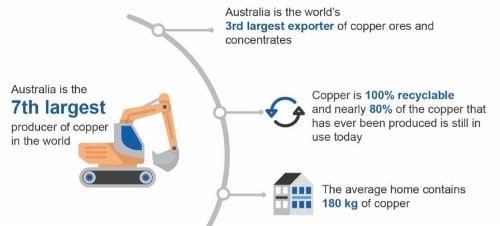
Although copper does have a part to play in the EV revolution, currently it is its older stomping grounds that are contributing to its recent positive run.
Source: DIIS

DIIS cited the London Metal Exchange (LME) copper price estimate to have averaged US$6,810 a tonne in the December quarter, the highest level since September quarter 2014.

Credit for this rise was given to growth in global industrial production and several supply disruptions, including incidents at KGHM’s Glogow smelter in Poland and Rio Tinto’s Garfield operations in the US.

Although copper inventories on the major global exchanges fell by 6.4 per cent quarter on quarter, contributing to higher prices in the December quarter these are expected to wane in 2018 with the LME copper price forecast to average US$6,340 a tonne as supplies increase.

A pick up in consumption over supply has forecasters predicting a rise in copper prices to US$6,490 a tonne in 2019.

“Global copper consumption is forecast to rise from 24 million tonnes in 2017 to 25 million tonnes in 2019, representing an average increase of 3.2 per cent each year,” DIIS said.

“Higher copper consumption will be supported by firm growth in global industrial production and higher investment in energy infrastructure.

“Emerging economies are expected to drive much of the growth in copper consumption over the next two years.”

China is expected to lead this copper consumptive period.

The country already accounts for around 50 per cent of global demand and looks to increase that number as it makes improvements to the nation’s power grid and enjoys further growth in the construction and manufacturing sectors.

The coming shortfall will kick in once global demand for electric cars and renewable energy takes off, leading to stronger growth in copper consumption over the next two years.

“Increased global production of electric vehicles…is expected to raise copper consumption by around 300,000 tonnes annually in 2018 and 2019,” DIIS said.

“Copper is used extensively in renewable energy technology and infrastructure, spending on which is expected to increase strongly over the outlook period.

“Global electricity capacity from renewable sources is expected to increase by 4.4 per cent annually over the outlook period.”