Bone Medical ends BN006 involvement

THE ROADHOUSE PHARMACY: Bone Medical (ASX: BNE) has received a from Proxima Concepts, the inventor and patent holder of BN006, with results of current studies which investigated BN006’s ability to achieve advantageous therapeutic effects across a broader dose range in comparison with market-leading treatments.

According to Bone Medical the studies were carried out in an animal rheumatoid arthritis disease model and have extended the understanding of BN006’s dose-response curve from partial results obtained in 2013.

However, on only one of the important measures of efficacy – the ability to reduce inflammatory response – and at only one of the BN006 dosage strengths tested, did BN006 appear to be close in its effects to the market leaders.

The company explained that a number of other BN006 product parameters remain unclear following completion of the experimental evaluation budgeted under its January 2014 recapitalisation plan.

Further data on the ability to administer the product orally indicates that this cannot be accomplished without more extensive formulation work than last year’s initial results indicated.

BN006’s underlying mechanism of action also remains undetermined following inconclusive lab work that was carried-out earlier this year by Bone Medical and the William Harvey Research Institute.

“The company has concluded that BN006’s profile has not been sufficiently advanced by these new results to justify continuing development,” Bone Medical said in its ASX announcement.

“Following the termination of the Licence and Research Agreements with the Proxima Group, Bone Medical will focus on identifying new technology opportunities both in Health Science and other sectors with the objective of increasing shareholder value.”

Email: query@bone-ltd.com

Website: www.bone-ltd.com

Universal Biosensors obtains European approval for blood coagulation system

THE ROADHOUSE PHARMACY: Universal Biosensors (ASX: UBI) announced that Siemens Healthcare Diagnostics has received CE Mark approval for the Xprecia Stride™ Coagulation Analyzer, a first point-of-care coagulation analyser developed in collaboration with Universal Biosensors.

The Xprecia Stride Coagulation Analyzer is a prothrombin time (PT-INR) testing system used to monitor the application of the anti-coagulant therapy, Warfarin.

Universal Biosensors will exclusively manufacture PT-INR strips for Siemens at the company’s existing plant in Rowville, Victoria.

Universal Biosensors said the CE marking follows the receipt of two commercial orders from Siemens for the production and supply of PT-INR test strips by Universal Biosensors, and is the final step prior to product launch in Europe.

The company explained the CE marking is mandatory for any company prior to selling its product within the 31 countries operating in the European Economic Area.

The CE marking indicates a product is fully compliant with all relevant EU legislation and can move freely within the European Economic Area.

It is estimated about ten million patients globally are taking Warfarin.

Patients are prescribed the drug for a variety of reasons, including the treatment of blood clots in the veins or certain heart conditions which increase the likelihood of a potentially life-threatening clot forming.

Patients on Warfarin require frequent testing of the clotting tendency of their blood.

PT-INR testing allows physicians to adjust patient doses for diet and lifestyle changes.

“Receipt of the CE marking is an important step prior to the market launch of this exciting new coagulation testing product developed in partnership with Siemens,” Universal Biosensors CEO Paul Wright said in the company’s announcement to the Australian Securities Exchange.

“We are looking forward to the launch of this new device and continue to work with Siemens to bring powerful and innovative systems to point-of-care testing.”

Email: info@universalbiosensors.com

Website: www.universalbiosensors.com

Origin confirms new gas discovery offshore Victoria

THE ROADHOUSE BOWSER: Origin Energy (ASX: ORG) has claimed to have confirmed its Speculant-1 exploration well has discovered potentially commercial quantities of gas in Waarre Formation reservoirs in the Otway Basin, offshore Victoria, within the Origin operated VIC/L1(v) permit.

Origin described the Speculant discovery as a tilted fault block structure covering over seven square kilometres in a nearshore section off the Otway coast, and sits immediately north of the Halladale and Black Watch fields previously discovered by Origin in 2006.

Origin Energy chief executive officer upstream Paul Zealand said in the company’s announcement to the Australian Securities Exchange.

“We are pleased to have discovered new gas resources in the Otway Basin, an area in which we have a long history of operating,”

“We look foward to completing further evaluation of the resource, as we seek to continue to expand our gas portfolio in order to meet growing demand for gas.”

The company said Logging While Drilling (LWD) data acquired during the drilling of the well indicates the presence of potentially commercial quantities of gas within excellent quality sands of the Waarre Formation.

This formation contains sands over a gross interval of approximately 100m vertical thickness.

The company also indicated wireline formation pressure data has confirmed the presence of a gas column of approximately 145m within the Waarre C formation.

Further evaluation of secondary targets are currently underway.

The Speculant-1 exploration well spudded on 23 September 20.

Website: www.originenergy.com.au

Austin Exploration’s fifth Eagle Ford well flowing

THE ROADHOUSE BOWSER: Austin Exploration (ASX: AKK) announced its fifth Eagle Ford well with Halcón Resources, the Curington ‘A’ 1H, in Burleson County, Texas is producing large volumes of oil and gas.

The Curington ‘A’ 1H produced 19,600 barrels of oil equivalent, (BOE), in its first 30 days, or an average rate of 653 BOEPD (92% Oil).

“Five from five is quite something and our sixth well, the Seaducer well, is coming along nicely,” Austin Exploration CEO and managing director Dr Mark Hart said in the company’s announcement to the Australian Securities Exchange.

“Fortunately, the Eagle Ford shale has the lowest production costs of any oil basin in the United States and remains profitable in this current low oil price environment.

“The Eagle Ford is expected to attract more energy industry investment than any other U.S. shale field.

“Independent reports have forecasted 2015 expenditures will exceed $30 billion in the Eagle Ford, nearly twice the $16.7 billion that will be spent in the Bakken Shale in North Dakota.”

Austin said its 5000 acre Birch property is large enough to accommodate more than 100 horizontal wells, adding the company was looking forward to further development in this oil basin for many years to come.

Carnarvon Petroleum cashes up on Thai asset sale

THE ROADHOUSE BOWSER: Carnarvon Petroleum (ASX: CVN) has entered into a Sale and Purchase Agreement (SPA) to divest its remaining 20 per cent interest in the Thailand oil production concessions L44/43, L33/43 and SW1A.

The company has agreed to sell its remaining 20 per cent interest in its Thai assets to the Berlanga Group for a total cash consideration of US$58.2 million (A$68.5 million).

The SPA was entered into with Berlanga Thailand Limited, a member of the Berlanga Group, and a deposit of US$2 million was received by Carnarvon upon signing the SPA.

“This is a positive commercial outcome for the company,” Carnarvon Petroleum managing director and chief executive officer Adrian Cook said in the company’s announcement to the Australian Securities Exchange.

“Carnarvon’s already robust balance sheet will be strengthened with cash forecast to exceed A$100 million post-completion.

“On completion of this transaction we will have realised US$91 million in the past year from the sale of our Thailand interests with up to a further US$32 million to be received in the future.

“This has proven to be a very profitable investment and a powerful demonstration of our willingness to think and act differently.

“With the sale, we are now entirely focused on maximising value in the North West Shelf of Western Australia.

“Upon completion of the sale we will have secured important funding for our future activities without diluting our shareholders’ interests or raising debt.

“We are now well-funded and focused to follow up on our success at the Phoenix South-1 well.”

The SPA is subject to satisfaction of standard terms and conditions, including receiving joint venture partner consents, executing completion documents and payment of the consideration.

Completion of the deal is currently scheduled to occur on or before 16 February 2015.

An industry under siege: why we need the junior resources sector.

MARK GORDON: So, why do we need the junior resources sector?

Speaking from a purely selfish viewpoint I need it so I can keep working in a sector that I have a strong passion for.

The mineral exploration and financial sectors involved with resources have given me a fantastic career over 24 years – one that I wouldn’t have changed, despite some frustrations over the years!

It is a sector that has been under siege of late from a number of quarters, which unfortunately has the effect of scaring investors away.

The first and key issue is the market, which we can’t do much about. This is a nature of the beast – markets are cyclical, with junior resources being more volatile than most, and given the risk profile it is one of the first sectors to suffer when funds dry up.

We have just been through the extraordinary ‘Super-Cycle’, driven by an ever emergent China, but unfortunately this has been interrupted by the GFC and ongoing headwinds, inhibiting broad growth in the global economy.

However, we are now back into an overall flat tracking to gently down trending and volatile period, following a dramatic downturn in the sector from March 2011 until June 2013.

Funding is still out there; however the market is much more discerning about where it goes than it was during the boom.

We have also been increasingly under siege from other interests – some sections of the media and noisy vested interest and anti-mining groups amongst others.

Although everyone is entitled to their ‘opinion’, it seems to me that a lot of the commentary that comes out of these groups is ill-considered, uninformed and emotive.

This actually often seems to be targeted – note the ‘shut the gate’ campaigns against coal and coal seam gas in New South Wales, and the anti-coal sentiment starting to come out in a number of quarters – this has been reinforced by Government decisions against compliant DA’s for a number of proposed Hunter Valley coal operations, the cancellation of several CSG leases and more recently all licence applications.

Fortunately, the large majority of Australians remain overall supportive of mining, and understand that it is an essential part of Australia’s economy.

A recent case that caused a storm in the media was the ANU’s decision to divest itself of seven resource stocks, based on a review of the university’s portfolio commissioned under the university’s Socially Responsible Investment Policy, and provided by CAER.

I am not going to go into detailed commentary on this issue here, however one point should be raised – although the media and commentariat picked up on the ‘move away from fossil fuel’ tone of associated comments by the Vice-Chancellor, only two of these companies are in fact involved in fossil fuel production!

The companies that were divested from the portfolio include:

Iluka Resources (ASX: ILU) – mineral sands – 1998 merger;
 
Sirius Resources (ASX: SIR) – nickel/copper – Recapitalisation of Croesus Mining – relisted 2008;

Sandfire Resources (ASX: SFR) – copper/gold – 2004 IPO;

Independence Group (ASX: IGO) – nickel/gold – 2000 IPO;

Oil Search (ASX: OSH) – 1929 – Oil and Gas Incorporated (PNG);

Santos Petroleum (ASX: STO) – Oil and Gas – Incorporated 1954; and

Newcrest Mining (ASX: NCM) – gold/copper – 1990 merger.

All are successful, Australian listed companies, with at least four (without knowing the detailed history of Oil Search) starting life as junior explorers that subsequently made large discoveries.
 
Herein lies a key reason why we need junior explorers:

Firstly, THEY MAKE DISCOVERIES, and are a vital part of the mineral resource sector in Australia.

Instead of being denigrated, maybe they should be lauded and held up as positive examples of what we can achieve here in Australia?

Whilst we must engage with the community and alleviate their concerns I will stress that it seems the industry is under siege from many quarters.

Secondly, and most importantly, mining is a key part of Australia’s economy.

However, some anti-mining groups use the argument that mining contributes a relative small amount to Australian GDP (around 10%), and employs a relatively low number of people (i.e. we are productive!).

On the GDP side they often forget the proportion of GDP in the mining related industries, which takes the total mining sector contribution to approx. 20 per cent, a very significant part of Australia’s economy.

More importantly, mining is a key contributor to national income through exports of mineral resources.

This cannot be stressed enough – at the current time, if mining should stop, Australia would lose close to 60 per cent of its foreign income; imagine your household losing at least 60 per cent of its income (which is what has occurred in the households of a number of mining professionals).

Published figures (see graph below from 2012 – 2013) show the contribution of mineral resources to Australia’s exports – note this includes bulk commodities, with the significant rise from 2005 largely due to increases in volume for iron ore and coal.


Source: Minerals Council of Australia


However, pre-2005 minerals exports were still a significant part of our export industry, averaging around 35 per cent of export earnings in the preceding 30 years.

Given recent price falls in iron ore and coal we would expect to see the overall resources contribution fall, however as history tells us it will and should remain a vital contributor to Australia’s income.

Of the resources exports, approximately 20 per cent by value are non-bulk commodities, including base and precious metals.

Gold is Australia’s third single largest export after iron ore and coal – the value of Australia’s seven largest exports are shown below – note that out of these five are natural resources and two are services, reinforcing the importance of natural resources to Australia’s wealth.
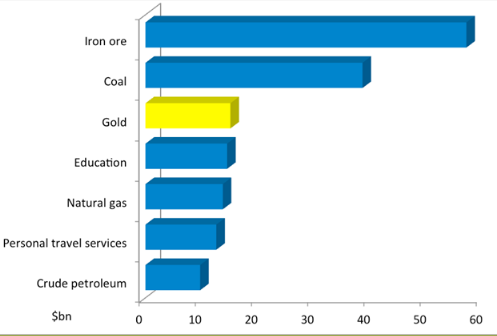
 

Australia’s seven largest exports – 2012-2013. Source: Minerals Council of Australia


Junior explorers are an important part of this, making approximately 66 per cent of the non-bulk discoveries in the period 2004 to 2013, and 50 per cent of the same in the period 1994 to 2003.

Mark Gordon

Senior Resource Analyst
mgordon@breakawayresearch.com

This article first appeared in

Friday Flashback

THE WEEKLY WRAP: Somebody needs to tell the Americans holidays are a time for relaxation.

As they settled in to give thanks, the land of the free began a frenzied sell-off of energy shares after the Organization of the Petroleum Exporting Countries (OPEC) decided to do nothing to ease the current glut of oil on the world market.

Brent crude oil prices slumped to a five-year low of US$60 a barrel to pull focus from iron ore, which didn’t actually have a bad day by bouncing up to US$71.30.

While the big players in the oil and iron ore sectors – you know who they are – continue their respective march to world domination other stocks also took a bath on Monday as Chinese manufacturing data took its toll on non-iron-or-oil-related commodities.

Copper hit a four and a half year low to US$6235 per tonne to follow respective losses recorded by aluminium, zinc, and nickel the previous Friday of 2 per cent, 1.8 per cent, and 0.5 per cent.

The all-Ordinaries lived up to its moniker to drop a hefty 107 points for the day.

Our national carrier QANTAS (ASX: QAN) steered clear of the damage flying over the two dollar mark to close at $2.01.

Obviously not enough people paid attention to our tweeting regarding the lack of entertainment on the flight from Perth to Brisbane.

It’s a first world problem I know but it wasn’t me who set the lofty standards the airline didn’t meet on this occasion.

They have assured us the problem is being dealt with as they rush to refurbish planes for the route.

However, when your timings off, its off and using Frequent Flyer points to upgrade to Business Class for the return leg sounded good until meal time when it became patently obvious it was Neil Perry’s day off from the kitchen.

Of course, as we have come to learn in the current market environment, a cup of tea and good lie down work wonders and on Tuesday the market rallied.

Brent crude jumped back over the US$70 puddle to US$72.80 with Woodside Petroleum (ASX: WPL) enjoying the moment to gain 66c to close the day at $34.86.

The Dow Jones and the S&P 500 closed higher on Wednesday, as a rebound in US oil prices led to gains in energy shares.

By Yesterday almost all had been forgiven and the goldfish investor mentality had returned with the Aussie market appreciating a rise in US equities on the back of cheerful economic news in the form of a US Federal Reserve report, which showed the largest democratic economy continued to grow in October and November giving rise to pre-Christmas optimism.

Stronger than expected trade and retail spending figures brought a smile to Federal Treasurer Joe Hockey’s dial as they helped the Australian dollar regain some of the ground lost earlier in the week.

The Aussie dollar hit a four year low after Wednesday’s economic growth data, which sparked talk of a possible rate cut by the Reserve Bank.

The currency got back on track yesterday from an 0.4 per cent rise in retail spending in October, and a narrowing of Australia’s trade deficit to $1.3 billion.

What the Analysts Say

WHAT THE ANALYSTS SAY: Interesting news and views from across the Resource Analyst universe.

Website: www.beerandco.com.au

Company: New Age Exploration (ASX: NAE)

Lochinvar is part of the Canonbie coal field, which was first drilled in the 1950s by the UK National Coal Board.

Lochinvar was explored intermittently until the mid-1980s, when it was shelved with much of the UK coal industry.

NAE announced the results of its scoping study in October 2014, affirming coal quality, with cap.ex of US$284 million for 1.35 million tonnes per year of product coal at a cash cost of US$70 per tonne, delivered; or US$79 per tonne all in costs.

First coal is expected early 2018.

Key Outcomes of scoping study on Lochinvar

First coal 2018 Q1;

Mine average 1.9 million tonnes per year of RoM coal, with CHPP yield of 71 per cent for 1.4 million tonnes per year of product coal;

Mining inventory of 47.3 million tonnes, of which 38 per cent is from Indicated
Resources, for 33.7 million tonnes of saleable coal;

Project capital costs: US$284 million (plus feasibility and corporate costs);

Cash costs of delivered coal: US$70 per tonne, plus US$9 per tonne of sustaining capital.

Next steps

The quality of the cost estimates is of a high standard.

NAE needs more assessment of the geology, starting with seismic surveys, to affirm the mine plan.

Work on the Environmental Impact Assessment will start early in 2015.

The PFS is expected to be completed late in 2015.

Impact on Beer & Co’s valuation

Beer & Co’s valuation was based on our assessment of capital and operating costs and production rates.

The major impact on our valuation was not a result of the scoping study but the low current share price forced us to reduce our estimate of the price at which equity will be raised.

Website: www.breakawayresearch.com

Company:  Altech Chemicals (ASX: ATC)

Following a change of management and name, Altech Chemicals (previously Australian Minerals and Mining Group) has recently commenced a BFS on its 4,000 tonnes per annum High Purity Alumina (HPA) project.

Work over recent years has developed a patented, low cost acid leach process that has produced High Purity Alumina HPA of the requisite quality.

As a result of the recent Integrated Plant Study (IPS) Altech has published estimated operating costs in the order of $8,600/tonne of 99.99 per cent purity HPA for a small scale plant, which is significantly lower than our estimated current industry average costs of approx. US$14,000 to US$17,500/tonne for the equivalent product, and could be a potential game changer for the industry.

Our view is that share price catalysts will be material progress on the BFS and optimisation testwork, and for the valuation to increase as the HPA project is advanced and de-risked.

Altech Chemicals is concentrating on the development of an HPA production operation, to enter into what is forecast as a rapidly growing market driven largely by the increased demand from the electronics industries.

Altech owns significant aluminous clay resources in Western Australia, which it has demonstrated is suitable feedstock for the proposed process.

Plans are to mine and beneficiate clays at its 100 per cent-owned Meckering deposit, some 130 kilometres east of Perth, and then ship the material for processing at the proposed plant at the Tanjung Langsat Industrial Complex (TLIC) in Johor Bahru, in southern Malaysia.

Altech Chemicals is targeting the lucrative HPA market, which is expected to grow strongly over the next few years on the back of technology applications.

The current market, estimated at approx. 19,000 tonnes per annum of HPA, has been forecast to more than double over the next few years to over 48,000tpa to supply sapphire glass and other products to the strongly growing LED and electronic industries.

The company is currently working on a bankable feasibility study, which it expects to complete in Q3, 2015.


Disclaimer: The above is intended as a guide only. The Roadhouse accepts no responsibility for investments made from this advice, successful or otherwise.

The views, opinions or recommendations of this article do not in any way reflect the views, opinions, recommendations, of The Resources Roadhouse.

The Roadhouse makes no representation or warranty with respect to the accuracy, completeness or currency of the content. The content is for educational purposes only and does not constitute financial advice. Independent advice should be obtained from an Australian financial services licensee before making investment decisions.

Fund Raising across the Boards

THE FUND RAISER: There seems to be enough going on to suggest interest in the resources sector still exists.

$1.1 million to advance San Santiago copper assets

Minera Gold (ASX: MIZ) has received commitments from existing major shareholders and clients of Alignment Capital to raise $1.1 million in new funding.

The company sought the funding to ensure its San Santiago plant operates at the level required to meet 2015 forecast production targets through both owner operator mining and third party toll treatment.

The funds were raised predominately through the company’s major shareholders by way of equity and convertible notes.

“We are extremely pleased with the strong support received from our major shareholders and APG, which is testament to the recent material acquisition of the San Santiago plant and surrounding concessions,” Minera Gold CEO and managing director Ashley Pattison said.

“These funds provide us with the opportunity to maximize capacity at the plant and bolster the returns for shareholders in the short term.”


Non-renounceable Rights Issue to raise up to $4.96 million

Alliance Resources (ASX: AGS) will conduct a non-renounceable rights issue to shareholders on the basis of two new shares for every 11 shares held at eight cents per new share to raise approximately $4.96 million.

Each shareholder will also be entitled to receive one attaching new option for every new share subscribed for, each exercisable into one Share at an exercise price of 15 cents per share and expiring on 30 September 2015, for no additional cash consideration.

The funds raised under the Rights Issue will primarily be used for:

Four Mile uranium project November 2014 cash call (due in December) to maintain the company’s participating interest in the project;

Costs awarded to Quasar and Heathgate in 2012 and 2013 in the Court proceedings commenced by
Alliance concerning access to books, records and agreements pertaining to the Four Mile Joint
Venture which are currently the subject of assessment by the Court;

Costs of the Offer; and

General working capital, including legal fees in relation to matters currently before the Court.

“The company is a uranium producer with a significant inventory of uranium concentrates, which when sold, will enable Alliance to declare a dividend, grow its existing 100 per cent projects and fund new projects,” Alliance Resources managing director Steve Johnston said.

“We believe that the rights issue is well-priced for our existing shareholders and that the funds raised, if fully subscribed, should see Alliance through to first revenue.”


$1.1M to Advance Cascavel

Orinoco Gold (ASX: OGX) has received commitments from professional and sophisticated investors to raise approximately $1.1 million through a share placement at 7 cents per share.

The company also advised it will be offering existing eligible shareholders the opportunity to participate in a Share Purchase Plan (SPP) at an issue price of 7 cents per share.

Together, the funds raised from the placement and SPP will be used to complete development and mine plans for the company’s Cascavel gold project while Orinoco secures a suitable debt funding package to underpin the start of development, as well as for general working capital purposes.


Placement- $2.5 million

Geopacific Resources (ASX: GPR) has completed a Placement to institutional and sophisticated investors of approx. 43.5 million shares at 5.75 cents per share raising $2.5 million.

Funds raised from this Placement will advance exploration activities at the company’s Kou Sa project in Cambodia.

“Investor support for the company, in this very difficult market, is outstanding,” Geopacific Resources managing director Ron Heeks said.

“Continual high-grade drilling results from several new discoveries at Kou Sa over the past few months has now attracted institutional interest.

“We expect Kou Sa to continue to produce compelling results as we move toward our initial resource estimate.”

Rhinomed snoring product receives regulatory approvals

THE ROADHOUSE PHARMACY: Rhinomed (ASX: RNO) has completed testing and technical documentation allowing its new snoring and sleep quality product Mute™ to gain acceptance with the US Food and Drug Administration(FDA), European authority (CE Mark) and the Australian Therapeutic Goods Association (TGA).

Rhinomed described Mute to be an internal nasal dilator that increases airflow, allowing people to breathe more and snore less.

The company claims a recently independently conducted trial achieved the primary endpoints of reduction in snoring severity, volume, frequency and duration.

The trial exceeded pre-specified criteria showing clear improvement in reported sleep quality in both snorer and partner.

Rhinomed said registering the Mute with the US FDA as a Class 1, 510(k) exempt medical device product allows it to be sold online and in store within the United States.

Conforming to the regulatory and manufacturing requirements necessary to receive a CE Mark also enables the Mute to be marketed directly to European consumers, and to consumers in the four member states of the European Free Trade Association and in Turkey.

Australian TGA registration ensures the company can commence its test-marketing program immediately.

“The testing, process and steps we put in place for the testing of our first product – the Turbine – ensured that our second technology – Mute was right from the start designed, tested and manufactured to fully comply with the most rigorous of regulatory requirements,” Rhinomed CEO Michael Johnson said in the company’s announcement to the Australian Securities Exchange.

“Our internal team and regulatory advisors have done a great job of ensuring that we built the required testing and quality control processes that have enabled the Mute to comply with ISO Standard 13485 for the development of medical devices and to be successfully registered with the European, US and Australian Authorities.”

Website: www.rhinomed.com.au