Enerji inks agreement to develop $15.1M Hybrid Solar Thermal Project

CLEAN ENERGY CAFE: Thermal energy company Enerji (ASX: ERJ) has struck an agreement with Carbon Reduction Ventures (CRV) and Morawa Solar Thermal (MST) for the planned development of a hybrid solar thermal project.

The project is supported by the Western Australian State Government through its Low Emissions Energy Development (LEED) Fund.

Enerji explained CRV is to be developer of advanced solar and hybrid solutions and is to act as the project’s proponent, while MST is the project vehicle and has a Financial Assistance Agreement for LEED funds of $3,775,000 comprising 25 per cent of the budget of $15.1 million.

The project includes ATEN 3 technology, which has been developed by Enerji, and an Opcon Powerbox.

According to Enerji’s announcement to the ASX the project has zero emissions with all of the energy to drive the power generator coming from a ground-breaking hybrid arrangement combining solar thermal energy with waste heat.

The Solastor System works by storing energy in high-temperature graphite, which is supplemented by waste heat harvested from the exhaust of a fossil fuel power station.

“The Hybrid Solar Thermal Project is one of the projects within Enerji’s ‘Five-Projects’ strategy,” Enerji said in its announcement.

“Enerji has been collaborating on this project for 12 months undertaking concept development and preparatory work.”

The company outlined the key projected characteristics of the project to be: a budget of
$15,100,000; power generated (annually) of 5500 megawatt hours (MWh); emissions abated (annually) of 3476 tonnes; and a heat storage capacity of 10MWh.

The company anticipates electricity produced by the project will generate revenue by displacing fossil fuel power generation.

The project will apply Enerji’s ATEN 3 system to collect thermal energy from two sources with distinctly different heat characteristics.

Medium temperature heat is to be harvested from the exhaust of the host power station, while high temperature heat will be collected from concentrated solar thermal.

“The flexibility of collecting concentrated thermal energy from multiple sources provides diversity and redundancy,” Enerji said.

“The ATEN 3 system applies accretive principles to optimise and regulate each energy source and further optimises the overall thermal energy mix.

“The system also enhances the thermal energy quality and governing, for power generation, in a manner that improves overall operating efficiency when compared to using either heat source in isolation.

“The cumulative benefit is improved efficiency and capacity factor, resulting in compounded improvements to capital efficiency.”

Email: info@enerji.com.au

Website: www.enerji.com.au

High Peak Royalties acquires stake in Royalco Resources

THE ROADHOUSE BOWSER: High Peak Royalties (ASX: HPR) has acquired a strategic 19.99 per cent shareholding in ASX-listed royalty company Royalco Resources (ASX: RCO).

High Peak explained Royalco holds a collection of oil & gas royalty interests across Australia and overseas.

The company’s key royalty interest is a one per cent interest in the Weeks Petroleum Royalty (a 2.5 per cent overriding royalty covering all production from the Bass Strait fields in the Gippsland Basin jointly owned by ExxonMobil and BHP Billiton).

Royalco received $852,792 in royalty payments in calendar year 2014 from its one per cent interest in the Weeks Petroleum Royalty.

High Peak said the acquisition of the stake in Royalco is consistent with its own royalties’ strategy of gaining exposure to interests, adding the deal fits in well with its existing portfolio of oil and gas royalties covering 23 producing areas and high potential exploration areas in Australia, the United States and the Seychelles.

“High Peak Royalties’ shareholding in Royalco provides an indirect exposure to 19 oil and/or gas production permits in the Gippsland Basin operated by ExxonMobil,” the company said in its ASX announcement.

“The permits currently supply 40 per cent of the East Coast of Australia’s gas demand and should be a beneficiary of rising LNG demand.

“High Peak Royalties has no current intention to materially increase its shareholding in Royalco, but does reserve the right to review the level of its shareholding in the future.”


Website: www.highpeak.com.au

Titan Energy inks US$50M Joint Development Agreement

THE ROADHOUSE BOWSER: Titan Energy (ASX: TTE) has signed a Joint Development Agreement for funding of up to US$50 million.

The deal has been struck with a United States-based oil and gas, energy funding partner and exploration and development company (referred to as the Fund) which Titan said had, in the past two years participated in the drilling and development of 38 Texas Gulf Coast salt dome wells.

Effective immediately, the Fund, has committed up to US$50,000,000 in joint development projects with Titan over the next three years.

This funding is to be based upon Titan completing a pilot project currently underway and meeting the Fund’s performance criteria.

Titan explained the initial pilot project consists of the workover and recompletion of five existing wellbores currently being undertaken at the company’s Allen Dome oil project in Texas and the drilling of five new development tests on Allen Dome to begin in February 2015.

Total initial project commitment exceeds US$5,000,000 subject to ultimate well costs during the project.

A second Titan project, slated for funding by mid-2015, is already being prepared for participation by the Fund.

Titan expects the joint development funds from this program will be available early in the second half of 2015.

Titan is currently completing a number of acquisitions across the US Gulf Coast, which meet the Fund’s criteria for development.

“This agreement is a significant development for the company and will undoubtedly have an ongoing impact on Titans shareholder value,” Titan Energy executive chairman Darren Levy said in the company’s announcement to the Australian Securities Exchange.

“The financial capacity that the Fund provides is huge for a company of our size.

“To have the cash flow to pursue all our planned drilling programs is a game-changer.

“At a time when the majority of oil and gas companies are announcing major reductions in their capital expenditure budgets and drilling plans, we are going significantly the other way.”

Email: info@titanenergy.com.au

Website: www.titanenergy.com.au

Investigator results promote Paris potential

THE DRILL SERGEANT: Investigator Resources (ASX: IVR) has received results from 15 holes (PPRC330 to PPRC344) the company drilled in December 2014 within its 100 per cent-owned Peterlumbo tenements in South Australia, which include the Paris silver Resource.

The drilling program was carried out to follow-up on shallow copper-gold targets Investigator had identified from previous magnetic modelling and copper-gold intersections encountered at the Helen copper prospect.

The company considers the new assays support an upgraded target model for the Paris-Nankivel mineral system, with one intersection at the Helen prospect returning:

19 metres at 0.58 per cent copper and 21 grams per tonne silver from 176m, including 4m at 1.17 per cent copper, 58g/t silver and 0.33g/t gold from 176m.

Investigator said it has also hit anomalous gold, lead and zinc intersections in scout drilling elsewhere around the Nankivel Intrusive Rim.

“Drilling was undertaken near Paris right up to Christmas, as we continue to expand the copper gold and silver potential and the exploration understanding of the district-scale mineral system,” Investigator Resources managing director John Anderson said in the company’s announcement to the Australian Securities Exchange.

“Following the encouraging copper-gold intersections at Helen from the September 2014 scout drilling program and the subsequent airborne magnetic survey, a number of copper-gold magnetic targets were identified and initial drill testing was done on the accessible targets.”

Anderson said the copper Investigator intersected at Helen this demonstrates the potential of the large 12 kilometre long rim of the Nankivel intrusive complex for skarn-style copper gold silver.

The company has combined the latest assay data with its historical knowledge of the area, from which it has refined its target model for the Paris-Nankivel mineral system.


Location of prospects within the Peterlumbo tenement. Source: Company announcement


Investigator has now identified three new accessible and high-priority targets at:

Nankivel Central, which it believes has potential for a porphyry/breccia copper-gold deposit;

Helen Southwest copper-gold skarn target on the Nankivel Rim; and

Nankivel West silver gold target.

“These accessible targets will be readied for drill testing in the June quarter after upcoming gravity detailing to further refine the targets,” Anderson said.

“Four other skarn copper gold targets around the Nankivel Rim require heritage surveys and access negotiations.”

Email: info@investres.com.au

Website: www.investres.com.au

Viralytics commences CAVATAK Bladder Cancer trial

THE ROADHOUSE PHARMACY: Viralytics Limited (ASX: VLA) has initiated a Phase 1 clinical trial of CAVATAK in patients with non-muscle invasive bladder cancer (NMIBC), also known as superficial bladder cancer.

The trial, titled the CANON (CAVATAK in Non-muscle invasive bladder cancer) study, has enrolled the first of an expected 30 to 40 patients in a two-part, open-label, dose-escalation study.

The trial will take place in the United Kingdom and is designed to evaluate the safety and tolerability of CAVATAK administered alone directly into the bladder, as well as in combination with the standard chemotherapy, mitomycin C.

The trial will also assess the pharmacodynamics of CAVATAK and document evidence of anti-tumour activity.

Viralytics described CAVATAK as an investigational cancer immunotherapy based on a proprietary cold virus that has been shown to preferentially infect and attack cancer cells.

The company claimed that in preclinical studies, the combination of CAVATAK and mitomycin C synergistically increased cancer-killing activity in bladder cancer cell lines.

“There is a real need for new therapies for bladder cancer that will improve the durability of response and reduce toxicities compared to current treatments,” Professor Hardev Pandha, principal investigator of the CANON study and director of the Surrey Cancer Research Institute at the University of Surrey said in Viralytics ASX announcement.

“Based on the promising preclinical performance of CAVATAK in our studies, we are keen to explore this novel treatment in human trials.”

Website: www.viralytics.com

Prescient completes acquisition of AKTivate Therapeutics

THE ROADHOUSE PHARMACY: Prescient Therapeutics (ASX: VHL) has finalised the acquisition of specialty oncology company AKTivate Therapeutics and its novel cancer drug candidate triciribine phosphatemonohydrate (TCN-P).

Prescient has paid US$300,000 cash consideration and issued 6.7 million shares to the vendors.

The company will issue a further 5 million Prescient shares to the vendors contingent on the meeting of major clinical and regulatory milestones.

Prescient Therapeutics chairman Steven Engle said completion of the AKTivate was another important milestone for the company.

“The completion of the AKTivate transaction is Prescient’s second major oncology acquisition this year, and significantly strengthens the company’s product pipeline,” Engle said in the company’s ASX announcement.

“We now have two novel cancer compounds with the prospect of five mid-stage clinical trials.

“The acquisition is highly complementary for Prescient – not only do the two compounds share scientific pedigrees and clinical investigators in the US, but there is also the potential for these two compounds to be used synergistically with one another to block key cancer growth pathways.

“Importantly for Prescient shareholders, this transformational acquisition does not come with near-term onerous costs typical of such clinical programs.

“Both the breast and ovarian cancer trials are currently funded by US government grants, which is a further endorsement of these programs.”

TCN-P is a small molecule that blocks the AKT growth-promoting pathway that leads to cancer.

AKT is the most frequently altered signalling pathway in cancer and thus plays a key role in the development of many cancers including those being currently pursued by the company (breast, ovarian and leukaemia).

High AKT expression is associated with a poor prognosis, resistance to chemotherapy and shortened patient survival time.

In animal studies, TCN-P has been shown to strongly suppress the growth of high AKT-expressing tumours and to overcome resistance to commonly used chemotherapeutic drugs, a key feature of the TCN-P drug.

What the Analysts Say

WHAT THE ANALYSTS SAY: Interesting news and views from across the Resource Analyst universe.

Website: www.beerandco.com.au

Company: PLD Corporation (ASX: PLD)

PLD has signed an agreement to acquire the Admiral Bay zinc deposit.

Upon successful completion of due diligence, PLD will pay $0.5 million in cash, issue a $0.5 million convertible note, grant a 1.5 per cent NSR and pay $2.5 million in cash/shares in the third year of production.

Admiral Bay has a resource of 72 million tonnes grading 6 per cent zinc and lead and 18 grams per tonne silver.

This is calculated from a 2.1 kilometre zone of an 18 kilometre mineralised corridor.

PLD has acquired a world class zinc deposit in the world class mining jurisdiction of Western Australia at a time when zinc is about to go into a significant shortage.

PLD is now focussed on extracting the strategic value from 100 per cent ownership of a world class deposit with a resource upgrade, development of an Exploration Target, metallurgical test work review and partner discussions.

Admiral Bay has significant strategic value

The zinc market is in deficit as exchange stocks have fallen by 387,000 tonnes, or 33 per cent, since the start of 2014, partly due to the closure of 320,000 tonnes of annual capacity at New Brunswick and Perseverance mines in Canada.

Major mine closures of a further 850,000 tonnes of annual capacity are expected by the end of 2016, plus up to 650,000 tonnes more in various small mines.

Admiral Bay has 2.2 million tonnes of contained zinc in Resources which makes it one of the largest available resources globally.

The Resource relates to only a 2.1km section of 18km of mineralised corridor, so there is significant further potential.

PLD is cheap on a peer comparison

Beer & Co calculate that PLD’s current Enterprise Value is equivalent to $1.3 per tonne of zinc or $0.6 per tonne of contained zinc equivalent.

This is less than half of the next cheapest zinc exposure listed on the ASX, and only 10 per cent of direct peers, though these projects are more advanced.

Admiral Bay is in WA, which has a much lower sovereign risk than many of its peers.

Website: www.argonaut.com

Company:  Kibaran Resources (ASX: KNL)

Kibaran Resources (ASX: KNL) is developing the Epanko graphite project in southern Tanzania.

In a sector that is racing to develop new projects amidst a relatively small market, Epanko is differentiated from its development peers by ultra-high quality, large flake size and off-take agreements in place.

Positive scoping study

KNL published a positive Scoping Study in August 2014 highlighting the potential for a low capital, low opex, high margin operation, whereby 420,000 tonnes throughput at 9.6 per cent will produce 40,000 tonnes per annum graphite.

The project benefits from low strip ratios (1.3:1 for the first five years), high grade, high recoveries and a high value, large flake product. The study defined a 27 year mine life at stated production levels.

Size matters

Where most commodities are measured primarily by grade, graphite deposits are additionally evaluated on graphite purity and flake size, with large flakes (+180μm) commanding premium prices.

Epanko’s scoping study has demonstrated its ability to produce ultra-high purity with 99.9 per cent graphite (applying final stage acid wash) via one-step purification comprising 29 per cent >180μm flakes.

However, the focus at this stage is to produce 94 to 97 per cent carbon concentrate through simple flotation.

Test work has showed no relationship between flake size and quality and also confirmed very high melting point (1,305°C), both favourable properties for product application and diversity.

Scaled to meet the market

The graphite market is relatively small (1.2 million tonnes in 2013) and the growth potential is very much hedged on the development of battery technology with demand forecast between 1.5 to 2.5 million tonnes per annum.

KNL planned production of 40,000 tonnes per annum is aimed at being non-disruptive to the market.

We envisage that both the Resource and plant design are amenable to expansion, subject to demand.

Off-take in place

Unlike many of its ASX-listed peers, KNL has signed two off-take agreements and is the first to do so with a non-Chinese party.

The second agreement with German trader ThyssenKrupp Group is for 20,000 tonnes per annum (split 50/50 Epanko and Merelani), which in addition to the first contract for 10,000 tonnes to an undisclosed party, accounts for 50 per cent of Epanko forecast production.

Disclaimer: The above is intended as a guide only. The Roadhouse accepts no responsibility for investments made from this advice, successful or otherwise.

The views, opinions or recommendations of this article do not in any way reflect the views, opinions, recommendations, of The Resources Roadhouse.

The Roadhouse makes no representation or warranty with respect to the accuracy, completeness or currency of the content. The content is for educational purposes only and does not constitute financial advice. Independent advice should be obtained from an Australian financial services licensee before making investment decisions.

AGM Season in Review

GUEST COMMENTATOR: Cannings Purple associate director Michael Vaughan provides his insights to the recent AGM season.

As one season finishes, another begins.

And as summer starts, December’s festivities close the door on another season – that of the AGM.

We look at five takeaways from some of the annual shareholder meetings we attended this year.

POSITION VACANT

At the smaller end of the market, the lack of shareholder engagement and participation is acute.

There was more than one meeting we attended where, other than the Board, company secretary and auditors, we were the only people at the meeting.

Meeting numbers for larger companies that tend to attract a crowd were also noticeably down on the previous year.

Don’t expect this to recover until share prices start to.

NEVER STRIKE TWICE

The lack of shareholder engagement in AGMs flowed through to the voting which had the effect of distorting the results in some instances.

Take Paladin Energy (ASX: PDN), where a vote of around 5 per cent of the total investor base against the remuneration report was sufficient to deliver a ‘first strike’ against the Board – despite widespread reductions in Directors’ fees and the salaries of senior management.

At Heron Resources (ASX: HRR), a second strike designed to trigger a Board Spill Meeting was recorded, amid allegations from the Heron Board that the move was a corporate tactic rather than any genuine grievance against the company’s remuneration practices.

Expect to see more of this in future, which could lead to a review of regulations around the remuneration report.

DEATH BY PROXY

The increasing influence of proxy advisors on shareholder voting continues to be a source of frustration for some companies.

Recommendations to vote against the reappointment of executive directors based on corporate governance grounds seemed to be an issue, often characterised as ‘protest votes’ in the resultant media coverage for higher profile companies.

Building a relationship with these groups outside of AGM season and before a report has been released is advisable, when it’s possible.

Otherwise, companies need to be conscious of how resolutions will be interpreted by these groups when putting matters forward.

The same applies to the Australian Shareholders Association, though they wield far less influence in terms of voting numbers.

PREACH TO THE CONVERTED

As we noted in the lead-up to the AGM season, the importance of presenting an update on the company’s activities was laid bare.

On the occasions where this didn’t happen, the Q&A session following the formal part of the meeting was often dominated by a small number of shareholders with specific grumbles or pet issues.

The majority of investors don’t ask questions but attend in the hope of building their understanding of the company.

Instead, all they witness is the Board responding to criticism and may leave with an unnecessary negative feeling towards the company.

A presentation with a controlled message and specific insight into the business should be core to every AGM.

BEST IN SHOW

It would be remiss of any 2014 AGM wrap to leave out the Wesfarmers (ASX: WES) event to commemorate the 100th anniversary of the business.

Having such a large balance sheet and retail offering presents a vast array of shareholder-pleasing opportunities and the iconic Western Australian company took full advantage, rolling out cooking demonstrations, fashion shows, live music and giveaways.

While Bob Every and Richard Goyder are unlikely to see any retail protest votes for the next little while, there’s probably not much your average ASX-listed company in Perth can apply from this to their own AGM.


www.canningspurple.com.au

Platypus Minerals

ONE OFF THE WOOD: Platypus Minerals managing director Tom Dukovcic  dropped into The Roadhouse to give us the lowdown on what’s happening at the company’s Peruvian projects.


Platypus Minerals has only been Platypus Minerals for 12 months since changing its name from Ashburton Minerals. Has there been any major change of focus since then for the company?

There has, in the form of a portfolio of Peruvian properties that were owned by our unlisted Australian subsidiary company called Platypus Resources.

What was it about those projects that raised your interest?

It means we are now viewed by the market as a company that is exploring for copper porphyry-style mineralisation in Peru.

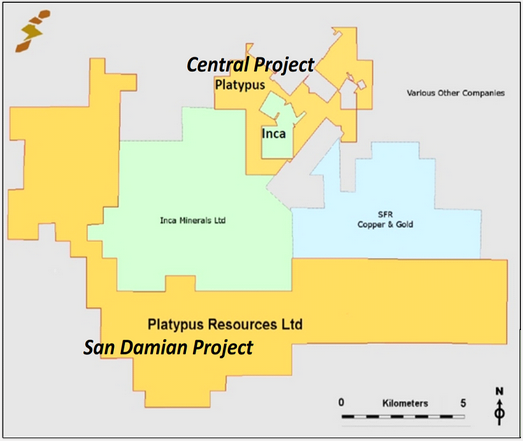
We hold rights to 15 concessions covering around 3,450 hectares in the central Chanape area of the San Mateo Mining District in Peru, located some 100 kilometres east of the capital Lima.  We also hold in our own right a further 20,000 hectares of regional ground surrounding the Chanape area.

That is augmented by our Gobbos project where we are chasing copper-molybdenum-porphyry-style mineralisation in the Archean of Western Australia.

Of the two which is your priority project?

The Peruvian project has the greater potential, while the Gobbos project is more advanced at this stage and we have just completed a three-hole 750m reverse circulation drilling program there.

Hopefully that drilling will provide an indication of whether porphyry-style mineralisation is getting stronger at depth beneath the mineralised brecciated basalt.  We’ve drilled to around 250 metres depth, but there is a possibility we may need to go deeper.

But the bigger picture potential is significantly greater in Peru by virtue of the fact it is a proven copper district with number of world-class billion tonne-plus copper porphyry deposits in the belt where we are exploring, with all of the world’s major copper miners active in the belt.

So what are the plans for the projects in Peru?

In order to fund all of our exploration work we currently have a rights issue in place looking to raise $1.6 million, which will be then primarily applied to exploration in Peru.

The first stage of that campaign will be ground-based work such as mapping, geochemistry, and rock chip sampling, augmented by acquisition of geophysical and remote sensing data.

Our ground is Peru is in a long-standing artisanal mining district where mining has concentrated on small tonnage vein-hosted mineralisation by non-mechanised methods.

However, what has now been confirmed in the district is that this mineralisation is being driven by an underlying porphyry mineralised system – and this is where the real excitement lies, as these deposits are typically very large and high value, the discovery of which would totally re-rate the company.

Has there been any exploration of note carried out by other companies in the area?

Our ground surrounds a small 800 ha holding being explored by ASX-listed Inca Minerals.  Inca has drilled several 600 metre – 800 metre holes that intersected porphyry-copper mineralisation.

Their best result was 284m at 0.32 per cent copper, which is open-ended at beyond 800m depth.

How is Inca Minerals’ drilling a good result for Platypus?

Because that landholding is so small and narrow, and because we hold all the ground totally surrounding it, anything they find is bound to extend into our ground.

In order to exploit anything they find through an open pit operation they would need to cut into our ground. So anything they find is to our benefit.

But more importantly, our central project is four times larger and we have a number of targets totally within our ground, and not dependent on the Chanape deposit. What we’re aiming to do now is to carry out the lead-up work on those targets immediately after the current fundraising.


So how do you see 2015 shaping up for Platypus Minerals exploration wise?

Assuming we satisfactorily complete the rights issue, we will be on the ground in Peru in the first quarter of 2015 conducting the ground-based first phase of work.

Once we have those results we’ll be able to hone in on our drilling targets such that by mid-year we’ll have all the permits in place to commence drilling of the optimised targets.

Any particular target putting its hand up yet?

We want to drill one prospect in particular called Shullac, which is a historical lead-zinc-silver mine with intense wall-rock alteration and adjacent breccias.

We know that where Inca has drilled beneath a breccia they have hit mineralisation, so we have all the indications that Shullac is a must-drill target.

Furthermore, we believe Shullac sits in a structurally uplifted block such that any underlying porphyry should be much closer to surface than the deep porphyry at Chanape.  But, we need to drill to confirm this.

The drilling phase always brings the most excitement, so we’re really looking forward to putting some holes into Shullac!


Website: www.platypusminerals.com.au

Friday Flashback

THE WEEKLY WRAP: The S&P 500 and Dow Jones ended last week on a positive note, recording their seventh straight week with gains.

The Aussie market took heart from this and began our working week in fine fettle to open up with a smile, although the resources sector let Team Australia down again to be the weakest link after further falls in commodity prices.

Banking stocks led the way with investors happy with former Commonwealth Bank boss David Murray’s final report into the financial system.

The bad news for the day came from the Aussie dollar, which nose-dived to fresh four year lows on the back of better than expected United States jobs data and disappointing Chinese trade figures.

Tuesday sounded more like a Coles commercial with Status Quo singing ‘Down, Down, Deeper and Down’, across all sectors.

The fall in the oil price continued to give energy stocks a tough time.

Sponsoring Queensland police cars didn’t stop oil giant Santos (ASX: STO) shares dropping 60 cents to $7.70, while Woodside Petroleum (ASX: WPL) lost $1.01 to $34.38, and Oil Search (ASX: OSH) lost 56 cents to $7.29.

The iron ore price kept its recent form resulting in falls to BHP Billiton (ASX: BHP) losing $1.22 to $28.88, Rio Tinto (ASX: RIO) dropping $1.63 to $55.50, and Fortescue Metals (ASX: FMG) casting off 11 cents to $2.55.

Medibank Private (ASX: MPL) gained 3 cents to close at $2.22, which probably had nothing to do with the Abbott Government deciding to drop its $7 co-payment budget proposal straight onto the hunched shoulder of the nation’s clinician community by hurriedly converting it to a $5 charge for non-concessional patients at the discretion of GPs.

Waking on Wednesday we learnt the Greek market had crumbled like fetta cheese after the country’s government announced an early election.

One can only imagine what the reaction to the local market would be if Tony Abbott took a sudden short drive to Yarralulma.

Nevertheless the local market was a bit skittish on the news and a fall in consumer sentiment in the lead up to Christmas isn’t helping anybody either.

Any mention of Greece tends to shake up local bank stocks and they performed accordingly with Westpac (ASX: WBC) down 54 cents to $32.52, ANZ (ASX: ANZ) dropping 39 cents to $31.49, National Australia Bank (ASX: NAB) lost 30 cents to $32.30.

The only one to go the other way was the Commonwealth Bank (ASX: CBA), which deposited 33 cents to close at $82.35.

The slippery environment appeared to be good for gold miners, which did well following a rally in gold prices.

Newcrest Mining (ASX: NCM) was up 21 cents to $10.49 and Northern Star Resources (ASX: NST) was nine cents shinier at $1.26.

The local market opened yesterday morning and was immediately dragged down by oil stocks suffering under five year low prices.

The day didn’t get any better from there with resources stocks joining the fray as most commodity prices also went down.

BC Iron (ASX: BCI) became the latest iron ore producer to cull its workforce by announcing it will cut staff at its Nullagine mine in Western Australia and head office as it reduces costs.