Drake Resources secures Norwegian rights

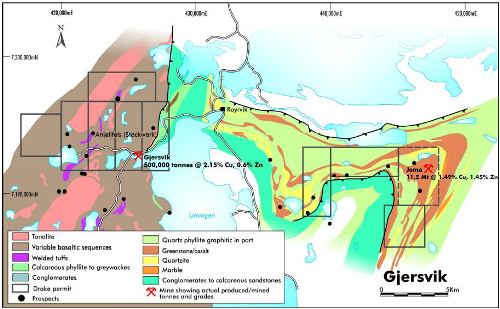
THE BOURSE WHISPERER: Drake Resources has acquired exploration rights to around 100 square kilometres of prospective copper and zinc ground in the Grong District of Nord Trondelag in Norway known as the Gjersvik project.


Drake claims relative to geology and mine locations Joma
Naeringspark claims outlined with dashed line. Source: Company
announcement


The company said the main reason it was attracted by the project was that the rights are located in a proven mining area, are close to infrastructure and have not had the benefit of modern exploration technologies.

The acquisition is in line with the company’s strategy to build a portfolio of precious and base metal resources in Scandinavia.

The rights include nine 100 per cent Drake claims, including the historic Gjersvik mine, as well as an Exploration and Exploitation (Mining) Agreement over the Joma mine, which closed in the 1990s.

“The Joma-Gjersvik project provides an exciting addition to Drake’s portfolio of advanced projects in a proven and not fully exploited mining district,” Drake Resources managing director Dr Bob Beeson said in the company’s announcement to the Australian Securities Exchange.

“We are happy to be working closely with the local community.

“Our joint strategy is to discover deposits, using Drake’s expertise and modern technologies, which could support a new project development in the highly prospective region.

“Our exploration programs’ aim is to add to the considerable mineralisation left in the mine when it closed due to low copper prices.”

The Exploration and Exploitation Agreement has been signed with Joma Naeringspark (JN), the commercial branch of the Røyrvik Commune and the owners of two claims which contain the Joma mine/project.

Under the terms of the Exploration and Exploitation Agreement with Joma Naeringspark, Drake will have an exclusive right to explore the claims to end 2015 and will:

–    Pay Norwegian Kroner (NOK) 75,000 (~A$13,000) to JN on signing the agreement and commit to a NOK 250,000 (~A$42,000) exploration program in calendar 2012 on the two JN claims, commencing with a helicopter borne aeromagnetic survey in August 2012;

–    Have the right to withdraw from the agreement at the end of 2012 or anytime thereafter;

–    Undertake, should it commit to continue, to pay NOK 75,000 to JN at the start of each calendar year to end 2015 and spend NOK 750,000 (~A$130,000) on exploration in each year to end 2015;

–    Undertake to employ locally where possible; and

–    In December 2015 Drake can exercise a right to apply for an extraction licence in its sole name in exchange for a one per cent Net Smelter Return royalty payable to Joma Naeringspark.

Neil Marston – Horseshoe Metals

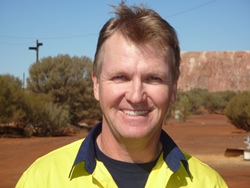
Horseshoe Metals managing director Neil Marston called in this week on his way home from the company’s Horseshoe Lights project.


Neil, in real estate parlance, your two projects, Horseshoe Lights and Kumarina, are located in a, ‘much sought after neighbourhood’. Was that a deliberate choice?

I have actually been involved with the Horseshoe Lights project on and off for around 25 years.

I’ve know that area a long time. Over the last 15 years exploration activity slowed up in the region. However, I still considered Horseshoe to have some potential – come the right time.

The opportunity presented itself to pick it up – it was sitting with Grange Resources who I had worked with in the past. Their shift of focus to iron ore resulted in them selling off the project.

Within the portfolio Grange sold were Horseshoe Lights and Kumarina.

Of the two projects did Horseshoe Lights immediately emerge as the company’s main focus?

When we acquired the project, we had to ascertain whether it was a ready-to-mine project or not.

We conducted scoping studies before we listed the company on the ASX and we decided there was some work required to get it to the point where we could say it was ready to get back into production so that has been our primary focus since listing.

However, with Kumarina we saw it as a being an interesting area, which had not been subjected to any significant exploration.

There was the existence of the old Kumarina copper mine where old-timers had proven to be pretty good at sniffing out copper. Where they had been able to mine and produce high-grade copper we felt there was potential there for us to do the same.

What gave you that confidence in the project’s potential?

We felt by employing the right exploration techniques it could be worth having a crack at.

So before we listed we saw Horseshoe Lights as being the stable, flagship project with Kumarina being more of a blue sky opportunity.

You have announced a recent run of drilling results, what have they told you about how the project is progressing?

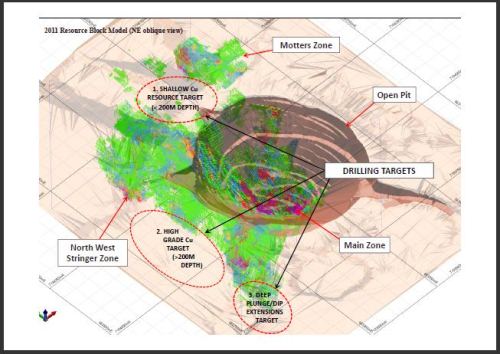
We’re trying to gain greater understanding of what is going on at the north end of the existing pit at Horseshoe Lights, underneath an old waste dump.

We have a specialised drill rig, called an Aardvark Rig, which is a rig that is capable of drilling horizontally.

We have been drilling shallow-angled holes under the waste dump to follow up drilling we conducted after we listed that encountered good intersections of mineralisation in what we call the Northwest Stringer Zone.

We want to test the up-dip potential of those earlier copper hits because, obviously, the shallower we can identify the mineralisation the greater the chance we have of fitting it into an enlarged open pit outline.

Why are you so focused on a waste dump?

People do wonder why the original operators put the waste dump where it is, but if you look at their actual tenement holding at the time, they had a very small parcel of gold mining leases and they were surrounded by other tenement holders so they basically had nowhere else to put it.

The dump was sited in 1985 when the mine was operating as a gold mine so they only sterilised for gold under the waste dump.

Some of the logs and geologists’ notes from the time identified the presence of copper so we want to get a good understanding of what’s going on under there, simply because it is such a shallow zone of potential mineralisation just sitting to the north of the pit.

So you’re at that stage with the drilling. Where to from here?

What we are doing is testing towards the southern end of the waste dump, trying to understand what is happening as close to the pit as possible.

We also have the Motters Zone on the eastern side of the pit, where earlier drilling has indicated a shallow copper oxide zone at surface.

So what you are looking for is an idea of where you are able to extend the existing pit?

That’s right. What we are trying to do is take our current JORC mineral resource estimation, which is 8.6 million tonnes at 1.06 per cent copper and 0.13 grams per tonne gold and fill in our block model with shallow material providing the economics to allow us to take the pit down another 50 to 60 metres into the high-grade zone that exists at the bottom of the existing pit.

We are also looking at chasing shoots of higher-grade mineralisation that could potentially be part of an underground story as well.


However, as the project is shaping up at the moment we have an oxide component that is relatively shallow at the surface. We then get down to the fresh, sulphide material in the high-grade Main Zone and we also have shoots of higher grade material at depth.

All those things are still in the mix, so we’re just drilling as much as we can in order to build the inventory up over the next few months.

That’s Horseshoe Lights, what about Kumarina?

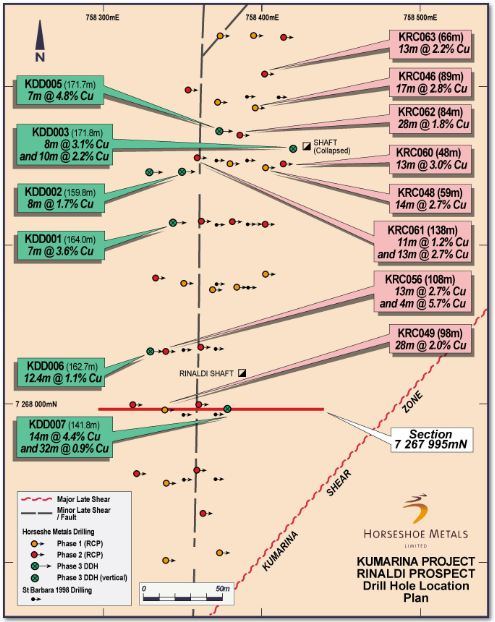
Kumarina is interesting because the grade is such and the depth is such that it looks very encouraging. We are hitting numbers like 13 metres at 3per cent copper from just 10 metres downhole.

We have drilled around the old workings at the Rinaldi Prospect and have extended a zone of mineralisation to around 300 metres.

It appears to be steeply dipping and structurally controlled and the good thing is that there are lots of similar structures on the tenement.

Our plan is to go back and drill out Rinaldi to work up a JORC resource number there as well as test a few areas where we had some drilling success last year.

The results you have achieved so far, have they been a pleasant surprise or pretty much what you were anticipating to see?

We were following up some previous aircore drilling carried out by St Barbara at Rinaldi with RC drilling and achieved better results than they had, so we have been happy with what we have seen.


So your generally happy disposition is well justified?

I think so. The best place to find copper is near where it has been discovered in the past and geological mapping we had done earlier this year impressed the geologist who was conducting it.

I consider the potential for this particular area to be good and, despite people predicting Australia is going to run out of new ore bodies, it just confirms to me that we really have only just scratched the surface.

What would you like to be telling the market by the end of the year?

By the end of the year we should be in a position to run a JORC resource calculation on Rinaldi. At Horseshoe we should have pretty much drilled out the northern zone to the point where we can recalculate our resource numbers there as well.

We also have some targets to the west and within the southern area at Horseshoe Lights, where we are trying to locate repetitions of the Main Zone.

We are currently conducting a comprehensive geological modelling exercise on all of our drilling data and we will be doing more in-pit mapping in September.

That should lead us to doing some deep targeted drilling later in the year.

Once we have an update of the Horseshoe JORC resource, we’ll run some economic appraisals on that and if it looks alright then commence the feasibility process from there.

Recent BHP and Rio presentations highlight rosy fundamentals of copper

As I’ve been at pains to point out, despite all of the doom and gloom pervading the resource sector at present, one thing for sure is that there are a host of supply-side factors that will ensure that commodity price remain robust over the medium to longer-term.

Gone are the days of steadily declining commodity prices as a result of new, lower-cost developments and efficiencies through new technologies.

The big issue in mining these days is the fact that pretty much all of the low-hanging fruit (in the form of easily accessible, large-scale, high-grade deposits) have already been identified and mined.

To get their hands on world-class projects, the world’s heavyweight miners these days have to head for less-friendly parts of the world where political situations are uncertain and infrastructure challenges are immense.
 

Even formerly ‘mining-friendly’ destinations like Australia and Canada have become less so – meaning miners have to factor in a whole new range of risk factors when assessing new project developments.

At the end of the day this means mining companies will justifiably seek higher prices for their products before committing to higher risk, higher cost developments.

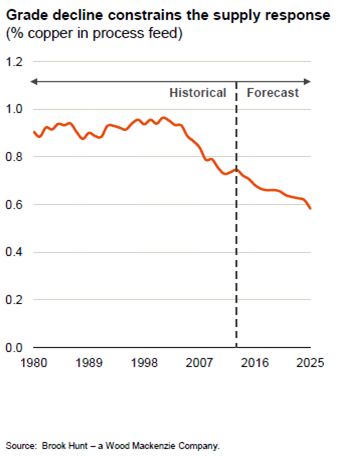
If we turn our attention to copper, head grades are declining alarmingly at virtually all of the world’s major copper mines, forcing up production costs and negatively affecting output.

The average head grade at the world’s major mines has fallen by around 20 per cent over the past decade, meaning miners have to dig 20 per cent more earth just to maintain production levels of a decade ago. And the grade decline is set to continue.
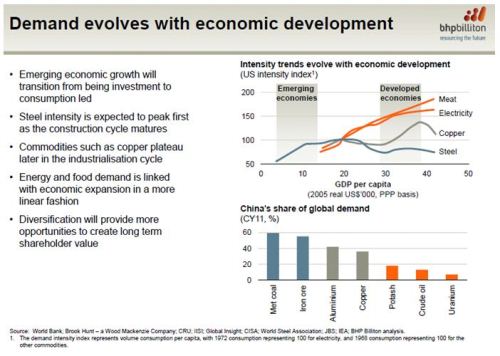
 

The second slide from BHP’s recent copper presentation highlights the change in economic growth as economies mature.

It’s already happened in most Western economies like the USA and Europe, where by growth evolves from being predominantly investment-related to more consumption-generated.

From the charts above, the intensity of copper use increases when economies like China’s begin to evolve from being heavily investment-driven (as they are now) to being more consumption-driven.

This occurs as citizens in emerging economies seek the sorts of lifestyle objects (motor vehicles, household white-goods, electronic items, etc.) that we take for granted.

Irrespective of near-term fluctuations due to market sentiment, copper consumption is set to continue rising strongly in emerging economies like China, Brazil and India.

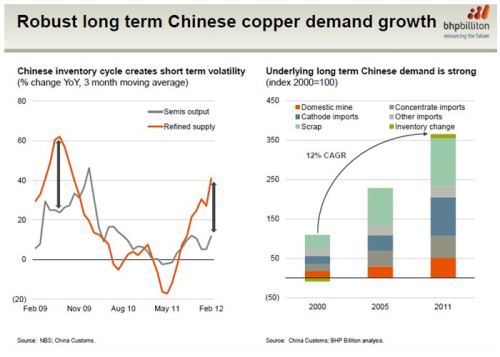
For the first five months of 2012, copper imports by China increased by 52 per cent year-on-year, as demand for the red metal continued to soar.

Chinese demand is likely to pick up during the coming months as authorities seek to stabilise the economy with new infrastructure measures.

New home appliance and car purchase subsidies currently under consideration in the country should help support copper demand.

Chinese buying helped copper prices surge some 140 per cent last year.

Prices are bound to move into positive territory, though most of the copper that China imported in May went for inventory build-up.

In 2011, China accounted for nearly 40 per cent of the 19.74 million tonnes of refined copper used worldwide.

Brazil too has emerged as a growing user of copper.

From 2002 to 2008, per capita copper consumption in Brazil increased 50 per cent to 2.1 kilograms, approximately 30 per cent higher than the country’s GDP growth in those years.
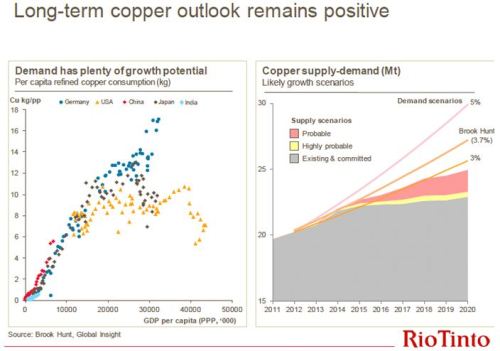
 

The graphic from Rio Tinto’s recent base metals presentation tells a similar story to that of BHP. Intensity of usage is rising rapidly amongst the world’s emerging economies.

Interestingly too, the head of Xstrata’s copper unit Charlie Sartain commented recently that despite the European situation, the fundamentals remain the same for copper.

“There’s still strong demand for copper in China and we’re seeing a slight recovery in the US economy,” he said.

It also has supply challenges of its own, with its copper output likely to dip slightly during the first half of the year as the world’s No 3 copper mine, Collahuasi, in which it has a stake, battles declining ore grades.

The annual CESCO week copper conference recently put No.1 producer Chile’s woes firmly back in the spotlight.

The truth is that there are no easy fixes for tumbling ore grades at massive mines in northern Chile, along with protests over key energy projects that are threatening mining expansions.

While Chile continues to produce a third of the world’s copper supply and holds an estimated 28 per cent of global reserves, the nation needs to fight on multiple fronts to boost annual output to the over 7 million tonnes it aspires to produce by the end of the decade.

“We’re frankly at a very delicate moment, especially in terms of energy,” Joaquin Villarino, head of the country’s Mining Council that represents Chile’s biggest miners, said at the forum on energy.

“If we’re not able to solve several problems, mining isn’t going to develop in the country or it will develop less than we would like.”
 

With no significant deposits slated to come on-line this year, so-called “strike season” yet to kick off in Chile and both Xstrata and Rio predicting ebbs in their production during the first half of 2012, Chilean miners are predicting tight supply will offset any Chinese slowdown.

Codelco has an ambitious plan to boost its annual output to 2.1 million tonnes by 2020, but forecasts a slight ebb in production this year.

Chile is seen attracting $1 billion in mining investment through 2020, but some analysts have questioned that figure as overly upbeat.

Last year Antofagasta Minerals launched its flagship mine Esperanza, one of the few promising deposits to come online in a copper market defined by its scarcity of new projects.

But Esperanza has disappointed, contributing to Antofagasta missing its 2011 copper output target and factoring into their veteran CEO Marcelo Awad’s abrupt resignation earlier this year.

Few deposits are more emblematic of Chile’s potential decline than its massive but tired, water-short and energy-strapped copper mines in the mineral-rich Atacama Desert.

Codelco’s century-old, behemoth Chuquicamata mine has seen its output drop from 528,000 tonnes in 2010 to 443,000 tonnes last year, chiefly on grade woes.

At the end of the day, it’s important to try and remain calm and ignore the frenzied headlines of negativity that one is currently exposed to on a daily basis.

Remember that the world is on an inexorable growth path, led by China and a host of other emerging economies, as the world’s population surges past 7 billion.

Commodity demand will remain robust for decades to come.

Both BHP Billiton and Rio Tinto remain confident about the long-term outlook for copper despite the current market pessimism.

The near-term issues that are impacting miners on a day-to-day basis are actually providing a solid platform for even higher commodity prices in the future.

So continue to retain your perspective, even when everyone else is losing theirs.

Gavin Wendt is the founder of MineLife, publisher of the MineLife Weekly Resource Report


Pioneer Hits High Grade Gold at Juglah Dome

THE DRILL SERGEANT: Pioneer Resources has announced that the recent rotary air blast (RAB) drilling program at its 100 per cent-held Juglah Dome Gold Project has successfully identified two new prospects for further drilling: Moonbaker  and John West.

Work earlier this year at the Juglah Dome Gold project included a 4,500 sample soil geochemistry program, resulting in the identification of Moonbaker and John West as priority targets.

During June 2012, Pioneer drill tested the targets and three other anomalies with 149 RAB drill holes (3,197 metres).

Moonbaker results included 3 metres at 18.0 grams per tonne gold from 9 metres, within a broader intercept of 12 metres at 5.4 grams per tonne gold.

This hole was drilled to a depth of 21metres with the last assay being 3 metres at 2.2 grams per tonne gold.

At John West, the combination of geochemistry and mineralised drill holes has defined a target with a strike length of 900m.

Previously, gold nuggets and gold-bearing quartz veins had been located at the John West prospect.

“Intersecting 3 metres at 18 grams per tonne gold close to surface is an exceptional outcome, but all results above 0.5 grams per tonne gold are very significant from this type of work,” said Pioneer’s managing director, David Crook in the company’s announcement to the Australian Securities Exchange.

More RAB drilling will be undertaken in the current quarter to outline the full extent of the anomalies.

“At that point we can plan a more targeted and systematic reverse circulation (RC) drilling program with a view to defining a commercial gold deposit,” added Crook.

The Juglah Dome Gold Project is located 58 kilometres southeast of Kalgoorlie, Western Aaustralia and some 5 kilometres southeast of the Majestic Gold deposit, owned by Integra Mining.

The project is also 25 kilometres east of Pioneer’s Golden Ridge Gold and Nickel Project.

Sandfire signs first copper concentrate contract

THE BOURSE WHISPERER: Sandfire Resources has signed the first sales contract for copper concentrate to be produced from its 100 per cent-owned DeGrussa Copper-Gold Mine in Western Australia, marking another key milestone ahead of the start of plant commissioning later this quarter.

Sandfire is aiming to finalise product sales agreements with four concentrate customers for up to three-year terms to cover the majority of its annual concentrate production, while allowing for delivery of a targeted 10-15 per cent of production into the spot market.

“The premium quality and grade of its concentrate has resulted in strong market demand from potential customers predominantly in the Asian region, enabling the company to obtain superior smelter terms including discounted treatment and refining costs,” said Sandfire’s managing director, Karl Simich in the company’s release to the Australian Securities Exchange.

“We are looking forward to concluding the remaining contracts over the coming weeks, ahead of the anticipated commencement of concentrate deliveries,” he added.

Degrussa copper mine location. Source: Company announcement

Product sales agreements are already in place for all of the high-grade chalcocite Direct Shipping Ore currently being mined and shipped from the open pit mining operation at DeGrussa.

Over 30,000 tonnes of massive sulphide ore grading 5 per cent copper has been mined from underground and stockpiled on the ROM pad ready for plant commissioning.

Talisman confirms VMS mineralising at Halloween

THE DRILL SERGEANT: Talisman Mining has announced that initial results from recently completed diamond drilling at its Halloween Project, located 11.5 kilometres south-west of the high-grade DeGrussa VMS Copper Project in WA, have provided strong evidence of the presence of a VMS mineralising system.

The drilling results have returned a series of significant high-grade gold, copper and silver assays, including individual intersections of up to 9.79 grams per tonne gold and 2.62 per cent copper.

“The combination of high-grade gold, silver and copper intercepts, significant pathfinder elements and the geology we are seeing in the drill core gives us great encouragement that we are in the right location and applying the correct techniques and approach to make a potential discovery,” said Talisman’s managing director, Gary Lethridge in a company announcement to the Australian Securities Exchange.

Halloween Drilling Update

Three diamond drill holes were recently completed to:

    •    test the prospective volcanic horizon for VMS mineralisation associated with the high-grade gold 
intercepts below HRC002; and

    •    target a late-time Fixed Loop electromagnetic (FLEM) anomaly located 250 metres along strike and to 
the west of HRC002.

The better gold and silver results are associated with sulphide bands in HWD004 and include:  

 •    4 metres at 5.34 grams per tonne gold, 3.12 g/t silver from 297 metres (including 1 metre at 9.79 grams per tonne gold, 6.54 grams per tonne silver from 299 metres);

    •    1m at 2.04 g/t gold from 288 metres;

    •    1m at 1.11 g/t gold from 281 meters; and

    •    2m at 0.99 g/t gold from 253 metres.


Simplified geological plan with drill hole locations showing significant mineralised intercepts. Source: Company announcement

In addition to copper, gold and silver, the zinc, selenium, tellurium, molybdenum and bismuth values are consistently elevated, consistent with the geochemical signature associated with the nearby DeGrussa VMS high grade copper- gold deposit.

Talisman is farming into a 60 per cent joint venture interest in the Halloween West JV Copper Gold Project from Chrysalis Resources.

Halloween West is located immediately to the west of the 100 per cent-owned Halloween Project and is interpreted to host the continuation of the Halloween VMS trend.

Talisman has recently completed a detailed 100m x 25m soil geochemical program (totalling 1,455 samples) covering the portion of the Halloween West JV Project immediately along strike of the Halloween VMS horizon with assay results from this program pending.

The company will shortly undertake detailed geological mapping and an extension of the Halloween FLEM survey at Doolgunna West in order to better define prospective stratigraphic horizons across the project and to assist in targeting future RC drilling later this year.

Canyon discovers parallel structure on Tao project

THE DRILL SERGEANT: Canyon Resources has announced initial auger soil sampling and RAB (Rotary Air Blast) drilling results from exploration conducted on the Tao Project.

Initial results from the programs, extensions of the previously announced 3.1 kilometre strike on the Tondoby Prospect, have indicated that the mineralisation extends to over 12 kilometres and remains open along strike in both directions along the main structure.

A second parallel structure has also been delineated by the auger drilling, with gold anomalism extending over 5 kilometres and remaining open.


During the current exploration season, 171 RAB holes were drilled for more than 6,000 metres, focusing on testing the strike to the north and south of the Tondoby Prospect. 

An auger soil sampling program of over 6,000 metres has also been completed over further areas to the south of the Tondoby Prospect to provide additional targets for drilling.

Initial results have indicated that the mineralisation extends over 9 kilometres further to the south and remains open.

Canyon is awaiting the return of a large number of RAB and auger results from this campaign, and will report these as they come to hand.

Following assessment of all RAB and auger results, the company will design an aggressive drilling campaign for the new exploration season scheduled for late 2012.


Canyon Resources project areas over Burkina Faso regional interpreted geology map. Source: Company announcement

Taparko North Project

At the end of May 2012, the company had completed a 6,019 metre RAB drilling program over 323 holes on the 10 kilometres long CS prospect gold anomaly focussing on the 4 kilometre higher grade zone within the prospect.

The company is waiting on assay results from this program.

Following the drilling of the CS Prospect, the RAB rig was shifted to the copper/zinc targets on the Karga Prospect, also part of the Taparko North Project.

A 4,360 metre program has been completed and XRF multi-element analysis is being undertaken on the samples prior to assaying.


“Canyon is conducting its most active field season since its IPO, and we are pleased to be able to release the first of what will be a substantial quantity of assay information which will help us to build our geological understanding of our projects and assist in planning the next round of drilling'” said Canyon’s managing director Phil Gallagher.

“We are very pleased with these initial results from the Tao Project, and we remain highly encouraged by what we are seeing across our entire Burkina Faso portfolio of assets,”
 added Gallagher.

Exploration success for Senex

THE BOURSE WHISPERER: Senex Energy, as operator of the PEL 111 joint venture, advised the Australian Securities Exchange today that the Mustang-1 oil exploration well has discovered a new oil field on the western flank of the Cooper Basin, South Australia.

According to Senex’s ASX release, the new oil field is an excellent quality reservoir with highly permeable oil filled sands.

The Mustang-1 oil exploration well was spudded on 4 July 2012 and reached a total depth of 2,123 metres on 12 July 2012.

Wire line logs confirmed the presence of a 4.5 metre gross oil column in the oil-bearing sands of the mid-Birkhead Formation over the interval 1,787.0 to 1,791.5 metres with an interpreted net oil pay of 4.0 metres.

A Drill Stem Test was conducted between 1,784.8 and 1,791.5 metres with the well flowing oil to surface after 23 minutes.

Continued flow at surface recovered 34.5 barrels of 45.4 degree API oil with no water from a 20 minute flow, equivalent to a rate of 2,484 barrels of oil per day.

The well will be cased and suspended as a future oil producer.

Location of Mustang-1. Source: Company announcement.

“The exploration success at Mustang-1 has significantly exceeded our expectations.”

“To achieve a free flow production rate of almost 2,500 barrels of oil per day is an outstanding result, and is analogous to the excellent results seen at the highly productive Growler oil field,” said Senex managing director, Ian Davies.

Senex holds a 60 per cent interest in PEL 111 and is the operator of the joint venture.

The remaining 40 per cent interest is held by Beach Energy.

Toro confirms high-grade uranium at Theseus

THE DRILL SERGEANT: Toro Energy has announced the completion of the recent drilling program at its 100 per cent-owned Theseus Uranium Project in Western Australia.

Theseus is developing into a major uranium discovery, potentially mineable with low cost In-Situ Recovery (“ISR”) technology.

In 2012, a total of 122 mud rotary holes were completed for approximately 16,000 metres during the months of May and June.

Toro has now defined five kilometre-scale mineralised zones which are open in four directions at the regional scale.

Key highlights from this latest drilling programme include:

  • Confirmation of high-grade uranium zones within the Theseus Project envelope as currently defined, including 0.79 metres at 1.17 per cent pU3O8 from 124.32m in LM0175 [0.92 per cent GT];
  • Development of predictive “tools” to elucidate higher-grade mineralisation at the “nose” of individual roll-fronts, evidenced by the success of two specifically targeted drillholes;
  • LM168 reporting: 3.34m at  0.08 per cent pU3O8 from 106.47m [0.27%GT];
  • LM170 reporting: 1.09m at 0.11 per cent pU3O8 from 101.34m[0.12%GT].


Drill plan of the Theseus Prospect showing drillhole collars ranked by %GT, and updated mineralised footprint. Source: Company announcement

Toro is presently compiling all relevant geophysical and geological data and completing a comprehensive QA/QC review program designed to assist with producing an Inferred Resource estimation for Theseus in August.

“Drilling in 2012 has further strengthened Toro’s belief that the Theseus greenfields discovery could develop into a potential ISR operation in the future,” said Toro managing director, Greg Hall in the company’s announcement to the Australian Securities Exchange.

Winmar intersects high-grade iron at Hamersley

THE DRILL SERGEANT: Iron ore exploration company Winmar Resources announced Monday, July 16th that it has intersected high grade iron mineralisation from assay results from its latest phase of drilling at the Hamersley Iron project in the Pilbara region of Western Australia.

The Hamersley project is located in the Tom Price Region of the Pilbara, in close proximity to Fortescue Metal’s Solomon project and Rio Tinto’s Marandoo and Brockman mines.

Winmar completed a 20 hole, 4012m RC drill program and results from the first 11 drill holes have been received with significant intercepts intersected in seven of these holes, with higher grade and thicker zones in the northern part of the deposit.

CID mineralisation was intersected in new drill holes up to 800 metres from the current resource, with the project remaining open in most directions.

High grade intercepts include;

  • 28 metres at 57.03 per cent iron (60.63 per cent calcined iron) in PLRC0145
  • mineralised Channel Intersections Deposits (CID) zones of up to 90 metres at 51.63 per cent iron (55.98 per cent calcined iron) in PLRC0154 on the northern extent of drilling


Location of 2010-11 drill holes showing strongest iron grade and thickness. Source: Company announcement

A diamond drilling program has commenced to provide metallurgical samples from the CID material.

Assay results from the remaining nine holes will be released in due course.

“This phase of drilling is designed to deliver a significant resource upgrade, due in the third quarter, which will be used to provide an updated scoping study and in mining plans,” the company explained in its release to the Australian Securities Exchange.

The project’s current JORC Inferred Resource is 241.6 million tonnes at 54.3 per cent iron (which includes a main CID zone of 169.1 million tonnes at 55.6 per cent iron) and an Exploration Target of 350-400 million tonnes at 54-56 per cent iron.