Aruma hits new mineralised zones

THE DRILL SERGEANT: Western Australia-based gold exploration company Aruma Resources has identified two new mineralised zones on its tenements.

The company has returned anomalous gold intercepts from its Jundee South project located 60 kilometres east of Wiluna on the Jundee-Gourdis-Bronzewing trend in the Eastern Goldfields region.

It has also reported anomalous nickel and copper results at its Steeple Hill prospect at the Kurnalpi South project, situated within the Glandore Hub.
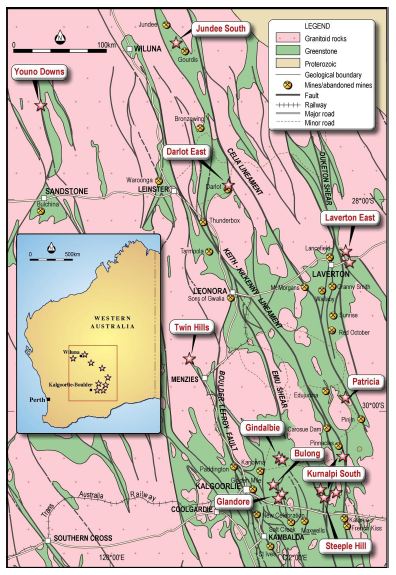
 

Aruma Resources project locations. Source: Company announcement

“The Jundee South project assays show two carbonate quartz alteration systems with the southern area over 1.6 kilometres long with mineralisation up to 16 metres thick,” Aruma resources managing director Peter Schwann said in the company’s announcement to the Australian Securities Exchange.

“The northern area is over 200 metres long and up to 12 metres thick.

“The anomalous intersections included 4 metres at 2.06 grams per tonne gold in Hole JS22 from 16 metres.
 
“The anomalous drilling results will be followed up after the four metre composites are re-assayed for one metre splits to better define the mineralisation.”

Assays from the Steeple Hill prospect returned:

–    3m at 0.21 per cent copper and 0.21 per cent nickel from 11m.

Aruma said the high copper values suggest Steeple Hill is a gossan rather than a lateritic nickel anomaly.

However, the results of the Steeple Hill drilling with respect to gold have resulted in Aruma designating the tenement to be of lower priority in the short term.
Blackthorn strikes wide copper mineralisation

THE DRILL SERGEANT: Blackthorn Resources is conducting a Phase 5 drilling program at its Mumbwa project in Zambia where the company is targeting a large Iron Oxide Copper Gold (IOCG) style of mineralisation.

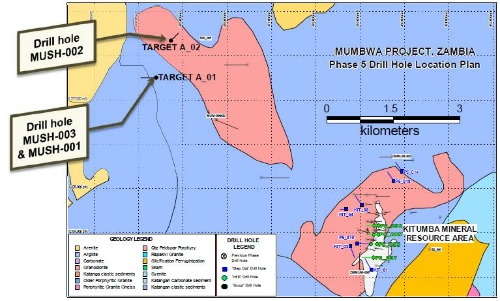
The Phase 5 program is planning to drill 16 targets over the company’s Kitumba mineral resource area, and two ‘scout’ holes on a geophysical target at Mutoya, which is located approximately six kilometres North West from Kitumba.

Blackthorn indicated it has received copper assay results from four drill holes, two located at Kitumba, and the other two at Mutoya, including high-grade copper mineralisation at Kitumba, and shallow-depth copper mineralisation at Mutoya.

Best intersections identified from Kitumba included:

(Inclined Hole)

–    222.3 metres at 2.15 per cent copper between 310 metres and 532.3 metres, including 37m at 5.19 per cent copper between 358m and 395m, containing 3m at 25.2 per cent copper between 384m and 387m.

(Vertical Hole)

–    11.8m at 0.29 per cent copper between 100.5m and 112.3m;

–    31m at 0.35 per cent copper between 138m and 169m;

–    27m at 0.45 per cent copper between 188m and 215m;

–    132m at 0.55 per cent copper between 277m and 409m; including 3m at 3.7 per cent copper between 279m and 282m and 4m at 1.8 per cent copper between 301m and 305m;

–    5m at 1.01 per cent copper between 343m and 348m; and

–    5m at 0.56 per cent copper between 429m and 434m.

Blackthorn completed scout drilling of a geophysical target at Mutoya ahead of the annual wet season, which returned some encouraging initial results.

These included the following intersections showing mineralisation at shallow depths:

–    39m at 0.44 per cent copper between 59m and 98m;

–    3m at 0.36 per cent copper between 106m and 109m;

–    37m at 0.46 per cent copper between 114m and 151m; and

–    4m at 0.71 per cent copper between 214m and 218m.


Phase 5 drill hole location plan for the Mutoya. Source: Company announcement

“Blackthorn Resources is delighted with the confirmation of more high-grade mineralisation in the Kitumba mineral resource area,” Blackthorn Resources managing director Scott Lowe said in the company’s announcement to the Australian Securities Exchange.

“The company will continue with work at Kitumba with the goal of achieving an upgrade in the JORC inferred mineral resource by the middle of the year.

“This work along with continued studies will further develop this project with a view to confirming economic potential and progressing along the project development pipeline.

“Blackthorn Resources is further motivated by the early results achieved at the Mutoya target area, which has revealed some positive indications that warrant further work.

“The shallow nature of mineralisation, albeit secondary in nature, together with the prospects of discovering a primary source to mineralisation provides an exciting back drop for future exploration.”

Exterra announces positive results from Zelica

THE DRILL SERGEANT: Exterra Resources has received results from drilling undertaken at the company’s Zelica gold project.

Best results from the drilling include:

–    7 metres at 4.90 grams per tonne gold from 26 metres;

–    4m at 5.35 g/t gold from 11m;

–    5m at 2.95 g/t gold from 37m; and

–    5m at 2.84 g/t gold from 69m.

The drilling was carried out at Zelica, located 20 kilometres to the North West of the company’s Linden project in Western Australia, throughout the months of November and December 2011.


Source: Company announcement


The program was aimed at confirming mineralisation below the current pit and extending and infilling mineralisation over the 400 metres to the north of the pit where prior drilling was intermittent.

The company said the grades reported from the latest drilling support previous drill results and remain relatively high for a vat leach style of project.

According to Exterra previous operators of the Zelica project had completed ground work including pre-strip on the 300m open pit mine, grade control drilling the base of the open pit ready for operation, construction of two vat leach ponds and drilled water bores.

“It is this level of preparatory work that has provided a strong foundation for Exterra to re-commence mining operations at Zelica, subject to regulatory approvals and resource confirmation,” Exterra said in its ASX announcement.

“In this regard, Exterra has applied to have the existing Exploration Licence (E39/1578) converted to a Mining Lease (MLA 39/1082), which is due for grant in the second quarter of 2012.

“The current results are being interpreted alongside previous drilling with the aim of providing an updated geological/resource model that will indicate where further drilling will be required.”

Exterra said it is scheduled to begin a 10 hole diamond drilling program in the first quarter of the year at the Second Fortune Gold Mine at Linden.

This drilling will be focusing on extending and upgrading the current Inferred Resource with drilling to 300m vertical.

Scandinavian updates exploration target at Altavaara

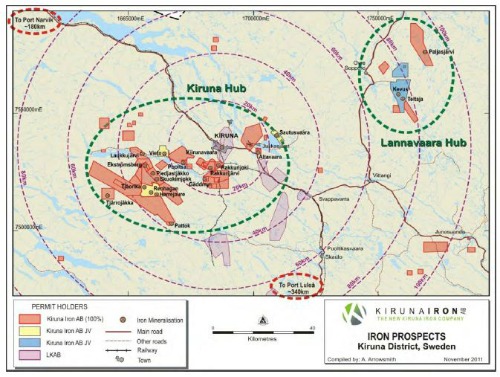
THE DRILL SERGEANT: Scandinavian Resources has informed the market of a JORC compliant Exploration Target update for the Altavaara prospect, which is part of the company’s Kiruna iron project located 1,300 kilometres north of Stockholm in Sweden.

Altavaara is one of a number of iron prospects within Kiruna Iron AB’s expanding Kiruna Hub.


Source: Company announcement


Scandinavian Resources said its concept for the Kiruna Hub is to develop a central facility to process ore from a number of satellite iron deposits located within 40km of the Kiruna mining centre.

The Altavaara prospect is located 15km south of Kiruna, 10km from rail and 650 metres from the road to Kiruna.

“The Altavaara prospect is shaping up to be a significant deposit within the Kiruna Hub,” Scandinavian Resources exploration manager Amanda Arrowsmith said in the company’s announcement to the Australian Securities Exchange.

“Measurements from the 13 diamond drill holes we have completed have increased the JORC Exploration Target to 55 to 60 million tonnes at 26 to 29 per cent iron, up from the previously reported 10 to 20 million tonnes at 23 to 30 per cent iron.

“This is the exciting part; the potential to significantly increase the tonnage within the Kiruna Hub is being proven by drilling the historical government iron occurrences which have until now been overlooked.”

Golden Rim hits good gold in Burkina Faso

THE DRILL SERGEANT: Golden Rim Resources has struck high-grade gold intersections from the third program of reverse circulation drilling carried out on its Balogo project in Burkina Faso.

The Phase 3 program comprises 30,000 metres of drilling with 61 holes completed so far for an aggregate of 7,658m.

Golden Rim has received assays for the first 13 holes.
 

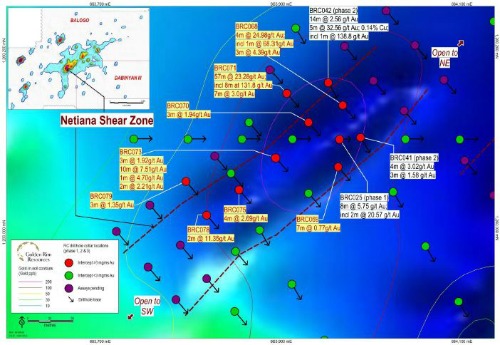
The company commenced its current program south west of the Balogo Hill prospect area, focussing around a newly defined structure, the Netiana Shear Zone.


Location of new gold intersections (red text) in the Netiana Shear
Zone at Balogo over an image of the ground magnetics which shows the
NE-SW-trending structure. Source: Company announcement


This drilling is following-up previous high-grade intercepts of:

– 8 metres at 5.75 grams per tonne gold; and

– 14m at 2.56 g/t gold and 5m at 32.55 g/t gold, 0.14 per cent copper.

Golden Rim said the mineralisation it has intersected appears to be associated with multiple sheared contact zones.

Gold intercepts of, what the company describe to be as, “significant grade gold intercepts”, have been obtained.

The company said it believes the mineralisation to be open to the SW and NE.

It has conducted further drilling along strike and is awaiting further assay results.

“The intercept of 57m at 23.3 g/t gold…is one of the best intercepts obtained in West Africa in recent times,” Golden Rim Resources managing director Craig Mackay said in the company’s announcement to the Australian Securities Exchange.

“We are particularly excited about the style of the mineralisation at Balogo.

“The high grades along with the association of significant magnetite with the gold and copper mineralisation are currently unusual in West Africa and we believe we may have uncovered an iron oxide copper-gold (IOCG) style deposit.”
 
Golden Rim is currently conducting a multi-element analyses program on a number of mineralised zones at Balogo to check if there are elements in addition to gold and copper that are anomalous.

The company said it is planning to mobilise a second rig to Balogo to commence diamond drilling on the Netiana Shear Zone.

Excelsior Gold expands potential

THE DRILL SERGEANT: Excelsior Gold has received assay results from a drilling campaigned it completed in December 2011 which focused on resource areas in the central portion of the company’s 100 per cent-owned Kalgoorlie North project.

A conceptual mine scoping study centred on the Excelsior Deposit conducted in September 2011 indicated the potential for large open pit development of the deposit as well as opportunities to mine other satellite deposits in close proximity to Excelsior.

According to the company results from the latest drilling program at the Excelsior gold deposit have potential to expand the conceptual pit design and demonstrates the significance and scale of the project area.


Excelsior Plan showing Drill Results and Conceptual Pit and Waste Dump Design. Source: Company announcement


New results received from outside of the current conceptual design include:

13 metres at 1.85 grams per tonne gold from 156 metres;

18m at2.97g/t gold from 81m;

7m at 1.90g/t gold from 20m; and

5m at 4.25g/t gold from 101m.

The Excelsior deposit hosts resources of 405,300 ounces of gold (9.72 million tonnes at 1.3g/t gold at 0.6g/t cutoff).

Six other satellite deposits within a four kilometre radius of Excelsior contain an additional 196,000ozs of resources.

Excelsior Gold said it has initiated a pre-feasibility study on the Excelsior area designed to evaluate a multiple open pit mining operation utilising heap leach and toll treatment processing options.

The company anticipates initial results from this study will be available in the second half of calendar
2012.

“The new assay results are predominately below the conceptual pit design and there is significant potential to increase the depth and length of the conceptual pit at the Excelsior deposit with the inclusion of these significant intersections,” Excelsior Gold said in its ASX announcement.

“A new resource model incorporating these results is in preparation to facilitate new mine design studies which will enable the company to commence sterilisation drilling and infrastructure planning to advance the development of the Kalgoorlie North project.”

Bassari hits more gold in Senegal

THE DRILL SERGEANT: Melbourne based gold explorer Bassari Resources has received initial results from a reverse circulation (RC) drilling program carried out during December 2011 at its Konkouto prospect in Senegal, West Africa.

According to the company the results have indicated a zone of gold mineralisation, which Bassari claims confirms the discovery of a new mineralised system.

The drilling program at Konkouto completed 25 holes for 2,025 metres of RC drilling.

 Significant intercepts based on assay results returned:

–    50 metres at 2.5 grams per tonne gold; and

–    20m at 3.0 g/t gold.

Bassari said it considers the drilling has confirmed an east-west trending mineralised zone over a strike length in excess of 600 metres, open in both directions and at depth.

The company has further drilling planned for Konkouto consisting of 12 holes for 1,000 metres to be conducted in the first quarter of 2012.

This will be undertaken once drilling of the Bennajiggi prospect in January has been completed.

The drilling at Bennajiggi will be testing east and west extensions of current mineralisation as well as targeting deeper mineralisation with diamond drilling.

The Konkouto prospect is located on the company’s prospective Moura Permit where it has identified seven quality targets.

It is situated 35 kilometres north east of the Makabingui project where Bassari recently announced an upgraded gold resource of 543,000 ounces (at a cut-off-grade of 0.2 g/t gold).

“Konkouto has advanced significantly since we first reported gold mineralisation back in September last year,” Bassari Resources managing director Jozsef Patarica said in the company’s announcement to the Australian Securities Exchange.

“The results of this program warrant follow up with more RC and diamond drilling which will commence this quarter.

“The wide mineralised intercepts confirm we are looking at a significant mineralised system.”

Discovery announces Maiden Resource

THE DRILL SERGEANT: Discovery Metals has reported an initial Mineral Resource estimate at the Selene deposit, located in north western Botswana.

The Resource calculation stems from the completion of 52 drill holes totalling 5,343 metres.

The Maiden Inferred Mineral Resource for the Selene deposit totals 16 million tonnes at 1.0 per cent copper and 15.9 grams per tonne silver, above a 0.6 per cent copper lower grade cutoff.

A number of higher grade zones of over one per cent copper were also identified within the Selene deposit.
 
“The Selene Mineral Resource estimate is another important step towards defining the ultimate scale of the Boseto copper project,” Discovery Metals managing director Brad Sampson said in the company’s announcement to the Australian Securities Exchange

“With recent drilling also returning encouraging results at the Zeta North East and the Mango prospects, the Selene Mineral Resource estimate confirms that substantial upside mineral resource potential continues within the Boseto Zone.”

Northern eyeballs Wolverine extension

THE DRILL SERGEANT: Diamond drilling being carried out by Northern Minerals at its Browns Range heavy rare earth (HREE) project in northern Western Australia has allowed the company to make visual observations and portable XRF measurements.

The company said the observations and measurements indicate an extension of the HREE mineralised zone to below 120 metres at the Wolverine prospect.


Wolverine Prospect – Drill hole location plan, Source: Company announcement


The first four holes, for approximately 714m of the 1,400 metre program, have been completed at Wolverine, testing the depth extent of mineralisation.

The drill holes were completed just prior to the Christmas break, with drilling set to re-commence early January.

Northern Minerals said it expects to receive laboratory assays in February, however all holes completed to date have visual indications of xenotime mineralisation and anomalous yttrium measurements recorded by a portable XRF.

Xenotime, an yttrium phosphate mineral, is the dominant HREE mineral identified at Browns Range.

Northern Minerals managing director George Bauk said the results the company had received so far continued to add to the potential of Browns Range, and the Wolverine prospect in particular.

“The diamond program is targeting areas identified by our RC drilling, and the first holes from the program have intersected the target and extended our known mineralised zone,” he said in the company’s announcement to the Australian Securities Exchange.

“The extended mineralisation of the Wolverine prospect, which has yet to be closed off, gives us even more confidence as we move toward definition of a JORC resource in the second half of 2012.

“We look forward to receiving further positive results from the program early in 2012.”

Monax identifies new Polinga anomaly

THE DRILL SERGEANT: Monax Mining has identified, what it describes as, a significant new chargeability anomaly, which the company considers could represent a newly-discovered manganese horizon.

The identification was made at the company’s Polinga manganese prospect, which forms part of its Waddikee project, located on Eyre Peninsula in South Australia.

Waddikee project, Eyre Peninsula, South Australia. Background image regional aeromagnetic data. Source: Company announcement

The anomaly was detected while Monax was conducting an expanded Gradient Array Induced Polarisation (GAIP) survey.

This survey followed an original GAIP survey that was planned to include only the area at Polinga where previous drilling was undertaken by Monax.

This had uncovered a chargeability anomaly on the northern boundary of the survey.

Monax decided to expand the GAIP survey northwards to further define the data it had collected.

The expanded IP survey has defined two major bedrock chargeable features which Monax considers may represent manganese mineralisation, enhancing the potential of the area.

“The new anomaly defined to the north of the previous drilling at Polinga represents a genuine target for manganese, and the next phase of drilling will target this feature,” Monax Mining managing director Gary Ferris said in the company’s announcement to the Australian Securities Exchange.

“The correlation between the previous drilling and the new IP data provides encouragement that this newly defined anomaly could potentially represent a new manganese horizon.

“The previous IP survey at our Hodgins prospect successfully showed the high grade manganese intersected in the drilling undertaken in April 2011 correlated with the GAIP chargeability response, providing a level of confidence for the new anomaly at Polinga.”

Monax is planning drilling to commence in late February based on the results of the IP surveys, with separate drilling programs scheduled for Monax’s Hodgins, Jamieson Tank and Polinga prospects.