Investigator continues to drill Paris

THE DRILL SERGEANT: Investigator Resources has received the first assays for a diamond and reverse circulation percussion (RCP) drilling program the company commenced late last year at the Paris silver prospect.

The company said assays for sections of the drilling demonstrate new intersections of high silver grades that continue to upgrade its greenfields silver discovery located on the Eyre Peninsula of South Australia.
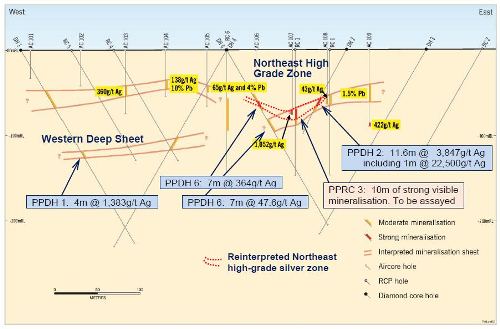
Paris prospect – Interpretive Section for Line 7. New intersections by
the recent diamond drill holes are shown in blue labels. Source: Company
announcement

Investigator claims the high silver grades confirmed the visual assessments of sulphide intersections the company reported to the market in January.

First assays for all three holes submitted from recent drilling on Paris Line 7 returned results including:
 
–    4 metres at 1,383 grams per tonne silver from 140 metres;

–    11.6m at 3,847g/t silver from 63.5m, including 1m at 22,500g/t silver from 66m; and

–    7m at 364g/t silver from 71m.

According to Investigator the silver intervals it has encountered on either side of the initial aircore intersection have confirmed the potential for a shallow high-grade silver target in the re-interpreted Northeast Zone of the Paris prospect.

“The assays were delayed beyond our expected timeframe due to the amount of re-assaying needed to get final silver values for our high grade samples,” Investigator Resources managing director John Anderson said in the company’s announcement to the Australian Securities Exchange.

“It was worth the short wait to get the result for our highest grade sample that at 2.25 per cent silver required assaying with a method usually applied to concentrate grade material.

“Our initial diamond drilling on the Line 7 section has been a great success with the first assays enhancing the potential for the large Paris prospect to produce coherent zones of high grade silver.

“The spectacular silver grades achieved by the new drilling so far have surmounted those of the widespread intersections by the prior aircore drilling.

“The Paris prospect continues to advance with each exploration step, a good indication at this early stage of drilling that the prospect has the potential to develop into a high quality silver deposit.”

GBM adds flavour to Milo

THE DRILL SERGEANT: Australian resources company GBM Resources has company’s told the market that recent drilling has expanded the copper zone at the Milo iron oxide copper gold, rare earth elements and yttrium (REEY) project in north- west Queensland.

GBM drilled three diamond core holes during December, which it claims has provided important additional information on the nature and extent of copper mineralisation at Milo.


Milo drillhole plan showing location of existing drillholes(recently completed holes in red). Source: Company announcement


The company reported that drillhole MIL011 intersected strong mineralisation downhole, with a 124 metres interval returning an average of 0.5 per cent copper equivalent from 82 metres, including 21 metres averaging 1.0 per cent copper equivalent.

GBM said this was confirmation a wide mineralised zone continues at least 80 metres beyond the previously announced drillhole MIL008, which had defined the northernmost extent of copper mineralisation in the central Milo prospect area.

According to the company initial indications from drillholes MIL012 and MIL013 (results pending) are that they have also intersected zones of mineralisation.

GBM has taken this to suggest the mineralisation may extend for a further 300 metres along strike to the north of MIL011.

Drillhole MIL011 also encountered several zones of Rare Earth and Yttrium  enrichment; including 27m and a 13m zone averaging 0.1 per cent Total REEYO.

GBM said the latest series of drillholes confirms the zone of sulphide mineralisation at Milo now extends at least 380 metres beyond previous drilling, representing a 70 per cent increase in the strike of drill tested mineralisation.

“Drilling has focused on confirming extensions of the known zone of breccia hosted IOCG style mineralisation beyond the 500 metres tested by drilling to date,” GBM Resources said in its ASX announcement.

“The company has previously estimated an initial Exploration Target of between 30 million tonnes and 80 million tonnes of mineralised material averaging between 0.8 per cent and 1.2 per cent copper equivalent for the Milo breccia hosted, polymetallic IOCG mineralisation.”

GBM has now commenced a scoping study which it expects to be completed during the June Quarter this year.

Ironbark hits home-grown high-grades

THE DRILL SERGEANT: Ironbark Zinc lifted its gaze from its Greenland activities to achieve some high-grade base and precious metal drilling results and strike length extension at its 100 per cent-owned Peakview prospect in New South Wales.

Significant intercepts from this program include:

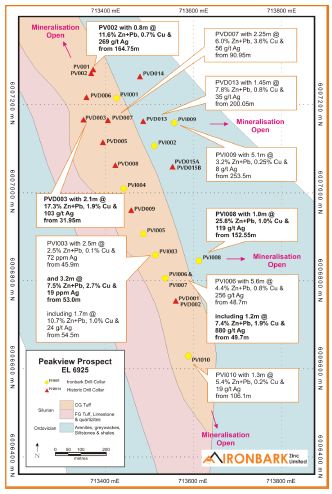
–    3.2 metres at 7.5 per cent zinc and lead and 2.7 per cent copper from 53.0 metres;

–    5.6m at 4.4 per cent zinc and lead, 0.8 per cent copper and 256 grams per tonne silver from 48.7m, including 1.2m at 7.4 per cent zinc and lead, 1.9 per cent copper and 880g/t silver from 49.7m; and

–    1m at 25.8 per cent zinc and lead, 1 per cent copper and 119g/t silver from 152.5m.

Dilling intercepts at the Peakview prospect, showing outcrop geology and collar locations. Source: Company announcement

Ironbark completed 11 holes for a total of 1709 metres during its 2011 drilling program at Peakview, which was designed to follow up on historic drilling.

Ironbark said it had confirmed the extension of the high-grade mineralisation both along strike and down-dip with the drilling targeting and intercepting shallow high-grade strike extensions.

“We are very excited by the results of our drilling program that has highlighted the economic potential of this project,” Ironbark Zinc managing director Jonathan Downes said in the company’s announcement to the Australian Securities Exchange.

“The results show a very extensive initial strike of mineralisation that now extends for at least 1.3 kilometres and remains open at depth.

“We still consider this “early days” and we will be planning further work in the near future.”

UXA commences Stuart Shelf drilling

THE DRILL SERGEANT: UXA Resources has commenced a drilling campaign at the company’s Stuart Shelf project.

The Stuart shelf project is located in the Olympic Dam-Prominent Hill area of South Australia.


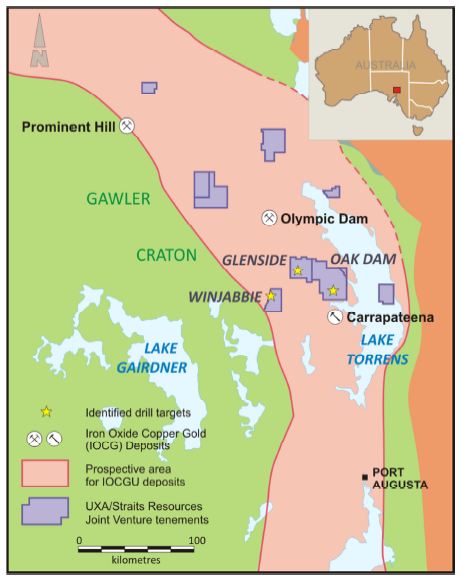
Project location. Source: Company announcement


UXA’s joint venture partner and project operator Straits Resources (Straits earning 70 per cent interest) has commenced a diamond drill program.

The joint venture comprises nine tenements covering some 3,300 square kilometres situated within the Olympic Dam-Prominent Hill area, which is renowned for its prospectivity for world-class copper-gold and uranium deposits.

The Winjabbie prospect is one of the joint venture’s drill targets.

Previous drilling carried out by UXA at Winjabbie intersected 42 metres at 0.34 per cent copper.

“Stuart Shelf is located in one of the most highly prospective regions for world class copper gold deposits in the world today, so we are excited to see drilling commence on the project,” UXA Resources managing director Dr Russell Penneysaid in the company’s announcement to the Australian Securities Exchange.

“This represents the second drilling program launched in the past two months for UXA, having commenced an eight hole Phase 2 drilling campaign at our flagship Dome 5 zinc lead silver prospect near Broken Hill, New South Wales in early December.”

Argonaut kicks off at Ban Klong

THE DRILL SERGEANT: Argonaut Resources has kicked off a 5,000 metre RC drilling program at the Ban Klong prospect, situated within the company’s Ban Bak project area on its Xekong concession in southern Laos.

The new drilling program is targeting gold mineralisation discovered by Argonaut last year through an exploration program of surface geochemical sampling, channel sampling and drilling.

“The exploration program is targeting replacement style gold mineralisation analogous in nature to mineralisation found at the Sepon gold mine in Laos and at the Carlin trend in Nevada, USA,” Argonaut Resources said in its ASX announcement.

In July 2011 the company announced that drilling at the Ban Klong prospect in the north-western corner of the Ban Bak area had intercepted:

–    6m at 26.2 grams per tonne gold from 22 metres, including 2 metres at 76.4 grams per tonne gold from 24 metres;

–     12m at 3.48g/t gold from 10m; and

–    8m at 4.45g/t gold from 0m.

“Ban Klong drill intercepts cited above may not represent the true widths of mineralised bodies,” Argonaut said.

“Additional drill hole data is required to properly determine the geometry and dimensions of any potentially economic mineralisation.”

Argonaut said the recently-commenced 59 hole program would be focusing on determining the geometry of the mineralisation the company intercepted by RC drilling in April/May 2011.

Once it has established the orientation of several known mineralised bodies, the company said the program will seek to define the approximate extent of the gold mineralisation.

Additionally, gold targets peripheral to Ban Klong that were defined by surface geochemistry during 2011 will be tested.

Central Asia hits gold in Kazakhstan

THE DRILL SERGEANT: Gold exploration and development play Central Asia Resources has received results of intersected gold mineralisation obtained during a diamond drilling campaign at the company’s Bizhe prospect in Kazakhstan.

Highlights of the drilling included:

–    7.4 metres at 4.80 grams per tonne gold, including 5.4 metres at 6.31 grams per tonne gold;

–    1.1m at 7.73g/t gold and 1.5m at 1.23g/t  gold; and

–    4m at 2.67g/t gold, including 2.0m at 4.67g/t gold.

Central Asia said mineralisation remains open at depth and along strike and the company has further drilling program scheduled for later in the year.

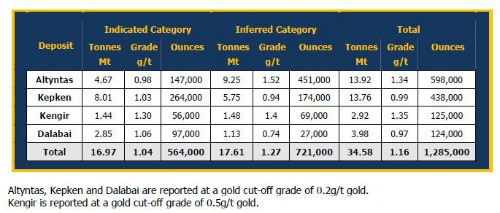
The company said it considers Bizhe has potential to provide feed and extend mine life at its Dalabai gold project.


Summary of Mineral Resource Estimates Reported according to JORC Category and Deposit. Source: Company announcement

“This was the company’s first drill program at its Bizhe prospect and was designed to confirm the encouraging results we had from earlier work” Central Asia Resources managing director Angela Pankhurst said in the company’s announcement to the Australian Securities Exchange.

The program comprised of 10 widely-spaced drill holes for more than 1,000m.

Central Asia had previously identified the surface trace of the main Bizhe ore zone, comprising pockets and lenses of high grade gold values that are in places up to 5m across, having carried out trenching and chip sampling techniques on the prospect.

These prior trenching results typically displayed gold assay values around 2.0g/t, and included:

–    9.0m at 5.23 g/t gold;

–    3.0m at 14.29 g/t gold;

–    6.0m at 2.74 g/t gold; and

–    4.0m at 3.76 g/t gold.

“These (latest drilling) results are very positive and confirm the presence of a number of intermittent gold values within a semi-continuous ore body,” Pankhurst said.

“They will be used to plan phased drilling program to substantiate a coherent body of ore that is sufficiently defined for mine-planning purposes.

“Bizhe is being appraised for its potential to be a feed source for Central Asia’s gold processing facility at Dalabai, less than 20 kilometres away, which is expected to start commissioning within days.”

Navarre intersects Tandarra mineralisation

THE DRILL SERGEANT: RC drilling being conducted by Stawell-based gold exploration company Navarre Minerals has hit 24 metres at 2.5 grams per tonne gold from a depth of 35 metres, including 3 metres at 10.9 grams per tonne gold and 1 metre at 15.3 grams per tonne gold.

The drilling is part of a program currently underway at the company’s Tandarra prospect.


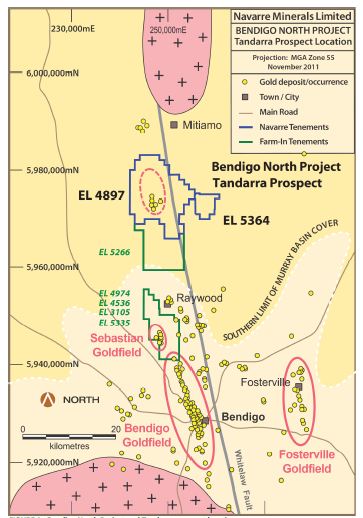
Bendigo North project and Tandarra prospect location map. Source: Company announcement


This result is from the first drill traverse undertaken across the Tomorrow Anticline as part of a 25,000 metre resource definition drill program at the Tandarra prospect, part of the company’s Bendigo North project, 40 kilometres north of Bendigo in Victoria.

Navarre said the data obtained from this RC program will be used to calculate the estimation of a maiden mineral resource at Tandarra by the end of 2012.

“We are particularly pleased with the width of gold mineralisation intersected in (drillhole) RCT006 and its relatively shallow depth from 35 metres down-hole as it aligns with our concept target of a mineral resource that may be suitable to potential open pit mining”, Navarre Minerals managing director Geoff McDermott said in the company’s announcement to the Australian Securities Exchange.

Navarre is targeting gold mineralisation at Tandarra below a thin veneer of sand and clay cover ranging in thickness from 20 to 50 metres.

The current drilling activity is set to be heightened by the addition of a second drill rig in February.

“While we experienced some delays associated with contractor’s equipment, we are now in full swing at Tandarra and we are looking forward to a busy program over the next few months,” McDermott said.

Navarre Minerals expects to release more drill results in the coming weeks from two further diamond holes at the Kingston gold project and from the ongoing RC resource definition drilling at Tandarra.

Thundelarra hears from Priscilla

THE DRILL SERGEANT: Thundelarra Exploration has received the final results from a 30 hole, 3,578 metre RC drilling program carried out on the company’s Priscilla gold prospect in the Northern Territory.

Thundelarra completed the drilling in December, which was designed as a preliminary assessment of selected targets at the Priscilla gold prospect, situated in the central part of the Pine Creek goldfield, some 160 kilometres south of Darwin.


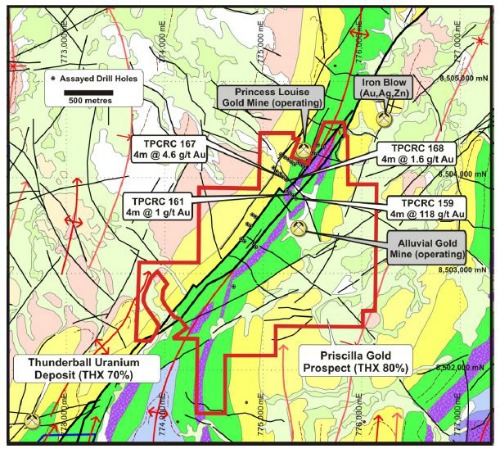
Priscilla gold project. Source: Company announcement


The results have returned additional gold mineralisation intersections including:

–    4 metres at 4.6 grams per tonne gold; and

–    4m at 1.6 g/t gold.

–    12 out of the 30 holes drilled returned greater than 0.5 g/t gold with a peak intercept 118 g/t.

Thundelarra said the drilling program had defined two north east trending gold mineralised zones within the tenement area.

The first of these new zones is the western zone, which the company described to be a, “southern extension of the Princess Louise stratigraphy”.

The best intercept returned from the western zone was 4m at 4.6 g/t gold.

“This sequence extends for over two kilometres within the Priscilla tenements, remains largely untested by drilling and will be further assessed during 2012,” Thundelarra said in its ASSX announcement.

The second new zone, the eastern zone occurs on or adjacent to a north east trending anticlinal hinge zone the company said appears to be plunging 20-30 degrees in a northerly direction.

Previous drilling on the eastern zone intersected mineralisation of 4m at 118 g/t gold.

“This prospective contact is untested down plunge to the north and will be the focus of Thundelarra’s exploration this field season,” the company said.

Gold Road continues to pave its way

THE DRILL SERGEANT: Gold Road Resources has announced to the ASX the discovery of multiple new gold anomalies across the company’s wholly-owned Yamarna Gold Belt.

The discoveries include the Koopman’s Find high-grade gold patch, which Gold Road identified during an auger drilling program at the Tobin Hill gold trend.

The following new gold anomalies, all located across the Yamarna Belt, have recently been identified through drilling activity:

Koopman’s Find prospect:

–    A new gold discovery located in Tobin Hill area; and

–    Rock chip returned a grade of 40.7 grams per tonne gold.


Free gold panned from Koopman’s Find patch at Tobin Hill area. Note floating fine gold. Source: Company announcement

Tatar prospect:

–    Located on the Tamerlane trend between Attila South gold deposit and the Hann prospect; and

–    Gold Road has delineated a 1.5 kilometre long gold anomaly.


VTEM prospect:

–    Located on the Tamerlane trend close to the Alaric 2 gold deposit;

–    Drilling has identified a 500 metre long gold and a 300 metre long arsenic-copper-lead-zinc-nickel anomaly; and

–    Assays and lithology suggest a possibility of VMS style of mineralisation.

Dorothy Hills (north) prospect:

–    Located approximately 23 kilometres north-east of Central Bore;

–    Drilling has identified a broad 100 – 200 metre wide gold anomaly;

–    Gold appears to be hosted by both granite and basalt; and

–    Follow up RAB program will focus on the long granite and basalt contact.

Western Ultramafics prospect:

–    Located 1.5 kilometres west of the Alaric 3 gold deposit;

–    Drilling was designed to test a 1.5 kilometre long zone where sporadic historical drilling identified gold anomalism (the best intercept: 1m at 3.72 g/t gold); and

–    Gold Road’s current drilling confirmed the presence of anomalous gold in the area – full interpretation of the results is in progress.


In addition to the above results Gold Road said it has also continued to delineate its Central Bore, Central Bore North, Central Bore South, Justinian, Hann and Khan North projects.

The company has surpassed its 150,000 metre target by drilling in excess of 170,000 metres of RAB, RC and diamond drilling throughout 2011.

Gold Road has already commenced its 2012 drilling campaign with all three rigs in operation and its entire exploration team back on site.

Nullagine JV confirms Bonnie East DSO

THE DRILL SERGEANT: The Nullagine Iron Ore Joint Venture between BC Iron and Fortescue Metals Group has intersected direct shipping ore iron mineralisation during infill drilling of the Bonnie East deposit.

According to an ASX announcement from BC Iron the Bonnie East deposit is a Channel Iron Deposit, of Direct Shipping Ore quality, hosted within the same palaeochannel as the Outcamp and Warrigal deposits and is directly south of the Outcamp Mine.


Bonnie East deposit location. Source: Company announcement


Assay results from the drilling include:

10 metres averaging 57.4 per cent iron (65 per cent calcium iron) from 6.5 metres;

5.5m averaging 59.1 per cent iron (66.7 per cent calcium iron) from 1m; and

10m averaging 56.8 per cent iron (65 per cent calcium iron) from 3.5m.

The Bonnie East prospect currently boasts an Inferred Resource of 8.6 million tonnes at 57 per cent iron.

Resource modelling and grade estimation followed by mine planning assessment are currently underway, which BC Iron said it expects to be completed in the March 2012 quarter.

The recent drilling was undertaken on a 100m by 50m pattern to infill previous drilling carried out in 2008.

Pending the outcome of the resource estimate, the Joint Venture said it expects to be able to upgrade the Bonnie East resource category from Inferred.

“A successful mining study would extend the mine life of the Nullagine project as well as improving the project economics,” The Nullagine Iron Ore Joint Venture said in BC Iron’s announcement to the Australian Securities Exchange.

“The proximity to the current mill creates an opportunity to optimise the current mine plan before the more distal deposits, such as Coongan and the northern Warrigal mesas, are brought on line.”