Cove encouraged by Goongarrie drilling

THE DRILL SERGEANT: Cove Resources has been encouraged by results it has received from a second drilling program carried out on the company’s Goongarrie project in Western Australia.

The Goongarrie project is made up of five Prospecting Licences that cover the historic Goongarrie gold mining centre situated in the Eastern Goldfields of Western Australia.

Cove completed a total of 28 RC holes for 2,232 metres, focussing on the Caledonian, Frank North and Goongarrie West prospects.
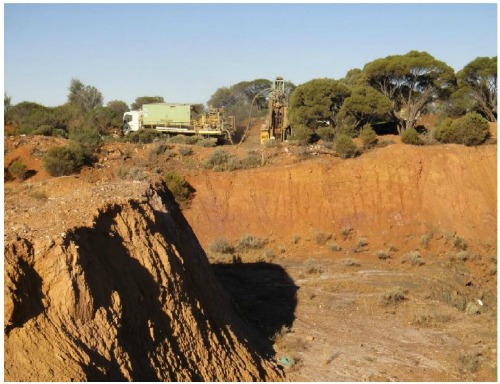
 

Drilling beneath the shallow Caledonian Pit. Source: Company announcement

According to Cove the recent drilling has identified a continuous zone of mineralisation over 120m.

Cove claimed the best result it achieved from the latest program of 43 metres at 1.55 grams per tonne gold is directly along strike from a hole the company drilled in an earlier campaign, which returned 57m at 1.23 g/t gold.

Other results of particular note from the drilling included:

Caledonian Prospect

–    5m at 3.24 g/t gold from 24m and 3m at 1.64 g/t gold from 72m;

–    1m at 38 g/t gold from 11m and 43m at 1.55 g/t gold from 71m, including 6m at 3.52 g/t gold from 106m.

Frank North Prospect

–    2m at 1.55 g/t gold from 2m, and 7m at 3.25 g/t gold from 35m, including 1m at 20.2 g/t gold from 36m;

–    4m at 1.41 g/t gold from 10m including 1m at 4.65 g/t gold from 10m.

West Goongarrie Prospect

–    1m at 1.21 g/t gold from 21m; and

–    1m at 2.18 g/t gold from 42m.

Surface rock sampling from a small pit above one of the drillholes returned 18.75 g/t gold and 19.7 g/t silver.

Cove said several low grade gold intervals were noted in most of the holes along the gold soil anomaly.

“These results will be interpreted together with previous drill results and a new program and the next phase of work will be implemented in the new year,” Cove Resources said in its ASX announcement.

“The near surface gold mineralisation is over wide intervals which increases the development potential of the area.

“Drillholes are currently being surveyed and full data, including plans and cross sections incorporating current and previous drilling will be provided shortly.”
Chalice fills up on drill results

THE DRILL SERGEANT: Chalice Gold Mines has received high-grade gold intercepts from diamond drilling carried out at the company’s recently discovered Debre Konate prospect.

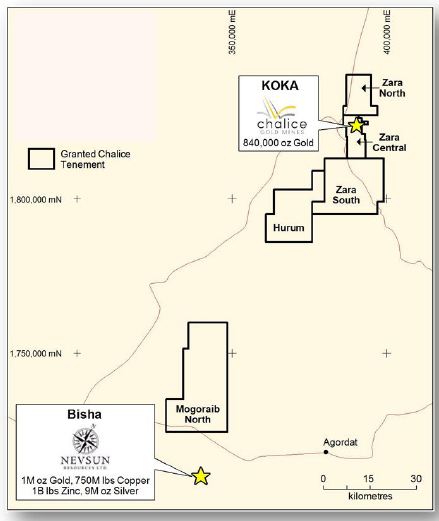
The Debre Konate prospect is situated immediately south of the soon to be developed Koka gold deposit at its Zara project in northern Eritrea.


Location of Zara Project and other Chalice Gold Exploration Licences. Source: Company announcement


Recent diamond drilling has focused on testing high priority targets within a 7.5 kilometres long corridor encompassing the Koka deposit where Chalice and its partner ENAMCO are planning to commence development of an open-pit mine in 2012.

The previously undrilled Debre Konate prospect, located around2.5km south of Koka, was initially targeted as an Induced Polarisation (“IP”) resistivity anomaly supported by minor artisanal workings and a significant gold and lead soil geochemical anomaly in a microgranite host.

The first hole Chalice drilled into the prospect intersected, what the company described to be as, “an extensive low-grade mineralised system.”
 
A further hole was drilled “up-section” from the first, which Chalice said has confirmed the previous drill results with numerous zones of narrow, higher grade mineralisation contained within the low-grade envelope.

The company said the second hole intersected the same extensive low-grade gold system, returning 111 metres at 1.41 grams per tonne gold (uncut) from 94 metres.

Better intersections (uncut) included:

–    4m at 11.45g/t gold from 94m;

–    1m at 12.55g/t gold from 119m;

–    1m at 22.42g/t gold from 129m; and

–    1m at 30.55g/t gold from 163m.

“The new discovery at Debre Konate and the potential bulk tonnage targets highlight the significant  prospectivity of the greater Zara project area,” Chalice Gold Mines managing director Dr Doug Jones said in the company’s announcement to the Australian Securities Exchange.

“The discovery of additional ounces near Koka will likely have a significant impact on the already robust economics of the project.”

Centaurus commences new drilling program

THE DRILL SERGEANT: Centaurus Metals has commenced a round of Reverse Circulation (RC) drilling its Jambreiro iron ore project in south-east Brazil.

The new drilling program is part of a Bankable Feasibility Study work program.


RC Rig drilling at Jambreiro project. Source: Company announcement


“The RC in-fill program, which is one of several programs to be undertaken as part of the BFS, is planned to convert the first 2-3 years of friable ore production into Proven Reserves, which will assist with securing the debt funding component of the overall project funding package for Jambreiro,” Centaurus Metals explained in its ASX announcement.

“The drilling will also enable the company to collect a bulk sample and use it in pilot plant testwork, which will greatly assist in securing product off-take arrangements with the Brazilian domestic steel mills.”

The new phase of drilling follows the release of a Pre-Feasibility Study on the Jambreiro project, which outlined a two million tonnes per annum project capable of generating revenues of $1.4 billion and EBITDA of $948 million over an initial 8.5 year life.

The overall RC drill program to be carried out at Jambreiro will comprise 2,250 metres of drilling with 1,750 metres of shallow drilling being undertaken to intersect the ore from surface to the bottom of the anticipated year-three pit.

A further 500m of drilling will also be carried out to test for pit extensions between the Tigre and Cruzeiro deposits in an area of the Jambreiro project that was not previously drilled.

Once Centaurus has completed drilling completed at Jambreiro, it said it will move the RC rig to undertake exploration drilling on the surrounding tenements in the Guanhães Region.

Centaurus has 18 tenements (including Jambreiro and Candonga) in the Guanhães Region covering a total area of 25,000 hectares.

The company has used surface mapping to identify itabirite mineralisation on 13 of the 18 tenements.

Centaurus said it has planned 2,500m of RC drilling to test some of the targets on these tenements.

Bassari drills while awaiting Resource upgrade

THE DRILL SERGEANT: Melbourne-based gold explorer Bassari Resources has commenced reverse circulation (RC) drilling at the company’s Bennajiggi prospect, situated within its Moura permit in Senegal, West Africa.

The company is awaiting results for a resource upgrade at its Makabingui gold project, which it said is on track to be released before the end of the year.

The Bennajiggi prospect is one of 13 quality gold prospects Bassari has identified along 80 kilometres of strike within its permits on the Birimian gold belt in eastern Senegal.


Moura permit – Prospect Location Map. Source: Company announcement

The company said it had undertaken the new drilling campaign as a result if previous exploration at Bennajiggi, which included trenching and pitting, that had returned encouraging results that the company considered warranted following up with drilling.

“Now that we have completed our first stage drilling program at Konkouto and have assays pending, Bennajiggi is our next high quality target to advance.” Bassari Resources managing director Jozsef Patarica said in the company’s announcement to the Australian Securities Exchange.
 
“Drilling has now commenced targeting mineralisation associated with a zone of multiple east-west trending and steeply south dipping quartz lodes.

“The main controlling structure appears to be a major north to north east trending shear zone. The drill program is designed to follow up this model to determine potential for a significant mineralised system.

“There are extensive artisanal workings concentrated around the Bennajiggi prospect which is typical of the region.”

The Bennajiggi prospect is located 38km north east of Bassari’s most advanced gold discovery, the Makabingui project.

Previous exploration undertaken at Bennajiggi has included trenching and pitting and an initial phase of shallow RC drilling.

EPA waives Poseidon Windarra assessment

THE DRILL SERGEANT: Andrew Forrest-led Poseidon Nickel has received news that its Windarra nickel project in Western Australia will not require formal assessment by the Environmental Protection Agency (EPA).

Instead the environmental approval for the project is to be managed under Part V of the Environmental Protection Act of 1986.

Receipt of this conditional waiver means the company’s plans for the development of the Windarra nickel project remain on track.

The Poseidon said this meant it would be able to achieve all of the necessary mining and environmental approvals during the first quarter of 2012.

The EPA waiver for the project was first granted in 2008.

“Substantial changes to the project, most notably incorporation of mining activities at the Cerberus nickel deposit, meant that a re-application for a waiver was necessary,” Poseidon Nickel said in its ASX announcement.

“The process should now deliver a rapid assessment within the development time scales of the project.”

Poseidon Nickel claims the Windarra nickel project to be a higher-grade nickel sulphide deposit that has demonstrated high recovery levels through a standard nickel floatation concentrator.

The total current Mineral Resource is located at two positions approximately 10 kilometres apart and includes an existing brownfields mine at Mt Windarra and a new discovery at Cerberus.


Source: Company announcement

Poseidon said it is on track to complete a definitive feasibility study by the end of 2011.

The company is targeting initial concentrate production in 2013.

A concentrator plant is to be constructed at Mt Windarra, which the company expects to have a nameplate capacity of 700,000 tonnes of ore per annum.

Intrepid expands Tujuh Bukit Resource

THE DRILL SERGEANT: Intrepid Mines has expanded the Inferred Resource estimate at its Tujuh Bukit copper-gold project in Indonesia.

The increase resulted from assay results the company recently received from a drilling program the company completed throughout the last six months around the known porphyry copper-gold zone of the Tumpangpitu area of the Tujuh Bukit project.


Updated Tumpangpitu porphyry resource outline to December 2011. Source: Company announcement


The expanded Inferred Resource estimate at the project now stands at 1.7 billion tonnes at 0.41 per cent copper and 0.46 grams per tonne gold, at a cutoff grade of 0.2 per cent copper.

The previously resource estimate released by the company in May 2011 was 990 million tonnes at 0.40 per cent copper and 0.45 grams per tonne gold at a 0.2 per cent copper or 0.2 grams per tonne gold cut-off.

The latest estimate is based on 41 drill holes in excess of 700 metres for approximately 36,600 metres.

In addition to these, five deep holes failed to intersect porphyry mineralisation.

Intrepid explained that although this latest Inferred Resource estimate may be a significant increase to the May 2011 estimate, the company remains confident the porphyry copper-gold resource at
Tumpangpitu can continue to grow, as it undertakes additional drilling.

The Tumpangpitu oxide gold-silver zone, which stands at 130Mt at 0.55 g/t gold and 18 g/t silver for 2.4 million ounces of contained gold and 80 million ounces of contained silver, is not included in the latest estimate.

“While we are pleased to have tripled the size of this porphyry resource in just a little over a year, we still have not reached the limit of the resource at Tumpangpitu, let alone across the entire Tujuh Bukit project,” Intrepid Mines chief executive officer Brad Gordon said in the company’s announcement to the Australian Securities Exchange.

“We will soon have 11 drill rigs available, including one capable of drilling to depths of almost two kilometres.

“We look forward to initiating drilling at the Salakan porphyry and continuing to expand our exploration program across this exciting project area.”

Horseshoe Metals hits at Kumarina

THE DRILL SERGEANT: Horseshoe Metals has completed its first drilling program at the company’s 100 per cent-owned Kumarina project in Western Australia.

A total of 51 Reverse Circulation Percussion holes were drilled at the Rinaldi and North Show prospects for a total of 3,429 metres with holes ranging in depth from 26 to 149 metres.

According to Horseshoe the drilling at the Rinaldi prospect produced the best results.
At Rinaldi copper sulphide mineralisation was observed in 11 holes along a north-south oriented fault zone for a distance of about 300 metres.

Best results recorded at the Rinaldi Prospect include:

–    28 metres at 2.0 per cent copper from 56 metres, including 2 metres at 5.3 per cent copper from 58m, 2 metres at 3.5 per cent copper from 63 metres and 2 metres at 5.7 per cent copper from 68 metres;

–    5m at 3.6 per cent copper from 49m, including a peak intersection of 1m at 13.4 per cent copper from 50m and 7m at 1.1 per cent copper from 82m;

–    17m at 2.8 per cent copper from 35m including 5m at 5.0 per cent copper from 35m and 1m at 5.8 per cent copper from 48m;

–    14m at 2.7 per cent copper from 22m, including 5m at 4.6 per cent copper from 25m, including 1m at 8.4 per cent copper from 28m; and

–    27m at 1.3 per cent copper from 65m, including 2m at 3.3 per cent copper from 65m and 2m at 4.3 per cent copper from 85m.

“The copper sulphide mineralisation consists mainly of chalcopyrite and appears to be hosted by quartz veins within and just above a dolerite intrusion,” Horseshoe Metals said in ijts ASX announcement.

“The structure is interpreted to be associated with a north-south oriented fault zone.

‘Importantly, this copper mineralisation zone remains open along strike and down dip and will be tested by further RC drilling.

“The occurrence of zones of high grade copper mineralisation at the Rinaldi prospect is considered by the company to be very encouraging.”

The drilling carried out at the North Show prospect intersected shallow copper oxide mineralisation.
The mineralisation consists of secondary copper minerals producing lower grade but consistent copper results.

Horseshoe Metals said it intends to recommence drilling at Kumarina, which will focus on the Rinaldi and Kumarina copper mine prospect areas.

This program is planned to be completed before the driller’s Christmas break with laboratory analysis of the drilling samples to follow in early 2012.

As a consequence of this second drilling program at Kumarina, the company has re-scheduled drilling planned for the Horseshoe Lights project into 2012.

Emmerson gives Goanna and Monitor the drill

THE DRILL SERGEANT: Emmerson Resources has extended the depth and strike of both the Goanna and Monitor discoveries at its 100 per cent-owned Tennant Creek project.

Two new drill holes recently completed by the company have struck high-grade copper mineralisation.

“The drilling continues to build on two very exciting discoveries that get better with each new hole,” Emmerson Resources managing director Rob Bills said in the company’s announcement to the Australian Securities Exchange.

“At Monitor we have extended the continuity of high-grade copper some 200 metres to the east, and demonstrated great potential for high-grade gold beneath; whilst at Goanna we have defined multiple zones of high-grade copper, also with deeper high-grade gold.

“Goanna and Monitor are 2.5 kilometres apart and lie either side of the historic Gecko copper mine and associated infrastructure.

“This raises the intriguing possibility of discovering further gold beneath the known Gecko copper mineralisation.”

The latest drill hole at Monitor was designed to test along strike from a high-grade copper zone of 27m at 1.75 per cent copper, including 6m at 2.67 per cent copper and 6m at 3.53 per cent copper previously intersected by the company.

The hole did not pierce another previously announced, deeper gold-copper zone, however the company said the multiple copper intersections achieved contained elevated bismuth, which it said suggested proximity to gold mineralisation.

Emmerson said the mineralisation is consistent with other recently announced intersections and has provided it with increased confidence of the continuity and grade at Monitor.

Drilling at the Goanna project returned the second drill hole the company has reported with visible copper.

Emmerson claims it extends the Far South Shear by a further 170m as well as confirming potential for shallow oxide copper.

“This new “shear zone” style of mineralisation found at Goanna and Monitor was largely blind to previous exploration methods and demonstrates the potential for a new generation of deposits,” Bills said.

“The discoveries at Goanna and Monitor follow a systematic, multi-faceted exploration program that utilised the world’s most powerful HeliTEM geophysical survey, compilation of the 3D geology and structure, combined with ground based deep penetrating Induced Polarisation geophysics.”

Deep Yellow releases Shiyela Resource

THE DRILL SERGEANT: Deep Yellow has had a maiden JORC Mineral Resource estimate completed for its Shiyela iron project in Namibia.

The Shiyela project is located on an exploration licence which is held 100 per cent by Deep Yellow’s wholly-owned Namibian subsidiary, Reptile Uranium Namibia.

The new Inferred Resource estimate totals 78.7 million tonnes at 18.88 per cent iron at 10 per cent Davis tube Recovery (DTR) cut-off for the M62 and M63 magnetite deposits with an average DTR magnetite content of 16.17 per cent.


JORC Mineral Resource Estimate Shiyela – December 2011. Source: Company announcement


The company has previously told the market that chemical assays conducted on concentrates produced from DTR testwork confirmed that Shiyela could produce a quality magnetite with high iron and low impurity levels suitable as a Blast Furnace product.

“This is another solid step forward in our assessment of the Shiyela iron project,” Deep Yellow managing director Greg Cochran said in the company’s announcement to the Australian Securities Exchange.

“Whilst we are pleased with the result we recognise that more drilling and analysis must be done to enhance the resource base. In the meantime our consultants ProMet are currently finalising the Scoping Study and the market can expect an announcement in that regard next week.”

Deep Yellow completed an exploration program earlier this year, consisting 210 Reverse Circulation and Diamond Drilling holes for 38,473 metres of drilling.

The company said this drilling had confirmed strong mineralised zones in both the M62 and M63 deposits.

Deep Yellow has now commenced a large-diameter diamond drilling program to provide core for the company’s next phase of metallurgical testwork, as part of a planned Feasibility Study.

The program will comprise at least 3 holes at both M62 and M63 for approximately 1,000 metres of PQ core to generate some 16 tonnes of mineralised material.

Subject to the availability of funding for the project  a program of RC and diamond drilling to target  lateral and depth extensions to the M62 and M63 deposits will be conducted in 2012.

Doray delivers Christmas bonus

THE DRILL SERGEANT: Doray Minerals has added to the high-grade Wilber Lode Resource at the Andy Well gold project (Doray 80 per cent).

The combined Inferred and Indicated Resource for the Wilber Lode and two associated quartz vein lodes now totals:

–    691,000 tonnes at 14.8 grams per tonne gold for a total of 329,000 contained ounces of gold.

The updated Resource represents an increase of over 90 per cent from the maiden resource Doray announced in February of 311,000 tonnes at 17.5g/t.


Schematic N-S Long Section of Wilber Lode resource with grade domains and classification. Source: Company announcement

The company has now defined the resource to a depth of approximately 480 metres below surface where it claims it to remain open at depth.

Doary has also re-estimated the previously released oxide shear zone resource to 115,000 tonnes at 0.7g/t for 3,000 ounces of gold.

The combined Andy Well resource, including all quartz vein and shear zone domains now totals 806,000 tonnes at 12.8g/t for a total of 332,000 ounces of gold.

“Our recent drilling campaigns have continued to deliver a stream of high grade gold intersections from Wilber over the last nine months,” Doray Minerals managing director Allan Kelly said in the company’s announcement to the Australian Securities Exchange.

“The substantially increased resource confirms the Wilber Lode as a very significant high-grade gold deposit and, more importantly, gives Doray the added confidence to push ahead with our current development activities.

“We believe that further drilling has the potential to again increase this resource.”

Doray said further drilling at the Andy Well project will consist of diamond drilling of a number of additional holes at Wilber to lift the status of the inferred resources and continued testing of the extents of the open ended resource.

It will also be subjected to RC drilling to test the potential for extensions to the Wilber Lode, as well as a number of nearby additional targets as well as aircore drilling of a number of other high priority targets.

Drilling programs to follow-up high grade gold results from the company’s Side Well and Abbotts prospects are scheduled for after the Christmas-New Year break.