Mithril Resources drilling at Spargos Reward gold mine

THE DRILL SERGEANT: Mithril Resources (ASX: MTH) has kicked off a 1,300 metre Reverse Circulation drill program to test the extensional potential of the company’s Spargos Reward gold mine.

The company has a second drill program to test regional targets south of the mine planned to commence in early 2013.

The drilling follows the acquisition of the gold mine and surrounding tenements by Mithril for $200,000 in cash.

The project is located 25 kilometres west of Kambalda in the Eastern Goldfields of Western Australia, 16km north along strike from the operating Wattle Dam gold mine of Ramelius Resources (ASX: RMS).
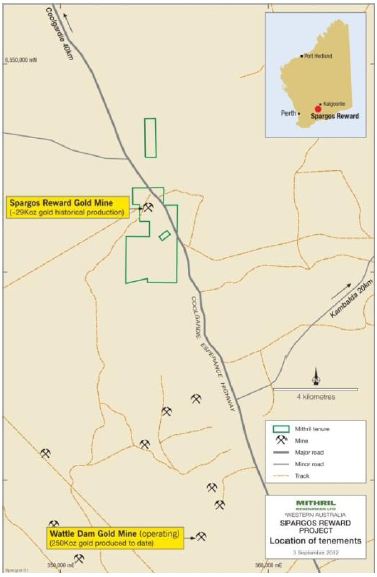
 

Spargos Reward location plan. Source: Company announcement


“The commencement of drilling on the newly acquired Spargos Reward gold project represents a new strategic focus for Mithril, and the work compliments exploration activities also being carried out on the company’s Illogwa IOCG Area in Central Australia,” Mithril Resources managing director David Hutton said in the company’s announcement to the Australian Securities Exchange.

“Results from the current near – mine program are anticipated by mid – January 2013, and Mithril looks forward to informing the market at that time.”

Spargos Reward was previously mined to a vertical depth of 120m (underground and open pit) with total production of approximately 29,257 ounces at 8 grams per tonne gold.

Mithril explained that mineralisation occurs within two parallel shear zones (the Western and Main Lodes) which have been previously drilled on 25 – 50 metre spaced sections throughout the mined area to an average depth of 140m.

The company said geological modelling indicates potential to extend the deposit at depth and along strike as only broad spaced drilling has been completed outside the mined area by previous explorers.

Mithril is using the current drill program to test both the continuity of mineralisation between existing drill intercepts and confirm the extensional potential of both the Western and Main Lodes.
Excelsior Gold increases Zoroastrian Resource at Kalgoorlie North gold project

THE DRILL SERGEANT: Excelsior Gold (ASX: EXG) has received results of interim resource calculations based on drilling results received to date from the Zoroastrian gold deposit within the company’s 100 per cent-owned Kalgoorlie North gold project.

The company has announced an increase in contained gold ounces at Zoroastrian by 50 per cent.

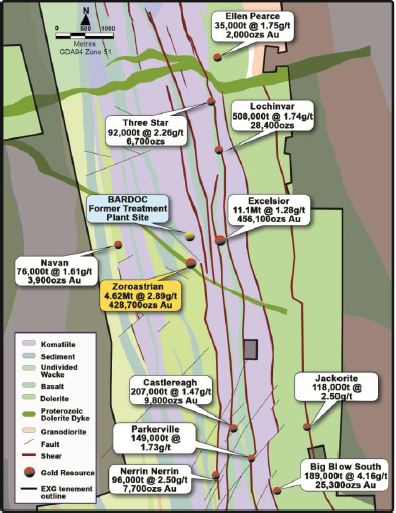
The Zoroastrian gold resource has increased by 142,400 ounces of gold to 4.62 million tonnes at 2.89 grams per tonne gold for 428,700 ounces.

The increase has increased the total Kalgoorlie North gold project resources to 19.31 million tonnes at 1.76g/t gold for approx. 1.2 million ounces.


Kalgoorlie North Project – Central Resource area. Source: Company announcement


The resource upgrade has been based on assay results the company received from its ongoing reverse circulation and diamond drilling campaign.

The campaign is designed to expand the Zoroastrian gold resource along strike and at depth.

“The expansion of the Zoroastrian deposit continues to demonstrate the potential for the extensive mineralised zone to host a substantial high grade gold deposit in the central part of the Kalgoorlie North tenements and immediately adjacent to the 456,100 ounce Excelsior gold deposit,”  Excelsior Gold said in its ASX announcement.

“The company believes there remains excellent potential to increase the gold resources at Zoroastrian and is currently evaluating large open pit and underground mining options as part of the Pre-Feasibility Study into the development of the project.

“The Pre-Feasibility Study is scheduled for completion in mid-2013.”

Phoenix Gold Resources now over 2.5M ounces

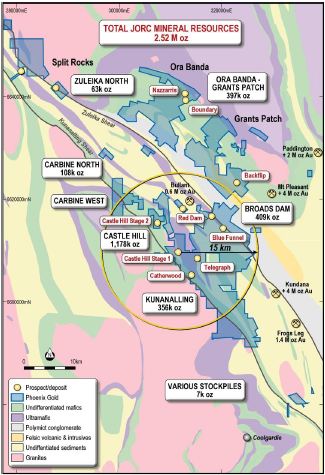
THE DRILL SERGEANT: Phoenix Gold (ASX: PXG) has increased the company’s total Mineral Resources at the company’s Castle Hill project to 45.35 million tonnes at 1.7 grams per tonne gold for 2.52 million ounces.

The company indicated this figure represents an increase of 324 per cent since it acquired the project in 2010.

Recent upgrades to the Resources are a result of drilling campaigns completed in 2012 at the Castle Hill, Broads Dam and Telegraph gold projects in the Western Australian Goldfields, near Kalgoorlie – Boulder.


Project location, Phoenix tenements and development centre. Source: Company announcement


“To have grown the Resource beyond 2.5 million ounces in under two years is a testament to both the quality of the assets and the dedicated geology team that has continued to deliver consistent results,” Phoenix Gold managing director Jon Price said in the company’s announcement to the Australian Securities Exchange.

“The latest Castle Hill and Broads Dam drill results further demonstrate the potential of both these projects to become multimillion ounce gold camps.

“Phoenix is now well funded to accelerate the large drilling programs and complete the definitive feasibility study on our core projects by December 2013.

“Next year will be a company defining year for Phoenix with significant resource growth expected together with a detailed economical evaluation to progress to mine development and construction of a standalone processing facility.”

Phoenix completed its first diamond drilling program at Castle Hill in September testing for extensions to mineralisation beneath the resource envelope that sits 85m from surface.

The company announced results from the drilling earlier this week.

The drilling was successful in demonstrating continuity of mineralisation at depth below Castle Hill Stage 1 and to confirm the structural geology interpretation of this large stock work system.

The Castle Hill Resource now stands at 23.54 million tonnes at 1.6g/t gold for 1,178,000 ounces.

A maiden drilling program was completed at Telegraph in August, which defined mineralisation over a 3km strike length that remains open along strike and at depth.

The maiden Telegraph resource totals 2.44 million tonnes at 1.6g/t gold for 122,000 ounces.

Phoenix commenced further drilling at Castle Hill in November as a part of a $20 million drill program aimed at defining the size of the project both laterally and at depth.

The drilling will be a combination of reverse circulation and diamond drilling with the first round at Castle Hill Stage 1 already completed and a 10,000m program commenced at Stage 2.

Archer Exploration announces Campoona maiden Resource

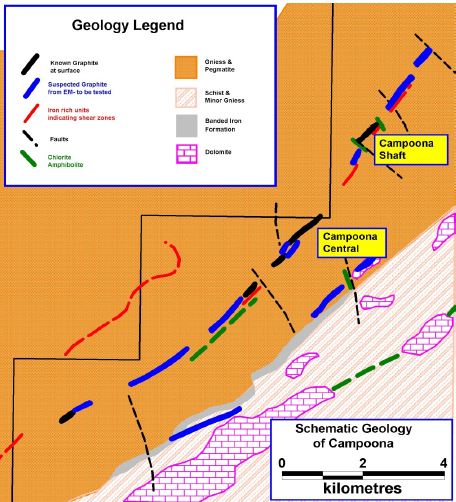
THE DRILL SERGEANT: Archer Exploration (ASX: AXE) has reported a Phase 1 JORC Resource for the Campoona graphite deposit at the company’s Campoona graphite project located 15 kilometres north of Cleve on Eyre Peninsula, South Australia.

The maiden JORC Resource at Campoona has come in at 2.572 million tonnes grading 12.3 per cent total graphitic carbon (TGC) with 310,800 tonnes of contained graphite at a lower cut‐off grade of 5 per cent TGC.

The Phase 1 Campoona JORC Resource which has been achieved within 9 months of the company’s discovery drill hole and is estimated to contain almost 400,000 tonnes of contained graphite.

Archer explained that less than 20 per cent of the Campoona shear has been drill tested.


Schematic geology of Campoona graphite deposit. Source: Company announcement


“Archer has progressed from a virgin discovery to a substantial high‐grade Maiden JORC Resource in less than 9 months – an outstanding achievement by our team,” Archer Exploration managing director Gerard Anderson said in the company’s announcement to the Australian Securities Exchange.

“The Phase I Resource encompasses only the data from Campoona Shaft and a small portion of Central Campoona.

“In‐fill drilling at Central Campoona is planned to commence in February 2013 with results to be incorporated into the Phase II Resource likely late in the second Quarter of next year.

“This Maiden JORC resource cements Campoona’s position as one of the most significant new graphite discoveries in Australia.

“With less than 20 per cent of the host shear drilled to date, the reasonable expectation supported by airborne EM results, is that further exploration is likely to lead to much more graphite being discovered.”

Archer has been working on defining the optimum processing flow sheet for the extraction of high value graphite products.

The intense weathering of the deposit has presented it challenges, however, the company said it has been successful in dealing with these through the application of mineral science and systematic testing, which has provided it with greater understanding of the project.

“We now know how to treat our ores to achieve ultra‐pure concentrates,” Anderson said.

“Results to date show us that greater than 98 per cent TGC concentrates are reproducible with excellent recoveries.

“No acid was needed or used to achieve this result. Further grade enhancements are realistically expected.

“Testing will now use that knowledge to quantify the product types across the length, breadth and depth of the deposit with results being progressively announced over the next two months.”

The company has now turned its focus on defining development options for Campoona, where it has completed Environmental Fauna and Flora Baseline Studies to provide Spring season data needed to support a future Mine Lease Proposal.

“Over the next quarter we will commence Scoping Studies which we expect to lead directly into a Pre‐Feasibility and Definitive Feasibility Study commencing in mid‐2013,” Anderson said.

Phoenix Gold encounters encouraging mineralisation at Castle Hill

THE DRILL SERGEANT: Phoenix Gold (ASX: PXG) has received early results from a drilling program the company recently commenced at its Castle Hill gold project located in the Western Australian Goldfields, less than 50 kilometres from Kalgoorlie.

The results included intercepts of:

–    94 metres at 2.6 grams per tonne gold from 88 metres;

–    8m at 2.4g/t gold from 74m;

–    5m at 2.2g/t gold from 142m;

–    56m at 0.9g/t gold from 79m;

–     38m at 0.8g/t gold from 161m; and
 

–     20m at 0.8g/t gold from 88m.


Castle Hill Stage 1 cross section. Source: Company announcement


“This result is by far the most significant and largest gram-metre intercept at Castle Hill and reinforces the potential strike and at depth,” Phoenix Gold managing director Jon Price said in the company’s announcement to the Australian Securities Exchange.

“The project continues to exceed our expectations and is only 35 minutes’ drive from Kalgoorlie-Boulder.

“We now look forward to releasing the rest of the assays in due course and updating the geological model for Castle Hill Stage 1 in the March Quarter next year.”

The current Castle Hill Resource estimate stands at 21.71 million tonnes at 1.5g/t gold for 1.6 million.

Phoenix Gold said the Resource extends to a depth of 85m below surface and is anticipated to be updated this Quarter with the results from diamond drilling the company completed in September.

A further Resource upgrade with these new results is expected in the March Quarter 2013.

Phoenix completed a program of 11 diamond drill holes at Castle Hill Stage 1 in November, which consisted of a combination of extensional drilling and infill drilling to provide improved geological confidence for the company to bring mineralisation into resource and convert Inferred material to the Indicated category.

The company said the latest results, combined with diamond drill results it announced in September have demonstrated the potential of the mineralisation to grow significantly at depth.

Bassari increases Makabingui estimate beyond 1M ounce mark

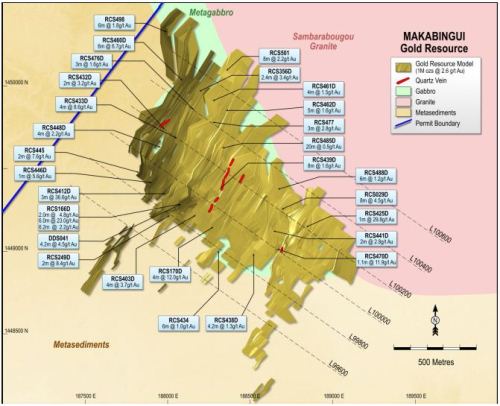
THE DRILL SERGEANT: Bassari Resources (ASX: BSR) has taken the Indicated and Inferred Mineral Resource estimate at the company’s Makabingui gold project in Senegal West Africa to over the 1 million ounce mark.

The company has announced a JORC Code-compliant Indicated and Inferred Mineral Resource estimate 11.9 million tonnes at 2.6 grams per tonne gold, at a cut-off grade of 0.5g/t gold for 1 million ounces.

Bassaris said the new estimate was its main objective for 2012 and represents a 100 per cent increase to the Mineral Resource estimate it had reported in December 2011.


Makabingui gold project plan. Source: Company announcement


“Increasing the gold resource at Makabingui to one million ounces marks a significant milestone for Bassari,” Bassari Resources managing director Jozsef Patarica said in the company’s announcement to the Australian Securities Exchange.

“We’ve delivered our 2012 objective and importantly, established foundations for further resource growth and development of the Makabingui project through 2013 and beyond.”

Patarica said the recently-completed step out drilling program had enabled Bassari to improve the geological model for Makabingui.

It also delivered an increase in gold grades for both the Indicated and Inferred Resource categories.

“The increase in grade on the previous model reinforces our confidence in the growth potential of the project,” Patarica explained.

“We will continue building our gold inventory by targeting extensions of mineralisation within the Makabingui project area as well as advancing our high-priority prospects across our other permits to develop a multi-million ounce gold district.”

Mining Group confirms continuous gold at Taub

THE DRILL SERGEANT: Mining Group Limited (ASX: MNE) has received further positive results from a high-grade gold bearing vein system at the Taub prospect at the company’s Comval copper gold project in the Philippines.

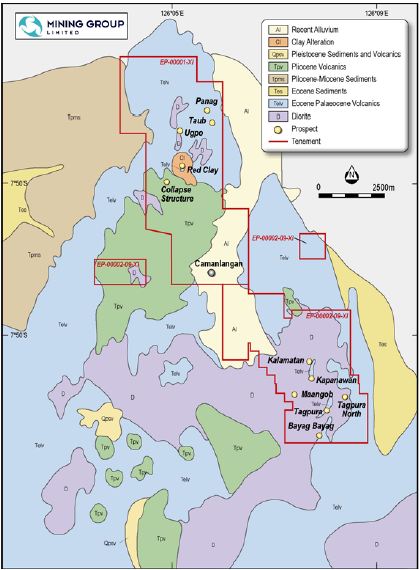
Mining Group claims Taub as a newly-discovered gold prospect situated approximately 7.5 kilometres north of the Tagpura copper deposit.


Location and geology map for the Comval copper gold project and prospect locations. Source: Company announcement


The company has undertaken a systematic trenching, mapping and sampling program at Taub, approximately 7km north of the historic Tagpura open pit mine (Figure 1 below).

The purpose of this work is to delineate the strike extent and grade continuity of previously identified quartz veins from historic rock chip sampling and the existence of small artisanal workings.

According to Mining Group this work has identified a 200m wide structural corridor at Taub with gold mineralisation identified over 300m along strike and open in all directions.

Mining Group has received results for trench CCPCH00003, 200m north of trench CCPCH00001, which returned a previously reported intercept of 4m at 17.75 grams per tonne gold.

Trench CCPCH00003 returned a best interval of 14m at 11.38g/t gold and 18.06g/t silver.

An individual rock chip result from the same trench returned 57.30g/t gold and 122.90g/t silver.

“Taub is clearly a high quality drill target with the latest results from trench CCPCH00003 demonstrating the continuity of the mineralised system over a 300 metre strike length with exceptional surface gold and silver grades,” Mining Group managing director Zeff Reeves said in the company’s announcement to the Australian Securities Exchange.

“These results not only show the zone is continuous but highlight the high-grade nature of Taub.

“We are aiming to commence RC drilling within the next few months to follow up these exciting results.

“We’ve also been carrying out similar work at Ugpo 1.5 kilometres to the west where four trenches have been installed with results indicating the presence of another strike extensive gold bearing zone.

“We need to carry out further work at Ugpo to better understand the controls on mineralisation prior to committing to drilling testing.”

Evolution claims new gold discovery at Pajingo mine

THE DRILL SERGEANT: Recent drilling along the Moonlight structure by Evolution Mining (ASX: EVN) at the company’s 100 per cent-owned Pajingo gold mine in North Queensland has intersected a new high-grade gold shoot.

The newly-identified shoot has been given the moniker Io (pronounced “eye oh”) and is situated approximately 200 metres south of the Moonlight prospect and 1,200 metres south of current underground mining activity.


Location plan of the Moonlight and Io prospects, located 1.2km south east of the Vera-Nancy trend


“The discovery of a new high-grade gold shoot at Pajingo, within 1,200 metres of current workings, is testament to the prospectivity of the Pajingo field – where, to date, approximately 2.4 million ounces of gold have been produced,” Evolution Mining vice president of discovery and chief geologist Roric Smith said in the company’s announcement to the Australian Securities Exchange.

“The Moonlight and Io mineralisation on the Moonlight Corridor, which runs parallel to the Vera Nancy trend, may represent a new and largely untested structure.

“The new intersections support our geological model for the preservation of blind vein systems at depth and on parallel structures.”

To date, five diamond holes for 2,720m have intersected mineralisation at Io over a 200m strike length and approximately 400m below surface.

Evolution said mineralisation remains open down plunge and along strike and occurs within crustiform banded quartz-adularia vein breccias, typical of the mineralised systems at Pajingo.

Recent assay results include:

–    8.1 metres at 6.2 grams per tonne gold from 417.4 metres, including 2.7 metres at 12.2 grams per tonne gold from 422.8 metres;

–    6m at 16.3g/t gold from 413.0m; and

–    0.9m at 8.5g/t gold from 442.1m.

Evolution said it is now planning additional drilling to define the potential of the area.

Taruga Gold commences Kossa exploration program

THE DRILL SERGEANT: Taruga Gold (ASX: TAR) recently commenced a program of exploration activities at the company’s Kossa project in Niger, West Africa.

The exploration program is designed to continue testing the Borobon prospect, which is situated within the Kossa project, in preparation for a maiden resource estimate.


Borobon prospect drill results and gold mineralised trends update September 2012. Source: Company announcement


The program will also continue the company’s assessment of high-priority reconnaissance prospects and complete a regional exploration program.

The program is to consist of:

–    6,600 metres of reverse circulation (RC) drilling;

–    10,000m of aircore drilling targeting high-priority reconnaissance targets;

–    7,140 line kilometres of detailed aeromagnetic survey; and

–    20,000m of auger drilling.

The program has been underway since early November and so far Taruga has completed over 3,600m of RC drilling targeting the Borobon prospect with over 1,000 samples already in the laboratory.

The company said it has also commenced aircore drilling as well as an extensive airborne magnetic survey that covers the entire project area.

“We have commenced the new field season with a busy and extensive exploration program,” Taruga Gold executive chairman Bernard Aylward said in the company’s announcement to the Australian Securities Exchange.

“We are excited about the RC drilling at the Kossa–Borobon trend where we are aiming to continue the success of our maiden drilling program that highlighted extensive gold mineralisation.

“Taruga is targeting a maiden resource estimate for the Kossa project in early 2013 and this drilling will provide critical support for the definition of gold mineralisation.

“We are also continuing to advance the under-explored Kossa project through our regional exploration program.

“We have started a detailed aeromagnetic survey of the project and are continuing to develop our pipeline of quality exploration prospects through our aircore and auger drilling.”

“We are well-funded to continue our exploration focus and will complete all activities efficiently.

“We expect to maintain a regular news flow as the program continues as a quicker turnaround in assays is expected as availability at laboratories improves.”

Metals of Africa records initial high-grade results from Rio Mazoe project

THE DRILL SERGEANT: Newly-listed base metals exploration play Metals of Africa (ASX: MTA) has received assay results for an initial rock chip sampling program it recently carried out at the Meque and Cocodeza prospects within the company’s 100 per cent-owned Rio Mazoe project, located in Tete Province of Mozambique.

Metals of Africa said the results support the potential for the project to host lead-zinc-silver mineralisation.

A total of 21 rock chip samples were taken from the Meque and Cocodeza prospects.


Regional geology map showing rock chip sample locations. Source: Company announcement


Of these, nineteen were sampled at the Meque prospect.

The best rock chip sample returned 1251 parts per million silver, 7.67 per cent lead, 23.8 per cent zinc and 1.1 per cent copper.

Zinc values of up to 27.48 per cent, lead values of up to 11.48 per cent and copper values of up to 5 per cent were received within this first batch of rock chip samples.

Two of the twenty one rock chip samples were sampled at the Cocodeza prospect.

These two samples both contained elevated gold (0.277 and 0.28 grams per tonne) and anomalous copper of up to 2.19 per cent, which is hosted in a carbonate unit the company said it believes may be prospective for replacement-style deposits.

The rock outcrop/exposure at Cocodeza is not as extensive as that at Meque hence the fewer samples were sent for analysis.

“Ground geophysics at Meque (magnetics and gravity) has defined a further drill target along strike from the mineralised rock chip samples,” Metals of Africa said in its ASX announcement.

“A drill hole is planned to test the cause of the Meque gravity anomaly in late January 2013 (weather permitting).

“Infill ground geophysics (magnetics and gravity) is expected to be completed over the Cocodeza prospect by early December 2012 and this data will assist in future drill-hole location planning.

“Many other anomalies remain to be tested at Meque and Cocodeza.”