Tawana Resources hits new itabirite at Mofe Creek

THE DRILL SERGEANT: Tawana Resources (ASX: TAW) has encountered a number of high-grade, coarse itabirite intersections over the Zaway prospect at the company’s Mofe Creek iron ore project in Liberia.

Tawana recently completed a program of 32 reverse circulation (RC) hole at the Zaway prospect.

Results from intersections over two kilometre strike, up to 200 metres wide included:

ZRC001: 6 metres to 32 metres at 39.5 per cent iron;

ZRC006: 0m to 40m at 34.6 per cent iron including, 12m to 34m at 40.6 per cent iron;

ZRC004: 0m to 34m at 37.1 per cent iron;

ZRC018: 0m to 46m at 36.2 per cent iron;

ZRC011: 0m to 100m (end of hole) at 29.4 per cent iron; and

ZRC022: 0m to 4m at 41.8 per cent iron, 16m to 26m at 37.2 per cent iron and 36m to 64m at 30.6 per cent iron.

“Surface mapping observations have been confirmed with multiple high-grade, coarse grained itabirite intersections reported in the maiden drilling program,” Tawana Resources managing director Len Kolff said in the company’s announcement to the Australian Securities Exchange.


Intersections at Zaway over Digital Terrain Model image
background. Drill collars shown in red, access tracks in black and
interpreted high-grade itabirite footprint in pink. Source: Company
announcement


“Positive drilling observations in the first holes resulted in the planned program being extended and in-filled to 200 metres by 60 metres drill spacing in support of a maiden inferred and indicated resource model.”

“Excellent geological continuity was observed within intersections and between drill holes and high-grade itabirite was drilled over a two kilometre strike length with surface widths of up to 200 metres defined and open to the east.

“Additional exploration upside within the near vicinity of the Zaway prospect has been confirmed in road cuttings and rock-chip sampling over a five kilometres strike, providing excellent growth prospects and resource extensions for the project.”

“Visual observation of diamond drill core, excellent grade continuity and low level contaminants within drill intersections at Zaway provides a high-degree of confidence that the mineralisation will beneficiate to a premium product and as well as the recently reported metallurgical results from Gofolo Main and Koehnko.”

Email: admin@tawana.com.au

Website: www.tawana.com.au

Centaurus Metals increases operational chances for Candonga project

THE DRILL SERGEANT: Centaurus Metals (ASX: CTM) has received results from a recent trenching program carried out at its 100 per cent-owned Candonga iron ore project, a satellite deposit of the company’s Jambreiro iron ore project in south‐east Brazil.

The company claims the results have strengthened the project’s potential to become a small‐scale direct shipping iron ore operation.

Centaurus released a maiden JORC 2004-compliant Resource estimate last year for the Candonga project of 11.9 million tonnes at 43 per cent iron.

The company drew attention to the fact the resource comprises 9.1 million tonnes of friable itabirite mineralisation at 43.8 per cent iron, including 0.9 million tonnes of high‐grade itabirite mineralisation at 58.6 per cent with low impurities.

The trenching targeted a zone of high‐grade itabirite mineralisation in preparation for a planned diamond drill program scheduled for later in Q1 2014.

The program also collected a bulk in situ sample for sieve (sizing) analysis and other metallurgical test work.

Highlights of the recent trenching program from Candonga include:

86 metres at 62 per cent iron, 6.4 per cent silcon dioxide (SiO2), 3 per cent aluminium oxide (Al2O3) and 0.03 per cent potassium in trench CDG‐TR‐13‐00008;

70m at 64 per cent iron, 5.1 per cent SiO2, 1.9 per cent Al2O3 and 0.02 per cent potassium in trench CDG‐TR‐13‐00007, including 52m at 65.6 per cent Fe, 3.6 per cent SiO2, 1.3 per cent Al2O3 and 0.02 per cent potassium; and

26m at 57.6 per cent Fe, 8.7 per cent SiO2, 4.7 per cent Al2O3 and 0.05 per cent potassium in trench CDG‐TR‐13‐00009, including 12m at 60.2 per cent Fe, 4.5 per cent SiO2, 5.1 per cent Al2O3 and 0.04 per cent potassium.


Candonga project map – Analytical signal image with trench and drill results – January 2014. Source: Company announcement


The results have provided Centaurus with the impetus to now accelerate the development of the Candonga project.

“We are very happy with the way the Candonga project is developing,” Centaurus Metals managing director Darren Gordon said in the company’s announcement to the Australian Securities Exchange.

“The RC drilling completed in 2013 identified some significant intersections of high‐grade itabirite material close to surface and follow‐up trenching work has now confirmed the high‐grade nature of this mineralisation.

“We are now well positioned to start a small diamond drilling program to drill out the high‐grade itabirite material and we expect to convert most of the 900,000 tonnes of high‐grade material to the Measured and Indicated categories.

“The sieve analysis undertaken to date on the Candonga mineralisation demonstrates a significant portion (40‐ 50 per cent) of lump material which will be beneficial in marketing any future production from the project.

“The company is looking forward to the delivery of the final metallurgical test work data over the next couple of weeks to confirm the high-grade nature of this lump material but visual inspection of the sieve analysis samples is very encouraging.

“The work completed to date, combined with the fact that the mineralisation is located on pastoral land and requires no native vegetation clearing, indicates that Candonga may be fast tracked to a small‐scale production opportunity for the company.”

Email: office@centaurus.com.au

Website: www.centaurus.com.au

Hot Chili adds further copper-gold zone to Productora

THE DRILL SERGEANT: Hot Chili (ASX: HCH) has enjoyed continued
exploration success at the company’s Productora copper project in Chile,
claiming the discovery of another zone of copper-gold mineralisation.

Hot Chili reported that its latest drilling results from Productora have outlined a new copper-gold zone, known as Rocoto, located immediately below the planned central pit design.

The results from Rocoto include:

97 metres at 0.6 per cent copper and 0.1 grams per tonne gold (and 222ppm molybdenum) from 243 metres, including 25m at 1.1 per cent copper and 0.2g/t gold (and 342ppm molybdenum) from 243 metres;

67m at 0.6 per cent copper and 0.2g/t gold (and 354ppm molybdenum) from 132m, including 25m at 1 per cent copper and 0.2g/t gold (and 403ppm molybdenum) from 149m; and

54m at 0.7 per cent copper and 0.2g/t gold (and 197ppm molybdenum) from 173m.

New drilling intersections at Rocoto in relation to the planned central pit design at Productora. Source: Company announcement

Hot Chili said it considered these recent results to be important as they demonstrate the potential for resource growth within development distance of the project’s current planned central pit.

“Rocoto was identified using the same advanced targeting technique that led to the discovery last year of the high-grade Habanero zone at Productora,” Hot Chili said in its ASX announcement.

“This is important because Hot Chili now has two firm pieces of evidence that this technique, which identified a total of eight targets close to the central pit, is extremely effective.”

The company indicated its intention now is to progressively drill test these other targets during 2014.

The Rocoto discovery comes as Hot Chili finalises the maiden reserve estimate and revised resource for Productora, which is expected to be released in the current quarter.

Email: admin@hotchili.net.au

Website: www.hotchili.net.au


Cradle Resources pleased with Panda study

THE DRILL SERGEANT: Cradle Resources (ASX: CXX) has received the results from a recently-completed Scoping Study on the company’s Panda Hill niobium project, located in south western Tanzania.

According to Cradle the Scoping Study results have indicated potential for a highly economic project generating substantial cash flow at current niobium prices for a relatively low capital outlay, subject to completion of a formal feasibility study.

“This scoping study exceeded management expectations and confirms the solid potential economics of the Panda Hill project,” Cradle Resources managing director Grant Davey said in the company’s announcement to the Australian Securities Exchange.

“The next phase of the study will focus on reducing operating costs, optimising capital and de-risking and growing the niobium resource.

“As the study progresses I gain confidence that Panda Hill will be the first highly profitable world class niobium mine in Africa.”

The study was based on a JORC Code (2012) compliant Mineral Resource estimate of 81.8 million tonnes at 0.52 per cent niobium for 423,000 tonnes of contained niobium with 76.4 million tonnes at 0.51 per cent niobium of Inferred material and 5.4 million tonnes at 0.62 per cent niobium of Indicated material.

The final conceptual optimised pit consists of approximately nine per cent Indicated Resource and 91 per cent Inferred Resource.

When adjusted to facilitate the three year payback period considered in the base case study approximately 55 per cent of the material is Indicated and 45 per cent of the material is Inferred.

The base case considered a 2 million tonnes per annum operation based on a mine schedule that prioritised the Indicated Resource for plant feed.

A staged case starting with 1 million tonnes per annum and ramping up to 2.3 million tonnes per annum after the first three years of production was also investigated.


Summary Financial KPIs (100% Project Basis). Source: Company announcement


The current Resource is open at depth, which Cradle considers to offer potential to expand the current Mineral Resource inventory.

The company said its next phase of site work will continue with the exploration program, while carrying out an infill drilling program for the area currently contained within the conceptual pit shell limits.

Cradle will also carry out sdditional technical studies in the next work phase focusing on the selection of a preferred mining option and the optimisation of the flotation process through a testwork program and targeted studies including mining and infrastructure requirements.

The Pre-feasibility Study, which incorporates the activities described above, is planned to start in Q2 2014 and is estimated to take approximately seven months to complete.

Email: admin@cradleresources.com.au

Website: www.cradleresources.com.au

Hi Ho, Hi Ho, it’s off to work we go

THE DRILL SERGEANT: Each week any number of junior exploration plays set out to drill their ground. Here’s a small selection of what’s been happening this week.

Latin Resources ready to drill at Ilo Norte

Latin Resources Limited (ASX: LRS) announced two drill drill rigs have been mobilised rigs to the company’s Ilo Norte project in Peru by Compañia Minera Zahena S.A.C. (CMZ) in preparation for drilling in accordance with the 70 per cent earn-in option contract announced 7 January 2014.

Twelve diamond drill holes totalling 10,000 m are required to be completed by CMZ within 18 months as part of the earn-in conditions. Of these, the first 6 must total 4800 m.

Drilling should commence once the definitive agreement signed as a public deed 27 December 2013 is inscribed in the Peruvian Public Registry, and as a result, environmental permits obtained by Latin’s 100 per cent owned subsidiary, Peruvian Latin Resources S.A.C, are transferred to CMZ.

“We are extremely pleased with the speed with which preparations have been made to drill at Ilo Norte, and are also very encouraged that two rigs have been allocated to the project, promising the timely realisation of work commitments and ultimately the rapid testing of this fantastic copper-gold target,” Latin Resources managing director Chris Gale said.

West African Resources kicks off Tanlouka work program

West African Resources Limited (ASX, TSXV: WAF) is pleased to report it has commenced extensive work programs at its recently acquired Mankarga 5 Deposit located on the Tanlouka Permit now part of the Boulsa Project, in Burkina Faso.

Work Programs at Mankarga 5, Q1 2014:

5,000m shallow RC drilling;

400m metallurgical diamond core drilling;

2,100m diamond core program; six 350m oriented core holes;

Re-logging of historic drill holes (22,000m RC and diamond core);

Re-interpretation of geology and mineralisation model;

Resource update towards end of Q1 2014; and

Scoping study on low CAPEX heap leach gold starter project towards end of H1 2014fully fund and accelerate rapidly advance.

“Work programs have commenced on the Mankarga 5 deposit following the acquisition of TSXV listed Channel Resources Ltd,” West African Resources managing director Richard Hyde said.

“The programs are designed to provide rapid assessment of near-surface, and high-grade mineralisation at Mankarga 5.

“Work programs include RC drilling, metallurgical diamond core drilling and oriented diamond core drilling targeting high-grade zones at depth.

“We are working on a detailed timetable incorporating current and future drilling programs, resource estimations, metallurgical test work and scoping studies.

“We will update the market in the near future with more accurate timing on key deliverables.”

Regal Resources to commence drilling at Kalongwe

Regal Resources (ASX: RER) is set to commence drilling at the Kalongwe copper project, located in the Democratic Republic of Congo (DRC) in the first week of February.

A drilling firm has been contracted to complete an initial 11 hole (~1,800m) diamond drilling program.

Drill pads have been cleared and the drilling contractor has initiated the mobilisation of equipment to site.

Drilling is expected to take approximately six to eight weeks to complete. Samples from each drill hole will be sent to ALS Laboratories, Johannesburg for analysis with all assay results expected to be available within four weeks of completion of the program.

The purposes of this program will be to test broad areas of copper and cobalt mineralisation determined and reported from historic drilling over a strike of 450m to a depth of about 250m and testing the continuity of mineralisation between wide-spaced drill holes.

Target areas have been selected on the basis of historic drill results, interpreted shape of mineralisation and mapped geology.

Specific holes are designed to verify and to further investigate historic drilling results, which included:

DKAL_DD006: 90.23m at 3.38 per cent copper and 0.93 per cent cobalt;

DKAL_DD007: 77.60m at 4.14 per cent copper and 0.57 per cent cobalt;

DKAL_DD019: 70.00m at 2.22 per cent copper and 0.84 per cent cobalt;

DKAL_DD005: 56.30m at 2.98 per cent copper and 0.46 per cent cobalt; and

DKAL_DD019: 47.00m at 2.07 per cent copper and 0.43 per cent cobalt.

PQ and HQ diamond core will be drilled in order to obtain samples for metallurgical test work.

The costs of the program will be co-funded with Traxys Europe SA, under the terms of a binding MOU the two companies signed in November 2013.

Regal has a high level of confidence that the results from the Phase 1 drilling program will confirm the potential of the Kalongwe project to host significant tonnage of high-grade copper-cobalt mineralisation.

While drilling is in progress, the company will also undertake a systematic soil and rock chip sampling program along the strike of the 2.7km long mineralised structure that hosts a number of mineralised fragments (ecaille) of Roan Group rocks with the objective to generate additional drill targets that can be tested in conjunction with the proposed follow up Phase 2 resource drilling program.

Doray Minerals confirms Suzie Zone extension

THE DRILL SERGEANT: Doray Minerals (ASX: DRM) has extended the recently identified Suzie Zone at the company’s Andy Well gold mine outside Meekatharra in Western Australia.

Doray has completed an underground diamond drill hole testing the footwall sequence to the Wilber Lode, which has intersected high-grade gold mineralisation from the interpreted northern extension of the Suzie Zone.

In its December 2013 Quarterly, Doray made mention of diamond drill hole WBUG0124, which it said had intersected a structure within a felsic porphyry unit, with associated quartz veining, at approximately 450 metres down hole.

The company has interpreted the intersection to represent the far northern extension of the Suzie Zone structure.

Doray has now received assay results confirming the veining contains high-grade gold mineralisation including:

0.5 metres at 59 grams per tonne gold from 451.6m to 452.2m within a wider interval of
3.6m at 8.8g/t gold from 451.6m down hole.

The intersection is approximately 1000m north along strike from the RC drilling which led to the discovery of the Suzie Zone mineralisation last year.


Drill hole cross section, showing location of Suzie Zone intersection in WBUG0124. Source: Company announcement


Doray made a point of noting this new intersection is open in all directions and at depth, with no previous drilling either from surface or underground.

The new high-grade intersection is approximately 135m below surface.
 
“This new high-grade drill intersection is highly significant and confirms the substantial upside potential of Andy Well and the high probability of extending the project mine life in the near term through systematic exploration,” Doray Minerals managing director Allan Kelly said in the company’s announcement to the Australian Securities Exchange.

“To date, we have drill tested the first three (Wilber, Judy and Suzie) of several interpreted structures beneath shallow cover at Andy Well and proved each of them to host high-grade gold mineralisation.

“In the case of the Suzie Zone, mineralisation has now been intersected at several points over at least 1200 metres of strike and provides us with a well-defined target for further drilling in the near term.”

Email: info@dorayminerals.com.au

Website: www.dorayminerals.com.au

Impact Minerals confirms extensive nickel at Mulga Tank

THE DRILL SERGEANT: Impact Minerals (ASX: IPT) has received assays results from the maiden drill program underway at the company’s Mulga Tank project, located 200 kilometres north east of Kalgoorlie.

Impact said the drilling has confirmed the widespread presence of nickel and copper sulphide mineralisation over an area of about 15 square kilometres within and close to the Mulga Tank Dunite within E39/988.

The company has hit nickel and/or copper mineralisation, which it considers warrants immediate follow up work, at four of the six targets tested, while lesser mineralisation was encountered at the other two targets.

Impact has now identified three different styles of high tenor mineralisation at Mulga Tank consisting of:

Extensive disseminated nickel in the Mulga Tank Dunite:

2 metres at 1.3 per cent nickel including 1m at 2 per cent nickel and multiple zones of 0.5m at 0.5 per cent to 1.2 per cent nickel within an intercept of 115m at 0.3 per cent nickel;

Other thick intercepts of 21m at 0.4 per cent nickel and 59m at 0.3 per cent nickel.

High tenor veins at the base of the Mulga Tank Dunite:

0.25m at 3.8 per cent nickel, 0.7per cent copper and 0.7 grams per tonne platinum group elements (PGE) and 0.3m at 0.7 per cent nickel.

High tenor nickel sulphide in multiple komatiites in a flow channel:

0.75m at 0.85 per cent nickel, 0.35 per cent copper and 0.28g/t PGE (platinum+palladium+gold); and

6.7 m at 0.5 per cent nickel.


Image of the Total Magnetic Intensity from airborne magnetic data
over the Mulga Tank Dunite showing the location and modelled geometry of
the five EM targets drilled. Source: Company announcement


Impact said it considers the styles of mineralisation and the geology at Mulga Tank to be similar to the Perseverance Dunite near Leinster in Western Australia, which hosts the Perseverance deposit and the nearby Rocky’s Reward deposit.

“A significant amount of new information has been obtained from the six targets tested in this maiden drill program at Mulga Tank,” Impact Minerals said in its ASX announcement.

“This work, together with the results from previous explorers drill holes, demonstrates that the Mulga Tank Dunite contains nickel sulphides in multiple horizons over a very large area of many square kilometres.

“In particular the discovery of high tenor nickel and copper close to the base of the dunite at two locations many kilometres apart is very encouraging.

“The basal contact is highly prospective for the discovery of a massive sulphide deposit over many tens of kilometres of strike both within E39/988 and along strike in other licences within the Mulga Tank project.

“These results are being further reviewed and synthesised in order to determine follow up work program.”

Email: info@impactminerals.com.au

Website: www.impactminerals.com.au

Rumble Resources identifies new anomalies at Beadell project

THE DRILL SERGEANT: Rumble Resources (ASX: RTR) has received the results of a dipole-dipole Induced Polarisation (IP) survey completed at the company’s Beadell project, located in the Paterson Province near Newman in northern Western Australia.

The survey took place in December 2013 over the Kaos and Ninety-Nine prospects completing 4 lines for a total of 11.3 line kilometres surveyed.


Location of main prospect areas and newly generated IP Anomalies on Airborne EM background. Source: Company announcement


A number of IP anomalies were identified across the two prospects including:

Anomaly A

Rumble described this anomaly as a new strongly chargeable response to the east of Kaos which correlates with moderate conductivity (>15 mV/V), and a magnetic high.

Anomaly B

Rumble had previously identified this chargeable response at the Ninety-Nine prospect in 2012. It is very strongly chargeable (>50 mV/V), moderately conductive, and correlates with a magnetic and topographic high on the northern side of a fold.

The company was unable to intersect this strong chargeable zone with drilling (BDRCD022).

Anomaly C

This is a newly defined, very strong chargeable high (>50 mV/V), at the Ninety-Nine prospect, moderately conductive, and correlates with a magnetic and topographic high.

Anomaly D

Is a shallow moderately chargeable response at the Kaos prospect. Rumble indicated it was co-incident with the shallow airborne EM conductor (15 to 20 mV/V).

Anomaly E

This anomaly is a stronger deeper chargeable response and was identified at the Kaos Prospect.

Rumble declared it to have no airborne EM conductive response (40 mV/V).

Rumble anticipates the new IP data in association with existing datasets will assist it with drill targeting for the coming field season.

The company has been awarded up to $150,000 in drill funding under the Western Australia State Government’s Exploration Incentive Scheme, which it intends using to fund some of the costs of drill testing the Kaos and Ninety-Nine prospects.

Email: enquiries@rumbleresources.com.au

Website: www.rumbleresources.com.au

Octagonal Resources intersects big gold during development

THE DRILL SERGEANT: Octagonal Resources (ASX: ORS) has intersected a swathe of high-grade gold while carrying out mine development on the 1100 level of the Alliance South deposit at the company’s Maldon gold project in Victoria.

Underground mine development work being undertaken by Octagonal has intersected high-grade gold in the Eaglehawk Reef at the Alliance Shoot.


Eaglehawk Reef with the Union and Alliance shoots and the Alliance South deposit. Source: Company announcement


The company has claimed to have hit an 18.5 metre strike length of reef averaging 21.4 grams per tonne gold over 3.5 metres width.

This includes a high-grade zone of 9.5m of reef averaging 32.1g/t gold over 3.2m width.

Individual face channel sampling has returned assays of up to 186.3g/t gold.

Octagonal explained the gold is located at the southern end of its planned mine development of the 1100 level, in an area where no previous exploration drilling has taken place.

“These bonanza results on the Eaglehawk Reef have confirmed our belief in the high-grade potential of the Alliance South Shoot,” Octagonal Resources managing director Anthony Gray said in the company’s announcement to the Australian Securities Exchange.

“The historic ore shoots at Maldon were generally 40,000 to 80,000 ounces in size and averaged 28 grams per tonne gold.

“We think that we’re onto one of these, but can’t be certain until we have completed more mine development.

“These results vindicate the significant time and funds that we have invested into developing the Alliance South deposit.

“It was always logical to assume the potential for a high-grade shoot from the cluster of visible gold intersections in exploration drilling, but it’s fantastic to have confirmation from high-grade mining faces.

“We will continue development to the south to assess the length of this ore shoot, before commencing stoping, and extending the decline down to the 1080 level.”

Email: info@octagonalresources.com.au

Website: www.octagonalresources.com.au

Pacific Niugini intersects further Garaina gold

THE DRILL SERGEANT: Pacific Niugini (ASX: PNR) has been excited by results received from an ongoing drilling program on the Kusi prospect, part of the company’s Garaina project in Senegal.

The Garaina project is the subject of a farm-out agreement with MGL Limited.

The drilling is following up previously announced results and has returned further high-grade assays, and has intersected, what the company described as, ‘classic porphyry style mineralisation’.


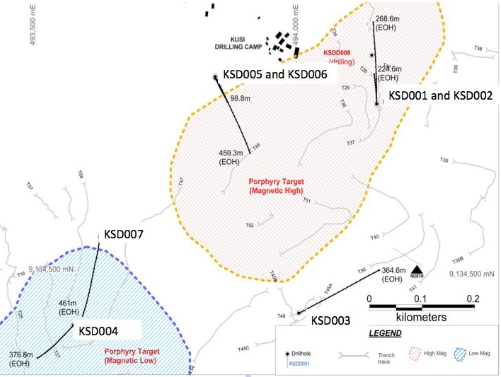
Diagram showing the location of drill holes completed to date. Source: Company announcement


Results from hole KSDD007 have indicated further gold mineralisation was intersected returning assays of:

35 metres at 3.04 grams per tonne gold from 136m, including 4m at 18.75g/t gold from 160m, and including 11m at 8.24g/t gold from 160m.

Pacific Niugini noted the high-grade results were part of a broad intersection of lower grade mineralisation which returned:

106m at 1.32g/t gold from 109m.

Hole KSDD006 also returned broad zones of low-grade gold, along with highly elevated copper, molybdenum, and zinc results, including:

17m at 0.22g/t gold, 1383ppm copper, 43ppm molybdenum, and 1913ppm zinc from 163.6m;

10m at 0.14g/t gold, 1218ppm copper, 70ppm molybdenum, and 805ppm zinc from 189m, including 4.65m of core loss; and

61m at 306ppm molybdenum from 202m, including 1.7m of core loss.

“Drill results to date are very exciting,” MGL general manager Dr Mark Lindsay said in Pacific Niugini’s announcement to the Australian Securities Exchange.

“Epithermal mineralization mapped over an area of 1500 metres by 300 metres, a multistage intrusion history with copper clearly associated with each stage, intense porphyry style alteration, and porphyry style veining all highlight the prospectively of the system and re-enforce the potential of a significant porphyry deposit nearby.

“The prospect clearly hosts a large hydrothermal system and Kusi could well be the next major mineral discovery in PNG.”

Pacific Niugini explained the current drilling program at the Kusi prospect is focusing on zones of high magnetic susceptibility adjacent to zones of magnetic destruction.

The company considers the magnetic anomalies correlate with surface geochemical results from manual trenching assays and grid based soil assays it has collected over the past three years.

The ongoing drilling will test both the magnetically enhanced and magnetically destructed anomalies within the prospect.

Email: admin@niugini.com.au

Website: www.niugini.com.au