Iron Road upgrades Central Eyre Resource

THE BOURSE WHISPERER: Iron Road has announced resource upgrade at the company’s 100 per cent-owned Central Eyre iron project (CEIP) in South Australia.

Iron Road has increased the Mineral Resources at CEIP from 1.33 billion tonnes to 2.10 billion tonnes, with 1.11 billion tonnes in the Indicated category.

The upgrade comes as part of an ongoing Mineral Resource expansion program at the Murphy South deposit.

Stage VI expansion drilling carried out by Iron Road at CEIP has added 770 million tonnes to the existing JORC Code compliant 1.01 billion tonne Mineral Resource estimate report for Murphy South for a total of 1.78 billion tonnes.
Iron Road said the Stage VI Mineral Resource estimate of 770Mt at 16.1 per cent iron compares favourably to the exploration target previously disclosed by the company for the program of 500-800Mt magnetite gneiss with a grade of 16 per cent to 18per cent iron.

The company said it considers the establishment of over two billion tonnes in Mineral Resources at CEIP demonstrates the project to have the necessary size and scale of resource to underpin the capital required for a potential long life initial 12.4 million tonnes per annum high-grade iron concentrate export operation in concert with the development of associated export infrastructure.

“The amount of iron resource at CEIP is now more than sufficient to underpin a long life project – having adequate resources is now a resolved challenge for the project,” Iron Road managing director Andrew Stocks said in the company’s announcement to the Australian Securities Exchange.

“We will continue to add Resources from ongoing drilling program, but the key tasks ahead for the company are now delivering the Definitive Feasibility Study currently underway, as well securing long term funding for the project.”

Australian Mines completes Mt Martin sale

THE BOURSE WHISPERER: Australian Mines has completed divestment of the Mt Martin tenements receiving the initial payments totalling $2.5 million.

The tenements are being transferred from Australian Mines to HBJ Minerals, a wholly-owned subsidiary of dual-listed (ASX and TSX) Alacer Gold.

Under the agreement HBJ is to pay a second instalment of $2.5 million on 29 June 2012, with a final $2.5 million instalment payable to Australian Mines on 28 June 2013.

Australian Mines said the funding from the will enable it to carry out an aggressive exploration program on its tenement portfolio located within Nigeria’s northwest gold province.


Location of Australian Mines’ tenement portfolio in northwest Nigeria. Source: Company announcement

This program includes completing detailed soil sampling programs that are currently underway on the company’s Yargarma and Kasele project areas, in addition to flying high-resolution airborne geophysical surveys over a number of priority targets within the first half of 2012.

Australian Mines also expects to spend a considerable amount of the $5 million it will receive from the second and third instalments to fund a series of reverse circulation (RC) drilling programs.

These drilling campaigns are anticipated to commence in the second half of 2012.

“This announcement constitutes very positive news for the company in allowing Australian Mines to focus wholly on our West African gold assets in Nigeria,” Australian Mines chief executive officer Benjamin Bell said in the company’s announcement to the Australian Securities Exchange.

“Furthermore, the payment of the second and third instalments totalling $5 million from the Mt Martin divestment sale ensures the company’s extensive exploration activities, including a significant amount of drilling, are fully-funded until 2014.”

Corazon upgrades EL target

THE BOURSE WHISPERER: Corazon Mining has upgraded the Exploration Target for the EL Deposit at the company’s Lynn Lake nickel sulphide project in Canada.

“The delineation of this target represents a significant step forward for Corazon,” Corazon Mining managing director Brett Smith said in the company’s announcement to the Australian Securities Exchange.

“It will allow us to complete high level mining studies and focus exploration on what is important.

“What we are about now is determining, with accuracy, the size and extents of the mineralisation.

“Mostly, in the short to medium term, we are looking forward to the process of proving up the size potential of our new discovery through ongoing drilling.”

Corazon’s new exploration target is supported by 72,300 metres of historical surface and underground drilling, as well as approximately 10,700 metres of surface core drilling undertaken by the company.


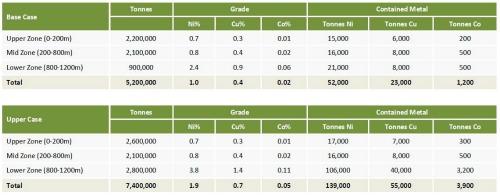
Exploration Target ranges for the EL Deposit, Lynn Lake nickel-copper
sulphide project. The numbers within the table have been rounded. Some
rounding errors may occur. Source: Company announcement

The exploration target now has a tonnage range of 5.2 million tonnes to 7.4 million tonnes, with contained metal of 52,000 tonnes to 139,000 tonnes of nickel, 23,000 tonnes to 55,000 tonnes of copper and 1,200 tonnes to 3,200 tonnes of cobalt.

The increase on the company’s previously released exploration target is mainly due to the discovery of a high-grade nickel sulphide breccia at depth below the historic EL Mine, called the Lower Zone, as well as the recognition in historical drilling of a substantial amount of near surface low-grade mineralisation, known as the Upper Zone.

Corazon said it considers the Lower Zone to be a significant and attractive exploration play.

The Lynn Lake mines were large-tonnage/low-cost operations that produced for 23 years at an average grade of 1 per cent nickel and 0.5 per cent copper.

Drilling is ongoing at Lynn Lake and Corazon will continue this program in 2012.

The company’s strategy is to now determine the size and extents of the newly discovered high-grade nickel-copper sulphide breccia.

This drilling will be used in the estimation of a new resource for the EL Deposit.

Corazon said it anticipates a Resource upgrade at the EL Deposit around mid-2012.

The project’s current resource of 1.8 Mt at 0.8 per cent nickel, 0.4 per cent copper and 0.02 per cent cobalt is an interim Inferred Resource to approximately 600 metres below surface.

It does not include the Lower Zone or much of the targeted mineralisation defined in the Upper Zone.

Equatorial extends ROC portfolio

THE BOURSE WHISPERER: Equatorial Resources has secured 100 per cent-ownership of two new Prospecting Authorisations for iron ore in the Republic of Congo (ROC).

The company claims the new acquisitions – the Oubouéssé Prospecting Authorisation for iron ore and the Moussondji Prospecting Authorisation for iron ore – are both contiguous to its 100 per cent-owned Mayoko-Moussondji iron project.

The new prospecting permits are held by Equatorial’s 100 per cent-owned ROC subsidiary, Congo Mining.

The company said the purchases confirm its position as a dominant land holder in the Mayoko region.


Mayoko region permit location map. Source: Company announcement

“Under the terms of the Republic of Congo Mining Code, a Prospecting Authorisation is granted for a period of 12 months,” Equatorial explained in its announcement to the Australian Securities Exchange.

“The Prospecting Authorisations give the company the right to conduct reconnaissance type exploration for the nominated commodity.

“An Exploration Permit gives exclusive permission to conduct more detailed exploration for an initial period of three years.

“Equatorial currently has two Exploration Permits, being the Mayoko- Moussondji Exploration Permit covering 1,000 square kilometres and the Badondo Exploration Permit covering 998 square kilometres.”

The 1,218sqkm Oubouéssé Permit extends to the south of Mayoko-Moussondji is traversed from top to bottom by a railway line connecting Mayoko to the port at Pointe-Noire.

Regular travel on the rail by Equatorial’s senior management and geological exploration has allowed it to identify a number of areas it has deemed prospective for iron mineralisation.

The 1,481sqkm Moussondji Permit extends to the west of both Mayoko-Moussondji and Oubouéssé and extends to the Gabon border.

Equatorial said geophysical data from an airborne magnetic survey flown over Mayoko-Moussondji has indicated magnetic anomalies prospective for iron mineralisation may extend west from Mayoko- Moussondji to the Moussondji Permit.

Beacon sells Barlee to Ramelius

THE BOURSE WHISPERER: Ramelius Resources has agreed to the purchase of 80 per cent of a mining lease from Beacon Minerals.

The minnig lease in question contains the Barlee gold project, located 200 kilometres north of Southern Cross in Western Australia.


Plan showing location of Lake Barlee Project and the Ramelius processing plants. Source: Company announcement

The consideration to be paid for the project is $4 million in cash and a staged royalty payment.

The purchase is subject to approvals under the ASX Listing Rules (including Beacon shareholder approval), Mining Act approvals and other standard conditions.

According to Ramelius’ announcement to the Australian Securities Exchange, Beacon Minerals has previously announced a resource for the project of 384,000 tonnes at 6 grams per tonne gold for 74,000 ounces of gold.

In addition, Beacon has recently lodged a Mining Proposal for the project.

The Mining Proposal was based on the extraction of gold from the Halleys East located within the Barlee project then trucking it to a nominated third party processing plant for toll treatment.

Key aspects of the Mining Proposal included:

–    An initial mining resource of 172,000 tonnes at 7.5 g/t gold for 42,000 ounces. This initial base mining resource is based on an economic optimisation which takes into account mining (both waste and ore quantities), trucking and processing costs. During the operating mine life these figures may vary depending on the economic drivers at the time;

–    Environmental studies indicated no endangered flora or fauna present in the ML; and

–    No registered Aboriginal heritage sites exist and there are no native claims within the project area.

The Barlee project is located between Ramelius’ Mt Magnet and Burbanks treatment plants.

Once it has completed the acquisition and gained the relevant mining approvals, Ramelius said it anticipates commencing mining at the project in 2012.

Mutiny upgrades Deflector resource

THE BOURSE WHISPERER: Australian Gold-Copper resources company Mutiny Gold has announced an upgrade in the company’s gold resources at its Deflector project 160 kilometres east of the Port of Geraldton in Western Australia.

The upgrade comes on the heels of Mutiny’s 2011 drilling campaigns into the Deflector deposit that were designed to delineate extensions of mineralisation both to the north and south of the previous resource.

Mutiny said this drilling enabled an upgrade of significant portions of the deeper West Lode mineralisation taking it from the Inferred to Indicated status.

The company indicated the 2011 drilling was focused on providing an appropriate quantity of Measured and Indicated resources in order to improve the Resource quality.

The main driver behind this was to attract the interest of a first tier international bank, as well as to ensure a robust resource capable of delivering a strong conversion to Reserves and to prove-up an initial mine life.

The upgraded resources represent a 50 per cent increase in the gold Measured plus Indicated Resources from 230,000 ounces of gold to 350,000 ounces of gold.

The previous 1,500,000 tonnes at 4.8 grams per tonne gold has been upgraded to 2,100,000 tonnes at 5.2 grams per tonne gold.

The Measured plus Indicated Resources also contain an additional 6,000 tonnes of copper metal.


Deflector Deposit Mineral Resources. Source: Company announcement


”Importantly the upgrade provides Mutiny with increased levels of confidence in the geology and grade of the deeper resources to the extent that a significant portion of them is eligible for conversion to reserves as part of the ongoing Definitive Feasibility Study,” Mutiny Gold managing director John Greeve said in the company’s announcement to the Australian Securities Exchange.

Mutiny Gold said it anticipates the Reserve upgrade will be completed by mid-February 2012.

Northern and Toro sign JV Agreement

THE BOURSE WHISPERER: Northern Minerals has signed a Joint Venture Heads of Agreement (HoA) with ASX-listed company Toro Energy.

The Agreement will allow Northern to earn up to 80 per cent interest in all mineral rights other than uranium within Toro Energy’s Browns Range tenements in the Northern Territory.
 

The HoA includes seven tenements comprising 1,403 square kilometres situated adjacent to Northern Minerals Browns Range project on the Western Australia / Northern Territory border.


Source: Northern Minerals announcement


Northern Minerals has identified high-grade Heavy Rare Earth Elements at Browns range and is aiming to be in production by 2015.

The agreement will expand Northern Minerals landholding on the Browns Range Dome, and will form part of the company’s broader HREE exploration and development program in 2012.

Under the terms of the HoA, Northern Minerals will spend $4 million on exploration over a three year period to earn a 51 per cent interest.

Northern Minerals has the option to increase its interest to 70 per cent, by spending an additional $2 million on exploration over a further two year period.

Northern Minerals can elect to complete a bankable or definitive feasibility study to increase its equity to 80 per cent.
 
Toro will retain all uranium rights on the tenements.

 “We are very pleased to have reached this agreement with Toro which gives us a dominant position in the region,” Northern Minerals managing director George Bauk said in the company’s announcement to the Australian Securities Exchange.

“It complements our strategy to expand our rare earth portfolio and it further bolsters the already exciting potential of our Browns Range REE project.”

“Our aim is to commence a strategic exploration program across the tenements as soon as possible, and test whether the geological setting identified at Browns Range continues into the NT.”

Northern Minerals said that exploration was expected to get underway in 2012, and will commence with airborne surveys over the seven tenements.

Minotaur cashes up on Tunkillia sale

THE BOURSE WHISPERER: Minotaur Exploration is six million dollars better off after selling off its share of the Tunkillia gold project in South Australia.

Minotaur said the sale will bolster its cash reserves and support an expanded exploration program through 2012 across its copper-gold tenements in the Gawler Craton of SA and around Cloncurry, Queensland.

The sale will see Minotaur dispose of its 55 per cent share in Tunkillia to ASX-listed resources company, Mungana Goldmines.

It will pay the diversified Adelaide-based explorer $4 million in cash and 3.08 million Mungana ordinary shares.


Location of the Tunkillia gold project in South Australia. Source: Minotaur Exploration announcement


“Minotaur intends to increase its activity level on all of its copper-gold prospects as these offer substantial upside through exploration success” Minotaur Exploration managing director Andrew Woskett said in an announcement.

“We have numerous drill ready geophysical targets plus new tenements awaiting ground based geophysics for 2012.

“The Tunkillia sale proceeds will therefore help service this expanded exploration spend ensuring Minotaur remains an active on-ground explorer through what is expected to be an extremely tough capital raising environment for juniors in 2012.”

The Tunkillia gold project contains a JORC compliant resource of 15.6 million tonnes at 1.6 ggrams per tonne gold for 803,000 ounces of gold.

The new owner of the project, Mungana Goldmines, said the acquisition marks the next milestone in its strategy to position itself as a mid-tier gold producer over the next 3 years.

Mungana’s flagship project, Red Dome is the current subject of a feasibility study, targeting gold production of 120,000 ounces and copper production of 20,000 tonnes per annum, scheduled for completion in June 2012.

“In assessing the project, Mungana has identified the potential to quickly grow the resource and develop a medium-sized gold mine,” Mungana said in its ASX announcement.

“Post the acquisition, Mungana will remain focused on progressing its Mungana gold project towards production in 2013.

“The company will retain a strong cash position to fund its Bankable Feasibility Study and aggressive exploration program in North Queensland.”

By acquiring the 55 per cent controlling interest in the Tunkillia gold project, Mungana will take over as manager in a Joint Venture with Helix Resources.

Completion of the deal is subject to satisfaction of remaining conditions, including FIRB approval.

Mungana said it is expected to be completed no later than the end of January 2012.

Golden Rim acquires Burkina Faso permit

THE BOURSE WHISPERER: Golden Rim Resources has finalised an agreement to acquire an additional gold exploration permit in Burkina Faso in West Africa.

The Tanlili permit covers an area of 162.1 square kilometres and is located immediately south of Golden Rim’s Zanna permit.

The Tanlili permit is situated 14.4 kilometres south of the 1.93 million ounce Karma gold project of Riverstone Resources and 6km west of the 0.6 million ounce Sega gold project of Orezone.

Location of Tanlili permit. Source: Company announcement


Tanlili hosts the Margo artisanal mining site where gold mineralisation was discovered in 1986 and has been continuously worked since.

According to Golden Rim, Margo is one of the largest artisanal sites in Burkina Faso.

Pelle South is another artisanal site located on the Tanlili permit, which consists of two parallel zones, each approximately 300m long and 60m wide.

Each of the parallel zones at Pelle South has been drill tested with a single hole.

A reverse circulation hole testing the eastern zone intersected three zones of mineralisation, returning:

15 metres at 2.08 grams per tonne gold from 14 metres;

13m at1.63 g/t gold from 31m; and

4m at 2.15 g/t gold from 52m.

Drilling on the western zone intersected:

6m at1.1 g/t gold from 45m.

“We have sought the Tanlili permit for some time now and it’s acquisition fits in with our strategy of consolidating our ground positions in our key project areas,” Golden Rim Resources managing director Craig Mackay said in the company’s announcement to the Australian Securities Exchange.

“We are very pleased to gain access to drill the broad zone of gold mineralisation that has been exposed at the Margo artisanal site.

“Both Margo and Pelle South are attractive walk-up drilling targets for Golden Rim.

“Currently we are looking to move our RC rig to Tanlili once we have completed the current drilling program on our Balogo project.”

Golden Rim is also in the process of organising a high resolution airborne magnetic survey over the combined Zanna and Tanlili permit areas.

It anticipates the results of tehse surveys will allow its geologists to interpret the structural and lithological controls on the currently identified gold mineralisation and enable the company to plan systematic geochemical sampling programs to test additional target areas.

Modun declares Mongolian Maiden

THE BOURSE WHISPERER: Mongolia-focused coal exploration play Modun Resources has announced a maiden JORC coal resource of 489 million tonnes at its wholly-owned Nuurst project.

The company acquired the 34.5 square kilometre project in June this year, which is located 120 kilometres south of Mongolia’s capital Ulaanbaatar.

Modun claimed the resource estimate is almost double its previous targets of 200Mt to 300Mt, adding the result has confirmed potential to develop the project into a large scale thermal coal mine.

“The JORC Reportable coal resource has confirmed our belief that we have a valuable asset to develop,” Modun Resources managing director Chris Mardon said in the company’s announcement to the Australian Securities Exchange.

“The close proximity to infrastructure and a major coal market adds to the potential for a large scale project.

“These results propel Modun to having one of the largest tonnage coal resources of the ASX-listed companies currently operating in Mongolia.

“Furthermore, we believe we have a substantial project on just 16 per cent of the licence area.

“We also see significant exploration upside – we are yet to unlock the full value of this licence.”


Nuurst project location. Source: Company announcement

According to the company rail infrastructure is located six kilometres from Nuurst providing a direct transport option to the Chinese border, which is 610km away.

Modun also said the project’s resource combined with its coal seam thickness should translate into a low stripping ratio, which lends itself to a large scale, low cost mining operation.

The fast timing of the resource discovery from the acquisition of the project six months ago has Modun planning to immediately commence a Scoping Study.

Modelling already carried out by the company has suggested the resource is open to the north and becomes shallower.

The company said it will be focusing on this area throughout its 2012 exploration program, which will target further coal seams.

In addition, the company will progress a mining licence application.