Panax inches closer to lighting up PTDPM

THE BOURSE WHISPERER: Panax Geothermal is closer to the development of up to 25 megawatts of geothermal power for PT Dairi Prima Mineral’s underground lead and zinc mine in northern Sumatra.

The company has received approval of the final mining licences and permits for the PTDPM mine.

The company said the Indonesian Ministry of Forestry had granted the project’s Underground Mining Licence on 15 November.


Location of the PTDPM mine. Source: Panax Geothermal web page


Panax signed a Binding Terms Sheet Agreement in August 2010 with PT Bakrie Power and PTDPM for the supply of up to 25 megawatts of geothermal power required for the operation of the mine.

This Terms Sheet Agreement is currently being finalised into a formal Power Purchase Agreement.

Once the project is up and running, it will supply up to 25 megawatts of geothermal power to the Dairi Prima underground mine at $US150 per megawatt hour for the first eight years and $US125 per megawatt hour thereafter.

Panax and PT Bakrie Power will also be entitled to each receive 50 per cent of all carbon credits generated from the geothermal project.

“Receiving licence approval was the final hurdle before PTDPM was able to proceed with its project development, with first production scheduled to occur by late calendar 2013,” Panax Geothermal managing director Kerry Parker said in the company’s announcement to the Australian Securities Exchange.

“Now that PT Dairi Prima Minerals has received these final approvals, Panax can look at advanced project planning and timeframes to start developing the geothermal project.

“This means that we are one step closer to achieving geothermal production and our first cash flow.”

Once it has achieved that mark Panax claims it will become the first Australian-based geothermal exploration and development company to produce electricity on a commercial basis from geothermal sources.

Minotaur releases Muster Dam Resource

THE BOURSE WHISPERER: Minotaur Exploration has announced the maiden JORC Inferred Resource for its Muster Dam deposit.

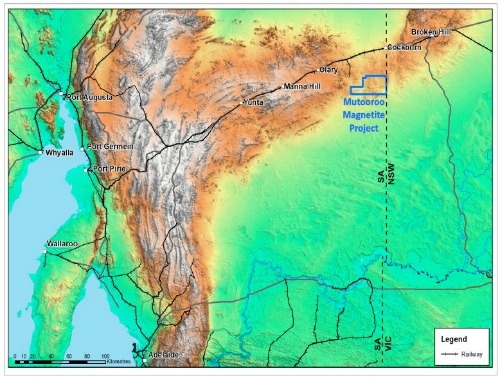
The Muster Dam deposit is one of a number of magnetite prospects Minotaur holds within the Mutooroo Magnetite project in South Australia.


Location of the Mutooroo Magnetite deposits in South Australia. Source: Company announcement


The new Inferred Resource for Muster Dam has been estimated by independent consultants Hellman and Schofield to be 1.5 billion tonnes at a Davis Tube Recovery (DTR) of 15.2 per cent magnetite.

“The issue of a JORC reported Inferred Resource represents a major milestone for the Mutooroo Magnetite project,” Minotaur Exploration said in its ASX announcement.

“It confirms the Muster Dam deposit has the scale and grade to produce the required throughput of a high-quality magnetite concentrate.

“In particular, the extremely low level of deleterious elements measured in the concentrate suggests that the product will be attractive to blast furnace consumers.

“It also confirms the continuity of grade in the formation and provides significant confidence in the ability of the other prospect areas to add significantly to the tonnage of magnetite mineralisation at similar grades.”

The assessment for the calculation of the new Resource was based on the analysis of nearly 3,000 DTR samples carried out at 45 micron grind size.

Minotaur completed a total of 49 Reverse Circulation (RC) and 10 diamond holes on a section spacing of approximately 400 metres.

Samples were composited over 4m or 5m intervals and analysed for DTR per cent magnetite.

XRF analyses for total iron and other elements were also carried out on the samples prior to DTR work (“head” samples) and on the DTR concentrate.

The Mutooroo Magnetite project is a Joint Venture between Sumitomo Metal Mining Oceania (59.1%) and Minotaur Exploration (40.9%).

The project is located 100 kilometres southwest of Broken Hill and, according to Minotaur, is laterally consistent, well bedded, magnetite-bearing strata in the Mutooroo area occurring over a strike extent of around 40 kilometres.

The recent Muster Dam drilling covered just six kilometres of strike length of the magnetite-bearing Braemar Iron Formation.

Murchison walks off Oakajee project

THE BOURSE WHISPERER: The worst kept secret of the last week was revealed when Murchison Metals announced it had entered into a conditional sale agreement with Japanese company Mitsubishi in relation to all of the former’s interests in Crosslands Resources.

Crosslands Resources is the owner of the Jack Hills expansion project, and the much anticipated Oakajee Port and Rail project.


Proposed site of the Oakajee port. Source: OPR web site

Speculation had been mounting since Murchison was placed in a self-imposed trading halt earlier this week that Mitsubishi would emerge to take control of the $6 billion Oakajee port and rail project with $325 million straining the seams of its trouser pockets.

After it has managed to offload its Crossland interests Murchison will have no ongoing exposure to the risks associated with project development, or the requirement to continue funding their ongoing development.

As it clicked the top of its biro over the agreement, Murchison agreed to continue funding Crosslands and OPR through to completion.

It has agreed to support interim budgets for the period from 1 January 2012 to 31 March 2012, capping its net exposure to the interim budgets at $11.2 million.

Subject to a pro rata scale back the transaction should be completed before 31 March 2012.

Now with a whack of cash, some early stage projects in the Pilbara region of Western Australia, and a reasonable amount of debt; it will be interesting to see where the company heads to from here.

The transaction is subject to a limited number of conditions. These include gaining the approval of Murchison shareholders at a meeting scheduled to occur prior to 15 February 2012.

Under the terms of the transaction, Murchison is free to continue to seek superior proposals up until and if it gets the nod from shareholders.

Should the Murchison Board opt to change its recommendation supporting the transaction, recommends a third party proposal or terminates the Share and Asset Purchase Agreement due to a superior proposal it will be liable to pay a break fee of $3 million.
 
“The company has tested third party interest in Murchison and its assets over recent months, and at this time it is the Board’s unanimous view that the transaction is in the best interests of shareholders,” Murchison Metals managing director Greg Martin said in the company’s announcement to the Australian Securities Exchange.
 
“The Murchison team has worked extremely hard to unlock value for its shareholders in recent months, and it is our view that the transaction represents a solid outcome in very challenging circumstances.

“Mitsubishi has put forward an offer that represents a good financial result for Murchison shareholders, although we will also continue to pursue discussions with other parties to give shareholders comfort this is the best option available.”

That Murchison has decided to pull the pin shouldn’t really be all that surprising.

Hindsight is often quoted as being a wonderful thing and a passage from the company’s update to the market in October probably should have raised more eyebrows than it did.

 “Murchison considers that the project schedule is largely dependent on the resolution of commercial arrangements between OPR and its targeted foundation customers,” the company said.

“To date, agreement on these commercial arrangements has not been achieved, such that the project development schedule remains uncertain.

“Murchison believes that restructuring the ownership of OPR represents the best means of achieving a commercial outcome that meets the needs of all parties and would enable the projects to proceed.

“Consequently, Murchison is actively engaging, or seeking to engage, with all stakeholders and parties with an interest in the development of the projects, including the WA Government, to achieve such an outcome.”

There’s no more certain way of ‘restructuring the ownership of OPR’ than selling it.

Gold Anomaly announces PNG Resource

THE BOURSE WHISPERER: Gold Anomaly has completed a maiden resource estimate in accordance with JORC guidelines for its Nevera prospect, part of the company’s Crater Mountain gold project in Papua New Guinea.

The Inferred Resource at Nevera comprises 24 million tonnes at 1.0 grams per tonne gold for 790,000 ounces of gold.

“This maiden resource marks a major milestone for the company, confirming the potential for Crater Mountain to ultimately become PNG’s next major gold discovery,” Gold Anomaly executive chairman Greg Starr said in the company’s announcement to the Australian Securities Exchange.

“This is truly an exceptional result given that we only launched our maiden drilling program some 12 months ago.

“We are excited that several of our drill holes have encountered extensive gold mineralisation mirroring that of previous exploration at Nevera.

“As such, our efforts today are confirming the views of previous owner BHP that considered Crater Mountain as a tier‐1, highest prospectivity asset.”


Drill locations of Nevera prospect. Source: Company announcement

The maiden resource estimate at Nevera only considers drilling the company has carried out within approximately 60 per cent of the Main Zone identified to date, and does not include the artisanal zone.

The company said that this zone is still partly open along strike, and it anticipates it will be able to increase the resource with more drilling in the coming months.

Gold Anomaly plans to extend its exploration activities to adjacent prospects Masi Creek and Nimi in 2012, which it considers to have similar surface geology, mineralisation and alteration to that at Nevera.

Now that the company has established an initial resource for Nevera, it has planned preliminary metallurgical testwork for early in the New Year.

Potash West increases domestic portfolio

THE BOURSE WHISPERER: Potash West has entered into an agreement with Ochre Resources, a wholly-owned subsidiary of Heron Resources.

The agreement will allow Potash West to earn a 70 per cent interest in the Langley project, which the company describes as, “A large, potentially glauconite rich, project in Western Australia’s north west”.


Langey project location plan. Source: Company announcement

Under the agreement Potash West will:

–    Earn a 51 per cent interest in the project by meeting expenditure commitments for 2 years, or spending $225,000;

–    Earn a 70 per cent interest by meeting expenditure commitments for a further 1 year, or spending $400,000; and

–    Free carry Ochre to a Bankable Feasibility study, or until the expenditure of $5 million.

The Langey project covers an area of 162 square kilometres and is situated 60 kilometres south of Derby, in the Kimberley Region of WA.

The project has already been subjected to exploration by Heron, which has carried out over 2,200 metres of RC drilling intersecting continuous glauconite and phosphate mineralisation at shallow depth over a tested strike of 14km.

Other activites undertaken at the project include geological modelling, costeaning and preliminary metallurgical evaluations.

Potash West said flotation tests on the phosphate nodules have produced a concentrate grading 31 per cent phosphorous with 81 per cent recovery.

Potash West and Heron are currently planning the next phase of exploration work at Langey.

This work is expected to include collection of a bulk sample for process testwork and completion of resource estimate studies.

“Previous drilling has shown a widespread, consistent layer with elevated potassium and phosphorous levels,” Potash West managing director Patrick McManus said in the company’s announcement to the Australian Securities Exchange.

“The project could benefit from the application of technology we are developing for our flagship Dandaragan Trough glauconite project in the Mid West region of Western Australia.

“With growing international demand for potash-rich fertilisers and the WA Government’s recently confirmed plans to significantly expand the Ord River agricultural area in the Kimberley Region, the Langley Project is ideally located to supply both global and domestic marketplaces.”

Western Desert rings Bing Bong bell

THE BOURSE WHISPERER: Western Desert Resources has signed a Memorandum of Understanding with Xstrata Zinc to investigate the feasibility of gaining access to the latter’s McArthur River mine loading facility at Bing Bong on the Gulf of Carpentaria.

The ability to access the Bing Bong facility would accelerate Western Desert’s plans to ship iron ore from its Roper Bar iron ore project located in the Northern Territory.


Proposed access road, Roper Bar project ‐ Bing Bong load facility. Source: Company announcement

The company said the being able to ship its product through the established facility would reduce the immediate need for investment in new pipeline infrastructure to Maria Island, which it had previously proposed.

“Accessing the Bing Bong facility would create significant capex savings and accelerate the export schedule for Western Desert Resources,” company managing director Norm Gardner said in an announcement to the Australian Securities Exchange.

“This could be the single most important development for the company since finding this project.

“Accessing an established loading facility would be a significant step in our transition from explorer to iron ore producer.”

The new thinking would result in Western Desert, subject to feasibility and necessary approvals, building an access road of approximately 160 kilometres from the Roper Bar project area to Bing Bong.

The company has estimated a reduction in capital expenditure of approximately $50 per annualised tonne of iron ore.
 
Access to Bing Bong would also accelerate Western Desert’s development time frame bringing the expected commencement date of iron ore to late 2012 to early 2013, 12 months earlier than the company had initially planned.

A feasibility study will be conducted to investigate whether the loading facility will be able to meet the initial needs of WDR to handle 2.5 to 3.0 million tonnes per annum.

The two companies have agreed to a three month study that will investigate the feasibility of Western Desert accessing the loading facility and constructing separate barging, storage and loading facilities.

Monax sweeps up Chilean iron sands

THE BOURSE WHISPERER: Monax Mining has signed an option agreement over an iron sands project in Chile, South America.

Under the terms of the agreement, Monax will have 90 days to carry out due diligence on the Huentelauquen iron sand project.


Location of Huentelauquen iron sand project, Chile. Source: Company announcement

During this period, the company said it will complete a ground-penetrating radar survey to estimate the volume of sand within the leases.

It has also engaged project engineering firm, Sinclair Knight Mertz (SKM), to undertake a scoping study based on available information to assess the project economics and potential processing options.

“The Huentelauquen iron sand project is a significant new project for Monax, not only due to the potential of the actual venture, but also because it is located within a mining friendly jurisdiction in Chile,” Monax Mining managing director Gary Ferris said in the company’s announcement to the Australian Securities Exchange.

“Iron sand deposits have many advantages over traditional hard rock sources of magnetite including lower cost exploration, lower mining costs and lower processing costs.”

The four granted mining leases cover an area of 855 hectares and are located along the coast near the settlement of Huentelauquen, 35km north of Los Vilas, and about 200km north of Santiago.

The leases are located close to existing infrastructure including the sealed coastal highway and port facilities at Los Vilas.

Monax said proposed processing stages will be compared with those used in typical mineral sands industries and the appropriateness of those stages will also be examined.

“A conceptual flow sheet showing the major processing stages will be prepared, while mining and concentration methodologies will be studied at a high level to verify the appropriateness of the methodology considered in the reports,” Ferris said.

“Based on the geology, a suitable mining and concentration method will be examined.

“A high level cost estimate for the mining and concentration plant and beneficiation plant will also be prepared and compared with the proposed estimate.”

Northern Minerals confirms Browns Range HREE

THE BOURSE WHISPERER: Northern Minerals has received final assay results from a Heavy Rare Earth Element (HREE) drilling program carried out at Browns Range, located in northern Western Australia.

The company said besides confirming HREE mineralisation at the first four targets at Browns Range, the drilling has returned the highest grades of HREE received to date at the project and has confirmed the Wolverine HREE prospect to be an, “outstanding discovery”.


Wolverine Prospect – Drill cross section. Source: Company announcement

 Northern Minerals is encouraged enough by the results to now move the project toward production, with further drilling and scoping studies set to commence in the coming months.

The drilling results also included the highest HREE grades received to date, from a hole at the Area 5 prospect.

Best intersections from the latest assay results include:
 
At Wolverine:

24 metres at 2.18 per cent Total Rare Earth Oxides (TREO) (2,072 parts per million dysprosium) from 96 metres (to End Of Hole) including 7 metres at 5.35 per cent TREO (5,151ppm dysprosium) from 112 metres;

6m at 2.68 per cent TREO (2,321ppm Dy) from 99m (to EOH), including 2m at 6.71 per cent TREO (5,838ppm Dy) from 103m (to EOH); and

5m at 1.1 per cent TREO (979ppm Dy) from 95m;

Area 5 and Area 5 North:

4m at 7.14 per cent TREO (6,712ppm Dy) from 4m, including 2m at 13.9 per cent TREO (13112ppm Dy) from 4m;

3m at 2.13 per cent TREO (944ppm Dy) from 70m;

19m at 0.73 per cent TREO (517ppm Dy) from 56m, including 3m at 1.66 per cent TREO (1339ppm Dy) from 62m;

3m at 1.23 per cent TREO (1,040ppm Dy) from 1m;

3m at 1.41 per cent TREO (1,093ppm Dy) from 14m;

7m at 1.08 per cent TREO (868ppm Dy) from 67m; and

3m at 1.62 per cent TREO (1,281 ppm Dy) from 44m.

“These results have surpassed our expectations, and have really established Browns Range as an exciting HREE project,” Northern Minerals managing director George Bauk said in the company’s announcement to the Australian Securities Exchange.
 
“We are now moving as quickly as possible to take the project forward, and the next milestones are to define a JORC resource and complete scoping studies which we are aiming to do in the first half of next year.

“Based on these results, Northern Mineral’s strategy is to develop a project to produce and deliver 3,000 tonnes per annum contained HREO in concentrate in 2015.”

Hastings releases scoping study results

THE BOURSE WHISPERER: Hastings Rare Metals has received the results of a recently completed scoping study on its 100 per cent-owned Hastings heavy rare earth project located near Halls Creek in the Kimberley Region of Western Australia.

The company said that the study results highlight the project’s potential to deliver excellent returns on the back of current strong market fundamentals for heavy rare earths in both the medium and long term.

It claims the project comprises one of the richest heavy rare earth deposits in the world today.


Source: Company announcement

The study assumed an initial mine life at Hasting of 15 years, however the company regards this to be a conservative estimate.

Based on the current JORC-compliant 36 million tonnes Inferred and Indicated Resource, the company asserted it anticipates the project to have a potential operational life exceeding 20 years.

“The scoping study results demonstrate the excellent potential for commercial success of Hastings’ heavy rare earth project,” Hastings Rare Metals technical director Steve Mackowski said in the company’s announcement to the Australian Securities Exchange.

“Completion of the scoping study is a major milestone, confirming the value of historical test work and the pilot plant in positioning the company years ahead of other heavy rare earth project.

“The study provided invaluable insight for ongoing metallurgical test work and future bulk processing trials, exploration and infill drilling.”

The internal scoping study primarily considered various production scenarios based on a plant capacity of one million tonnes per annum producing a combination of critical heavy rare earth oxides and rare metal products.

The study modelled an openpit mining operation and the on-site production of marketable products.

Based on the study, Hastings Rare Metals said the project now has a net present value in excess of $500 million.

“This is a world-class resource and there is great scope to further develop the project through pre-feasibility and bankable feasibility studies,” Mackowski added.

“The positive results of the study follow completion of a large drilling program and release of a new 36 million tonne JORC-compliant resource in September 2011, which included for the first time assays for all rare earth elements and identification of previous test work results at the Hastings’ heavy rare earth project.”

Carpentaria increases Hawsons NPV

THE BOURSE WHISPERER: Carpentaria Exploration has raised the estimated net present value (NPV) of its Hawsons iron project to $3.2 billion.

The increase has been based on lower projected operating costs used in a recent mining option study.

The Hawsons iron project is located 60 kilometres from Broken Hill and includes an Inferred magnetite Resource of 1.4 billion tonnes at a Davis Tube Recovery of 15.5 per cent (12 per cent cut off) and an Exploration Target of six billion tonnes to 11 billion tonnes at 14 per cent to 17 per cent DTR.

This includes up to 1.9 billion tonnes of high grade magnetite concentrate.

The increased NPV represents a rise of 14 per cent from the company’s pre-feasibility study and is based on modelling of in-pit crushing and conveying by GHD with significantly reduced mining cost estimates compared to conventional truck haulage.

According to Carpentaria Exploration executive chairman Nick Sheard the company views the new results as very pleasing as they boost the prospects of a new mine being established at Hawsons.

“This builds on an already robust financial model and development concept and shows the benefits of a very large and simple deposit,” Sheard said in the company’s announcement to the Australian Securities Exchange.

“In-pit crushing and conveying is an established mining method and well suited to the Hawsons deposit, importantly it has not yet been optimised and further cost reductions are possible.”

Carpentaria described the in-pit crushing and conveying technology it intends using as a preferred option for large openpit mines with high outputs.

The systems offer advantages over traditional truck haulage by reducing haulage distances.

It also reduces the costs involved with trucks due to lower maintenance costs, reduced road preparation, fewer movements during operations, less energy consumption and longer life span.

In addition to the in-pit crushing and conveying, Carpentaria said it is also working on processing cost savings, including capital costs, to maximise the benefits of the soft ore at Hansons and its amenable magnetite liberation.
 
“These ongoing improved project results show the potential of Hawsons to become a company-making project for Carpentaria and an ongoing source of wealth for shareholders,” Sheard continued.

“Carpentaria will continue to work to reduce costs and strive to produce magnetite at a comparable cost to West Australian hematite producers.”