Batteries Generating Market Buzz

COMMODITY CAPERS: If you haven’t heard rumblings in recent times regarding the rise of global battery markets, then you really haven’t been paying enough attention.

The world received its first lithium-ion battery in 1980 when it fell off the drawing board of American inventor John Goodenough.

From humble beginnings they went on to take over the world, being responsible for powering so many of the devices we use every day, such as our phones, computers and televisions.

Climate change and carbon emissions have combined to provide the perfect storm for Li-ion batteries thanks to their use in the development of electric vehicles (EVs).

This is by no means a new phenomenon.

In 2017 EVs had become the environmental touchstone and were predicted back then to dominate the market sooner, rather than later, due mainly lower costs for battery manufacturing and commitments from car companies to establish themselves as market leaders.

In its Electric Vehicle Outlook 2017 report, Bloomberg New Energy Finance noted just how quickly EVs would start to dominate the global car market.

“By 2040, 54 per cent of new car sales and 33 per cent of the global car fleet will be electric,” Bloomberg said.

“Falling battery prices will bring price-competitive electric vehicles to all major light-duty vehicle segments before 2030, ushering in a period of strong growth for electric powertrain vehicles.

“While EV sales to 2025 will remain relatively low, we expect an inflection point in adoption between 2025 and 2030, as EVs become economical on an unsubsidized total cost of ownership basis across mass-market vehicle classes.”

That was then and just last year more than 2.6 million electric vehicles were sold in the world’s two emerging major EV markets, with Europe selling almost as many plug-in electric cars as China a trend that is showing no signs of slowing down this year.

Western European plug-in electric car sales rose to 12.3 per cent of car sales in 2020, while in China EV sales hit 5.4 per cent of the broader market in 2020.

Australia should not be left out of any discussion concerning the purchase of electric cars.

If there is a new status symbol in town, Australians, particularly those in the West are always eager to cut in line for their bit of the action.

In its 2021 August/September Horizons members’ magazine the Royal Automobile of Western Australia declared the state to be on the way to 2000 registrations of EVs, with the WA Department of transport data affirming 1819 EVs had been registered by March 2021.

“These included battery electric vehicles (BEV), plug-in hybrid electric vehicles (PHEV) and fuel cell electric vehicles (FCEV),” RACWA said.

“Of these, 1393 were BEV, 411 were PHEV and 15 were FCEV.

“The most common BEV was the Tesla Model 3, at 426, followed by the Nissan Leaf (201) and the Tesla Model S (149).”

Battery market growth creates unique opportunities for Australian producers of key commodities, notably lithium, graphite and cobalt.

“Already, demand for batteries and associated technologies has changed the game for producers of lithium, cobalt and graphite, turning them into outliers at a time when other commodities are undergoing price falls and declining investment,” the Department of Industry, Science, Energy and Resources said.

“Time and technological change will show whether the battery boom can drive wider change in global markets and energy models.

“Investment is being drawn by the promise of electric vehicles, and by the potential for community-generated solar power to displace grid monopolies and fossil fuels.

“This investor interest is, in turn, generating sizeable funds dedicated to further research and development.

“Commodity demand will be strong in the short term, but long-term prospects for battery technology are still in motion.

“The potential opportunities are vast, and investment and production decisions of today could cast a long shadow into the future.”

Australia ranks fourth globally for lithium deposits and is currently the largest producer of lithium.

Source: DISER: Resources and Energy Quarterly June 2021

The country hosts substantial resources of spodumene, potentially making it a major producer over the longer term.

Graphite is used for a range of products, including lubricants, foundry operations, brake linings, and steelmaking, with the use of graphite in batteries on the rise.

China is currently the main producer of graphite, but there is noise from countries such as Brazil and Turkey that they too could host greater reserves than what is presently known.

Australia’s reserves of graphite are comparatively modest, and at this stage there are no operating graphite mining projects, however, a range of projects are currently being progressed.

Refined cobalt supply is expected to fall below consumption, which is being pushed up by demand from Li-ion batteries and aerospace industries and advancements are suggesting developing battery technologies may require less cobalt.

Until that time cobalt will need to be found somewhere, and again China leads the refined cobalt producer pack, owning 70 per cent of global refinery capacity.

What is advantageous to potential Australia producers is that the bulk of cobalt is sourced from mines in the Democratic Republic of Congo, where there is increasing concern over the use of child labour and environmental damage.

Australia has significant cobalt reserves, although there are no dedicated cobalt mines in operation with most cobalt mined as a by-product of copper, gold or nickel mining.

Around 40 of Australia’s gold and nickel operations are co-located with some form of cobalt deposit.

If you think this is all going unnoticed by the country’s mining industry, think again

At the 30th Diggers & Dealers Mining Forum in Kalgoorlie this year, there was any number of companies more than willing to talk up their battery metals credentials that are combining to contribute to a revolutionary transformation of the traditional nature of the mining sector.

One such company was IGO Limited (ASX: IGO), which concluded the forum by taking out the prestigious Dealer of the Year Award at the closing night Gala Dinner.

Speaking during his presentation spot on Day One, IGO managing director and chief executive officer Peter Bradford went through the company’s recent transition from a diversified producer seven years ago with two profitable but short-life base metals mines and a 30 per cent minority stake in the Tropicana gold mine (with international partner AngloGold Ashanti) to one specifically focused on metals that are critical to a green energy world.

The movement began with IGO’s acquisition of the Nova nickel-copper project in WA through a friendly takeover of Sirius Resources in 2015.

As Nova reached commercial production, the company then known as Independence Group saw crystal ball opportunities of the emerging demand for battery metals to drive a global trend towards clean energy.

A subsequent change of tack that included the sale of its Tropicana stake to Regis Resources, resulted in IGO holding a unique portfolio of nickel, copper, lithium and cobalt assets in a Tier 1 jurisdiction and further exploration projects focused on discovery of the next generation of nickel and copper mines.

Bradford said the company’s impetus was its belief in a green energy future, “and our belief that we can make a contribution to a better planet.”

COVIC-19 didn’t succeed in driving the climate change conversation away, but it did ramp it up.

“COVID hit the pause button on the planet, we paused power production, we paused industry and we paused transportation,” Bradford said.

“As a result, we all got an opportunity to see what could be. Places around the world that haven’t seen clean air for generations were able to see clear blue skies.

“That’s allowed all of us to visualise what could be possible and how we could make a contribution for future generations.

“Our strategy is to be a globally significant supplier of clean energy metals and a diverse suite of products made safely, ethically, sustainably and reliably.

“To my knowledge, we are the only company globally that produces that one-stop for electric vehicle battery metals.”

Source: IGO Diggers & Dealers Presentation

Batteries are now the tip of the global manufacturing iceberg.

A report prepared in June this year for the Future Battery Industries Cooperative Research Centre (FBICRC) by Accenture determined that diversified battery industries could contribute $7.4 billion annually to Australia’s economy and support 34,700 jobs by 2030.

The report concluded that Australia now has a major economic opportunity to leverage its competitive advantages to become a dominant supplier of battery minerals and expand its role within a growing global industry.

“This report provides a compelling business case for Australia to develop into a competitive player in the international batteries industry, and Australia has many strengths for succeeding in this ambition,” Stedman Ellis, CEO of the FBICRC said.

“We are shining a light on the different segments of an industry in which Australia can be a leader, and there is substantial economic value to gain if we capture the opportunity.”

The report lays down a pathway for Australia over the next ten years, during which time the opportunity exists for real industry growth, shaped by changing international relationships and driven by technological improvements in batteries, increasing demand for energy storage and regulatory changes to energy systems.
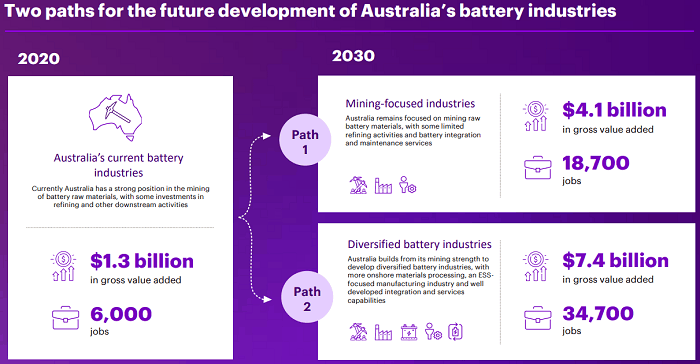
Source: Accenture – Future Charge: Building Australia’s Battery Industries Report

Demand for batteries has grown steadily but is now forecast to accelerate, increasing nine to ten-fold over the next decade, with sales expected to reach US$133-151 billion by 2030.

I think we would all like a piece of that.


Black Cat Syndicate Takes Kal East Resources to 1.2M Ounces

THE DRILL SERGEANT: Black Cat Syndicate (ASX: BC8) reported an increase to the total Resources at the company’s Kal East gold project near Kalgoorlie in Western Australia.

Black Cat Syndicate was able to do so via an update to the Majestic Mining Centre JORC 2012-compliant Mineral Resource with the inclusion of two maiden Resources from the Crown and Jones Find deposits.

The two deposits have added 95,000 ounces sitting within 1.5 kilometres of the planned 800,000 tonnes per annum processing facility at the Majestic Mining Centre.

Black Cat explained there has been no previous mining on either deposit, adding they have been converted into Resource at a combined discovery cost of less than $4 per ounce.

These new shallow Resources total 2.2 million tonnes at 1.4 grams per tonne gold for 95,000 oz and increase total Resources at the Kal East gold project to 17.5 million tonnes at 2.1g/t gold for 1.2 million ounces.

Both Resources remain open along strike and at depth with extensional drilling at Jones Find to begin this week.

Since its initial listing in January 2018, Black Cat has steadily built Resources from zero to over 1 million ounces through a combination of discovery, acquisition, and extensional drilling.

The company has achieved this at an estimated discovery cost of approx. $21/oz and an acquisition cost of $6.5/oz.

“The maiden Resources for Crown and Jones Find are within two kilometres of our planned processing facility at the Majestic Mining Centre so are high priority for our proposed mine plans,” Black Cat Syndicate managing director Gareth Solly said in the company’s ASX announcement.

“Neither deposit has seen modern mining and both are open along strike and at depth and will feature in future extension and upgrade drilling programs.

“Current drilling programs are infilling and growing the Majestic underground and Fingals open pit Resources.

“Furthermore, extensional drilling at Jones Find is commencing this week and drilling at the Crown deposit is expected in the December 2021 quarter.

“Additional discovery drilling is planned on multiple exploration targets at Kal East in 2021.”


TO READ THE FULL ANNOUNCEMENT: CLICK HERE


Email: admin@blackcatsyndicate.com.au


Web: www.blackcatsyndicate.com.au


Blackstone Minerals Maintains Nickel Strike Form at Ta Khao Project

THE DRILL SERGEANT: Blackstone Minerals (ASX: BSX) has drilled further value at the company’s Ta Khoa nickel-copper-PGE project in Northern Vietnam.

Blackstone Minerals reported assay results from a maiden drilling program carried out at the Ban Khoa Disseminated Sulphide (DSS) prospect at the Ta Khoa project.

Blackstone considers Ban Khoa to be a bulk tonnage open pit opportunity with potential to provide mine life extension and complement mining at the nearby large Ban Phuc open pit deposit.

The Ban Khoa DSS prospect is being targeted for inclusion in the company’s upcoming Upstream Business Unit (UBU) Pre-Feasibility Study (PFS).

Highlights from the maiden drill program include:

BK21-11
147metres at 0.31 per cent nickel, 0.04 per cent copper, 0.01 per cent cobalt and 0.14 grams per tonne PGE from 62m, including 34.65m at 0.55 per cent nickel, 0.08 per cent copper, 0.01 per cent cobalt and 0.37g/t PGE from 103.7m, including 10.6m at 1.06 per cent nickel, 0.11 per cent copper, 0.02 per cent cobalt and 0.88g/t PGE from 123.3m;

BK21-10
67.7m at 0.33 per cent nickel, 0.04 per cent copper, 0.01 per cent cobalt and 0.19g/t PGE from 105.3m and 32.1m at 0.48 per cent nickel, 0.08 per cent copper, 0.01 per cent cobalt and 0.33g/t PGE from 193.1m; and

BK21-08
60.2m at 0.37 per cent nickel, 0.07 per cent copper, 0.01 per cent cobalt and 0.09g/t PGE from 208.6m, including 10.8m at 1.03 per cent nickel, 0.13 per cent copper, 0.02 per cent cobalt and 0.39g/t PGE from 210.2m.

“We are pleased to present the results of Blackstone’s first drill program at the Ban Khoa prospect,” Blackstone Minerals managing director Scott Williamson said in the company’s ASX announcement.

“Ban Khoa is a bulk tonnage disseminated opportunity with excellent potential to completement mining and processing of material from the large Ban Phuc open pit orebody.

“We look forward to presenting a maiden resource for Ban Khoa as part of Blackstone’s UBU PFS.

“We are confident that the current reported drilling results are indicative of the significant geological upside that Blackstone will continue to unlock at our flagship Ta Khoa nickel-copper-PGE project.”


TO READ THE FULL ANNOUNCEMENT: CLICK HERE


Email: admin@blackstoneminerals.com.au


Web: www.blackstoneminerals.com.au


Golden Mile Resources to Reassess Quicksilver Metallurgy

THE DRILL SERGEANT: Golden Mile Resources (ASX: G88) has committed to a second phase of metallurgical testing on the company’s 100 per cent-owned Quicksilver nickel-cobalt project, located just outside Perth, in the Wheatbelt Region of Western Australia.

The decision follows a desk top review recently completed by leading nickel laterite processing engineers Wood Mining and Metals Australia to assess the potential of the Quicksilver project to produce a concentrate on site for either export from one of several nearby ports, processing by an existing local refinery or downstream processing by the Company.

The Wood review noted limitations in earlier test work, leading the engineers to recommended further metallurgical investigations focused on a less energy intensive conceptual flowsheet.

Golden Mile’s previous metallurgical testwork identified potential to beneficiate the Quicksilver mineralisation, however these studies were limited by focussing on assessing the direct acid leaching performance.

The Quicksilver project currently has a resource of 26.3 million tonnes at 0.64 per cent nickel and 0.04 per cent cobalt for more than 16,000 tonnes of contained nickel.

“We are very pleased to join forces with Wood to initiate further metallurgical test work looking at beneficiation options to upgrade the nickel resource at the Quicksilver nickel-cobalt project,” Golden Mile Resources managing director James Merrillees said in the company’s ASX announcement.

“This is an obvious opportunity to extract value for our shareholders, and we see the potential for a low-cost operation to produce a beneficiated product for export through nearby ports or feed to a local Western Australian nickel refinery.

“The Quicksilver beneficiation testwork will get underway at the same time as we push hard to progress on-ground exploration at our exciting Yarrambee copper-zinc project, where geophysical crews will be in the field later this month in preparation for drilling.”


TO READ THE FULL ANNOUNCEMENT: CLICK HERE


Email: info@goldenmileresources.com.au


Web: www.goldenmileresources.com.au


Great Boulder Resources Scores 150g/t Gold Hit at Mulga Bill

THE DRILL SERGEANT: Great Boulder Resources (ASX: GBR) announced a substantial gold hit from recent Reverse Circulation (RC) drilling at the Mulga Bill prospect within the company’s Side Well gold project in Western Australia.

Great Boulder Resources conducted the drilling as part of a third phase of RC it completed at Mulga Bill completed between late June and early July.

First assays to be received from the Phase 3 RC drilling at Mulga Bill have returned the highest grades the company has recorded to date at the Side Well project.

Highlights include:

21MBRC034
14m at 36.12 grams per tonne gold from 91m, including 3m at 149.89g/t gold from 91m;

21MBRC034
6m at 24.33g/t gold from 132m, including 4m at 34.86g/t gold from 134m; and

21MBRC036
2m at 9.61g/t gold from 100m.

“These results demonstrate the high-grade potential at Mulga Bill,” Great Boulder Resources managing director Andrew Paterson said in the company’s ASX announcement.

“We’re learning more about the potential of this project with every drill program.

“Given its location, size and the results we’ve seen to date I think Mulga Bill has the potential to have a plus million ounce gold endowment.

“These holes were drilled at the start of July, indicating assay results are currently taking eight weeks to report.

“We have over 4,000 samples in the pipeline which we’ll be reporting as soon as results are available.”


TO READ THE FULL ANNOUNCEMENT: CLICK HERE


Email: admin@greatboulder.com.au


Web: www.greatboulder.com.au


Kin Mining Eyes Mount Flora as Potential Large Mineralised System

THE DRILL SERGEANT: Kin Mining (ASX: KIN) reported on follow up air-core (AC) drilling undertaken at the Mount Flora prospect, located 20 kilometres from the company’s 100 per cent-owned 1.23 million ounces Cardinia gold project (CGP) near Leonora in Western Australia.

Kin Mining reported the drilling had intersected zones of shallow, high-grade, gold mineralisation, returning several strong intercepts such as:

MF21AC710
8 metres at 3.75 grams per tonne gold from 32m; and

MF21AC715
16m at 1.16g/t gold from 24m.

These results were encountered along strike from drill-hole MF21AC522 which intersected:

22m at 8.96g/t gold from 24m.

Other results included:

MF21AC524
8m at 2.79g/t gold from 28m.

Kin Mining declared the results confirmed the discovery of an important zone of new mineralisation, which has rapidly elevated the Mount Flora prospect as a priority for the company’s exploration team.

“While still early days, Mt Flora has all the hallmarks of a significant new discovery which is quite different to what we’ve seen in the Cardinia area before,” Kin Mining managing director Andrew Munckton said in the company’s ASX announcement.

“The aircore drilling has so far outlined a substantial mineralised position in the eastern side of our tenure and an additional smaller zone in the north-west.

“The eastern zone contains numerous ore grade hits in shallow drilling within a zone extending over at least 700 metres in length and up to 150 metres wide.

“New intersections such as 8m at 3.75g/t gold and 16m at 1.16g/t gold support earlier spectacular intersections such as 22m at 8.96g/t gold and 8m at 2.79g/t gold in the first pass of shallow air-core drilling in a new area.

“The eastern zone has been intersected on all eight lines of 100m spaced drilling returned to date and remains open to the north and east – suggesting that this is shaping up as a potential discovery of considerable scale and potential for Kin.

“Given the widespread nature of the ore grade intercepts we have seen, we will now move to a broad-spaced RC and diamond drilling program at Mt Flora as a priority.

“We will be pushing hard to get the first deeper drilling into this area as quickly as possible while we wait for the remaining assays to confirm potential extensions to the eastern mineralisation and the other complementary zones.

“Mount Flora formed part of the original Kin Mining IPO but has had relatively little exploration attention until recently when the regional exploration program commenced.

“This program is targeting potential satellite discoveries which can be complementary to our central Cardinia asset.”


TO READ THE FULL ANNOUNCEMENT: CLICK HERE


Email: info@kinmining.com.au


Web: www.kinmining.com.au


Foreign Minister Acknowledges Australian/African Cooperation

THE CONFERENCE CALLER: Western Australia is probably the most difficult state to enter at present, especially so for international travellers.

This meant this year’s Africa Downunder Conference in Perth became a televisual feast as government officials from around the resource-rich continent were required to send pre-recorded video presentations.

The hard state border meant the Federal Minister for Foreign Affairs; Minister for Women, Senator the Hon. Marise Payne joined the conference in the same way.

The Minister opened her address by noting Australia and Africa share strong economic and people to people links with, “vibrant diaspora communities and robust trade and investment”.

“In 2019, two-way trade was valued at almost $11 billion,” Payne told her viewing audience.

“Our engagement in agriculture, energy and professional services is growing, and our mining sector remains a key contributor to economic jobs growth and prosperity.”

Payne paid tribute to the role that Australian companies play in Africa.

“I know many of the people who make those companies successful are participating today in Africa Down Under,” she said.

“You represent large and small companies: those that explore and extract gold and other traditional minerals, as well as those who find and supply the critical minerals that are essential to new technologies and to global efforts to reduce carbon emissions.

“Across the African continent, you’re working to identify and develop resources essential to Australia’s, and Africa’s, prosperity.

“I want to say thankyou for working to open new markets and to grow our global supply chains.

“Companies are providing training and employment opportunities for young people and I pay particular acknowledgement to those companies that are encouraging more women into the industry and empowering them to be leaders in the mining sector.”

The Minister also paid homage to the work that African governments are doing to enhance trade.

“The African Continental Free Trade area is the largest in the world, in terms of the number of countries participating,” Payne continued.

“Many of you contribute to unlocking opportunities to improve the livelihood of Africans and to create a more prosperous market.”

Payne declared Australia’s desire to work with African nations saying Australia’s nine High Commissioners and Ambassadors across Africa are more than happy to work with the Continent’s Nations to help reduce barriers to investment and operations.


Miramar Resources Identifies New EM Targets

THE DRILL SERGEANT: Miramar Resources (ASX: M2R) informed the market of a review of historical data, from which it has identified multiple electro-magnetic (EM) conductors.

Miramar Resources has identified the EM conductors within the Dooley Downs tenement application (aka E09/2484) within the company’s Bangemall nickel-copper-PGE project in the Gascoyne region of Western Australia.

E09/2484 is one of seven 100 per cent-owned granted Exploration Licences and/or Applications held by Miramar in the Bangemall region.

The company believes the Bangemall project to be prospective for craton-margin nickel-copper-PGE mineralisation, such as that discovered at Nova-Bollinger and Nebo-Babel, and the giant Norilsk and Voisey Bay deposits.

Miramar plans to model the EM data and will field-check the anomalies once the tenement is granted.


TO READ THE FULL ANNOUNCEMENT: CLICK HERE


Email: info@miramarresources.com.au


Web: www.miramarresources.com.au


Aurumin Encounters High-Gold-Grades at Mt Dimer

THE DRILL SERGEANT: Aurumin (ASX: AUN) reported assay results from recent Reverse Circulation (RC) drilling undertaken at the company’s 100 per cent-owned Mt Dimer project, north-east of Southern Cross in Western Australia.

Aurumin conducted the RC drilling at seven deposits and prospects across the Mt Dimer project.

Mt Dimer is a historical high-grade production centre that produced over 125,000 ounces of gold, including open pit and underground production of 600,000 tonnes at 6.4 grams per tonne gold.

Drilling highlights included:

Lightning

LTRC2106
4 metres at 48.69 grams per tonne gold from 104m, including 1m at 153.5g/t gold from 106m;

LO3

L03RC2106
5m at 19.26g/t gold from 61m, including 1m at 54.8g/t gold from 62m; and

L03RC2107
8m at 5.7g/t gold from 100m, including 1m at 21g/t gold from 102m.

T12

TMDRC2101
4m at 2.76g/t gold from 15m, including 2m at 4.02g/t gold from 16m; and

TMDRC2102
8m at 2.58g/t gold from 22m, including 2m at 4.4g/t gold from 26m.

“This is a tremendous intercept at the historically high-grade Mt Dimer production centre,” Aurumin managing director Brad Valiukas said in the company’s ASX announcement.

“These latest results both extend known mineralisation and progress T12 towards being declared a new deposit, further supporting our view of Mt Dimer having potential for multiple high-grade open pits.

“We are continuing to improve our understanding of the project, and these results support our revised interpretation of lithology, fluid pathways and prospective areas.

“Drilling is planned to recommence at Mt Dimer next month as we look to follow up these high-grade intercepts and increase the value of the project.”


TO READ THE FULL ANNOUNCEMENT: CLICK HERE


Email: admin@aurumin.com.au


Web: www.aurumin.com.au


Auroch Minerals Commences Nepean and Saints Scoping Studies

THE DRILL SERGEANT: Auroch Minerals (ASX: AOU) announced commencement of scoping studies at both its Nepean (Auroch Minerals 80%) and Saints nickel projects in Western Australia.

Auroch Minerals is conducting the studies to evaluate the economic viability of several mining scenarios at Nepean, including an initial open-pit mine of the known shallow high-grade nickel sulphide mineralisation which it believes could generate cash flow in the short to medium term, as well as potential underground mining scenarios of the known high-grade nickel sulphide mineralisation.

A scoping study of potential underground mining scenarios at the high-grade Saints nickel project will be run in parallel to the studies at Nepean, looking at taking advantage of synergies between the projects to reduce the overall costs of the studies.

Saints currently hosts a high-grade JORC 2012-compliant Resource of 1.05 million tonnes at 2 per cent nickel and 0.2 per cent copper for over 21,000 tonnes of contained nickel.

Auroch has an existing offtake agreement in place for Saints with BHP Nickel West.

Ore from the historic nickel mine at Nepean, when in production, was processed at the Kambalda Nickel Operations that BHP is currently preparing to re-start early next year.

Auroch has initiated the scoping studies to build upon these existing relationships with BHP and evaluate the viability of several mining scenarios that may lead to nickel sulphide production and cash flow in the medium term.

“We are very pleased to join forces with P1 Australasia and initiate scoping studies at our Saints and Nepean nickel sulphide projects,” Auroch Minerals managing director Aidan Platel said in the company’s ASX announcement.

“With the nickel price consistently around US$19,000 per tonne and forecast to increase, we believe there is great potential to take both projects forward to production and hence generate significant cash flow for the company in the medium term, and so we are eager to evaluate the economic viability for several different mining scenarios at these two projects.

“We have developed a good relationship with the processing team at BHP and have an existing off-take with them for Saints, so we are keen to develop this further and to potentially build a solid business case to provide high-grade nickel sulphide feed for their processing facilities to produce Class 1 nickel products required for batteries for the fast-growing electric vehicle (EV) market.

“Parallel to these studies, we continue with our aggressive exploration for a new nickel sulphide discovery across all three of our WA nickel projects.

“Our exciting Nepean Deeps diamond drill program beneath the historic Nepean nickel mine is currently underway, with the first hole NPDD008 on target and on schedule at a depth of approx. 400 metres.

“The hole is planned to reach a depth of 1,200 metres and we look forward to keeping the market informed of its progress.”


TO READ THE FULL ANNOUNCEMENT: CLICK HERE


Email: admin@aurochminerals.com


Web: www.aurochminerals.com