Blackstone Minerals Encounters More Ban Chang Nickel

THE DRILL SERGEANT: Blackstone Minerals (ASX: BSX) attracted a crowd at its booth at the New World Metals Conference in Perth following the release of an update on infill drilling from the Ban Chang target at the company’s Ta Khoa nickel-copper-PGE project in Northern Vietnam.

Ban Chang is the most advanced massive sulphide vein (MSV) target at the Ta Khoa project.

The drilling results included a highlight of 5.35 metres of massive sulphide nickel intersected in drill hole BC21-66.

Other intercepts include:

BC21-18
3.8 metres at 1.13 per cent nickel, 0.59 per cent copper, 0.06 per cent cobalt and 0.52 grams per tonne PGE from 92.5m, including 1.6m at 2.49 per cent nickel, 0.65 per cent copper, 0.14 per cent cobalt and 1.01g/t PGE from 93m;

BC21-23
1.83m at 1.57 per cent nickel, 0.32 per cent copper, 0.09 per cent cobalt and 0.96g/t PGE from 82.39m, including 1.27m at 2.01 per cent nickel, 0.42 per cent copper, 0.12 per cent cobalt and 1.13g/t PGE from 82.39m;

BC21-24
1.52m at 1.95 per cent nickel, 0.42 per cent copper, 0.1 per cent cobalt and 0.78g/t PGE from 51.02m; and

BC21-34
13.85m at 0.51 per cent nickel, 0.33 per cent copper, 0.03 per cent cobalt and 0.3g/t PGE from 56m, including. 4.13m at 1.16 per cent nickel, 0.72 per cent copper, 0.07 per cent cobalt and 0.67g/t PGE from 65.72.

“We look forward to presenting a maiden resource at Ban Chang and incorporating the successful outcomes of infill drilling into a mine plan as part of our Upstream Business Unit PFS,” Blackstone Minerals managing director Scott Williamson said in the company’s ASX announcement.

“Drilling at Ban Chang is tightly spaced and has consistently intersected massive sulphide mineralisation, providing a high level of confidence as we progress through the next phases of mine development.”


TO READ THE FULL ANNOUNCEMENT: CLICK HERE


Email: admin@blackstoneminerals.com.au


Web: www.blackstoneminerals.com.au


Green Hydrogen: Aspiring Towards 2050 Zero Emissions Energy Production

COMMODITY CAPERS: Opening the book on ‘Green Hydrogen’ a reader would most likely be surprised to read of the collaboration between former Australian Prime Minister Malcolm Turnbull and mining magnate Andrew ‘Twiggy’ Forrest.

The two gents are co-founders of the Green Hydrogen Organisation (GH20), which advocates clearer boundaries between green hydrogen made using renewables, and supposedly ‘clean’ H2 as a by-product from the fossil fuel sector, such as blue hydrogen, which is made from fossil gas linked to carbon capture and storage (CCS).

H2, also called molecular hydrogen, is a gas which forms when two hydrogen atoms bond together and become a hydrogen molecule.

It is the most common form of Hydrogen because it is stable with a neutral charge.

The thinking behind the formation of GH20 is to provide green hydrogen with its very own organisation for representation around global energy table talks.

This is because the emerging technology requires a different set of policy settings and investment decisions, as opposed to fossil fuel hydrogen.

Speaking at a Clean Energy Council webinar earlier this year, Forrest said Australia needs to set a target for green hydrogen as a contributing factor in the Nation’s quest to reach net zero emissions by 2050.

“This is our last chance to slow, then stop, the planet cooking,” he said.

“I am not in the doomsday business; I’m an optimist, and I am in the solutions business.

“My answer is renewable green hydrogen.

“The answer isn’t to stop mining iron ore, which is critical to the production of steel, and to humanity.

“The answer is green zero-emissions energy to make all iron ore and steel.

“If it is not renewable green, don’t be fooled by any other colour-coded spin.

“Any other colour than renewable green is dirty hydrogen.”

The potential for hydrogen as a potential source of clean energy is well-founded, especially when you consider one kilogram of hydrogen contains about 2.4 times as much energy as natural gas.

The only input needed to release this energy is oxygen and the only output is water, the consequences being that, as an energy source, hydrogen produces zero greenhouse gas (GHG) emissions.

However, to be able to utilise it as a source of energy, hydrogen must be in its pure form, which means it must be extracted from another material.

Depending on the source material used, the hydrogen produced is graded into colours to acknowledge the GHG emission profile.

The brighter, more user-friendly members of the rainbow spectrum, such as green, blue, even turquoise and pink, have lower emissions, while the gloomier colours of grey, brown and black produce higher emissions.

Green hydrogen is extracted using a method that does not produce GHG emissions and as a result is considered sustainable and environmentally friendly.

“Green hydrogen is most commonly produced using a device called an electrolyser,” Commonwealth Scientific and Industrial Research Organisation (CSIRO) said in a CSIROscope article.

“Electrolysers use electricity to split water into hydrogen and oxygen.

“The key to this method of producing green hydrogen is that the electricity that powers the electrolyser comes from renewable sources, such as wind, solar, which have no associated GHG emissions.”

Blue hydrogen is produced using a process called ‘steam reforming’, which uses steam to separate hydrogen from natural gas.

Production of blue hydrogen does produce GHGs, however carbon capture and storage technologies can be used to capture and store those emissions.

“Hydrogen has exciting potential as an emerging source of clean energy,” CSIRO said.

“But not all hydrogen is the same.

“Colours help to differentiate between the types of hydrogen.

“The colours, however, can be distracting from the main game.

“Hydrogen will only achieve its goal of being a clean source of energy if it does not generate emissions during production.”

CSIRO is not the only body with a positive outlook for the role hydrogen from renewable energy could potentially play in the global energy transformation.

The International Renewable Energy Agency (IRENA) has said in its Hydrogen: a renewable energy perspective report, “hydrogen from renewable power, so called green hydrogen, could translate into eight per cent of global energy consumption by 2050.”

At this time, IRENA anticipates some 16 per cent of all generated electricity would be used to produce hydrogen by 2050.

“Green hydrogen could particularly offer ways to decarbonise a range of sectors where it is proving difficult to meaningfully reduce CO2 emissions.”

According to the Department of Industry, Science, Energy and Resources (DISER) Hydrogen is a priority low emissions technology for Australia.

DISER said producing clean hydrogen under $2 per kilogram (H2 under 2) is a priority stretch goal under the federal government’s 2020 Low Emissions Technology Statement.

In the statement, Minister for Energy and Emissions, Angus Taylor outlines the government’s intention to continue to invest in mature technologies, such as coal, gas, solar, and wind via its Technology Investment Roadmap research and development strategy.

“The Government’s efforts will focus on new and emerging technologies with the potential for transformational economic and emissions outcomes, in Australia and globally,” Taylor says.

“Getting these technologies right will create jobs, and preserve and expand our energy-intensive export industries.

“We will beat our 2030 emissions reduction target, with a platform for future emissions reductions beyond the next decade.

“This technology-led approach won’t compromise energy affordability or reliability, and will position Australia as a global technology leader.”

DISER outlined the aims of the strategy to include:

Delivering more affordable, clean and reliable energy to households and industry for transportation, heating, production and power;

Expanding production and increasing productivity, creating jobs and substantially reducing emissions from Australia’s primary industries;

Preserving and expanding onshore manufacturing of energy-intensive products and capturing new export markets for low emissions commodities; and

Scaling geological and biological sequestration such that we provide globally significant permanent sequestration of CO₂.

Hydrogen hasn’t featured very high on too many top ten lists of interesting things in recent times, despite it being the most common chemical in the universe.

This is a bit unfair, especially given Hydrogen is a multi-talented chemical, which in musical theatre terms would be described as a ‘triple threat’, in that it can be produced as a gas or liquid, or made part of other materials, enabling it to be used in myriad forms, including as fuel for transport or heating, a way to store electricity, or as a raw material in industrial processes.

The government is now talking up the green credentials of hydrogen, by highlighting it can be produced using renewable energy or processes, enabling it to be stored as a form of renewable energy for use at a later time when it is needed.

The strategy was supported this year when government agency, Australian Renewable Energy Agency (ARENA) announced funding to support a feasibility study by Rio Tinto to investigate the potential to partially decarbonise its alumina refining operations using renewable hydrogen.

Historically, alumina refining has used natural gas to achieve the high temperatures necessary in the calcination process.

The Rio Tinto study will investigate the technical implications of displacing natural gas with renewable hydrogen at the company’s Yarwun alumina refinery in Gladstone, Queensland.

“If we can replace fossil fuels with clean hydrogen in the refining process for alumina, this will reduce emissions in the energy and emissions intensive refining stage of the aluminium supply chain,” ARENA CEO Darren Miller said.

“Exploring these new clean energy technologies and methods is a crucial step towards producing green aluminium.

“This study will investigate a potential technology that can contribute to the decarbonisation of the Australian alumina industry.

“If successful, the technical and commercial lessons from Rio Tinto’s study could lead to the implementation of hydrogen calcination technology, not only in Australia, but also internationally.”

IRENA noted the falling cost of renewables is advantageous to the potential of green hydrogen.

This is particularly for so called ‘hard-to-decarbonise’ sectors and energy-intensive industries and the global desire to clean them up and to limit CO2 emissions.

“Large-scale adoption of hydrogen could also fuel an increase in demand for renewable power generation,” IRENA said.

“In total, IRENA sees a global economic potential for 19 exajoule (EJ) of hydrogen from renewable electricity in total final energy consumption by 2050.

“This translates into around 4-16 terawatts (TW) of solar and wind generation capacity to be deployed to produce renewable hydrogen and hydrogen-based products in 2050.”

As IRENA says, the introduction of hydrogen-based solutions will not happen overnight, and the technology is more than likely to be at the rear of the global pack, unless governments start to get super serious.

“Green hydrogen could make a substantial contribution to the energy transition in the long run,” IRENA said.

“(The Agency’s Report)…recommends acknowledging the strategic role of hydrogen in the transition and at the same time calls on governments and private sector to better understand energy system benefits, cost-reduction and investment requirements to tap into the potential of a hydrogen future.”


Miramar Resources Hits High-Grade Gold at Glandore

THE DRILL SERGEANT: Miramar Resources (ASX: M2R) reported results from the first drilling campaign at the company’s 100 per cent-owned Glandore project in the Eastern Goldfields region of Western Australia.

The Glandore project is located approximately 40 kilometres east of Kalgoorlie in proximity to a number of existing and/or proposed gold mining and/or processing operations.

Miramar Resources declared its first aircore drilling campaign completed at Glandore has outlined a 600 metres long zone of regolith gold anomalism south of Lake Yindarlgooda, with results up to:

GDAC015
2 metres at 4.78 grams per tonne gold.

Drilling has demonstrated a northeast trending zone, defined by results of greater than 0.25g/t gold, remains open onto Lake Yindarlgooda towards the East Target, where historic drilling intersected high-grade supergene and primary gold mineralisation.

The company plans to infill the recent results with further aircore drilling and test the interpreted north-eastern strike extension with the lake aircore drilling campaign.

“The Glandore project provides another fantastic opportunity for our company to make a significant gold discovery close to Kalgoorlie,” Miramar Resources executive chairman Allan Kelly said in the company’s ASX announcement.

“Like Gidji, Glandore is very underexplored despite some significant high-grade gold results.

“We are therefore looking forward to systematically testing the project given our first aircore campaign has already turned up results worthy of follow up.”


TO READ THE FULL ANNOUNCEMENT: CLICK HERE


Email: info@miramarresources.com.au


Web: www.miramarresources.com.au


Venture Minerals Declares Mount Lindsay Tin Discovery

THE DRILL SERGEANT: Venture Minerals (ASX: VMS) has claimed a new tin discovery at the company’s Mount Lindsay tin project in Tasmania.

Venture Minerals recently completed exploration drilling at Mount Lindsay on a priority tin target it had delineated along strike from the high-grade Renison Bell tin mine.

This drilling has intersected 16 metres of potentially tin bearing sulphide rich, magnetite skarn.

The new skarn discovery is located within the extension of the Renison Mine Sequence, host to one of the world’s largest and highest-grade tin mines.

The diamond drilling program undertaken by Venture was designed to test extensions of the Renison Mine Sequence, with drillhole ML337 specifically targeting a coincident electromagnetic (EM) and surface geochemical anomaly, favourably located on highly prospective carbonate units that typically dominate the Renison Mine Sequence.

ML337 intersected an alteration halo over 150 metres thick, containing a 16m wide skarn mineralisation zone dominated by magnetite and sulphides typical of those seen in the company’s adjacent Mount Lindsay Deposit, which it enjoys telling anybody listening is one of the largest undeveloped tin deposits in the world, containing in excess of 80,000 tonnes of tin metal.

“Immediate success from the first exploration drilling at Mount Lindsay since 2013, has seen the discovery of a substantial skarn system immediately along strike from one of the world’s most significant and high-grade tin mines (Renison Bell Mine) and adjacent to Venture’s Mount Lindsay tin deposit located within Australia’s premier tin district,” Venture Minerals managing director Andrew Radonjic said in the company’s ASX announcement.

“The discovery of a potential new tin-bearing skarn system so close to the company’s flagship tin deposit delivers Venture an excellent opportunity to add to the already significant resource base at Mount Lindsay.

“Consumers and investors are becoming extremely focused on ESG-compliant sourcing of tin, Mount Lindsay is well positioned to meet this demand, being in a ESG compliant jurisdiction, with access to renewable hydropower, combined with the company’s commitment to minimizing its carbon footprint, through planned underground mining and processing strategies.”


TO READ THE FULL ANNOUNCEMENT: CLICK HERE


Email: admin@ventureminerals.com.au


Web: www.ventureminerals.com.au


Pilbara Minerals Increases Pilgangoora Resource to 309Mt

THE DRILL SERGENT: Timing, they say, is everything in this world and Australian lithium producer, Pilbara Minerals (ASX: PLS) announced a substantial increase in the Mineral Resource at it’s the company’s 100 per cent-owned Pilgangoora lithium-tantalum project just days out from the New World Metals Conference in Perth.

Located in the Pilbara region of Western Australia, Pilbara Metals said the update to the project’s Resource estimate has reinforced its claim to be the world’s premier hard rock lithium operation.

The updated Resources represents a 39 per cent increase in the total Measured, Indicated and Inferred Resource, growing to 308.9 million tonnes at 1.14 per cent lithium oxide (Li2O), 105ppm tantalum pentoxide (Ta2O5) and 0.59 per cent iron (III) oxide (Fe2O3), containing 3.5 million tonnes of Li2O and 71.7 million pounds of Ta2O5.

The numbers also show a 59 per cent increase in the total Measured and Indicated Resource to 210.2 million tonnes grading 1.17 per cent Li2O, 103ppm Ta2O5 and 0.56 per cent Fe2O3, containing 2.46 million tonnes of Li2O and 47.7 million pounds of Ta2O5.

With an increased cut-off grade of 0.5 per cent Li2O, the total Measured, Indicated and Inferred lithium Resource amounts to 277.2 million tonnes at 1.22 per cent Li2O containing 3.4 million tonnes of Li2O.

All this before the tantalum by-product credits are taken into consideration.

The updated JORC 2012-compliant Mineral Resource incorporates all historical data including drilling data acquired through several exploration campaigns completed by Pilbara Minerals between November 2014 and June 2021.

The update also includes the integration of the former Altura lithium operations Mineral Resource.

“This landmark Resource upgrade is another clear indication of Pilgangoora’s position as the world’s premier hard-rock lithium asset,” Pilbara Minerals managing director and CEO Ken Brinsden said in the company’s ASX announcement.

“The scale of the endowment is quite remarkable, with the integration of the adjoining Ngungaju Resource, combined with highly successful development and drilling programs, taking our Resource inventory well and truly to the next level.

“We are looking forward to completing an updated Ore Reserve next month that will underpin operations for many decades to come.

“Against the backdrop of surging global demand for lithium raw materials, Pilgangoora is incredibly well positioned to play a pivotal role in the accelerating global energy transformation.”


TO READ THE FULL ANNOUNCEMENT: CLICK HERE


Web: www.pilbaraminerals.com.au


Rox Resources Identifies Potential Parallel Youanmi Gold Lode

THE DRILL SERGENT: Rox Resources (ASX: RXL), and Joint Venture partner Venus Metals Corporation (ASX: VMC), reported identification of a potential new parallel lode at the Youanmi gold mine within the JV’s Youanmi gold project near Mt Magnet in Western Australia (Rox 70% and Manager, VMC 30%).

The identification came during drilling at Youanmi that intersected high-grade mineralisation in a newly defined position in the hanging wall to the main lode structure.

Rox Resources said the high-grade intersection in the untested hanging wall area reveals potential for new lode:

RXDD022
4 metres at 45.5 grams per tonne gold from 341m, including 1.33m at 129.3g/t gold from 341.75m (new hanging wall zone at Junction).

Further high-grade gold intercepts were received from infill and extension drilling at Junction, including:

RXDD024
16m at 4.22g/t gold from 56m, including 3m at 16.4g/t gold from 66m and 3m at 4.1g/t gold from 203m (Junction); and

RXRC398
3m at 15.17g/t gold from 108m and 3m at 3.35g/t gold from 204m (Junction)

Drilling remains on track to deliver further increases in the Youanmi gold resource.

Rox said the identification of high-grade mineralisation at Junction and the new hanging wall zone demonstrates the potential for new discoveries at Youanmi as the company continues to build confidence in its exploration strategy.

“We are very pleased to report strongly mineralised intersections in a newly identified structure near the Youanmi mine and up-sequence from the main-lode ore body,” Rox Resources managing director Alex Passmore said in the company’s ASX announcement.

“This an exciting development as it lies within a previously untested area.

“In addition, extension and infill drilling at Junction continues to deliver high-grade results that will contribute to resource growth at Youanmi and is likely to add ounces in crucial areas that will improve project economics.”


TO READ THE FULL ANNOUNCEMENT: CLICK HERE


Email: admin@roxresources.com.au


Web: www.roxresources.com.au


Azure Minerals Metallurgical Testwork Produces Pleasing Nickel-Copper Concentrates

THE DRILL SERGENT: Azure Minerals (ASX: AZS) reported pleasing results from initial metallurgical testwork of nickel and copper sulphide ore from the company’s Andover project (60% Azure / 40% Creasy Group), located in the West Pilbara region of Western Australia.

Azure Minerals commissioned a metallurgical testwork program focused on developing an economic processing flowsheet for ore from the VC-07 East nuckel-copper deposit by producing saleable nickel and copper sulphide concentrates in either separate or combined form.

Stage 1 of the metallurgical testwork program comprised both sulphide flotation and comminution (crushing and grinding) testwork.

The program achieved excellent recoveries and to produce high-grade nickel-cobalt and copper concentrates, with low levels of deleterious elements.

Additionally, an internationally marketable bulk concentrate was also produced.

“These very positive results from the Stage 1 testwork program indicate that we will be able to produce high quality, high grade, clean concentrates with excellent recoveries and I am confident that further optimisation studies will continue to deliver additional improvements,” Azure Minerals managing director Tony Rovira said in the company’s ASX announcement.

“Metallurgical factors and results play a critical role in evaluating project viability, and to have produced marketable nickel and copper concentrates using a relatively simple and robust industry-standard flow sheet, at such an early stage, bodes well for the project as we move through the development studies process.”


TO READ THE FULL ANNOUNCEMENT: CLICK HERE


Email: admin@azureminerals.com.au


Web: www.azureminerals.com.au


Bellevue Gold Raises $106M

THE BOURSE WHISPERER: Bellevue Gold (ASX: BGL) provided early morning Friday risers something to talk about by announcing it has received firm commitments for a $106 million fully-underwritten share placement to institutional investors at 85 cents per share.

Bellevue Gold said the proceeds of the Placement will combine with an existing $200 million debt facility to fund the development of the company’s Bellevue gold project in Western Australia.

“The strong demand from institutions around the world reflects the quality of the Bellevue Gold Project, the exceptional free cashflow generation forecast and the immense potential for further growth,” Bellevue Gold managing director Steve Parsons said in the company’s ASX announcement.

“With the project fully-funded to production, we will proceed full-steam ahead with development while maintaining a strong emphasis on further growth by increasing and upgrading the Mineral Resources and Ore Reserves.

“The Stage Two Feasibility Study is based on a Resource of 1.5 million ounces, which represents just half of the total three million ounces Resource base at Bellevue.

“We have already announced a host of high-grade drilling results outside that Resource, we have another 14,000 samples awaiting assay and there are now two rigs drilling from underground.

“This multi-pronged approach to expanding the Resource is aimed at growing the mine life, which will increase the already-strong financial results forecast in this Study.”


TO READ THE FULL ANNOUNCEMENT: CLICK HERE


Email: investors@bellevuegold.com.au


Web: www.bellevuegold.com.au


Bulletin Resources Granted New Project Tenement

THE BOURSE WHISPERER: Bulletin Resources (ASX: BNR) increased its portfolio of Western Australian projects with the addition of the Duketon North project.

Bulletin Resources announced that the Western Australian Department of Mines Industry Regulation and Safety (DMIRS) has granted the Duketon North project E38/3552 totalling 176 square kilometres in area.

The Duketon North project is located 150km north-northwest of Laverton, lying within the Duketon Greenstone belt that hosts Regis Resources’ Moolart Well gold operations to the south and the Olympia nickel deposit to the north.

“Bulletin continues to build on its project portfolio, concentrating on areas that are near existing infrastructure with the potential to build on previous early exploration work,” Bulletin Resources chairman Paul Poli said in the company’s ASX announcement.

“Our portfolio of projects now includes gold, lithium and now nickel targets, and we regularly investigate opportunities that have potential to substantially grow the company.

“We are and will continue to explore at Lake Rebecca, Chifley and Ravensthorpe and I look forward to the future of Bulletin as the company grows.”


Email: admin@bulletinresources.com


Web: www.bulletinresources.com


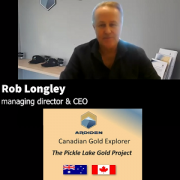
Rob Longley Ardiden Limited (ASX: ADV) August 2021

Ardiden Limited (ASX: ADV) managing director and CEO Rob Longley zoomed into The Resources Roadhouse to inform Wally Graham on the ins and outs of the company’s recent Joint Venture deal for its Canadian lithium tenements.