Why Gold is Approaching a Bottom

FRIENDS OF THE ROADHOUSE: Recent months have proven challenging for the gold sector, with trading momentum definitely on the negative side as speculators have sided with the US dollar. By Gavin Wendt

These pillars of global financial markets move inversely proportionately to each other – i.e. when one’s rising, the other falls – and vice versa.

Nevertheless, the key fundamentals with respect to gold at present still ring true and support higher gold prices. But why is this so?

Well firstly, recent price gyrations are predominantly related to short-term trading positioning, especially as traders have deemed the US dollar as the go-to safe-haven of choice whilst the current trade imbroglio gets resolved.

Inflation is already spiking, and trade tariffs and other factors will almost certainly accelerate the inflationary process.

Furthermore, US national debt is the elephant in the room and the inconvenient truth that nobody wants to talk about – and the only way it’s going to get smaller is if it’s ‘inflated’ away.

In essence, the recent sell-off is overwhelmingly a transient phenomenon that’s decoupled from any intermediate or long-term fundamentals, which potentially presents a compelling opportunity for investors.

Let’s remind ourselves about gold’s unique status and why it has been a staple of the world’s economic systems for thousands of years.

Gold is simultaneously both a commodity and a financial asset.

Central banks around the world retain gold as part of their foreign currency reserves.

During 2018, as in past years, governments have continued to be net buyers of gold adding to official sector holdings.

The two main accumulators of gold are China and Russia, whose gold stocks remain far below those of other leading nations like the USA and countries within the European Union.

Whilst the Chinese and Russian governments have done some light buying in the international gold market, the bulk of their reserve accumulation has come from their domestic production.

China is the world’s leading producer of the yellow metal, whilst Russia has considerable annual output.

Amongst all of this, I believe there are various factors that could set the stage for a gold price recovery over the coming weeks and months, which I will outline below.

Gold’s Role Undiminished

Precious metals like gold and silver do best in times of elevated inflation, because of their abilities to hold value, protect against currency devaluation, and provide investors with a safe-haven alternative to financial instruments like stocks, bonds, derivatives, and other fiat-based assets.

After all, gold and silver are time tested, trusted commodities, that have served as stable forms of currency throughout time, for millennia.

Whereas, “all forms of fiat currencies eventually return to their intrinsic value, which is zero.” – Voltaire, famous French enlightenment writer and philosopher.

This is effectively true, since organizations such as the Federal Reserve, the European Central Bank, and most other central banks can essentially create money out of thin air, continuously inflating the money supply in perpetuity.

In the modern age, this is done with little more effort than punching numbers on a computer screen.

In fact, only about 8% of the world’s ‘money’ is physical cash, and the remaining 92% are basically just digits in a computer program.

Fiat money continuously loses its value through inflation, whereas gold and silver move in the opposite direction, and once confidence in a fiat currency begins to be impacted, the value of a currency can drop precipitously, which would produce an enormous surge in precious metals.

This has occurred numerous times throughout history.

Instances of hyperinflation are not just limited to poor Latin American and African countries.

Hyperinflation-induced currency crises have struck about 55 times over the last century alone and have deeply affected economies of countries like France, Germany, China, and many others.

If you add up all the physical and digital cash in the world, also known as the M3 money supply, you would get an immense number of over $90 trillion.

Moreover, the global debt market is even bigger, with an estimated $215 trillion.

And if you consider the world’s derivatives market you get an insane figure ranging from $544 trillion to about $1.2 quadrillion.

Yes, that’s an estimated upper range of $1,200,000,000,000,000 worth of derivatives floating around the world.

So, where do silver and gold factor in all of this?

Well, all the silver in the world currently represents only about $15.5 billion worth of value at current price, with an estimated one billion ounces out there.

And all the world’s gold combined, an estimated 187,200 tons, represents a value of around $7.5 trillion at its current price.

These are some of the world’s most essential and valuable metals that are used widely in industry, jewellery, store of value, and for thousands of years were used as currencies.

In fact, it was just very recently, fewer than 50 years ago that the world was ‘decoupled’ from the gold standard.

All the gold and silver in the world currently represent only about 8% of the value that M3 fiat currencies have, and fewer than 1% if you consider all the debt and derivatives floating around the world.

But why is this important for gold and silver prices going forward?

Simply because there are far too many fiat-based ‘assets’ in the world relative to the intrinsic, real assets like gold and silver.

In addition, the number and ‘value’ associated with fiat-based assets continuously increases, thus so should the value of gold and silver.

In fact, this trend has been intact for many years, and there is no reason to believe it is going to stop.

Gold Outperforms Dow More Than 10-Fold Since 1970

This may come as a surprise to many people, but the price of gold was very stable for many years – almost 150 years actually.

From about the inception of the dollar in the late 1700s to 1932, the price of gold remained around $20 an ounce.

In 1933, gold got repriced to about $35 an ounce, and once the world’s monetary system became decoupled from gold in the early 1970s, the price began to rise drastically.

Since then, the price has appreciated by about 3,400% to its current price of roughly $1,225 an ounce.

By comparison, the DJIA and the S&P 500 are up only about 315% and 385% in the same time frame.

The explanation for this wide difference lies in the perpetual rise in inflation, immense levels of fiat-based assets and derivatives, combined with the continuous degradation of the dollar and other currencies.

The bottom-line is that there is only so much gold and silver that can ever be mined, yet, fiat money can be inflated to infinity.

Therefore, as global debt levels continue to rise, the inevitability of perpetual money inflation becomes inescapable.

The United States, as well as many other nations around the world, has enormous levels of debt.

There are many countries out there with significant, problematic debt loads, but for the sake of simplicity we will focus on the U.S. alone.

The U.S. national debt currently towers at around $21.27 trillion, about 105% of GDP.

Moreover, U.S.’s personal debt is now over $19 trillion, total debt recently eclipsed $70 trillion, and total U.S. unfunded liabilities are over $114 trillion now.

This a problem because since 2000, the U.S.’s GDP has expanded by roughly 112%, whilst over the same period the national debt has exploded higher by about 325%, personal debt has grown by 134%, and total debt has increased by 168%.

It is clear that debt growth is significantly outpacing the growth of the economy.

In addition, since 2000, the M1 money supply (monetary base) has been increased by 505%, M2 money supply has grown by 193%, supply of U.S. treasuries has exploded by 596%, and derivatives have grown by 512%.

These are drastic increases over the past 18 years and are indicative of substantial money manipulation designed to inflate the global monetary supply.

Therefore, it is not a coincidence that the price of gold has increased by nearly 400% since 2000.

As more fiat-based financial assets flood worldwide markets to support the current financial status quo, gold and silver have risen.

This trend is very likely to continue and should accelerate going forward.

The U.S.’s debt burden is essentially unsustainable, and the national debt will only get bigger with time.

Right now, the Federal budget deficit is close to $800 billion.

This means you can add about another $800 billion to the $21.27 trillion national debt in roughly one year from now.

Moreover, Trump tax cuts, infrastructure spending, and other efforts to “grow the U.S. economy”, will likely cause the Federal budget deficit to blow out to over $1 trillion in future fiscal years.

The kicker here is that debt doesn’t come cheap, and the U.S. is required to pay interest to service its national debt.

We know that the U.S. already pays about $500 billion annually just in interest to service the gargantuan national debt.

But in this rising rate environment coupled with a continuously increasing debt load, the U.S. will pay more, much more.

Just by simply applying a 3% interest rate (which is very close to the current 10-year and an appropriate benchmark for national debt servicing), we arrive at an annual figure of about $640 billion.

It seems clear that with the enormous Federal budget deficit, and the perpetual debt servicing, the national debt only has one way to go, and that’s a lot higher.

Trade War Threat

There is a lot of talk about the current trade tensions in the world, especially in regard to U.S. and China.

In addition, gold and silver seemingly declined on news of further tariffs imposed on Chinese goods and vice versa.

But are trade tariffs negative to the overall inflationary narrative? In fact, the opposite appears to be true.

For instance, the U.S. has now slapped tariffs on hundreds of billions of dollars’ worth of Chinese goods entering the U.S. each year.

This means that the underlying goods will now cost more for U.S. consumers.

In conjunction, new higher priced competing products coming in from other producers, domestic and foreign will also be more expensive.

Producers will also pay higher raw material prices for steel, aluminium, oil and so on.

And companies facing higher tariffs will likely pass the bill to consumers.

Similar developments are likely to ensue all over the world from retaliatory tariffs and so on.

Both consumer and producer prices will go much higher due to trade tariffs, which are very beneficial for inflation, and supports much higher gold and silver prices.

Historically, investors have used gold as an inflation hedge and the yellow metal has seen prices increase substantially when inflation rises above 3%.

Gold and Silver Trade Decoupled from Fundamentals

In the most recent bull cycle, gold and silver started going up substantially in the mid to late 2000s, and then exploded higher when the Fed took rates down to zero and started implementing QE.

This bull cycle is just getting started, it began in the end of 2015, and prices will go substantially higher as inflation spikes, and should explode higher when the Fed engages in further monetary manipulation to make America’s debt problems more ‘manageable’ and/or attempt to avert or lessen the impact of future economic downturns.

I believe the current situation is analogous to where gold and silver were in the early 2000s.

Prices were bouncing around in a sideways trajectory, much like they are right now.

Then, around 2004-2005, a wave of inflation began to propel prices higher, much like the increasing tide of inflation we’re seeing develop right now.

And then, through financial engineering, the Fed drastically increased the money and treasuries supply, and gold and silver skyrocketed.

A second wave of something similar is coming down the line, only this time gold and silver are likely to grow substantially higher than they did during the past bull market cycle.

The World Gold Council (WGC) holds a similar view.

It believes gold’s current price presents an attractive entry point, as investors should expect macro trends to boost the yellow metal’s relevance over the coming months.

The WGC makes the case that three critical macroeconomic forces will drive gold’s behaviour during the second half of 2018: positive but uneven global economic growth, trade wars, and rising inflation and an inverted yield curve.

Uncertain US Political Landscape

The US political scene remains divided like few times over recent generations.

The upcoming mid-term elections will either provide President Trump with validation or put a giant roadblock in front of his initiatives for the next two years.

While polls are leaning towards the opposition Democrats taking control of at least one house of Congress, we have learned that polls can be misleading.

The level of the US stock market and economic growth would clearly favour the ruling party in an ordinary election; however, few things are normal in the world of American politics these days.

At the same time, the investigation of Russian collusion in the 2016 and other issues continues to weigh on the Trump administration.

Moreover, calls for impeachment by Democrats and a vitriolic environment in Washington, continue to rise to unprecedented levels.

Uncertainty over the election could cause volatility in markets in the lead-up to the November contests and gold could be a beneficiary.

Conclusion

I remain very bullish on gold and silver short, intermediate, and long term.

Recent price gyrations appear to have nothing to do with long term fundamentals pertaining to gold and silver, but are likely the result of short-term trading, especially the positioning of the US dollar as the current safe-haven of choice.

Thus, the recent sell-off will in time will come to be seen as a substantial buying opportunity.

I anticipate gold will recover to trade between $1250 and $1350 over the next 12 months.


Disclaimer: Gavin Wendt, who is a director of Mine Life Pty Ltd ACN 140 028 799, compiled this document. It does not constitute investment advice. I wrote this article myself, it expresses
my own opinions and I am not receiving compensation for it. In preparing this article, no account was taken of the investment objectives, financial situation and particular needs of any
particular person. Investors need to consider, with or without the assistance of a securities adviser, whether the information is appropriate in light of the particular investment needs,
objectives and financial circumstances of the investor. Although the information contained in this publication has been obtained from sources considered and believed to be both reliable and accurate, no responsibility is accepted for any opinion expressed or for any error or omission in that information. I have no positions in the stock mentioned and no plans to initiate any positions within the next 72 hours.
 

Lithium Australia Boss Laments Lack of Government Foresight

COMMODITY CAPERS: Lithium Australia (ASX: LIT) managing director Adrian Griffin launched a stinging criticism of the lack of government support for the emerging Australian lithium industry.

Griffin has never been one to waste words when getting a point across and he took aim at a government he – and others – see to be missing a great opportunity for the country.

That opportunity being the development – in country – of technologies to produce lithium concentrates to export as the essential additive to the battery industry and make the country richer than it currently is.

Griffin intimated that there is currently plenty of interest in the battery technologies being developed by Lithium Australia from industry players internationally.

Unlike the company’s home country, he said many of these jurisdictions sitting beyond our sea-girt shores are encouraging Lithium Australia to consider opportunities within their own regions, where governments are prioritising the development of such technologies as a key focus of next-generation economic growth.

“Unfortunately, although Lithium Australia is at the forefront of next-gen battery technology and supply sources, it has not received the same encouragement from within Australia, where its governing bodies, while voicing enthusiastic support for mooted downstream lithium processing, are in reality allowing the country to lag behind international competitors – despite the natural advantages Australia enjoys with its rich endowment of lithium and other battery elements,” Griffin said.

“Australia’s federal government in particular has significantly reduced R&D rebates, now capped at $4 million per annum for all but the biotech industry, which will continue to enjoy open-ended rebates for the purposes of conducting clinical trials.

“Is this anomalous, in that pilot testing and product endorsement within the metallurgical industry in many ways mimic clinical trial processes for biotech products?

“Lithium Australia has, for example, initiated similar procedures to secure product endorsement of the advanced cathode powders being produced at its VSPC plant in Brisbane, Australia.

“As it stands then, the federal government’s R&D policy would provide biotech companies with an open-ended rebate for clinical trials of lithium carbonate (an accepted treatment for certain medical conditions but also a precursor to the manufacture of lithium-ion battery cathodes) but not Lithium Australia for trials of the same product for other applications.”


Email: info@lithium-au.com

Web: www.lithium-au.com


WA Industry Health Important to Nation’s Wealth

COMMODITY CAPERS: As Diggers & Dealers is a Western Australia-based event there is little wonder it focuses on that state’s industry and how it is ticking along.

The recent GST turnaround by the Federal Government was a long-awaited ‘dip of the lid’ to the WA mining sector, which has been a strong contributor to the state’s – and nation’s – high standard of living.

With its coffers now fuller than they were, hopefully the WA government can start to shift its gaze from the low hanging fruit of industry-focused royalties and look to contribute to greater infrastructure.

By doing so it may very well allow the industry to continue this contribution by taking a lead in the beneficiation of commodities vital to the surging global electronics industry.

“Investment in Australia’s mining industry eased in the March quarter 2018 and is expected to be little changed through the remainder of the year.”

Unfortunately, The Roadhouse cannot claim such a knowledgeable sobering statement, in fact it was expressed by the Office of the Chief Economist (OCE) in its recent June 2018 Resources and Energy Quarterly.

The bean counters went on to declare that,” mining investment is expected to have declined by around five to ten per cent in 2017–18, to around $35 billion.”

A figure it put down to the years of sharp declines from 2012–13 when investment reached $95 billion until the good times ended abruptly, putting an end to the much lauded ‘mining boom’.

These figures, the OCE said, followed its expectations, adding that its crystal ball was telling it that we can look forward to a small downturn in mining investment in the short-term leading to capex in the sector levelling out thanks to an anticipated jump in projects both under way and consideration, to construct a sturdy base for future mining investment beyond 2017–18.

GOLD

The OCE predicted the value of Australia’s gold exports could reach a peak of $20 billion in 2019–20, propelled by increased production and export volumes (356 tonnes), however it did suggest a rising US dollar will limit the upside for the price of gold.

This follows a healthy year (FY 2016-2017) for the yellow metal, during which Western Australia’s gold sales broke through the 200-tonne barrier to reach 205 tonnes (6.6 million ounces), the highest level since 1999–2000.

A four per cent increase in year-on-year sales across the industry combined with strength in the Australian dollar gold price for a seven per cent increase in the value of the gold sector from $10.1 billion in 2015–16 to $10.8 billion in 2016–17.

The second half of 2018 and the subsequent two years, according to the OCE, will be gold’s time to shine as political uncertainty drives investment in bars and bullion-backed investment funds.

“Trade tensions between the US and China are expected to continue through to 2019, and possibly 2020,” the OCE said.

“Geopolitical tensions in the Middle East — linked to the Gaza conflict, Syria’s civil war and the possible failure of the Joint Comprehensive Plan of Action (JCPA) relating to Iran’s nuclear materials program — are yet another source of upside for gold.

“Any sustained overheating in the US economy would likely see inflation rise and gold demand rise, as investors seek an inflation hedge.

“Rising inflation would likely also push US Treasury bond prices down.

“Gold is likely to benefit in the short run, with the price likely to increase by around eight per cent in 2018, to average US$1,352 an ounce.”

LEAD

Not all roads – or mines for that matter – are paved with gold, and other metals are currently enjoying the renewed interest being shown to the sector.

Although lacking the same renown as it shinier cousin, lead is gaining some notoriety thanks to the growing interest in electronica.

The largest current use for lead is in batteries for vehicles.

This application accounts for around 80 per cent of modern lead usage with lead-boffins predicting this figure to rise with an increased role for lead in large storage batteries used for load-levelling of electrical power and in electric vehicles.

The growing popularity of electric bikes, particularly in China, has led to an increase in demand for lead to make batteries for e-bikes.

NICKEL

The Western Australia Department of Mines, Industry Regulation and Safety (DMIRS), in its Statistics Digest for 2016-2017, acknowledged nickel as one of the more volatile commodities over the period.

“Prices were comparatively positive at the start of the financial year following strong stainless steel production in China and demand growth for nickel in batteries for electric vehicles, which pushed the monthly average to an 18-month high of US$11,142 per tonne in November 2016,” the Department said.

“However, the nickel sector was again affected by global events.”

These events were the January 2017 relaxation by the Indonesian government on its nickel ore ban, indicating a possible increase in exports, causing global nickel prices to drop more than nine per cent between December 2016 and January 2017 from US$11,013 per tonne to US$9984 per tonne.

The Filipino government flipped its hard-line stance, announcing it was unlikely to enforce the closure of nickel mines in response to environmental concerns.

The OCE expects the nickel price to rise above US$13,400 a tonne in 2018.

“Nickel prices faced significant upward pressure in the June quarter, rising from just over US$13,000 a tonne at the start of April to US$13,600 a tonne by the end, and then to over US$15,450 a tonne in early June,” the OCE said.

“Prices have been supported by the emergence of a significant supply deficit driven by higher stainless steel production.”

A rise in nickel supply is expected to continue with mine output projected to rise from 2.3 million tonnes in 2018 to 2.5 million tonnes in 2019 and 2.6 million tonnes in 2020.

Around $46 million was spent on exploration for nickel and cobalt, its long-overlooked companion and now market sweetheart, during the March 2018 quarter.

When lined up against the $48.6 million spent in the December quarter, it doesn’t look as though much is happening, however it is more than double the spending at the same time of the previous year.

Price growth will always lead to interest and nickel, like cobalt, is no orphan in this regard.

The bulk of growth in exploration spending across Australia is occurring among the large untapped deposits of Western Australia.

“Australia’s nickel production is expected to rapidly recover from a period of significant mine and facility closures in 2016 and 2017,” the OCE said.

“Mine production is expected to rise from an estimated 163,000 tonnes in 2017–18 to 168,000 tonnes in 2018–19 and 178,000 tonnes in 2019–20.”

COBALT

Nickel miners producing cobalt as a by-product are taking advantage of strong prices with the cobalt price hitting a high of US$70,000 per tonne in July.

Although Australia has significant cobalt reserves, there are no dedicated cobalt mines in operation, however, since the demand created by the electronics industry has heightened interest, there are several companies looking to change this.

Currently most cobalt is mined as a by-product of copper, gold or nickel, and about 40 of Australia’s gold and nickel operations are co-located with some form of cobalt deposit producing varying quantities of cobalt as a secondary commodity.

“Most deposits are in Western Australia, though there are small producers in Queensland, New South Wales and South Australia,” DMIRS said.

“Australia accounted for four per cent of global cobalt production in 2011.

“In the March quarter 2017, nickel and cobalt exploration expenditure increased by 187 per cent year-on-year to $20 million – the highest quarterly expenditure on nickel and cobalt exploration in more than two years.”

MINERAL SANDS

The Western Australia mineral sands industry is concentrated on titanium minerals such as ilmenite, which can be sold directly or upgraded to synthetic rutile.

These minerals represented more than half of the industry’s value for 2016–17 with the remainder from zircon, garnet and staurolite.

Western Australian mineral sands exports exceeded reported production in 2016–17, with $794 million in exports.

Mineral sands differ to many of the commodities produced in Western Australia, in that they are exported to a wider range of countries.

Around 35 countries benefited from WA’s minerals sands abundance throughout 2016–17 with, surprise, surprise, China running out as the state’s largest export market, taking just on 25 per cent of exports.

Other major destinations included the United Kingdom (12 per cent), Saudi Arabia (11 per cent) and the United States (11 per cent).

LITHIUM

“Emergence of the battery market Global battery markets entered a period of extremely rapid growth in recent years, and the implications for Western Australia are potentially significant,” DIRS said.

“This is partly due to the potential of battery technology itself, and its capability to revolutionise clean energy, vehicles, and consumer products.”

The WA lithium sector exercised its vocal chords earlier this year with backing from the Association of Mining and Exploration Companies (AMEC).

The lobby group produced a report encouraging State and Federal government participation in development of the Western Australia lithium industry.

AMEC hopes its proactive stance on the issue will inspire State and Federal governments of all persuasions to do the same, rather than be reactive, while the global demand for lithium as a vital element of the global electric vehicle revolution is in a relatively embryonic stage.

In its Future Smart Strategies Report, AMEC declared WA could become a leader in the downstream processing of battery minerals, which it believes could be worth $2 trillion by 2025.

It’s a fair point, considering WA already mines 60 per cent of the world’s lithium and produces all the other minerals necessary to construct batteries, which stands out as a genuine industry opportunity for Australia, and for Western Australia.

In its follow up report, The Path Forward: Supporting the development of a lithium and battery mineral industry in Australia; AMEC outlined the next steps it believes the State and Federal Government should be taking to make the most of this battery mineral processing and manufacturing potential.

“There is a two-year window for industry and both tiers of Government to act, this plan steps through what needs to be done to get further down the value chain,” AMEC chief executive officer Warren Pearce said.

“There is a clear need for both tiers of Government to provide leadership in the development of a domestic battery industry.

“A clear signal from Government has to be sent to attract investment to Australia.

“There must be a willingness to clearly plan and coordinate where a battery industry would be located, and deliberate efforts made to entice international companies to come and set up in Australia.”

Of course, this is just the tip of the commodity iceberg that is Western Australia.

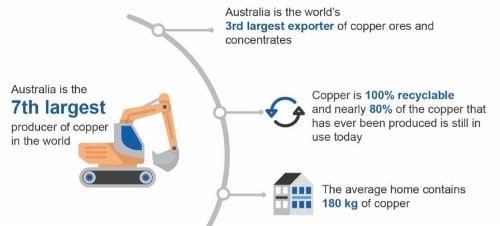
Throw in other traditional commodities the state produces such as iron ore, zinc, and copper and the tale of wealth and potential offered to economic growth within and without the rabbit-proof fence seems endless.


Resources IPOs Lead 2018 Listings

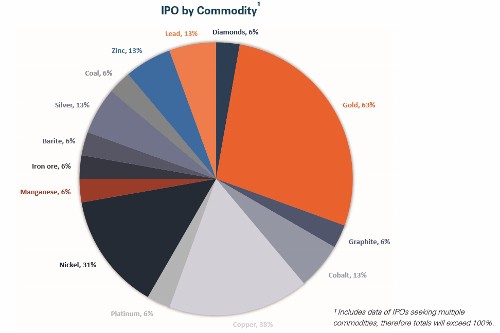
COMMODITY CAPERS: An interesting piece of research hit The Roadhouse inbox this week in the shape of a Snapshot of Australian IPO Activity for the first half of 2018 from our friends at HLB Mann Judd.

According to the business and finance advisers’ Perth-based Partner Corporate & Audit Services man, Marcus Ohm, the first six months of 2018 witnessed a slower start to the IPO market than the same period for 2017.

Through the 2018 time-frame 39 companies listed on the ASX, compared to 57 for 2017.

As always, there was some silver lining the declining IPO cloud with 2018 still managing to outperform the previous five-year average of 37 listings.

“During 2017 there were 110 listings in total and these were relatively well spread throughout the year, which is contrary to the trends seen over the past decade,” Ohm noted.

“Historically, approximately a third of new listings occur in the first half of the year, which would indicate that 2018 may still prove to be a positive year for the Australian IPO market.”

The irony continued with the month of January providing the strongest month to date – listing-wise – with 10, but money-wise it recorded the lowest total funds raised, with just $50 million, or two per cent of the total for the six-month period.

April came in as the strongest money month, thanks to the listing of L1 Long Short Fund Limited (ASX: LSF) to the tune of $1.3 billion, accounting for 65 per cent of all funds raised for the six-month period.

May was also a good month, welcoming seven new listings – the same number as April.

RESOURCES MAINTAIN THE RAGE

The resources sector continued to be a major contributor to the IPO market, making way for 16 listings in the first six months of 2018.

According to Ohm, the sector is performing on par with its start to 2017, when 15 new listings hit the bourse.

Most noteworthy is that it is the rock-kickers doing all the heavy lifting in the sector with Energy stocks failing to bother statisticians.

Source: HLB Mann Judd

“New Materials listings are still enjoying support from the market, with an average of 98 per cent of subscription rates achieved, which is similar to 2017’s subscription rates,” Ohm observed.

In the lead-up to Diggers & Dealers it is good for the Western Australian sector to be well-represented.

The state has continued its domination of the resources listings, providing 13 new listings.

New South Wales, Queensland and Victoria all recorded one listing each.

“While the Eastern states are usually home to the larger resources listings, this has not been the case so far this year with only $28.1 million raised,” Ohm said.

“Three states: Western Australia (+12 per cent) NSW (+11 per cent) and Queensland (+10 per cent) all recorded gains to the end of June, with only Victoria finishing in the red.”

With IPOs heavily slanted towards WA, it can be no surprise gold has featured heavily in the listings for the start of the year.

Five listing to date in 2018 are solely focused on the precious metal while another five polymetallic companies are also on the lookout for gold.

Copper and nickel have also enjoyed their recent rise in popularity and relevance thanks to the interest generated by the burgeoning electronics and Electric Vehicle spread across six and five listings respectively.

“No other commodities recorded more than two listings, however the diversity of the market continues to grow with over 14 different resources sought,” Ohm said.

“Coal, which for some time has struggled to gain traction in the market, recorded one listing.”

So, there we are at the halfway mark and with another 11 listings in the pipeline for 2018, coupled with an outlook of strong commodity prices and solid share price performance, Ohm predicts Materials IPOs are likely to remain strong performers for the remainder of the year.


Web: www.hlbwa.com.au


WA Government Establishes Lithium Strategy Taskforce

COMMODITY CAPERS: The Western Australian State Labor Government showed it is prepared to listen to the mining sector with the announcement of a Taskforce to develop a Lithium and Energy Materials Strategy in consultation with an industry stakeholder reference group.

Western Australia-based mining lobby group the Association of Mining & Exploration Companies (AMEC) was one to the first with a friendly greeting to WA Premier Mark Mc Gowan’s announcement.

AMEC has released a couple of reports on the subject this year that have obviously resonated with the Premier and his Cabinet, which has responded by looking to develop a strategy to create a world-leading lithium and energy material industry in WA and, subsequently, the creation of some long-term employment opportunities.

The State Government has committed to facilitating the processing of lithium and other energy materials in WA in a bid to capitalise on the global demand for lithium batteries and WA’s large deposits of lithium and energy materials.

Lithium has quickly become a Western Australia story with the state currently mining over 60 per cent of the world’s supply of lithium, as well as being endowed with all the other minerals necessary to develop further down the battery minerals value chain.

In its A Path Forward report, AMEC estimated there to be a two-year window before the global battery supply chain solidifies.

The report outlined several recommendations for the Federal and State Government that will position Australia to take advantage of this once in a generation opportunity.

AMEC said the State Government’s announcement has delivered on the report’s first recommendation: leadership.

“The State Government has stepped up to clearly signal that WA is open for business and determined to play a much larger role in the lithium and battery minerals value chain,” AMEC chief executive officer Warren Pearce said.

“Today’s announcement is an important step to take leadership in a key global growth industry.

“A Ministerial taskforce will provide co-ordination for the multiple government departments that will be critical in planning and approvals.

“They will have a key role in ensuring there are no regulatory hurdles that slow the development of this new industry.

“Our Association looks forwards to engaging with the Stakeholder Reference Group and representing the views of emerging battery mineral producers and explorers.”

The WA Government said it was establishing the taskforce to capitalise on the state’s immense potential to produce and process lithium and other energy materials, signalling its thinking that there is plenty of potential to increase downstream processing of lithium and other energy materials.

The development of the Lithium and Energy Materials Strategy will consider how to build on WA’s competitive advantages, and to develop a world-leading energy materials industry that maximises benefits.

“The availability of lithium and other energy materials in Western Australia creates a once-in-a-lifetime opportunity for our State,” West Australia premier Mark McGowan said.

“My Government is committed to the development of this industry to boost our economy and create long-term jobs for Western Australians.

“’The taskforce will do the work, in consultation with industry, to ensure our State is front and centre in production of battery technologies, and will also work to make sure these materials can be processed here in WA to maximise local jobs.”

The Taskforce is to be chaired by WA Minister for Mines and Petroleum Bill Johnston and will consist of senior government representatives.

The taskforce will engage with key companies and will be informed by an industry stakeholder reference group.

It is expected the taskforce will present recommendations to the State Government in November with recommendations of how Western Australia should respond to the battery minerals opportunity.

“Lithium-ion batteries are among the most popular batteries in use today,” WA Mines and Petroleum Minister Bill Johnston said.

“Western Australia possesses all the elements required to produce these batteries such as lithium, nickel, graphite and cobalt, meaning we are in the box seat to capitalise on the growth of this industry.

“This isn’t just about extracting resources from the ground. It’s also about processing them here in WA to create jobs for Western Australians.

“We are determined to make the most of the opportunity, and the taskforce will set out a clear plan to establish Western Australia as a world leader in this industry.”

As part of the State Budget, the Government announced $5.5 million in provisional funding to the Minerals Research Institute of Western Australia (MRIWA), to support development and manufacturing of technology metals and renewable energy sources.

MRIWA will invest the funds, if successful, in its bid to establish a New Energy Industry Cooperative Research Centre (CRC) in WA.

The New Energy Industry CRC’s objective will be to create value, through industry-led research, and drive global demand for local products, services and solutions.

“The Lithium and Energy Materials Strategy is needed to attract international companies that hold the necessary technology to undertake further battery mineral precursor development,” Warren Pearce said.

“This is a once-in-a-generation opportunity, the sort WA hasn’t seen since iron ore in the 1960s – today’s announcement is a first step to positioning ourselves to work our way further down the value chain.”


AMEC Champions Local Battery Metal Industry Development

COMMODITY CAPERS: The Association of Mining and Exploration Companies has taken a front foot approach to encouraging State and Federal government participation in development of the Western Australia lithium industry.

The lobby group hopes its proactive stance on the issue will inspire State and Federal governments of all persuasions to do the same, rather than be reactive, while the global demand for lithium as a vital element of the global electric vehicle revolution is in a relatively embryonic stage.

AMEC pointed out that Western Australia mines 60 per cent of the world’s lithium and produces all the other minerals necessary to construct batteries, which it considers to be a genuine industry opportunity for Australia, and for Western Australia.

AMEC has released a follow-up report to its Future Smart Strategies Report from earlier this year saying that WA could become a leader in the downstream processing of battery minerals, which it believes could be worth $2 trillion by 2025.

In its The Path Forward: Supporting the development of a lithium and battery mineral industry in Australia report, AMEC has outlined the next steps it believes the State and Federal Government should be taking to make the most of this battery mineral processing and manufacturing potential.

“There is a two-year window for industry and both tiers of Government to act, this plan steps through what needs to be done to get further down the value chain,” AMEC chief executive officer Warren Pearce said.

“There is a clear need for both tiers of Government to provide leadership in the development of a domestic battery industry.

“A clear signal from Government has to be sent to attract investment to Australia.

“There must be a willingness to clearly plan and coordinate where a battery industry would be located, and deliberate efforts made to entice international companies to come and set up in Australia.”

The AMEC report outlines the importance of attracting an international battery producer to Western Australia to firmly establish Australia’s position in the global battery supply chain.

Currently technology and intellectual property for processing high-grade lithium hydroxide, and undertake further battery cathode development, is held by a tight enclave of companies based within the Asia region, primarily in Japan, South Korea, China, with others scattered around the European Union and the United States.

They also have well-established markets for their products that are generally earmarked for the burgeoning electric vehicle, computer screen, and phone manufacturing sectors.

“The necessary battery materials need to be readily accessible to make the decision to invest in Western Australia attractive,” the report says.

“This makes a concentrated single hub preferable, as it will help provide critical mass.

“While not all the precursors need to be domestically produced, there are obvious advantages if the majority are.

“A preliminary focus of engagement must be on ensuring Australia attracts the companies developing precursor materials.

“The next step is attracting the international companies that combine the precursor materials, make cathodes and eventually assemble batteries.

“A strategic approach is needed.

“We cannot wait for these countries and companies to come to us.

“We cannot expect them to understand the opportunities available in Australia; we must make the case.”

The argument hasn’t been lost on Western Australia Minister for Mines and Petroleum Bill Johnston.

Addressing the recent Paydirt Latin America Down Under Conference in Perth, Johnston highlighted the growing opportunities coming out of the emerging battery materials sector for both Western Australia and, due to the subject matter of the conference, South America.

Johnston said there was a genuine opportunity for WA to reap the rewards of the growing scale of the battery materials industry.

“We have the resources in the ground, we have the capacities and the technologies, and we believe with careful partnership between government and investors we can get a genuine long-term processing industry,” he told the conference.

“And indeed, given those in the successful industries in Argentina and Chile and elsewhere, there’s many things we can learn from our friends in Latin America so that we are all successful in this new industry.”

Johnston said one advantage held by Australia, and WA especially, was the greater expectations the discussion was placing on the establishment for local supply chains.

“The fact that we have very high standards in WA is now a competitive advantage for operators in this state,” he said.

“We can go to end users of materials and make the point that we can guarantee the environmental impact and social impact of projects in WA that may not be able to be done in other jurisdictions.

“It is our relationships with indigenous people, our high environmental standards, our health and safety standards, and our work and labour standards.

“These are all now competitive advantages in these types of supply chains.”

It’s not as if this is suddenly a new thing.

The AMEC report acknowledged the number of battery minerals and processing research activities and projects already underway

Regional Development Australia (RDA) Perth is preparing a detailed report for consideration by the Federal Government that outlines the advantages of developing a ‘lithium valley’ in Australia.

The Silicon Valley reference is cute, but it the report is serious in outlining the development of a focussed lithium processing and battery minerals hub.

The Chamber of Commerce and Industry Western Australia commissioned a Business Case looking at investment in Western Australia for lithium and battery minerals aimed at determining the economics of developing a lithium battery industry in Australia.

The WA State Government, WA Universities and industry have combined to support a bid for a New Energy Industry Co-operative Research Centre (CRC) bid for Energy Minerals to support ongoing research into the potential of battery minerals development and processing and will further enhance the long-term development and attractiveness of the industry.

“Each breakthrough in technology and innovation could drive Australia further down the cost curve, further down the value chain, or both,” the AMEC report concluded.

“State and Federal Government backing of the New Energy Industry CRC bid will support initial academic and industry funding to grow a domestic research capacity to support a battery minerals industry in Australia.”


The Association of Mining and Exploration Companies (AMEC)


Email: info@amec.com.au

Web: www.amec.org.au

Aussie Juniors on the Cobalt Trail

COMMODITY CAPERS: The search for new cobalt resources in on in earnest with several ASX-listed explorers conducting greenfield exploration and revisiting previous results across their tenements.

Jervois Mining (ASX: JVR) has developed its Nico Young cobalt-nickel project into a core asset, with cobalt-nickel resources becoming increasing valuable due to the forecast acceleration in demand.

The Nico Young exploration licenses, held by Jervois, contain published JORC Inferred resources of:

167.8 million tonnes at 0.59 per cent nickel and 0.06 per cent cobalt (using a 0.6% nickel equivalent cut-off), including a higher-grade zone of 42.5 million tonnes at 0.8 per cent nickel and 0.09 per cent cobalt (using a 1% nickel equivalent cut-off).

Within this mineral resource, focusing upon cobalt leads to JORC Inferred resource of:

99.1 million tonnes at 0.58 per cent nickel and 0.08 per cent cobalt (using a 0.05% cobalt cut-off), including 33.4 million tonnes at 0.66 per cent nickel and 0.12 per cent cobalt (using a 0.08% cobalt-cut off).

The company is currently undertaking a drilling campaign with the view to define an Indicated Resource.

The intention of the infill drilling is to consolidate current nickel-cobalt mineralisation and delineate the extents of high-grade cobalt zones.

Jervois considers that expanding the size and geological confidence of shallow cobalt rich zones will assist early mining studies, which will be reviewed as part of a Preliminary Feasibility Study.

Corazon Mining (ASX: CZN) has recently extended the cobalt footprint of its Cobalt Ridge prospect within the company’s Mt Gilmore project near Grafton in north-eastern New South Wales.

Corazon claimed discovery of four new cobalt-copper-gold anomalies at the Cobalt Ridge prospect.

The new geochemical anomalies have extended the known cobalt-mineralised system at Cobalt Ridge to an area of approximately three kilometres in strike and one kilometre in width, which remains open in all directions.

The company said the newly-identified cobalt-copper-gold anomalies strengthen its exploration model for the entire project area to potentially host cobalt dominant sulphide deposits, in addition to the known mineralisation at the Cobalt Ridge prospect.

The new anomalies were identified via results from a recently completed geochemical soil-sampling program at Cobalt Ridge testing for extensions to previously defined mineralisation.

Corazon owns a 51 per cent interest in the project, and the exclusive right to earn up to an 80 per cent interest.

Recent drilling by Corazon at Cobalt Ridge has validated historical mining and exploration results and confirmed the presence of multiple zones of cobalt-copper-gold sulphide mineralisation over a strike length of at least 300 metres.

The mineralisation remains open along strike and at depth.

The Main Cobalt Lode has been the primary target of the company’s recent drilling (and much of the historical drilling).

This lode is up to 25m in true width and contains multiple narrow zones of higher-grade mineralisation.

Of course, Australia is not the only country to be blessed with attractive amounts of cobalt endowment, which is why some ASX exploration plays are active overseas.

Blackstone Minerals (ASX: BSX) recently commenced a maiden drilling program at the company’s high-grade Little Gem cobalt-gold project in British Columbia, Canada.

The first diamond drill hole of the program tested the upper portion of the alteration zone.

Although the hole was terminated (due to mechanical issues) halfway through the mineralised target, it had managed to intersect massive, semi-massive and disseminated mineralisation with results including:

4.3 metres at 1 per cent cobalt and 15 grams per tonne gold, including 1.1m at 3 per cent cobalt and 44g/t gold.

The initial results Blackstone achieved from the maiden drilling at Little Gem are consistent with historic drilling and adit channel sampling, which returned average grades of 3 per cent cobalt and 20g/t gold.

Azure Minerals (ASX: AZS) is currently drilling its second diamond drilling campaign on the company’s 100 per cent-owned Sara Alicia gold and cobalt project in the northern Mexican state of Sonora.

The drilling is following up Azure’s 2017 maiden drilling program, in which all six drill holes intersected high-grades of gold and cobalt mineralisation at shallow depths, returning a best intersection of:

26.2m at 9.5g/t gold and 1.26 per cent cobalt from 0.60m depth, including 12.6m at 16.8g/t gold and 6.35m at 3.57 per cent cobalt.

The new drilling has been designed to target along-strike and down-dip extensions of the high-grade mineralisation intersected in the 2017 program.

Based upon anticipating further success, Azure is already planning a second phase of drilling to complete a 50m by 50m drill pattern over the mineralised body.


Cobalt Firms into Battery Favouritism

COMMODITY CAPERS: Try striking up a conversation about lithium-ion batteries without cobalt eventually featuring.

The reason is simple, cobalt contributes up to 60 per cent of the value of lithium-ion batteries, which in turn accounts for 42 per cent of demand for cobalt.

Cobalt’s other main use at 16% is in superalloys which compliments the battery demand as high-tech industry grows.

Therefore, there is little surprise that cobalt represents similar percentages of any discussion of lithium-ion batteries, electric vehicles (EVs) and all the other electronic paraphernalia that rules our modern world.

We have spoken in previous articles on how the lithium-ion battery is projected to become the world’s most significant source of power with their use in EVs being a key driver.

Bloomberg forecasts 35 per cent of vehicles sold by 2040 will be electric.

Those of us who remember the seventies know that isn’t far away and the fact that currently only one per cent of global car sales are EVs means they will be an omnipotent presence on our roads sooner rather than later.

One only has to recall how cool it was to have been the first kid in class to own a Casio digital watch to understand.

The number crunchers have determined cobalt demand is expected to rise at five per cent compound annual growth rate (CAGR) over the next four years.

Cobalt has been something of a poorer cousin in recent commodity terms, especially when compared to the battery markets eponymous metal, lithium.

Lithium kicked off all the excitement – and it took a long time to take off as crusty old exploration company executives struggled to come to the realisation that gold, iron ore, and uranium may have been losing the appeal, and importance, they once exerted over the rest.

Cobalt is expected to have a supply deficit as currently mining is only just meeting demand.

This has been reflected in a rise in the cobalt price which Deloitte, in its recent WA Index March 2018, said had,” increased by 1.4 per cent to US$81,000 per tonne as a beneficiary of bullish global demand for lithium.”

Deloitte claimed that electronics giant, Apple had been the subject of reports suggesting it was, “Entering into talks to secure long-term supplies of cobalt directly from cobalt miners amid fears of a looming shortage attributable to what has been coined the electric vehicle boom, has seen the metal’s price increase across February.”

The current price is heading in the right way, but it is still shy of the heady days of 2008 when it was sitting at US$52/lb (US$115,000/t), which was coincidently, also the last time global supplies of cobalt were in deficit.

The reason global cobalt supply is as tight as it is stems from approximately 98 per cent of the world’s supply being produced as a by-product of copper and nickel production with 15 mines representing half of the world’s supply.

Not only does this make supply tight, it also exposes it to any supply stream disruption, such as the shutdown of copper mining in the Katanga Province in the Democratic Republic of Congo (DRC) slicing off three per cent of cobalt supply.

Sixty per cent of global production comes from the DRC, which has a reputation as a politically unstable country and is thought by many to be somewhat unethical in its approach to the mining industry.

In the Fraser Institute Survey of Mining Companies, 2017, DRC was rated amongst the bottom ten jurisdiction in the world for investment according to the survey’s Policy Perception Index (PPI), a composite index that measures the overall policy attractiveness of the 91 jurisdictions in the survey.

That means the good corporate citizens of the world are looking elsewhere for their cobalt supplies to produce ethically-cleansed products for their equally ethically-minded customer base.

At the recent RIU Explorers conference, Patersons senior resources analyst Simon Tonkin declared cobalt as being the best performing commodity over the past 12 months.

“Cobalt is a critical metal in terms of lithium-ion batteries and it is very difficult to secure supply,” he said.

Tonkin suggested there was potential for the demand for cobalt to double by 2022 and that by 2030 some estimates are for 47 times the current cobalt demand.

“Australia has the second largest cobalt reserves in the world, he said.

“Hopefully we can look to exploit that position.”


Old Campaigners on Standby for EV Revolution

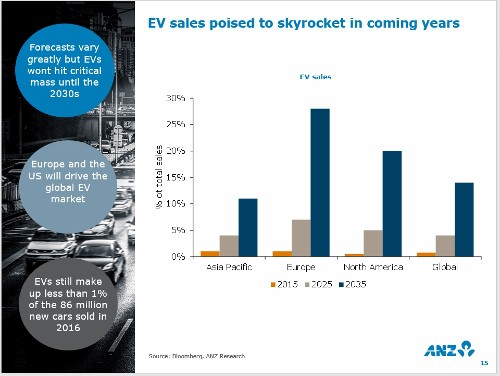
COMMODITY CAPERS: Some analysts suggest that EV sales will be responsible for around 25 per cent, and more, of total vehicle sales by the end of 2035 from the current levels of around one per cent.

Coming off a relatively low base the projected growth could have a significant effect on markets for certain commodities.

Nickel and copper are two traditional commodities that have found the running comfortable with the upsurge in interest for battery metals.

Although lithium and cobalt have been sneaking away with the bulk of the headlines, nickel and copper are also integral parts of the lithium-ion battery make-up, and as such are enjoying some new-found fame.

In his presentation to the 2018 RIU Explorers Conference, ANZ senior commodity strategist Daniel Hynes said investors have woken up to the impact lithium-ion batteries have had on these two markets.

“Environmental issues have evolved from being secondary policy targets to one of the top priorities for many countries over the past few years,” Hynes said.

“Certainly, China has been quite important in driving this dynamic over the past few years and clearly all the headlines have been focused on sectors such as the Electric Vehicle market and what that can do for commodity demand.

“No-one really knows the level of adoption that the market place will take.

“That certainly has been a big reason behind the rebound of nickel prices, even though the volumes are going to be relatively low.

“It is interesting to note the differences in the amounts of copper used in a conventional car as opposed to a battery EV.

“Essentially nine times the amount of copper is used.

“The dynamics are quite strong, and we do expect to see the markets turning.”

Currently, the EV/ lithium-ion battery chatter is creating a strong global market interest for nickel, which is receiving support, albeit in the short-term by higher stainless-steel production.

Australian mine production is expected to fall to 176,000 tonnes in 2017–18 before recovering slightly to 183,000 tonnes in 2018–19 while the country’s nickel export earnings are expected to fall slightly to $2.1 billion in 2017–18, before rebounding to $2.3 billion in 2018–19.

In a metals&ROCK research note released in April, Morgan Stanley noted that the main driver to global nickel demand to be, “any change in the level of activity in China’s stainless steel industry”.

Seventy per cent of the world’s primary nickel supply is gobbled up by Chinese smelters as they produce 54 per cent of the world’s total 46 million tonnes of stainless steel.

“And so far in 2017, China’s SS-output rate’s up (+23 per cent year-on-year, Jan-Feb),” Morgan Stanley reported.

“Roughly in line with the general lift in output of its +820 million tonnes per annum carbon-steel industry – buoyed by Q1’s credit surge, and a central government sponsored infrastructure program.”

The Department of Industry, Innovation and Science noted a recent rise in nickel prices attributing markets factoring in growing demand linked to lithium-ion batteries, however it also said that it was not clear that the immediate boost to prices will persist.

“Although sales of electric vehicles are rising sharply, at this stage, batteries still account for a small share of nickel sales, and stainless steel is still estimated to account for around two-thirds of nickel consumption over the outlook period,” the department said in its December Quarter Resources and Energy Quarterly.

Although copper does have a part to play in the EV revolution, currently it is its older stomping grounds that are contributing to its recent positive run.

Source: DIIS

DIIS cited the London Metal Exchange (LME) copper price estimate to have averaged US$6,810 a tonne in the December quarter, the highest level since September quarter 2014.

Credit for this rise was given to growth in global industrial production and several supply disruptions, including incidents at KGHM’s Glogow smelter in Poland and Rio Tinto’s Garfield operations in the US.

Although copper inventories on the major global exchanges fell by 6.4 per cent quarter on quarter, contributing to higher prices in the December quarter these are expected to wane in 2018 with the LME copper price forecast to average US$6,340 a tonne as supplies increase.

A pick up in consumption over supply has forecasters predicting a rise in copper prices to US$6,490 a tonne in 2019.

“Global copper consumption is forecast to rise from 24 million tonnes in 2017 to 25 million tonnes in 2019, representing an average increase of 3.2 per cent each year,” DIIS said.

“Higher copper consumption will be supported by firm growth in global industrial production and higher investment in energy infrastructure.

“Emerging economies are expected to drive much of the growth in copper consumption over the next two years.”

China is expected to lead this copper consumptive period.

The country already accounts for around 50 per cent of global demand and looks to increase that number as it makes improvements to the nation’s power grid and enjoys further growth in the construction and manufacturing sectors.

The coming shortfall will kick in once global demand for electric cars and renewable energy takes off, leading to stronger growth in copper consumption over the next two years.

“Increased global production of electric vehicles…is expected to raise copper consumption by around 300,000 tonnes annually in 2018 and 2019,” DIIS said.

“Copper is used extensively in renewable energy technology and infrastructure, spending on which is expected to increase strongly over the outlook period.

“Global electricity capacity from renewable sources is expected to increase by 4.4 per cent annually over the outlook period.”


Electric Vehicles Driving Nouveau Commodity Rush

COMMODITY CAPERS: While scientists debate whether climate change is a real/false, natural/man-made phenomenon, countries with large populations have realised opening a window does not necessarily provide its people with fresh air.

Keeping people breathing has become a major concern for the larger countries, China is the first that comes to mind.

It’s extremely rare to see vision of a Chinese populace going about their daily routines without seeing high numbers wearing face masks to minimise the effects of the air pollution the country endures.

But the Hidden Kingdom is not alone as many European and North American centres also move to diminish the effects of long-term air pollution.

Electric Vehicles (EVs) have become the touchstone of the new environmental times and are expected to dominate the market sooner, rather than later, due mainly lower costs for battery manufacturing and commitments from car companies to establish themselves as market leaders.

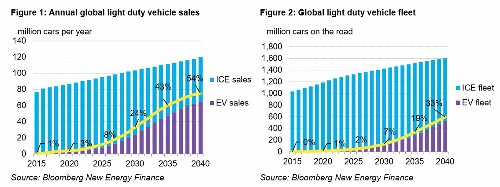
In its Electric Vehicle Outlook 2017 report, Bloomberg New Energy Finance noted just how quickly EVs will start to dominate the global car market.

“By 2040, 54 per cent of new car sales and 33 per cent of the global car fleet will be electric,” Bloomberg said.

“Falling battery prices will bring price-competitive electric vehicles to all major light-duty vehicle segments before 2030, ushering in a period of strong growth for electric powertrain vehicles.

“While EV sales to 2025 will remain relatively low, we expect an inflection point in adoption between 2025 and 2030, as EVs become economical on an unsubsidized total cost of ownership basis across mass-market vehicle classes.”

Green politicians may have struggled to capture voter attention of late, but the green economy is running at a much faster pace.

Speaking at the recent 2018 RIU Explorers Conference in Fremantle, Patersons senior resources analyst Simon Tonkin said the Green economy has been a key driver for resources over the past 12 months.

Tonkin went all the way back to 2014, when, he said, China announced it wanted to reduce pollution and it wanted 20 per cent of its energy needs to come from renewables by 2030.

“China’s energy needs are currently around 13 per cent renewables, but it is amazing how much China is building in terms of the world’s solar panels,” he said.

“It is installing two-thirds of the world’s solar panels and around half of the world’s wind turbines.

“There are currently 3.5 million clean-energy jobs in China and this is expected to grow to 10 million jobs by 2020.”

Like the Chinese, it didn’t take Tonkin long to set his sights on the EV and associated lithium-ion battery market, where he indicated technology was gaining traction, noting that Tesla, and others, are currently building giga-factories.

“There is a shift to new-age metals, such as lithium, nickel, cobalt, manganese and graphite – we could also add vanadium and zinc into the mix,” he said.

“Australia has plenty of these metals to supply to the world.”

According to Tonkin, the best performing commodities over the past 12 months is dominated by the battery metals of cobalt and lithium with those trailing the pack being the sector stalwarts of iron ore, silver, and gold.

The importance of lithium batteries to modern living has increased with their use in such high-demand devices, such as phones and computers and the growing EV market.

A lithium-ion battery lives in a category of itself with around four diverse types of batteries in use, utilising a mixture of commodities, including aluminium, cobalt, manganese, graphite and nickel

Demand for these commodities is expected to increase exponentially over the next ten years to meet the increased demand for batteries and EVs towards 2030

“Our (Patersons’) view on lithium with the emergence of electric vehicles, we are going to see a significant increase for lithium demand as soon as the mid-2020s,” Tonkin said.

“However, in the short-term we could see supply outstrip demand as the spodumene producers ramp up.”

Tonkin is not alone in his view of a possible lithium glut.

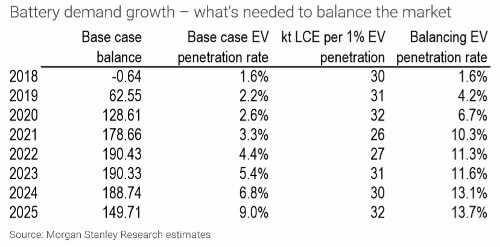
In its recent report – Lithium: The long-term pain of new supply, Morgan Stanley suggested that should the current pipeline of planned projects goes ahead the result will be substantial, and sustained, market surpluses from 2019 onwards.

“We forecast 2018 to be the last year of global lithium market deficit,” Morgan Stanley analysts said.

“Beyond that, we expect global lithium prices to correct as the market moves into a period of sustained surplus.”

Morgan Stanley noted that the Chilean Economic Development Agency (Corfo) has granted additional production quota to SQM.

Another lithium producer, Albemarle also requested an uplift to its quota for production from La Negra in late2017.

The analysts have forecast these expansions to add 200,000 tonnes per annum to Chile’s lithium output by 2025, bringing the country’s total output to 255,000 tonnes LCE – a third of global supply.

“We’ve also increased our supply forecasts for Australia and Argentina,” Morgan Stanley said.

“Combined we forecast cumulative supply growth of 3.9 million tonnes from 2019-2025 (vs. our previous estimate of 2.9 million tonnes supply additions, a change of +35 per cent).”

Although lithium powerhouse SQM intends to increase lithium production by four to six times, it is likely to take years to eventuate and will come at a much higher cost than current production, possibly making it less competitive.

Australia has the third largest lithium reserves behind that of China and Chile – a position the country is starting to exploit with production coming on line from companies such as Pilbara Minerals and Pioneer Resources as well as lithium extraction technology plays such as Lithium Australia and Neometals.