


South Australia okays vital port Infrastructure
As the iron ore minnows of the Pilbara in Western Australia continue their battles to gain access to vital port infrastructure the proposed development of a significant South Australian infrastructure project has moved closer to being.
The project in the spotlight is the proposed new multi-million dollar bulk commodities export facility to be located at Port Bonython on Spencer Gulf.
The South Australian government and Spencer Gulf Port Link Consortium, the group originally selected by the government as its preferred bidder for project, has jointly announced a comprehensive Environmental Impact Statement (EIS) will be undertaken into the project.
A wide-ranging public consultation process will also be undertaken to ensure the community is fully educated and consulted on all facets of the proposed development – including the planned construction method.
Based on mining industry expectations for the region, the consortium believes the port is viable, and the timing of its development will meet future demand from a range of iron ore mining projects across South Australia.
Spencer Gulf Port Link Consortium comprises Flinders Port Holdings, Leighton Contractors, Macquarie Capital, BIS Industrial Logistics and the Australian Rail Track Corporation (ARTC).
“One of the most crucial export infrastructure projects in South Australia has taken a monumental step forward today with the SA Government approving the studies and communication phase of our development plan,” Flinders Ports chief executive and consortium spokesman Vincent Tremaine, said in a release.
“The consortium partners are delighted by the faith and commitment the State Government has shown in them to undertake the necessary work to take the project to the next stage.
“We strongly believe the port is viable, and in fact essential, given the expected increases in mineral resource volumes from proposed mining projects in the region.
“The consortium plans to build a state-of-the-art, environmentally sound, highly efficient, cost effective facility in support of South Australia’s growing mining sector.
“Port Bonython is the most appropriate location for this type of port in the area, taking in a number of factors including water depth, land availability, and its proximity to rail and proposed mining projects in the region.
“It is an existing harbour with a defined deepwater passage established enabling large ships to operate efficiently, and it can be expanded to meet expected future demand.
“Further, under our proposal, public access to the foreshore will be maintained.”
The final design for the project is dependent on a range of issues, including geotechnical conditions, environmental controls, finalising user agreements with customers, a wide range of approvals, and financing for the project.
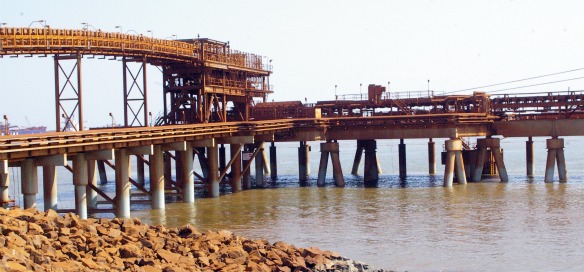
Despite these conditions the project is likely to include a three kilometre-long jetty reaching into deep water, with enclosed conveyors and a ship loader, which will be designed to handle “Cape” size ships carrying up to 180,000 tonnes of cargo as well as significant rail and storage facilities on land adjacent the jetty precinct.
“If the project is approved, construction would take about 2.5 years to complete, and employ about 400 workers,” Tremaine added.
“It would be ready for export in about 4.5 to 5 years from now.”
Tremaine identified the advantages the Port Bonython site held over over other sites being considered to include: the most efficient export facility for iron ore in the region; environmentally manageable with no expensive dredging required, and; capable of expanding output to meet expected future demand of over 50m tonnes of product per annum.
“The Spencer Gulf Port Link Consortium partners had already invested significant resources on the project and were committed to continued investment in the development of the new port facility,” Tremaine said.
The South Australian iron ore industry is definitely make waves with this announcement coming on the back of Ironclad Mining’s plan to develop a multi user bulk shipping port for the project, including a floating harbour, on Spencer Gulf.
IronClad executive chairman Ian Finch recently told companyinsight.net.au about the new project.
“The Lucky Bay port option will cut the land transport distance of iron ore from Wilcherry Hill into ships from 540km for our previous Port Adelaide option to only 154km for Lucky Bay” Finch said.
“We estimate this will reduce operating costs by about $A20- $A25 per tonne from $A85 to $A60- $A65 per tonne. Assuming an average iron ore price of $A140 net of freight into China, this will increase our margin to approximately $A75– $A80 per tonne for Stage One of the project.”
Finch told companyinsight.net.au Stage One of the project is planned to ship 2 million tonnes of premium priced Direct Shipping Ore per year over a period of four years; based on the assumed iron ore price of $A140.
“We are looking at potential margins totalling more than $600 million during Stage One,” Finch continued.
“The current price is about $160 net of freight. Measured against the current iron ore price, our cash flow estimates are relatively conservative.
“IronClad and Trafford (Resources) will share the benefits on an 80:20 basis; making this Lucky Bay port and floating harbour proposal good news for the shareholders of both companies.
“From the time IronClad decided to produce Direct Shipping Ore from the Wilcherry Hill crystalline magnetite, the project has looked to be a commercially robust undertaking. The Lucky Bay port option makes it even more robust, delivering cost reductions in the region of 25% – 35%.”