


Roger Mason – Antipa Minerals
We welcomed a new face to The Roadhouse in Anitpa Minerals managing director Roger Mason who had a lot of interesting things to say about the company’s Citadel project.
In the grand scheme of things Antipa Minerals is relatively new to the ASX. When did you list?
We listed in April of 2011 after raising $10 million for the Initial Public Offering, which we are using to explore our Citadel project, located in the Paterson Province of Western Australia.
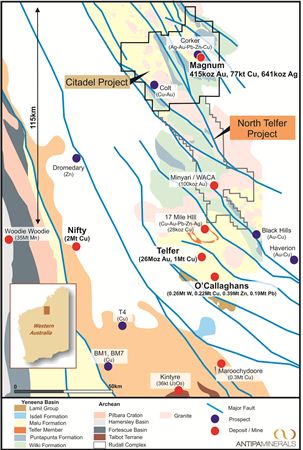
The granted tenements that make up the Citadel project cover an impressive 1700 square kilometres making us the largest holder of granted tenure in the Paterson Province.
We did a deal with Paladin just after we listed to acquire some additional high quality ground under application called the North Telfer project, giving us another 1300sqkm on the southern side of Citadel, bringing us to within 25km of the world-class Telfer and O’Callaghans deposits.
In total we have a 115km long continuous package of tenements covering a huge 3000 square kilometres of shallowly covered, grossly under explored world-class Paterson Province.
How did you come to acquire the Citadel project?
We acquired the project from Centaurus Metals, who had switched focus to Brazilian iron ore and were divesting their Australian assets, when we listed on the ASX last year.
Was that a case of being in the right place at the right time or had you had your eye on it?
We had spent around 12 months, as a group, undertaking due diligence, and looking for an appropriate project. Citadel ticked all the right boxes for us.
We wanted a project that was located in a ‘world-class’ under-explored province, which the Paterson Province certainly is with historic exploration being deterred or ineffective due to 85 per cent of the Paterson being under-cover.
The Citadel project also had proven endowment with the Magnum gold-copper-silver deposit being discovered there in the mid-1990s.
After appraising around two dozen projects, Citadel clearly stood up as the one to select and go forward with.
The Citadel project was a good one for Antipa Minerals to acquire given the company’s Board has a great deal of experience working up similar projects?
The Board was constructed on the thinking we had the right blend of technical and commercial capabilities to build a successful resources company.
Myself and non-executive directors Peter Buck, Mark Rodda and Gary Johnson all worked together with LionOre International. Peter and I are both geologists with over 60 years combined experience and we worked on similar projects in covered terrains with Western Mining and LionOre.
Our Chairman Stephen Power was an external counsel, who worked extensively with LionOre.
So LionOre was the connection and our main premise was if we could put a good enough team together and find a project with a potential high-leverage discovery scenario that would be an excellent combination.
So you ventured off into the under-explored, under-cover Paterson province with a prospective target having already been identified?
That’s right. The area hadn’t been explored for about ten years and previous exploration had been limited to that conducted by BHP in the early 1990s with nothing prior to that.
Some juniors working it during the late 1990s discovered Magnum on the back of BHP’s regional exploration efforts.
That provided an excellent foundation for us to work with in terms of regional geochemical and geophysical data sets, which came with the project.
The project basically sat idle through the 2000s and, as a consequence, never received any state-of-the-art geophysical surveys until we commenced exploration last year.
Besides the Magnum deposit there is also the Corker deposit. Had that been identified the same time as Magnum?
No – Corker is a greenfields Antipa discovery we found while conducting our ongoing regional exploration program using state-of-the-art airborne electromagnetic VTEM surveys.
We flew VTEM over 25 per cent of Citadel last year. This survey also identified an EM anomaly over Magnum from the air, which hadn’t been achieved by older generations of airborne EM technology.
It also picked up another very high quality EM conductivity anomaly, which we called Corker.
You must have been impressed to give it a name like that?
Our consulting geophysicist involved with the VTEM survey rang and said, ‘we have a corker of an EM anomaly!’ so we ran with it.
We like to consider it as the cork that has shot out of the champagne Magnum landing just four kilometres away.
What have you learnt about Magnum from the work you have conducted so far?
Our pre-IPO due diligence at Magnum determined the historical drilling had been drilled the right way for the stratigraphy, but the wrong way for the mineralisation.
We saw an opportunity to change the ‘personality’ of the deposit by turning the drill rigs around, which is what we did last year.
We drilled a number of holes in the opposite direction and instead of seeing two thin, steep east dipping gold-copper shoots we intersected a west dipping corridor greater than 350 metres wide hosting significant gold-copper-silver mineralisation, which we now know extends for more than 1.8 kilometres north-south and 600 metres in depth, and is open in all directions.
We also identified a number of higher-grade gold-copper bearing structures within this corridor.
That culminated in our March announcement of our maiden Inferred Mineral Resource at the Magnum deposit of 27.8 million tonnes at 0.5 grams per tonne gold, 0.3 per cent copper and 0.7 grams per tonne silver, which covers only approximately 25 per cent of the deposit’s strike length.
That gave us total contained metal of 415,000 ounces gold, 77,000 tonnes of copper and 641,000 ounces of silver at a 0.3 grams per tonne gold equivalent lower cut-off grade.
Are you confident of being able to grow that Resource?
We have conducted some bold, but limited, step out drilling. We drilled 200m to 400m and 600m step-out holes, which we are awaiting the assays for, and we had success in finding copper sulphide bearing mineralisation by this approach.
We’re not sure yet of the total volume of mineralisation as we only completed several ‘sighter’ step-out drillholes, but the mineralised system, at the moment, continues for at least 1.8km north-south along strike and remains open in all directions.
Drilling at Magnum is very broad spaced, nominally 100m centres or greater within the 500m long Resource envelope, and so Magnum requires further exploration to grow the Resource and, in particular, to further evaluate its economic potential. Magnum is already a very large gold-copper-silver system with plenty of upside, both low-grade and higher-grade.
The early drilling results from Corker have been encouraging?
We started drilling the Corker EM anomaly in late April and the first drillhole hit bonanza grades returning an intersection of 0.13m grading 772 grams per tonne silver, 14.8 per cent lead, 1.86 per cent zinc, 0.10 per cent copper and 0.85 grams per tonne gold.
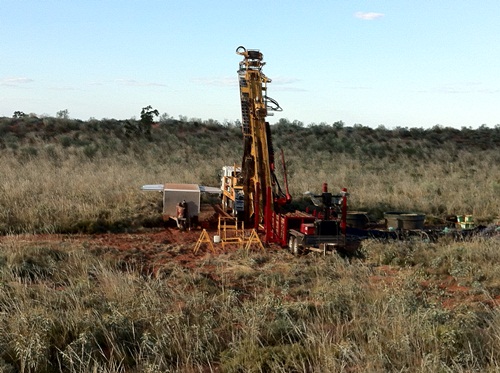
Corker was the first prospect Antipa has drilled besides Magnum, which speaks volumes for the prospectivity of the Paterson project.
We have completed just four drillholes at Corker and there is more information to come, but the volume of sulphide that we have intersected to date hasn’t been anywhere near adequate to explain the level of EM anomalism that was generated from the helicopter VTEM, or from the ground EM or subsequent downhole EM surveys.
The downhole EM generated a cracking off-hole EM anomaly which remains untested.
So we’ve got, as yet unexplained, EM conductors in the presence of very strong precious and base metal mineralisation and our goal now is to follow these leads up and find larger volumes of ‘quality’ sulphide mineralisation.
It appears to us that we have the proverbial ‘tail of the tiger’ and firmly believe that it is highly likely there are some pretty exciting intersections to be had at Corker by further drilling. It’s just a natural part of exploration – sometimes you get it easy, but most of the time you have to work harder and be more persistent to win the prize.
Has the VTEM survey provided any other potential targets for you to follow up?
We ended up with about 11 priority one targets, including Magnum and Corker, and 30 or so second and third order targets. That’s just from surveying 25 per cent of the Citadel project area or just 13 per cent of both projects combined.
At this stage we only have drilling ‘feedback’ from Corker and Magnum, both of which have proven to be strongly mineralised systems, an excellent proof of concept substantiating why we identified these Paterson Province projects as being high leverage exploration assets in the first place.
On that basis, once we have completed VTEM coverage, and additional exploration activities, over the entire 3000sqkm combined project area we anticipate to having a number of high calibre targets to drill.
So what are your plans for the immediate future?
At this stage our number one priority is to follow up the initial drilling success at Corker and to locate the thickened portions of that high-grade sulphide material.
We also intend testing a number of other targets that are situated within a couple of kilometres of both Magnum and Corker.