


Miners reject royalty rate rise
THE CONFERENCE CALLER: The Western Australian Government has a looming budget blow out and a pesky panel beating bill to pay.
At the Paydirt Gold Conference in Perth this week WA Department of Mines and Petroleum director-general Richard Sellers gave notice the State Government’s royalty review could be considering a staggered change in gold royalty rates.
The rumour doing the rounds at present is that the review could be looking at doubling the royalty rate from 2.5 per cent to five per cent.
Taking the heat for Mines Minster Bill Marmion, who cancelled his appearance at the conference at the last minute, Sellers told delegates it was unclear whether the joint DMP and Department of State Development task force conducting the review would recommend a multi-tiered gold royalty system, which would acknowledge the differing cost structures and profitability of WA mines.
Sellers did admit, however one of the aims off the review was to keep the royalty system simple – to benefit miners or bureaucrats he didn’t say.
“We know it is a very varied industry where you have some very high-cost producers and then some others that have very high grades and produce at a lower cost,” he said.
“But the difficulty is that if you tried to design a system that catered for that it would get very complex and very hard. My gut feeling is that it will stay a simple process.”
Later in the day a panel session featuring a gaggle of the State’s leading golden egg laying geese, including Kelvyn Eglinton of Newmont Asia Pacific, Bill Beament of Northern Star Resources, Matt Judkins of Deloitte Access Economics, Allan Kelly of Doray Minerals, and Dianmin Chen of Norton Goldfields lined up to express their concerns about the potential hike in royalties.
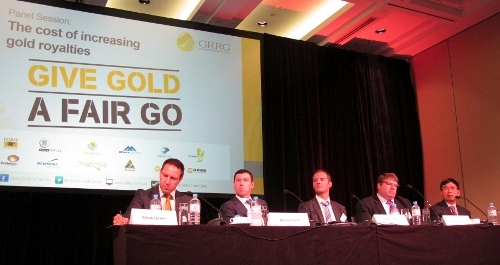
The panel members were representing the Gold Royalties Response Group (GRRG), which was initially formed in 2010 when the possibility of a raise in gold royalties first poked its head above the parapet.
Kelly suggested the idea was a short sighted one by the WA government saying that although it may supply short term benefits in more money being syphoned of gold producers now, it would most probably result in having a detrimental effect on the current group of explorers, ultimately leading to a dearth of gold mining companies in the future.
Beament supported Kelly’s idea, adding that as a company Northern Star currently pays some $15 million per annum into the State’s coffers.
Should the royalty rate double – the math is reasonably simple – that figure rises to $30 million, a figure Beament suggested would be difficult for any busy to absorb into its bottom line.
Eglinton pointed out that, like his company, those represented by the others on the panel, have some big-hitting international mining investment funds on their shareholder register.
These investments, he said, could be in a perilous position if the increase in royalties was introduced as many of these funds could very easily take their cash elsewhere.
Beament stressed this was a real possibility, citing the way international funds had quickly deserted during the Global Financial Crisis and when the price of gold had crashed.
According to a report by Deloitte on the Economic Contribution and Impact Assessment of the WA Gold Sector a hike in the gold royalty could have impacts across the board.
.jpg)
.jpg)
.jpg)