


Gold Anomaly hits best copper yet at Crater Mountain
THE DRILL SERGEANT: Gold Anomaly has intersected the best copper zone to date with the third hole to be drilled at the Nevera prospect, situated within the company’s Crater Mountain project in Papua New Guinea.
According to Gold Anomaly hole NEV033 contained strongly anomalous copper and gold values in the bottom 280 metres of the hole.
It was drilled to follow up a detailed review carried out by the company of the 8,904m of drill core in 2011 and early 2012.
Gold Anomaly claimed the assay results from NEV033 demonstrate:
– The strongest coherent copper-gold mineralisation lies within a 124m interval from 704m to 828m;
– The copper value averages 124m at 0.09 per cent copper, starting with 18m at 0.126 per cent copper;
– The accompanying gold values for the 124m from 704m to 828m averages 0.38 grams per tonne gold, starting with 24m at 0.76g/t gold including 8m at 1.0g/t gold and 6m of 1.02g/t gold; and
– Anomalous molybdenum values accompany anomalous copper in the bottom of the hole , the first such occurrence at Crater Mountain.
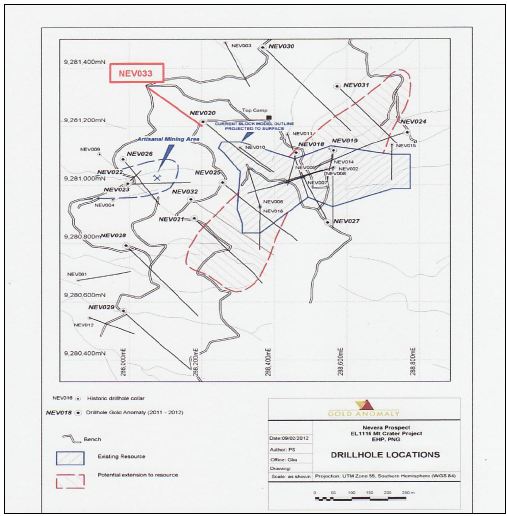
Drill hole NEV033 location map. Source: Company announcement
Gold Anomaly said the intersection, which is the first it has achieved at Nevera, combines signs of both gold and copper over such a wide interval.
The company indicated it felt this was significant as combined with accompanying geology it presents a strong indication it is getting closer to the porphyry copper-gold source.
“The result from NEV033 of 280 metres of porphyry copper-gold style mineralisation is the largest intersection of its type in the 9,888 metres of drilling undertaken at Crater to date,” Gold Anomaly exploration director Peter Macnab said in the company’s announcement to the Australian Securities Exchange.
“The geological signs are very strong that we are zeroing in on a large porphyry copper-gold system at depth.
“I believe that NEV033 has drilled through a mineralised arm radiating from the source porphyry.
“The core will now be subject to a detailed petrological study, which along with similar studies of core from other holes, will help to determine the direction of heat flow and the location of the source of the mineralisation in the underlying porphyry system.”