


Energia Minerals identifies historic Italian mineralisation
THE DRILL SERGEANT: Energia Minerals (ASX: EMX) has claimed to have identified a high-grade zone of zinc-lead mineralisation while reviewing recently recovered historical drilling data at the company’s 100 per cent-owned Gorno zinc-lead project in northern Italy.
The company said the zone, as well as several other high grade intersections drilled from underground, is located within an area known as Panel 7.
The historic results include:
– 6 metres at 14.83 per cent zinc and 3.53 per cent lead from 62.5 metres down-hole (Hole 37);
– 5m at 11.67 per cent zinc and 2.4 per cent lead from 62.5m (Hole 36); and
– 8m at 10.21 per cent zinc and 2.15 per cent lead from 18m (Hole 46).
Energia claims the five drill-holes located at the base of Panel 7 define a zone of mineralisation averaging approximately 5m in true width over a strike length of some 150m, which remains open to the west and at depth.
As far as Energia is aware, there has been no drilling carried out between these newly discovered drill holes and the developed ore on the 940RL level.
The company indicated this undrilled area will be the primary target of a planned program of exploration drilling at Gorno.
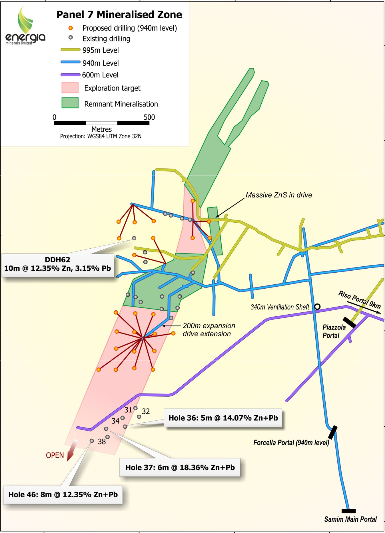
Gorno zinc-lead project, Italy, detailing historical underground
drilling and sites for proposed underground diamond drilling. Source:
Company announcement
“The higher grades in this area has significantly enhanced the project and provide a logical and immediate target for drilling to establish a JORC Mineral Resource estimate,” Energia Minerals managing director Kim Robinson said in the company’s announcement to the Australian Securities Exchange.
“Importantly, this new mineralisation also lies at a higher elevation than the treatment plant site and could be extracted via the existing 12 kilometres-long Riso Parina adit with rail haulage.”
Robinson said the Gorno project had much to offer as a potential mining operation, including a high level of community support from a population with a strong mining background.
He highlighted the high grade of the deposit, which he claimed is potentially 7 to 8 per cent zinc with silver credits compared with similar deposits being mined in North America of 3 to 4 per cent with no silver credits.
“We are looking forward to the opportunity of exploring this potentially valuable and strategic deposit with a view to establishing a JORC Mineral Resource and advancing it towards a Feasibility Study and development scenario,” Robinson said.