


Coventry is counting on Cameron
While the world trudged through the Global Financial Crisis, Coventry Resources recognised an opportunity that may well prove to be a company maker.
After its ASX-listing in 2009, Coventry agreed to purchase a 100 per cent interest in the Cameron gold deposit, located in northwestern Ontario, Canada.
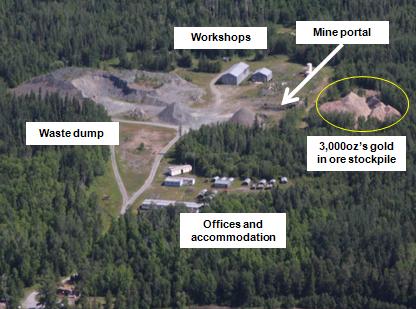
The vendors, TSX-listed Nuinsco Resources had owned Cameron since 1980, during which time it had carried out 85,000 metres of drilling.
Completion of the acquisition in 2010, allowed Coventry access to the historic data to calculate a JORC-compliant Indicated and Inferred Mineral Resource estimate for Cameron of 11.3 million tonnes at 2.77 grams per tonne gold for 1,005,833 ounces of gold, using a conservative cut-off grade of 1.5 grams per tonne.
“We knew just from the historic drilling that we have an economically viable project,” Coventry Resources executive chairman Mike Haynes told The Inside Story.
“Nothing has been done on the project since 1988, when the gold price was close to US$300 per ounce. This is a totally different opportunity today.
“The previous owners had considered Cameron to be an underground mining proposition, we are very confident we can develop an open-pit operation followed by underground mining.”
Mineralisation close to surface encouraged Coventry to commence a shallow drilling program in June 2010.
One rig became two and by the time the northern hemisphere winter rolled in Coventry had four rigs going.
The rigs kept turning until just several weeks ago, completing 299 new holes, comprising 44,135m of drilling.
Coventry called a short halt to the drilling while it awaits over 10,000m of outstanding analytical information from the laboratories.
The latest results will be combined with the historic data to calculate a resource upgrade, which Coventry hopes to announce during November 2011.
“We’re confident the recent drilling has added a lot of shallow ounces that are open-pittable,” Haynes continued.
“We know we have improved the economics of the project.
“What we don’t know yet, because we haven’t received all of the analytical results and carried out a resource upgrade, is just how good it is going to be.”
A clue to how good Cameron may be came with one impressive assay result of 3.4m at 58.7g/t gold from 5.4m (including 0.6m at 320g/t gold from 5.4m).
The initial purpose of the extensive drilling at Cameron was to convert shallow, open-pittable sections of the current resource into “Measured” and “Indicated” categories.
Because Coventry didn’t have any of its own data the calculation of the original resource was conservative in estimate and classification.
This meant a large proportion, about 58 per cent, was classified as “Inferred”, despite there being 85,000m of drilling to draw from, while only 42 per cent was categorised as “Indicated”.
“We wanted to improve the confidence level of our resource, so we can confidently move the project through feasibility studies and into production quickly,” Haynes said.
“We anticipate bumping a lot of the current resource into higher categories to where we anticipate having some in the “Measured” category.”
Another objective of the drilling program was simply to add ounces at the Cameron deposit.
A lot of the historical work had focused on a thicker, high-grade portion of the deposit that has been drilled to over 700m depth, with little attention paid to the project’s shallow mineralisation and open-pit potential.
“Previous explorers were exploring this when the gold price was sliding,” Haynes explained.
“Nuinsco had purchased Cameron in 1980 when gold was US$650 per ounce.
“From 1980 to 1988, when virtually all of the previous work was undertaken, gold fell almost US$350 per ounce.
“That severely impacted the way they viewed this project, believing the low prevailing gold price meant the only way to make this work was to focus on a higher-grade component of the deposit.”
That higher-grade component of the deposit forms a thicker, higher-grade chute extending beyond 700m depth. As such, during the 1980s, Cameron was assessed as an underground mining proposition, with this chute the main target.

“There is a robust core to this deposit that has been exceptionally well-defined,” Haynes said.
“We acquired a substantial, robust resource, but we also realised that with a drastically different gold price, we could approach this from a totally different perspective.”
Coventry’s different perspective is to focus on the upper couple of hundred metres, from surface, where very little work had been done to explore the lower-grade material on offer.
Where the previous owners were chasing five to six grams per tonne at depth, Coventry believes it can mine much lower grades from surface with an open-pit operation.
“There is a lot of lower-grade mineralisation. We can be mining around two to 2.5 grams per tonne and make good money,” Haynes said.
“That in itself makes accessing the deeper ore for subsequent underground mining cheaper, but our intention is to have at least six years of open-pit mining before we have to go underground.
“In that time we will pay off the capital and the processing plant; we will have reached a reasonable depth, probably to 200 metres to 250 metres depth, and have access to the thicker, high-grade chute that extends to 700 metres and beyond.”
A conceptual open-pit study conducted in 2010 looked at mining 5Mt at 2.1g/t gold for 336,000 ounces.
At operating costs estimated at US$595 per ounce, based on current gold prices, this would provide Coventry with around US$300 million – solely based on the historic drilling data.
“There is much merit starting with an open-pit,” Haynes said.
“It requires less capital up front and we will recover a lot more gold by mining a lower grade due to the cheaper mining costs.”
A considerable amount of Coventry’s recent 44,000m drilling program has delineated additional shallow resources within close proximity to the high-grade chute at Cameron.
But the company also recognises considerable potential to add resources and extend mine life with successful exploration away from the Cameron deposit.
Coventry originally acquired a 100% interest in a package of 3,200 hectares. Through aggressive growth that has now become a 100 per cent interest in 12,800 hectares.
The Cameron deposit sits on the western edge of this landholding, hosting all of the one million ounces of current resources.
It is surrounded by a series of deposits, prospects and occurrences, many of which sit within the company’s landholding.
The project measures 30 kilometres wide, making it easy to truck ore from a satellite deposit to the proposed centralised processing facility at the Cameron deposit.
Initial exploration has commenced at the highest priority of these other prospects, with a view to growing the project’s resource base while the initial open-pit at Cameron is developed.
The expected resource upgrade in November will be used to generate a new mine design as part of a pre-feasibility study, scheduled for delivery during second quarter of 2012.
A baseline environmental study has also been implemented, which forms the basis for a mine permit application when the feasibility study is completed.
“In Ontario the permitting process takes around six to eight months, Haynes said.
“So by mid-2013 we will have approval, then move into construction and hopefully be in production by early 2014.
“We expect six to seven years from the open-pit then five or six years from combining satellite and underground mining at Cameron – through that period we will just continue to explore.”
Coventry Resources (ASX:CVY)
…The Short Story
HEAD OFFICE
Suite 9
5 Centro Avenue
Subiaco, WA, 6008
Ph: +61 8 9324 1266
Fax: +61 8 9226 2027
Email: info@coventryres.com
Web: www.coventryres.com
DIRECTORS
Michael Haynes, Tony Goddard, Rhod Grivas, Faldi Ismail
SHARES ON ISSUE
174.5 million shares
37.8 million options
MAJOR SHAREHOLDERS
Macquarie Bank 8.8%
Sun Valley Gold Master Fund 5.9%
Nuinsco Resources 5.7%
MARKET CAPITALISATION
~$33.16 million at 10 October 2011