LNGL finalises Bear Head acquisition

THE ROADHOUSE BOWSER: Liquefied Natural Gas Limited (ASX: LNG) has finalised the acquisition of 100 per cent of Bear Head LNG Corporation (BHLC).

The acquisition follows the company’s announcement in July regarding the signing of an agreement to acquire BHLC from a subsidiary of Anadarko Petroleum Corporation for US$11 million.

LNG said acquiring BHLC is in line with its strategy of procuring sites in North America where the company can replicate its Magnolia LNG project and fast‐track development by using its existing LNGL development team and its OSMR® technology.

The Bear Head LNG project is located in Richmond County, Nova Scotia, Canada.

Its key assets include:

A 255‐acre site comprising industrial‐zoned land (180acres) and deep‐water acreage (75 acres) as well as foundations in place for two 180,000 cubic meter LNG tanks. The land has been cleared, a majority of site works completed and roads constructed; and

The Project Rights of the previously proposed LNG import terminal, including all assets, rights and obligations associated with the Bear Head project.

LNGL signalled its intentions to transform Bear Head into a 4 million tonnes per annum LNG export facility with potential for future expansion.

The company said it is in discussions with gas transportation companies and owners of gas reserves regarding the supply of natural gas from onshore and offshore Canadian natural gas supply options, and the Marcellus Shale Gas Play in North‐Eastern USA, to the Bear Head LNG project site.

“We are very pleased to have finalised the acquisition,” LNG Limited managing director Maurice Brand said in the company’s announcement to the Australian Securities Exchange.

“This is a significant transaction for LNG Limited and is consistent with our strategic plan to selectively secure sites that meet our criteria and develop a strong North American presence.

“Importantly, Bear Head LNG will further de‐risk the company’s asset base.

“We are particularly keen to secure opportunities where we can either replicate Magnolia LNG or substantially use all the company’s technical, engineering, technology and development expertise.

“Bear Head fits those criteria with the development plan based on the use of the company’s OSMR® LNG Process Technology which will deliver lower capital costs, improved energy efficiency and a shorter development and construction schedule.”

Email: LNG@LNGLimited.com.au

Website: www.LNGLimited.com.au

Jacka reports initial oil Reserves

THE ROADHOUSE BOWSER: Jacka Resources (ASX: JKA) has announced the initial booking of oil reserves attributable to its interests in the Aje Field, OML113 in Nigeria.

Jacka’s interests are held by its wholly-owned subsidiary PR Oil & Gas (Nigeria) Limited (PROG).

An independent Competent Persons’ Report on the Aje Field has recently been completed on behalf of PROG and its Joint Venture partners, which has indicated that the gross 2P oil reserves for the Phase 1 Cenomanian oil development are 23.4 million barrels.


2P Reserves – Aje Phase 1 Cenomanian Development Project, OML 113. Source: Company announcement


The gross 2C contingent resources total an additional 179 million barrels of oil equivalent (MMBOE), of which 15.7 million barrels of oil is attributable to the Phase 2 Cenomanian oil development and the remainder to the later Turonian gas/condensate development.


2C Contingent Resources Aje Field Cenomanian & Turonian, OML 113. Source: Company announcement


These reserve and resource estimates were derived assuming an oil price of US$80/barrel flat real terms.

Jacka has booked net 2P reserves of 1.3 million barrels of oil attributable to its Aje interests.

In addition, the company’s net 2C contingent resources from the Cenomanian oil Phase 2 and 3 developments have been revised upwards to 1.5 million barrels – an increase from Jacka’s previous 2C contingent resources for the Cenomanian of 1.3 million barrels.

In aggregate, Jacka’s total net 2C contingent resources from the Aje Field have increased from 10.5 MMBOE to 12.1 MMBOE.

Jacka Resources chairman Max Cozijn said in the company’s announcement to the Australian Securities Exchange.
 
“Jacka is pleased to achieve this milestone in the development of the Aje Field and of the company,”

“Following the Final Investment Decision by the Joint Venture the first significant activity in the field will be the drilling of Aje-5 and the completion of this well and the existing Aje-4 well, in Q1 2015.

“Installation of the production facilities, including tying the wells to the FPSO, will occur later in 2015.

“Jacka looks forward to achieving first commercial production at the end of 2015.”

Email: info@jackaresources.com.au

Website: www.jackaresources.com.au

Cardinal continues gold run at Namdini

THE DRILL SERGEANT: Cardinal Resources (ASX: CDV) said it has received further encouraging results from part of the Phase II RC drilling program at the Namdini gold bearing mining license located within the company’s Bolgatanga project in Ghana.


Namdini proximity map. Source: Company announcement


“We are very pleased that Cardinal has now completed ahead of schedule, a further part of the Phase II RC drilling program at a greater depth from the previous gold intercepts,” Cardinal Resources managing director Archie Koimtsidis said in the company’s announcement to the Australian Securities Exchange.

“Very encouraging gold grades deeper than previously drilled have been intersected in all six RC drill holes confirming that a second zone of mineralisation occurs from approximately 70 to approximately 100 metres downhole depths.

“These very encouraging results will assist with further drill planning which we anticipate will further expand the gold resources at Namdini”.

Results include:

6 metres at 4.5 grams per tonne gold from 65m vertical

10m at 4.17g/t gold from 47m vertical;

5m at 4.16g/t gold from 50m vertical;

2m at 3.13g/t gold from 11m vertical;

3m at 2.78g/t gold from surface; and

4m at 2.62g/t gold from 10m vertical.

The results Cardinal has received from all of the RC drilling to date has prompted the company to plan a further 14 RC drill holes at Namdini.

The extra drilling will be carried out to confirm continuation of the gold mineralisation both along strike and at depth.

Drilling will take place over 24 hours per day with the company-owned drill rig and is expected to be completed by mid‐September.

Website: www.cardinalresources.com.au

Clinical study confirms effectiveness of tennis elbow treatment

THE ROADHOUSE PHARMACY: Orthocell Limited (ASX: OCC) released results from a long-term clinical study into the company’s Ortho-ATI treatment for tennis elbow.

Orthocell said the results had provided evidence of the durability and long term success of this treatment.

The company claimed the clinical study showed grip strength scores of patients suffering from a severe form of tennis elbow, called chronic lateral epicondylitis, improved by an average 84 per cent at one year after treatment and 207 per cent at an average of 4.5 years after they underwent the Orthocell procedure.

This data represents the first long term efficacy data for a stem cell based tendon regeneration treatment, that has been published globally.

“Ortho-ATI has proven itself to be an effective and durable long-term solution for degenerate, treatment-resistant tendons,” Orthocell managing director Paul Anderson said in the company’s announcement to the UAstyralian Securities Exchange.

Tennis elbow is a painful condition caused by damage and degeneration of tendons in the elbow due to overuse.

Current treatments such as steroid injections are limited in their effectiveness and fail to address the underlying cause of the egeneration.

Orthocell explained Ortho-ATI treats tennis elbow by extracting a small sample of patient’s healthy tendon stem cells, culturing and expanding them in a laboratory and then re-injecting the cells into the damaged tissue to help it regenerate and to reduce pain and inflammation.

“The results are very positive and encouraging for patients affected by painful and debilitating degenerate tendon injuries,” Anderson continued.

“They show long-term, sustained and statistically significant positive results in a very difficult to treat group of chronic patients.”

The study found a single injection of a patient’s cultured tendon stem cells considerably improved clinical function at the 3 to 5 year follow up of patients who had previously undergone an unsuccessful course of conservative treatment such as exercise and corticosteroid injections.

The study was undertaken at the University of Western Australia in conjunction with Sir Charles Gairdner Hospital in WA and was led by Orthocell’s consultant Chief Scientific Officer, Professor M.H. Zheng and orthopaedic surgeon Associate Professor Alan Wang.

Ortho-ATI is available in Australia and New Zealand for patients who have failed conservative treatment options such as corticosteroid injections and exercise programs and have ongoing symptoms.

Website: www.orthocell.com.au

Swala Energy commences seismic data acquisition program

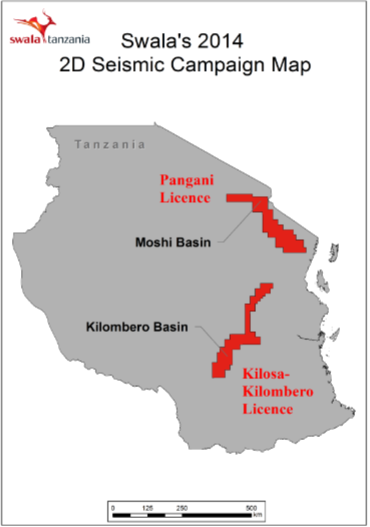
THE ROADHOUSE BOWSER: Swala Energy (ASX: SWE) has kicked off its 2014 2D seismic data acquisition program over the Moshi Basin, located within the Pangani exploration licence in northern Tanzania.


Swala’s licences and the target basins for the 2014 seismic campaign. Source: Company announcement


Swala Oil and Gas (Tanzania) Plc, which is partly owned by Swala Energy, and its Joint Venture partner Otto Energy (ASX: OEL), will acquire approximately 200 kilometres of 2D seismic data over the basin in the next four weeks and that data will be processed as the survey progresses.

This seismic survey is a follow-up to an earlier program carried out in the basin in 2013, from which results indicated a sedimentary basin of about 3,000 metres in thickness.

Swala Energy explained once the survey in the Moshi basin is complete seismic operations will move to the Kilombero basin where a further 430km of 2D data will be acquired.

“The commencement of the 2014 seismic program underlines Swala’s commitment and capability to move ahead with its exploration program.” Swala Energy CEO Dr. David Mestres Ridge said in the company’s announcement to the Australian Securities Exchange.

“This work is intended to firm up potential drilling targets for a planned 2015 drilling campaign as required under the terms of the respective Production Sharing Agreements with TPDC.”

Website: www.swala-energy.com

TGA approval for Uscom BP+ Central Blood Pressure

THE ROADHOUSE PHARMACY: Uscom (ASX: UCM) announced the listing of the company’s Uscom BP+ device on the Australian Register of Therapeutic Goods.

The Australian Therapeutic Goods Administration (TGA) lists devices which meet Australian Government standards of quality, safety, efficacy and timely availability on the Australian Register of Therapeutic Goods.

Listing on the TGA register is essential prior to sale of a medical device in Australia.

Uscom explained the Uscom BP+ uses patent protected suprasystolic oscillometry to measure the blood pressure at the heart, information previously only provided by cardiac catheterization, and which better predicts cardiovascular risk and provides better treatment guidance.

The company claims the patent protected Uscom suprasystolic oscillometric central blood pressure technology has advantages over simple sub systolic oscillometry, which only measures the cuff blood pressure in the arm.

The TGA listing now means the Uscom BP+ can be sold in Australia by distributors and directly by the company to Hospitals, clinics, researchers and consumers concerned with improved management of hypertension and other diseases related to blood pressure abnormalities such as heart failure.

“Regulatory approval is becoming a significant hurdle for market entry as the regulatory process becomes increasingly complicated,” Uscom executive chairman Dr Rob Phillips said in the company’s announcement to the Australian Securities Exchange.

“We are delighted to have FDA, CE and now TGA approval for the Uscom BP+, and are currently preparing for Chinese CFDA submission.

“Australian Doctors are responsive to new and improved technologies and the Uscom supra systolic oscillometric central blood pressure device, the BP+, represents a breakthrough technology in the field.

“We are now targeting Hospitals, cardiovascular researchers, clinics and individuals with hypertension or heart failure that require highly accurate clinical blood pressure measurements and improved management.”

Website: www.uscom.com.au

Beach Energy completes 3D Oil Farm-in

THE ROADHOUSE BOWSER: 3D Oil Limited (ASX: TDO) announced the completion of the sale of a 20 per cent working interest in the T/49P exploration permit to Beach Energy (ASX: BPT).

3D said it has now received the remaining $2.5 million of the of the $3 million purchase price.

The company explained the T/49P permit was previously held at a 100% equity interest by TDO since it was acquired via government gazettal in April 2013.

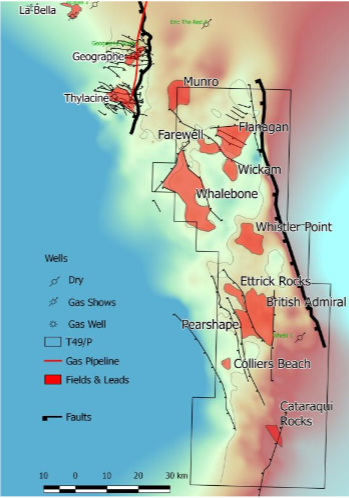
3D said it considers T/49P to be highly-prospective for gas and is located offshore in the Otway Basin in Tasmanian waters west of King Island proximal to existing offshore gas infrastructure.

The T/49P permit covers an area of 4,960 square kilometres in water depths generally no greater than 100 metres.


T/49P Leads and Thylacine and Geographe Fields. Source: Company announcement


The permit is lightly explored covered by a broad grid of 2D seismic data of varying vintages and has two early exploration wells.

The permit is adjacent to the Thylacine (the largest gas discovery in the Otway Basin) and Geographe gas fields which have a combined gas in place (GIP) of over 2 TCF.

3D Oil said the T/49P JV is planning to initiate its exploration program with the acquisition of at least 755sqkm of 3D seismic.

This Flanagan marine seismic survey is scheduled to be acquired late in 2014 subject to JV and regulatory approvals.

This survey is the major commitment in the primary term of the permit.

The company indicated it is currently in discussions with a range of further potential farminees to jointly explore T/49P.

Website: www.3doil.com.au

Cryosite and Regeneus partner up to develop stem cell products

THE ROADHOUSE PHARMACY: Cryosite (ASX: CTE) and Regeneus (ASX: RGS) have signed an agreement to collaborate on the development and manufacture of new stem cell products for human applications.

Key elements of the agreement include:

Cryosite will provide production facilities for Regeneus’ off-the-shelf allogeneic stem cell product for human osteoarthritis (Progenza).

The product, to be used for clinical trial purposes, will be manufactured within Cryosite’s GMP clean room facilities by Regeneus staff;

Regeneus will provide technology, know-how and research facilities to assist Cryosite with the development of methods for the expansion of cord tissue-derived mesenchymal stem cells (MSCs); and

The companies will jointly explore new product development and manufacturing opportunities.

“There are a number of synergies between our two companies that we are focused on bringing to commercial fruition,” Cryosite’s acting CEO Graeme Moore said.

“The agreement has a direct and immediate effect on increasing Cryosite’s revenues and will enable the further development of a new cord tissue derived stem cell product that will complement our established cord blood stem cell banking service.

“Cord tissue contains MSCs that are not generally found in cord blood”.

Progenza is Regeneus’ off-the-shelf stem cell product for human OA that is manufactured by collecting a small amount of fat from a human donor.

The stem cells from the fat are expanded by tissue culture, dispensed into vials and frozen.

Several hundred thousand doses of the product can be produced from fat from one donor thus allowing a true pharmaceutical industry style stem cell product.

“This agreement allows Regeneus to cost effectively fast-track the production of Regeneus’ off-the shelf Progenza product for preclinical and clinical trials for market entry into Japan,” Regeneus CEO Professor Graham Vesey said.

“Our relationship with Cryosite is developing into a strong partnership and we anticipate that it will continue to grow over time.

“Cryosite currently provides stem cell handling and storage services for Regeneus’ personalised stem cell therapy for human OA, HiQCell.

Cryosite’s capabilities in the manufacture and storage of GMP cell-based products in a TGA licensed facility compliments Regeneus’ product development and early stage commercialisation capabilities.

“We foresee a future where our two companies use these capabilities together to develop and supply a range of regenerative medicine products.”

Website: www.cryosite.com

Fund Raising across the Boards

THE FUND RAISER: Things seemed to have tapered off on the Fund Raising front this week.

Placement of $250,000 in Securities

Perpetual Resources (ASX: PEC) has agreed to issue 5 million fully paid ordinary shares at 5 cents per share ($250,000 in aggregate) to International Mining Supplies Pte Ltd.

The purpose of the Placement is to raise funds to continue with the exploration program at the Wiagdon Thrust Joint Venture project and also for working capital for Perpetual.

Completion of Share Placement to raise US$1 million

Prospect Resources (ASX: PSC) has raised US$1 million via the issue of approx. 71.9m shares at 1.5 cents each.

The share placement is to Armoured Fox Capital (Pty) Ltd, an investment vehicle represented by Sithembiso Mthethwa and Manana Nhlanhla, who Prospect identified as successful South African business people.

The company said it was pleased to secure Armoured Fox Capital as a major shareholder describing it as a South African based company with a regional outlook and as such understands growing opportunities in Zimbabwe.


Raising $340,000

Goldphyre Resources (ASX: GPH) has resolved to raise up to $340,000 through the issue of just over 15.4 million new shares at 2.2 cents per share.

The placement includes one free attaching listed option (ASX Code: GPHO) exercisable at 8 cents with an expiry date of 30 September 2016 for every share subscribed in the placement.

The funds will be primarily used for gold drilling programs at the company’s Laverton Downs project, to strengthen the balance sheet as the company assesses new project opportunities and for working capital purposes.


Non-renounceable entitlement issue

Monteray Mining Group (ASX: MRY) will undertake a one for one entitlements issue of approximately 65,400,355 shares at an issue price of 1 cent per share.

The Offer will raise up to $654,004 before costs and will be applied to funding exploration activities at the company’s Burkina Faso projects, for due diligence on additional projects for acquisition and for working capital.

Monteray has initiated a follow up exploration program at its Pepin and Guimba gold exploration permits located in central Burkina Faso.

The program, to follow up previously announced positive exploration results, will include in-fill soil sampling and a targeted ground magnetics program over auger and RC anomalies at the Pepin permit to help define targets for follow up drilling, as well as rock chip sampling and mapping at the Guimba permit.

Shale Energy – is it all it’s cracked up to be?

GAVIN WENDT: The great hype surrounding the advent of a shale gas bonanza within California might turn out to be just that – hype.

The U.S. Energy Information Administration (EIA), which is the statistical arm of the Department of Energy, in late May downgraded its estimate of the total amount of recoverable oil within the Monterey Shale by 96 per cent.

EIA officials have admitted that previous estimates of recoverable oil within the Monterey shale reserves in California of about 15.4 billion barrels were vastly overstated.

The revised estimate has slashed this amount by an extraordinary 96 per cent to just 600 million barrels of oil.

The assessment cut US national reserves by 39 per cent.

The Monterey formation, previously reported to contain more than double the amount of oil estimated within the Bakken shale in North Dakota, and five times larger than the Eagle Ford shale in South Texas, was slated to add up to 2.8 million jobs by 2020 and boost government tax revenues by $24.6 billion annually.

The main reason for the downgrade was that the original 2011 estimate mistakenly assumed that California’s shale oil and gas could be recovered with as much ease as it is elsewhere in the country.

However, the geology of the Monterey Shale is much more complex than in the Marcellus, Bakken, or Eagle Ford Shales – the three formations principally responsible for the surge in oil and gas production within the USA.

The layers of shale in the Monterey are folded in such a way that drilling is difficult, and test wells thus far have come up disappointing.

The Los Angeles Times quoted a downbeat assessment from an official with the EIA.

“From the information we’ve been able to gather, we’ve not seen evidence that oil extraction in this area is very productive using techniques like fracking,” said John Staub, a petroleum analyst with the EIA.

“Our oil production estimates, combined with a dearth of knowledge about geological differences among the oil fields, led to erroneous predictions and estimates.”

The oil and gas industry was quick to point out that the calculation could change once again if drillers could improve technology to access the Monterey.

After all, no one saw the shale revolution coming only a few short years ago.

But as Staub, the EIA analyst noted, for now oil and gas production in, “the Monterey formation is stagnant,” and it could remain that way.

The sharply downgraded numbers come amid a heated debate within California at the present time over whether or not the state should permit oil and gas companies to use hydraulic fracturing (fracking) – the process in which a combination of water, chemicals and sand are injected underground at high pressure in order to break apart shale rock and access trapped natural gas.

Of course, issues over fracking are nothing new to industry participants, residents, landowners and activists on Australia’s east coast, where the ‘social licence’ of the industry to operate is an extremely hot topic of conversation and much debate at the present time.

The parallels between Australia’s east coast and America’s west coast are significant.

Like New South Wales and Queensland, California is home to an enormous agricultural industry and with the Monterey Shale being situated beneath the fertile Central Valley, fracking is competing with agriculture, grazing and other commercial and residential users for water use.

On March 20, Santa Cruz became the first county in California to ban fracking.

The move may have been symbolic though, since there isn’t much of a presence by the industry in that locality.

It was aimed more at putting pressure on Governor Jerry Brown to stop fracking within the water-starved state.

That follows a unanimous February vote by the city of Los Angeles to ban the practice, the largest city in the USA to do so.

But the issues with respect to California’s Monterey Shale are in my opinion even more significant from a broader industry perspective.

Just recently, the cover of Barrons magazine read, “Here Comes $75 Oil”.

The article argues that due to several new ‘game changers’ within the oil production industry, the oil price would fall to $75 a barrel within the next five years.

The three main reasons it argues that would contribute to cheaper oil are deep-water oil, shale oil and oil sands.

All of these new-found resources are estimated at roughly one trillion barrels in newfound oil.

When added onto the existing global oil reserve that’s currently estimated at 1.5 trillion barrels, this newfound oil is potentially a major factor in the future of oil pricing.

The article also references Citigroup energy analyst Eric Lee, who believes that most of this new oil could be recovered for around under $75 per barrel, leading to a global decrease in price.

The reality however does not marry up with such an optimistic outlook.

After examining existing extraction cost data, it is hard for the supply-side economics to actually work out and support $75 oil for a sustained period of time.

According to the EIA, worldwide consumption of petroleum products is forecast to grow by 1.2 million barrels per day during 2014 and 1.5 million barrels per day during 2015.

This increased demand would put worldwide oil consumption at 91.60 million barrels per day during 2014 and 92.97 million barrels per day during 2015.

Last year, total world oil production came in at 90.33 million barrels per day, compared to a global consumption of 90.38 million barrels per day.

The EIA would agree with the Barron’s article that new-found oil reserves will offset the current deficit, but current estimates show that newfound oil reserves would only add 1.3 million new barrels of oil to the existing world oil market.

This would put total supply estimates for 2014 and 2015 at 91.67 million barrels per day and 93.0 million barrels per day, a slight surplus, but not enough to justify a 25 per cent decrease in price.

The below graph highlights the EIA’s estimates for global oil supply and consumption over the past two years and its forecast for the next two years.


With respect to shale oil and gas, its method of extraction and production is difficult and costly.

The primary reason for this is due to the fact that the oil is heavier and flows more slowly.

This ultimately drives up the costs of production compared to more conventional oil extraction methods used by OPEC nations.

Given the necessary time, difficulty, and cost, shale production break-evens within the US can range anywhere from $60 to $80 per barrel.

At current oil price levels, there is room for healthy profits, but if prices were to contract, that healthy margin would evaporate, impacting production.

As oil price contraction becomes a possibility, several of the area’s largest producers – Continental Resources, Statoil, and Hess Corp – are all working to try and bring down the costs of production.

Thus far, these firms have been successful at decreasing costs, but given the overall difficulty in extraction, those costs can only come down so far.


This should come as a signal that any significant downward change in the price of oil would be a major headwind for the continued operations of these firms, especially as they continue to push to increase output.

The EIA estimates that this year the U.S. will produce an average of 8.54 million barrels of oil per day.

Compare this to the EIA’s estimate that the U.S. on average consumes 18.49 million barrels of oil per day.

Even with the strongest domestic oil output since 1986, the US is still short by almost 10 million barrels per day of just meeting its own demand.

When comparing total estimated US oil output during 2014 to the EIA estimates of global oil demand, US oil production in 2014 will only make up 9.32 per cent of total global demand.

Some might argue that as more wells come online, US production will increase and make up a bigger piece of the pie. However, one of the biggest criticisms of standard shale wells is the short lifespan of the wells.

Global Sustainability estimates that the US will need to drill 6,000 new wells per year at a cost of $35 billion just to maintain current production levels.

Given this, the firm believes that by 2017 the US will hit its max production levels and ultimately return back to 2012 production levels.

Essentially, strong overall oil prices have encouraged the advent of shale energy and are continuing to facilitate its sustainability.

Whilst shale can produce vast new volumes of oil, this comes at a cost – and relies on a strong underlying oil price for its sustainability.

Shale can supply vast new oil supplies, but we must be aware of its limitations in terms of cost and other impacts.

Gavin Wendt is the founder of MineLife, publisher of the MineLife Weekly Resource Report