Sheffield Resources scores high-grade HM at Thunderbird

THE DRILL SERGEANT: Sheffield Resources (ASX: SFX) has received further results from drilling undertaken at the Thunderbird heavy mineral sand (HMS) deposit, located within the company’s Dampier HMS project near Derby in the Canning Basin region of Western Australia.

The results are the second batch of assay results to be reported from Sheffield’s 2013 aircore drilling program and have returned thick, high grade intervals, which the company considers to have confirmed the grade continuity of the deposit.

The results relate to 77 infill drill holes and include:

–    40.5 metres at 9.3 per cent heavy minerals (HM) from 1.5 metres, including 22.5 metres at 13.3 per cent HM from 1.5 metres;

–    55.5m at 10 per cent HM from 30m, including 49.5m at 11 per cent HM from 30m;

–    42m at 8.61 per cent HM from 9.5m, including 33m at 10.2 per cent HM from 18.5m;

–    36m at 8.19 per cent HM from 15m, including 24m at 10.9 per cent HM from 16.5m; and

–    63m at 7.41 per cent HM from 18m, including 46.5m at 8.96 per cent HM from 28.5m.

Sheffield said the results underscored the continuity of both the mineralised sequence and the high-grade zones at Thunderbird and that a better understanding of the geometry of the anomaly’s high-grade zone was emerging from these results.


Section looking northwest showing the continuity between holes of
the mineralised envelope (>2% HM), and the higher grade zones (>5%
and >7.5% HM). Source: Company announcement

“The infill drilling has outlined a coherent zone of mineralisation above 7.5 per cent HM, which in current results is about 2.5 kilometres wide, four kilometres long and expected to grow as results are returned from the remaining drill holes,” Sheffield Resources managing director Bruce McQuitty said in the company’s announcement to the Australian Securities Exchange.

“Within this zone is a broad high-grade lobe up to 39 metres thick, orientated in a north south direction.

“We are still awaiting results for many holes drilled within this interpreted channel.

“In addition, the assay results still to be received include samples from extensional drilling to the deposit.

“Following receipt of these assays in the coming weeks, the significance of this discovery will become clearer.

“Once all results are received we will finalise the resource update, followed by a scoping study scheduled for Quarter one, 2014.”

Sheffield’s 2013 drilling program at Dampier comprised 326 holes for a total of 21,747m at the Thunderbird and Argo prospects.

First pass drilling carried out first on the Argo prospect, located 12km to the west of Thunderbird returned HM results similar in tenor to those previously obtained by
Rio Tinto.

The drilling achieved results of greater than 2 per cent HM from four holes:

–    19.5m at 3.69 per cent HM from 84m, and 4.5m at 2.52 per cent HM from 69m;

–    27m at 2.35 per cent HM from 49.5m;

–    18m at 2.46 per cent HM from 55.5m; and

–    7.5m at 2.80 per cent HM from 52.5m.

Sheffield indicated it intends to conduct mineral assemblage testwork from the drilling to determine the zircon content of the Argo mineralisation.

Future exploration will attempt to track the mineralisation closer to surface and will target higher grade strandline targets.

Email:
bmcquitty@sheffieldresources.com.au

Website:
www.sheffieldresources.com.au

Pioneer drills further encouragement at Kalpini South

THE DRILL SERGEANT: Pioneer Resources (ASX: PIO) has received results from recent drilling conducted at the Kalpini South prospect, part of the company’s Acra gold project in Western Australia.

Pioneer completed seven RC holes for 1,027m at the Kalpini South prospect, which were carried out along strike from high-grade gold drill hits the company announced in April this year.

The company said two of the holes had encountered strong gold mineralisation, and have subsequently been used to interpret the strike and dip of mineralisation.

Two of the remaning holes encountered he right stratigraphy and anomalous, but sub-grade gold – and have been interpreted by the company to be near misses to the principal gold structures.

Pionerer has now delineated high-grade gold intersections over 100 metres of strike, with mineralisation remaining open in all directions.

Results included:

KSRC007: 11 metres at 3.77 grams per tonne gold from 94 metres within an intersection of 15 metres at 2.93 grams per tonne; and

KSRC010: 3m at 5.44g/t gold from 128m (this has been interpreted as a gold lode intersection) and 8m at 1.41g/t gold from 85m (interpreted as flank mineralisation to the principal gold-bearing structure).


Kalpini South project: Long Section showing drill hole
intercepts and potential for mineralisation down plunge of the current
mineralisation. Source: Company announcement


Pioneer said the latest high-grade hits at Kalpini South have complemented earlier drill holes (KSRC004 and KSRC005), which returned 10m at 6.38g/t gold from 61m, and 9m at 5.31g/t gold from 36m respectively.

Hole KSRC007 is located 50m to the southeast, and KSRC010 50m to the northwest along strike of these results.

Pioneer said it was encouraged by the spread of high tenor gold intersections as they occur at a range of depths, including:

5m at 12.06g/t gold from 61m, and 2m at 6.66 g/t gold from 101m;

8m at 5.76g/t gold from 36m;

6m at 6.01g/t gold from 99m; and

3 m at 5.44g/t gold from 128m.

“Significant intersections of gold mineralisation within fresh rock bodes well for the identification of potentially commercial tonnages of gold ore at depth,” Pioneer Resources said in its ASX announcement.

The company’s next phase of drilling will commence the drill-out of Kalpini South, with fences of holes, enacting a change in drilling azimuth.

At the Carmelia South prospect drilling will define the mineralisation orientation.

The first holes will be drilled at the Mountain Maid prospect, while at the Jubilee East prospect drilling will test for mineralisation continuity.


Email:
dcrook@pioresources.com.au

Website:
www.pioneerresources.com.au


Caravel Minerals claims third Wynberg gold discovery

THE DRILL SERGEANT: Caravel Minerals (ASX: CVV) has claimed to have discovered a third copper-gold prospect on the company’s Wynberg project, located in the Cloncurry District of North Queensland.

The discovery was made during a recently-completed program of surface soil geochemistry and rock chip sampling.

The new prospect, known as Wynberg C, is located along strike from the Wynberg A prospect, which contains an Inferred Resource of 140,000 ounces of gold (3.1 million tonnes grading 1.4 grams per tonne).

The company gave credit for the discovery to its strategy of systematically exploring the Wynberg project to gain an understanding of the region’s geology and to identify priority areas for follow-up exploration.

“The results to date clearly demonstrate the outstanding potential of the project to host significant copper-gold mineralisation,” Caravel Minerals chief executive officer Marcel Hilmer said in the company’s announcement to the Australian Securities Exchange.

“The Cloncurry District is one of the most significant mineral provinces in the world, and having results like this on the doorstep of some of the great copper-gold finds of modern times, like Ernest Henry, is very encouraging.

“We intend to progress cost-effective and focused exploration activities at Wynberg to advance this project to the next stage, without compromising our ongoing focus on our primary asset, the Calingiri copper-molybdenum project in Western Australia.”

Caravel collected a total of 14 rock chip samples from within the Wynberg C prospect on the back of encouraging surface geology and soil geochemical results.

Copper-gold results were returned in 6 out of the 14 rock chips taken.


Wynberg C prospect with 2013 rock chip results and historical RC drilling. Source: Company announcement


From the results the company has identified surface mineralisation is hosted within strongly altered and brecciated sediments.

Caravel stressed that although individual grades of selected rock chip samples are not necessarily representative, it does consider the association of copper and gold and the alteration style to be consistent with Cloncurry District style mineralisation.

Caravel has also been encouraged by historical Reverse Circulation (RC) drilling of two holes within the newly identified trend, which returned results of:

–    8 metres at 1.58 grams per tonne gold and 0.4 per cent copper from 12 metres; and

–    12m at 1.19g/t gold and 0.1 per cent copper from 26m.

The company did acknowledge the limitations of these drill results, but nonetheless it believes they increase its confidence the new prospect can host economic copper-gold intersections.


Website:
www.caravelminerals.com.au

Monax Mining strikes Designated Project deal with Antofagasta

THE DRILL SERGEANT: Monax Mining (ASX: MOX) has established its Millers Creek project in South Australia as a ‘Designated Project’ (DP) with its strategic alliance partner, a wholly-owned subsidiary of major Chilean copper producer Antofagasta, via its wholly-owned subsidiary, Monax Alliance.

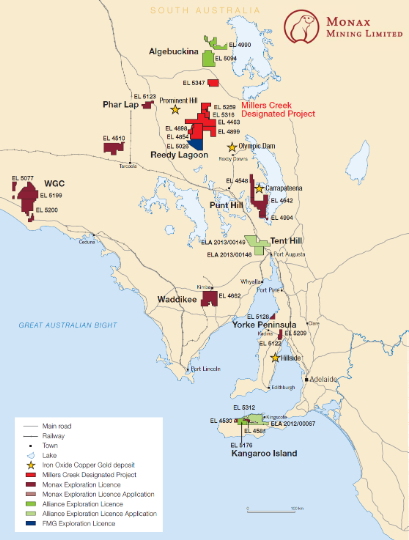
The Millers Creek DP comprises three Alliance tenements together with four tenements owned by ASX-listed Maximus Resources (ASX: MXR), all located within the Woomera Prohibited Area (WPA).

The Alliance announced the signing of a Memorandum of Understanding (MOU) earlier this week with Maximus for the Billa Kalina project which now forms part of the Millers Creek DP.

Combined, the seven tenements cover 3165 square kilometres and represent a fair-sized landholding within the Olympic iron-oxide copper-gold (IOCG) Province.

The Millers Creek area is located between Olympic Dam and Prominent Hill within the Olympic IOCG Province and has not been subject to extensive mineral exploration, due to its location within the WPA.


Location of Monax projects including the new Alliance Millers Creek Designated Project. Source: Company announcement


“The new Designated Project is a significant project for us and provides the Alliance with a major exploration focus within a prospective and under-explored part of the Gawler Craton,” Monax Mining managing director Gary Ferris said in the company’s announcement to the Australian Securities Exchange.

“Due to it being a heavily restricted Defence area for many years, exploration access within the WPA has been virtually non-existent.

“The recent opening of this highly-prospective area has provided the Alliance with a major focus to secure tenements for exploration.

“There is limited available tenure within the Olympic IOCG Province, so the Alliance was eager to secure the three available tenements at Millers Creek, and combine them with the Maximus project area, to have a combined suite of tenements under the DP which has not received significant exploration for IOCG deposits.

“The extension of the strategic alliance for a further year, and the new DP, show that Antofagasta regards South Australia as prospective for the discovery of large copper deposits.”

Monax said the Alliance has commenced the land access approvals process and plans to undertake detailed gravity in late 2013 or early 2014 over selected target areas.

Email:
info@monaxmining.com.au

Website:
www.monaxmining.com.au


Artemis Resources extends Eastern Hills mineralisation

THE DRILL SERGEANT: Artemis Resources (ASX: ARV) has received final drill results from a 15 hole, reverse circulation (RC) drilling program recently completed at the company’s Eastern Hills antimony–lead deposit, located in the Ashburton region of Western Australia.

The company said the laboratory assays from the 2,470 metre drill program have confirmed the presence of antimony–lead mineralisation at Eastern Hills.

Intersections from the final batch of assay results include:

–    4 metres at 2.4 per cent antimony and 3.1 per cent lead from 141 metres, including 1 metre at 5.3 per cent antimony and 7.3 per cent lead from 141 metres;

–    2m at 3 per cent antimony and 3.7 per cent lead from 137m; and

–    1m at 3.0 per cent antimony and 3.6 per cent lead from 59m.

The latest results have extended the Taipan Zone along strike to the west resulting in a total strike length of 850 metres, up 40 per cent from the strike length Artemis had interpreted prior to commencing the drill program.


Eastern Hills drill hole plan (latest assays received in yellow). Source: Company announcement


Other results, in particular, from hole AREHRC013 doubled the interpreted depth of antimony-lead mineralisation by approximately 90m on that cross section, while also increasing mineralised thickness.

Artemis highlighted the Taipan Zone antimony-lead mineralisation remains open along strike to the east, and also at depth along the 850m of strike extent it has defined to date.

The final batch of assay results also demonstrated additional mineralisation at the western end of the deposit with grades up to:

–    1 metre at 5.3 per cent antimony and 7.3 per cent lead.

Artemis has engaged an independent consultant to commence the estimation of a JORC code-compliant resource for the Eastern Hills deposit.

“We are extremely happy with the success of our Eastern Hills drilling program in significantly expanding the antimony-lead mineralisation,” Artemis Resources general manager-exploration Trevor Woolfe said in the company’s announcement to the Australian Securities Exchange.

“Before year’s end we expect to be able to quantify this expansion as we announce a maiden JORC-compliant resource for the deposit.

“In a significant step, Artemis will be attending the World Antimony Conference in Guilin, China in early December, as well as visiting Chinese antimony operations.”

Email:
info@artemisresources.com.au

Website:
www.artemisresources.com.au

Lamboo Resources closer to market-grade graphite

THE DRILL SERGEANT: Lamboo Resources (ASX: LMB) has advanced its McIntosh flake graphite project in Western Australia close to meeting market requirements for battery-grade crystalline-grade flake graphite.

The company has had Nagrom Laboratories at Kelmscott in WA conduct metallurgical beneficiation of flake graphite from the McIntosh project.

The beneficiation work has achieved high-concentrate grades of 96.1 per cent total carbon (TC) as well as high purity for Target 1 flake graphite.


Location of flake graphite Target areas in the McIntosh project. Source: Company announcement


The company indicated its next step is to produce bulk flake graphite concentrates for commercial testing.

“The McIntosh project is living up to its potential to become a major flake graphite producer in Australia,” Lamboo Resources technical director Dr Craig Rugless said in the company’s announcement to the Australian Securities Exchange.

“It is gratifying that testwork has produced excellent results after a single re-grind and using standard metallurgical techniques to preserve the flake graphite required by potential high-tech customers.”

Lamboo explained the goal of the metallurgical testing to, not only to produce high-concentrate flake graphite, but also a product it hopes will potentially satisfy the large and increasing demands of the lithium battery industry as well as high technology uses.

The company said research conducted by Nanotechnology has identified fine flake graphite could provide a breakthrough for fast charge batteries.

High-purity flake graphite required for this process can command premium prices as it demands specifications that have been difficult to achieve to date with natural flake graphite.

Email:
Ken Banks–Investor Relations
kbanks@bigpond.net.au

Website:
www.lambooresources.com.au

Birimian Gold encouraged by Ntiola deposit test work results

THE DRILL SERGEANT: Birimian Gold (ASX: BGS) has received encouraging metallurgical results from laboratory based test work conducted on material from the Ntiola deposit at the company’s Massigui gold project in southern Mali.

The Ntiola peposit is situated approximately 25 kilometeres from the Morila Mine Treatment Plant, which Birimian considers could present a near term opportunity for the company to develop mining operations and truck ore to supplement feed at Morila.

Birimian explained the test work was designed to reflect the Morila Treatment Plant flow sheet with the intention to broadly characterize the metallurgical properties of oxide and primary material types from typical Ntiola gold bearing material.

Three separate 20 kilogram composite samples were prepared from reverse circulation and diamond core material collected during the last drilling program at Ntiola.

One sample represented the oxide material from the central portion of the Ntiola mineralised zone.

The remaining two samples were from primary rock types in the central portion of the mineralised zone.

“Excellent overall gold recoveries and a very high proportion of gravity recoverable gold were observed in both material types,” Birimian Gold said in its ASX announcement.

“Test results record gold recoveries of 98.4 per cent in oxide material and from 80 per cent to 96.5 per cent gold recoveries in primary material.

“Further work is currently underway to determine the distribution of primary material types.

“Exceptional gravity gold recoveries of up to 64.2 per cent in primary rock types are very pleasing given a highly efficient gravity circuit is in operation at Morila.

“High gravity recoveries may imply that significant processing efficiencies and cost savings can be achieved during ore treatment.”

Birimian Gold said it had been encouraged by the preliminary metallurgical results and views them to be a step towards the potential development of the Ntiola deposit.

The results demonstrate material from Ntiola would be amenable to processing through the existing facilities at the Morila gold mine and Birimian indicated it is confident additional test work will further optimize recoveries and refine the processing parameters for Ntiola.

“Multiple drilling campaigns and recent technical studies at the Ntiola prospect have defined what the company believes to be a robust gold mineralised zone amenable to open pit mining and subsequent treatment at the existing Morila processing plant,” Birimian said.

“This is supported by the positive metallurgical test work results, which demonstrate that high gold recoveries can be achieved utilising the nearby Morila processing plant to treat material from the Ntiola deposit.”

Email:
info@artemisresources.com.au

Website:
www.artemisresources.com.au

Red Mountain trenching returns one ounce per tonne gold

THE DRILL SERGEANT: Red Mountain Mining (ASX: RMX) is excited with its encounter with a high-grade surface trenching intersection from the Lobo prospect, located on the company’s Batangas gold project in the Philippines.

The highlight of recent trench sampling returned:

–    2 metres at 31.1 grams per tonne (1 ounce per tonne) gold, including 1 metres at 60.2 grams per tonne gold.

This new high-grade trench intersection is located 100m along strike to the southwest of recent drilling completed at the Japanese Tunnel prospect.

Further drilling carried out 200m along strike to conduct surface sampling of vein boulders produced assays of up to 33.5g/t gold extending the Southwest Breccia-Japanese Tunnel zone to 500m strike length before the structure passes under younger limestone to the southwest.


Southwest Breccia-Japanese Tunnel plan with soil anomalies and surface/trench sample results. Source: Company announcement


“The rich gold grades of the new, at surface, lode discoveries – more than an ounce to the tonne – highlights the potential for additional high-grade gold shoots within this mineralised corridor, which may be similar or better than the high-grade Southwest Breccia resource,” Red Mountain managing director Jon Dugdale said in the company’s announcement to the Australian Securities Exchange.

“The company has identified a vein system that now extends over 500 metres and further trenching, then drilling, is planned to confirm continuity and define additional high-grade mineral resources to upgrade our current 408,000 ounce resource base.”

Drilling at Japanese Tunnel during August and September 2013produced peak intersections of:

–    8.7m at 4.34g/t gold from 2.9m, including 3.7m at 8.6g/t gold; and

–    3.7m at 3.06g/t gold, 2.26 per cent copper from 12.3m, including 1.55m at 5.97g/t gold, 4.88 per cent copper.

Red Mountain considers these results have partially confirmed its Exploration Target while opening potential to extend the mineralised zone to the southwest, where mapping has determined the structure continues a further 500m before it is covered by a veneer of post-mineralisation limestone.

The new trench (7), which targeted an area below a surface-subcrop rockchip sample result of 15.9g/t gold and 18.7g/t silver, intersected a 2m wide quartz-barite-sulphide breccia lode 100m directly along strike from the Japanese Tunnel drilling.

Samples were initially taken 1m bellow surface, producing an intersection of 2m ta 10.7g/t gold, including 0.5m at 34.4g/t gold and again at the base of the trench 1.5m below surface where the intersection of 2m at 31.1g/t gold, including 1m at 60.2g/t gold was produced.

Further trenching is in progress, as well as additional trenching in the vicinity of the 33.5g/t Au boulder sample location, 200m west of the new trench, and in other prospective areas.

Email:
info@redmm.com.au

Website:
www.redmm.com.au

Sirius Resources hits big gold at Nanook

THE DRILL SERGEANT: Sirius Resources (ASX: SIR) has continued its love affair with the drill bit with recent drilling undertaken at the Nanook gold prospect, located within the company’s 100 per cent-owned Polar Bear project.

Siruis has reported the latest drilling at Nanook has encountered the highest grade gold mineralisation yet at Polar Bear.

Assays are still awaited for approximately half of the recent drill program, however the last two holes from which assays have been received returned:

–    13 metres at 23.9 grams per tonne gold from 44 metres, including 4 metres at 74.7g/t gold from 44 metres; and

–    18m at 1.46g/t gold from 44m, including 8m at 2.85g/t gold from 44m.

The latest drilling is being carried out to follow up earlier 400m spaced lines at one of Sirius’ gold targets, which identified a broad anomaly known as the Nanook prospect.


Plan of Nanook gold prospect showing key reconnaissance drill intersections. Source: Company announcement


The recent follow up drilling on 200m spaced lines has defined the presence of an extensive layer of gold-bearing quartz gravel, which Sirius considers to have eroded off an adjacent elevated area of hydrothermally altered bedrock.

Assay results for the remainder of this drill program are expected next week, until then Sirius said, the significance of this zone is unknown.

Two other gold anomalies defined in the first pass reconnaissance drilling of the southern gold targets have yet to be followed up, and the northern gold targets have not yet been subject to any drilling as they are located on tenements recently granted to Sirius after 15 years of inactivity whilst previous ownership issues were resolved.

“In conjunction with our nickel exploration around Nova we will now accelerate our gold exploration program to continue to expand the first pass reconnaissance drilling coverage of the remaining 60 per cent of the gold targets beneath Lake Cowan and also delineate the extent of the gold mineralisation at Nanook in more detail, both within the palaeochannel deposit and in the adjacent bedrock ridge,” Sirius Resources managing director Mark Bennett said in the company’s announcement to the Australian Securities Exchange.

“With a strong cash position of over $110 million following settlement of the recent capital raising, we will be well positioned to fast track these outstanding exploration opportunities whilst we continue to progress the Nova-Bollinger project through feasibility and into development.”

Email:
admin@siriusresources.com.au

Website:
www.siriusresources.com.au

Dacian Gold hits high-grades at Jupiter

THE DRILL SERGEANT: Dacian Gold (ASX: DCN) has claimed to have intersected a high-grade lode position with the drilling of three 80 metre-spaced diamond drill holes at the company’s Jupiter prospect.

The Jupiter prospect is part of the company’s 100 per cent-owned Mt Morgans gold project, located in the Laverton District of Western Australia’s North Eastern Goldfields.

Dacian has interpreted the intersections to lie within a high-grade lode structure that cuts both the syenite intrusive and the adjacent host basalt.

The mineralisation remains open in all directions.

The new mineralisation has been identified 1000 metres south of the existing 73,000 ounce Mineral Resource and the Jupiter pit where similar style lode structures were mined in the 1990s.

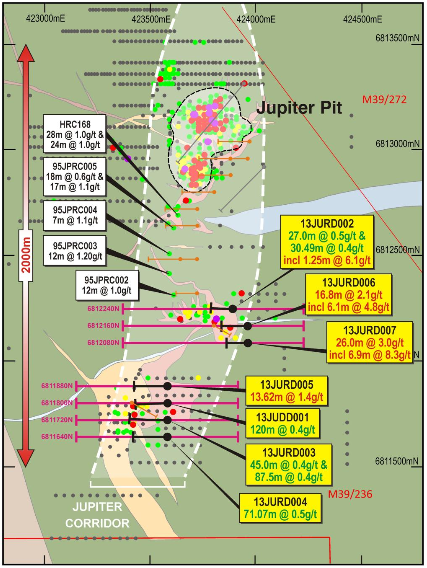
The new results include:

–    6.9 metres at 8.3 grams per tonne gold from 154.1 metres within 26 metres at 3 grams per tonne gold;

–    6.1m at 4.8g/t gold from 166.9m within 16.8m at 2.1g/t gold; and

–     1.25m at 6.1g/t gold from 122.7m within 3.2m at 2.62g/t. (This intersection was previously reported within an interval of 30.49m at 0.4g/t gold.).


Jupiter plan showing high-grade Dacian drill hole results in red
type, historic intersections and planned holes. Source: Company
announcement


Dacian said the new intersections support its exploration model of targeting the two kilometre long Jupiter Corridor for flat to moderately dipping high-grade structures lying within the syenite intrusives.

The company also consider the results to have confirmed all rock types within the Corridor are prospective for high-grade mineralisation.

“These important results confirm our view that the two kilometre long Jupiter Corridor has the potential to develop high grade lodes within a range of rock types similar to the lodes currently being mined at the nearby seven million ounce Wallaby deposit,” Dacian Gold managing director Paul Payne said in the company’s announcement to the Australian Securities Exchange.

“We have commenced follow-up drilling to determine the potential size of the high-grade mineralisation at this location as well as continuing the framework drilling along the length of the corridor.”

Dacian is of the opinion these latest drilling results demonstrate high-grade lodes can develop along the length of the Jupiter Corridor, and like the nearby Wallaby deposit, the lodes can develop in the mafic country rock surrounding the mineralised syenites.

Email:
info@daciangold.com.au

Website:
www.daciangold.com.au