Ausgold Scoping Study Shows Katanning Gold Mine Potential

THE DRILL SERGEANT: Ausgold Limited (ASX: AUC) has completed a Scoping Study for the company’s 100 per cent-owned Katanning gold project in Western Australia.

Ausgold reported the Study had determined key outcomes highlighting the potential of the project to support a viable standalone gold mining and processing operation.

The Scoping Study incorporated a revised Mineral Resource Estimate of 33.9 million tonnes at 1.1 grams per tonne gold for 1.2 million ounces of gold.

The company said preliminary economics indicate the project has positive financial metrics over an initial mine life of seven years with capital payback early in the life of the project.

As a result of the positive outcome of the Scoping Study, the Ausgold Board has wasted little time in approving the commencement of further studies and metallurgical test work.

There is also to be a new drilling program charged with the aim of expanding the current Resource with a focus on targeting high-grade mineralisation within the Central Zone.

“The Scoping Study is a huge step forward for the Katanning gold project highlighting as it does the potential for a standalone mining operation,” Ausgold managing director Matthew Greentree said in the company’s announcement to the Australian Securities Exchange.

“The Scoping Study outlines a base case for a 1.25 million tonnes per annum mining operation capable of producing over 350,000 ounces over an initial seven-year mine life with an attractive payback period of less than two and half years.

“The Study has been completed to a high standard by an experienced team of independent Western Australian based consultants who have developed conservative operating parameters providing a high degree of confidence in study outcomes.

“This provides a realistic base case at an $2,000 per ounce gold price providing an attractive payback period of less than 2½ years, with these economics being significantly improved when current spot gold prices are considered.

“The project is located less than 300 kilometres from Perth and close to high-quality infrastructure which supports the near-term development of the project.

“The significant near Resource exploration potential, improves the economics of this project with a planned drill program to further enhance projects economics.

“The Scoping Study highlights the potential for the development of a robust standalone gold operation and, as a result, the Ausgold Board has approved the commencement of further studies, metallurgical test work and new drilling programs with the aim of expanding the current Resource with a focus on targeting high-grade mineralisation to expand the current Resource within the Central Zone.”


Email: info@ausgoldlimited.com
Web: www.ausgoldlimited.com


Independence Group Maximises Value of Nova Concentrates

THE DRILL SERGEANT: Independence Group (ASX: IGO) has been busy of late working to maximise value from the high-quality nickel and copper concentrates produced at the company’s Nova Operation in Western Australia.

The recent work includes the completion of a highly competitive concentrate tendering process and conclusion of a Downstream Nickel Sulphate Pre-Feasibility Study.

A binding concentrate offtake agreement for a three-year term has been executed with Trafigura for 50 per cent of nickel concentrate and for 100 per cent of copper concentrate produced from Nova.

An offtake term sheet with BHP Billiton Nickel West for an additional 50 per cent of the nickel volume for a period of five years has been executed, subject to the completion of a formal agreement within one month and all necessary internal approvals of both parties.

Having identified the potential value of downstream processing and, following scoping and proof-of-concept studies, IGO initiated a PFS on the technical and financial merits of converting nickel sulphide concentrate from Nova into high quality nickel sulphate via its trademarked (patent pending) The IGO Process.

The company declared the study demonstrated the technical feasibility of The IGO Process, which it describes as being “a technically advanced process for converting nickel sulphide concentrate directly to battery grade nickel sulphate”.

The study involved extensive pilot and continuous plant testwork to be completed on The IGO Process that achieved metal extraction rates of better than 97 per cent for both nickel and cobalt.

The results underlined IGO’s confidence in the potential for The IGO Process to become an established flowsheet for the production of nickel sulphate.

The IGO Process has a smaller carbon and environmental footprint compared with traditional methods for nickel sulphate production due to much lower emissions, power consumption and waste generation.

“It is pleasing to have brought these two workstreams to completion, and to have achieved the material improvement in commercial terms for our new offtake agreements,” Independence Group managing director and CEO Peter Bradford said in the company’s announcement to the Australian Securities Exchange.

“The tightening supply and strong demand forecast for nickel and copper has led to strong competition for Nova concentrate, which is now established as a high quality, highly desirable product for end users.

“The work we have completed as part of the nickel sulphate downstream prefeasibility study has demonstrated that IGO has developed an innovative processing technology to more efficiently produce nickel sulphate for the clean energy and the electric vehicle battery market at a lower cost and in an environmentally sustainable manner.

“We recognised that this project would have to compete with tightening supply and higher payabilities in the market and as a result of the improved nickel payabilities obtained, the returns on this project are unlikely to meet IGO investment hurdles for construction of such a facility in Western Australia, hence the decision not to advance this project beyond the pre-feasibility study.

“We remain committed to our strategy to focus on metals critical to clean energy.

“We will continue to explore partnering opportunities, leveraging the technology we have developed on downstream processing to create additional value for shareholders.”


Email: contact@igo.com.au

Web: www.igo.com.au


Golden Rim Resources Identifies 1.6km Gold Anomaly at Kouri

THE DRILL SERGEANT: Golden Rim Resources (ASX: GMR) copleted an Induced Polarisation (IP) survey at the company’s Kouri gold project in Burkina Faso.

Golden Rim reported that the IP survey has detected a large chargeability-high anomaly associated with the high-grade gold mineralisation at the Diabatou prospect.

The company has, to date, completed 180 line kilometres of the planned 500 line km survey, from which initial data has outlined a strong, 1.6-kilometres long, IP chargeability-high anomaly.

“It is believed the IP anomaly is related to the pyrite mineralisation (up to 5%) that is associated with the high-grade gold mineralisation,” Golden Rim Resources said in its ASX announcement.

Previous drilling intersections within the IP anomaly at Diabatou include:

MRC008
7m at 121.2 grams per tonne gold from 41m, including 1m at 783.8g/t gold; and

MRC014
4m at 23.3g/t gold from 67m, including 1m at 65.7g/t gold.

Golden Rim commenced a 9,200m RC drilling and 4,000m diamond drilling program at Kouri in October.

A diamond drilling rig is currently on the third hole (MDH003) at the Diabatou prospect that has a planned depth of 150m to test the new IP anomaly and is located 60m along the interpreted southwest strike extent of the high-grade gold mineralisation intersected in previous RC drill hole MRC008.

A second RC rig will be operating for the next few weeks to test the southern portion of the IP anomaly at Diabatou and then the northeast strike extent of the 1.4 million ounce Mineral Resource in the new Goueli Permit.


Email: info@goldenrim.com.au

Web: www.goldenrim.com.au


Pantoro Highlights Potential for a Large Low-Grade Gold System

THE DRILL SERGEANT: Pantoro Limited (ASX: PNR) has completed follow up drilling at the company’s Mary River gold project near Halls Creek in Western Australia.

Pantoro said the drilling identified consistent low-grade gold mineralisation over 450 metres of strike that remains open in all directions.

The drilling was undertaken around the historic Reform mine located approximately 20 kilometres from the Nicolsons gold project.

The seven-hole program included five diamond drill holes and two RC holes, and according to Pantoro, has confirmed the potential for a large low-grade gold system with new results including:

14 metres at 1.23 grams per tonne gold, including 2m at 5.33g/t gold;

13m at 0.97g/t gold;

4m at 3.35g/t gold;

4m at 2.24g/t gold;

15.7m at 0.89g/t gold; and

17m at 0.74g/t gold.

The drilling was carried out central to the historic Mary River gold field, which has had limited modern exploration with only three RC exploration drill holes prior to the work commenced by Pantoro in 2018.

The latest drilling was following up on the company’s maiden program undertaken during 2018, which was designed to collect stratigraphic information relating to the project scale geology of the prospects.

“This additional drilling confirms the presence of a broad, low grade gold system near the historic Reform mine,” Pantoro managing director Paul Cmrlec said in the company’s announcement to the Australian Securities Exchange.

“Future drilling will be focussed on extending the tested strike extent of mineralisation at Reform, and undertaking initial drilling programs at in the northern parts of the field which will be undertaken under the DMIRS EIS co-funding scheme.

“We are highly encouraged by the geological mapping and sampling undertaken in this area and the extensive historical workings.”

In addition to the work undertaken at Reform, Pantoro also carried out detailed surface mapping and sampling of the northern five kilometres of the Mary River goldfield.

The programs were conducted in an around the extensive historic and alluvial workings at McPhees, Blue Bar , Spear Gully and Chinamans where 60 pits and shafts were recorded.

The mapping and reconnaissance work identified a similar shear system and geology to that seen at Reform, with both the broad low-grade mineralisation and the localised high-grade quartz veining that the company has documented in previous work.


Email: admin@pantoro.com.au

Web: www.pantoro.com.au


Matador Mining to Follow High-Grade Rock Chips as Exploration Guide

THE DRILL SERGEANT: Matador Mining (ASX: MZZ) recently completed a regional soil sampling program at the company’s Cape Ray gold project in Newfoundland, Canada.

Matador Mining conducted the program as part of a greenfield target generation process it anticipates to be tested further during 2020.

The company expects the results of the soil sampling program during Q4 2019.

“To identify targets for the 2019 regional exploration program, the company considered a range of factors, including analysis of structural data, geophysics, rock geochemistry, pathfinder geochemical elements and regional mapping,” Matador Mining said in its ASX announcement.

“The company also reviewed all historical rock chip samples and found numerous high-grade samples along the 80 kilometres of strike.”

The key targets for the 2019 regional exploration program included:

The Granites; Isle aux Morts; The Gap; Benton; and Keats Find.

Results include:

191 grams per tonne gold and 59g/t gold at Benton (11.5km north of Central Zone);
11.6g/t gold at Keats Find (16.8km south of Central Zone);
56.8g/t gold at Grandy’s Find (16km north of Central Zone);
18.7g/t gold at Benton 5 (39km north of Central Zone); and
41.9g/t gold at Isle Aux Morts (7.5km North of Central Zone).

Matador claims the Cape Ray shear is regarded as one of the more prospective, yet under explored gold regions in North America.

The company consolidated approximately 80km of continuous strike across the southern portion of the shear earlier this year, the first time this ground has been under the ownership of a single company.

The majority of drilling at the project is within a strike of 5km, between the Central Zone and Window Glass Hill deposits.

Matador said the location of this drilling is unsurprising as approximately 95 per cent of the total resource of 1.02 million ounces at 2.2g/t gold is contained within this area.


Email: info@matadormining.com.au

Web: www.matadormining.com.au


Hillgrove Resources Announces Kavanagh Underground Minerals Resource Estimate

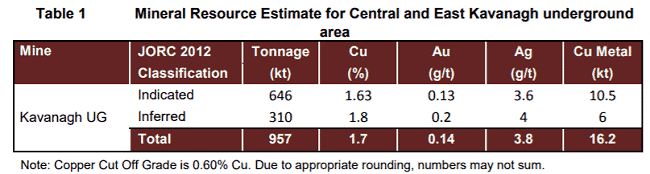
THE DRILL SERGEANT: Hillgrove Resources (ASX: HGO) completed a JORC Code 2012-copliant Mineral Resource Estimate for the Central and East Kavanagh underground area at the company’s Kanmantoo copper mine in South Australia.

Hillgrove Resources said the underground Mineral Resource Estimate has incorporated 2019 diamond drilling results with the earlier 2006 diamond drill results.

Source: Company announcement

The company said the copper grade of the resource estimate indicates that the grade and dimensions of the orebodies may be suitable for underground mining.

“The resource estimate only covers a portion of the Central and East Kavanagh areas and there is considerable opportunity to increase the resource with further drilling on Central and East Kavanagh and drilling of the identified West Kavanagh Exploration Target,” Hillgrove Resources said in its ASX announcement.

Hillgrove indicated the Mineral Resource Estimate will now be subjected to mine design, optimisation and feasibility studies, as permitting, finance and an agreement with AGL over mine life are finalised.


Mincor Resources Eyes Cassini Ore Reserve after Encouraging Nickel Hit

THE DRILL SERGEANT: Mincor Resources (ASX: MCR) has commenced an updated Mineral Resource for the company’s Cassini nickel sulphide deposit after recent diamond drilling yielded a further thick zone of high-grade nickel sulphide mineralisation.

Mincor Resources drilled an ‘up-wedge’ hole (MDD334w1) that returned a high-grade intercept of 8.1 metres at 5.7 per cent nickel that was encountered within a targeted 72m down-plunge gap situated between previously reported high-grade intercepts.

Mincor explained that MDD334w1 was drilled on the Inferred/Indicated Resource boundary within the current Mineral Resource envelope in the recently delineated CS5 channel.

The company said this new intersection is higher grade and thicker than currently estimated in the Resource block model and demonstrates the continuity, thickness and high grade nickel sulphides contained within the CS5 surface and clears the way for the completion of an updated Mineral Resource which will be used by the Operations Team to establish a Maiden Ore Reserve for the Definitive Feasibility Study (DFS).

The anticipates an Ore Reserve will be released as part of the DFS in the March 2020 quarter.

“The intersection from the up-wedge hole announced today is the icing on the cake of what has been a remarkably successful drilling campaign,” Mincor Resources managing director David Southam said in the company’s announcement to the Australian Securities Exchange.

“During this period, we’ve drilled six diamond holes, all which have been mineralised, with four of those intersecting very thick and high-grade nickel sulphides, which is an exceptional result by any measure.

“Our focus now turns to completing an updated Mineral Resource in November, building further on the last update in August.

“In the meantime, the exploration story at Cassini will continue to evolve.

“The diamond rig moves firstly to the adjacent magnetic anomaly and then the CS1 channel.

“Success at either of these locations could further open up the prospective horizon at Cassini along strike to the north and potentially further elevate the significance of this remarkable greenfields nickel discovery.”


Email: mincor@mincor.com.au

Web: www.mincor.com.au


Musgrave Minerals Recommenced Mainland Drilling After Hitting More High-Grade Lena Gold

THE DRILL SERGEANT: Musgrave Minerals (ASX: MGV) has recommenced drilling at the Mainland area, part of the company’s 100 per cent-owned tenure at the Cue gold project in the Murchison district of Western Australia.

Musgrave Minerals reported the drilling at Mainland had recommenced to follow-up high-grade gold drill results that were achieved in August and surface high-grade rock-chip sampling in October.

The company executed an Option Agreement to acquire the Mainland tenements near Cue in March, after which it quickly completed an initial Reverse Circulation (RC) drilling program at the Mainland-Consols target that intersected:

3m @ 5.4g/t Au from 74m down hole (19MORC008)

The Mainland-Consols target is open to the south and down dip and follow-up drilling that has commenced is aimed at further testing this area along with other high-priority targets including the area where a high-grade (3,499.4g/t gold) rock-chip sample was identified.

Musgrave indicated that there has been no historical drilling carried out in the area of this high-grade rock-chip sample.

“We are excited to recommence drilling at Mainland in areas where we have previously identified high-grade gold,” Musgrave Minerals managing director Rob Waugh said in the company’s announcement to the Australian Securities Exchange.

“There is significant untested gold potential within the Mainland tenements and we are only just getting started in terms of applying modern exploration techniques in the area.”

The current program will consist of up to 18 RC drill holes for approximately 1,000m before the rig moves to Break of Day and Lena.

Musgrave also received further high-grade gold assay results from diamond drilling at the Lena deposit that returned high-grade gold over potentially mineable widths below the current JORC resource boundary and confirm the continuity of the mineralisation at depth.

Lena has an existing JORC 2012 resource of 2,682,000 tonnes at 1.77 grams per tonne gold for 153,000 ounces of gold.

Two of the three recent diamond drill holes completed at Lena (19MODD020 and 19MODD021) intersected high-grade gold lodes over potentially minable widths.

Results include:

19MODD021
6 metres at 4.4 grams per tonne gold from 191m down hole, including 2.2m at 10.6g/t gold from 194.8m

This intersection was encountered approximately 30m vertically beneath the existing resource boundary on the eastern high-grade lode; and

19MODD020
2.8m at 4.8g/t gold from 384m down hole, 140m below the existing resource on the western lode.

The mineralisation is open down plunge on all lodes.

Musgrave explained that hole 16MODD019 that was drilled at the southern end of the high-grade plunging main shoot at Lena, lifted above the intended target position and intersected the lode above and outside the south plunging high-grade shoot at this location without intersecting any mineralisation of note.

That being said, the company acknowledged the new drilling had supported its re-interpretation of historical drill data that identified a southerly plunge on the high-grade gold lodes that remain open at depth below the current JORC resource boundary.

Musgrave has been encouraged by the drilling program, saying it has improved its geological confidence in the continuity of the mineralisation beneath the current resource.

The results will be incorporated into the geological model to facilitate a re-estimation of the Lena gold resource.

Further RC drilling is scheduled to commence at Lena in early November to support an updated JORC compliant resource estimate in early Q1 2020.

“At Lena we continue to define high-grade extensions to the gold mineralisation below the existing JORC resource boundary,” Waugh continued.

“The drilling has improved our confidence in the continuity of the high-grade mineralisation at depth and will likely add high-grade ounces as we continue to drill to upgrade the existing resource at Lena.”

The Mainland area and Lena deposit are 100 per cent-owned by Musgrave and are excluded from the Earn-in and Exploration Joint Venture with Evolution Mining (ASX: EVN).

On the new JV area over Lake Austin at Cue, Musgrave and Evolution are planning follow-up drilling programs at Lake Austin North and other lake targets where there is evidence of a potential large gold system.


Email: info@musgraveminerals.com.au

Web: www.musgraveminerals.com.au


St George Mining Encounters More Step-Out Results at Mt Alexander

THE DRILL SERGEANT: St George Mining (ASX: SGQ) released more results from ongoing exploration programs underway at the company’s Mt Alexander project in the north-eastern Goldfields of Western Australia.

St George is concentrating on shallow, high-grade nickel-copper sulphides it has discovered at the Cathedrals Belt to date, which it believes to be associated with mafic-ultramafic intrusions interpreted to have passed upwards from the Earth’s mantle through structures located in the northern margin of the Belt.

Deeper drilling to track the mineralised intrusive units down-plunge of the shallow deposits has intersected these units in their interpreted down-dip extension.

Subsequent downhole EM (DHEM) surveys the company has underway in these deeper holes have now identified multiple off-hole EM conductors, which St George consider to be excellent targets for the discovery of further nickel-copper sulphide mineralisation.

“These new EM targets from the deeper holes indicate that the large, high-grade mineral system at the Cathedrals Belt is ‘live’ at depth,” St George Mining executive chairman John Prineas said in the company’s announcement to the Australian Securities Exchange.

“With all EM conductors drilled in the Cathedrals Belt confirmed as nickel-copper sulphides, the new EM conductors present a tremendous opportunity to make further discoveries and to confirm the continuation of mineralisation down-plunge.

“We are seeing increasing potential for significant mineralisation at depth, and are excited to be escalating our drill program to more intensely test this priority target area.”

MAD168 is the latest deep stratigraphic hole St George has completed at the Cathedrals Belt.

The hole was drilled to a downhole depth of 301 metres where it intersected 6.5m of nickel-copper sulphides from 227.1m downhole.

The sulphides were intersected in the interpreted down-dip continuation of the Investigators ultramafic unit.

MAD168 is a large 95m step-out to the north of the previously known mineralisation in MAD123 that St George claims has confirmed a large extension of the down-plunge strike of high-grade mineralisation at Investigators.

The breccia and stringer sulphides intersected by MAD168 suggest remobilisation from a larger and proximal source of massive nickel-copper sulphides.

This interpretation is given additional weight by the high chalcopyrite content of the sulphides in MAD168, a further indicator of proximal remobilised mineralisation.


Web: www.stgm.com.au

Southern Gold to Commence Drilling at Bonanza Zone

THE DRILL SERGEANT: Southern Gold (ASX: SAU) is set to commence a diamond drilling program on the Bonanza Zone, within the company’s 100 per cent-owned Deokon project in South Korea, having secured land access and regulatory approvals.

Southern Gold explained the drilling would be a first pass scout program initially to test the Bonanza Zone outcrop and will involve close spaced drilling to determine the currently unknown true width of the mineralised zone and quantify representative gold and silver grade.

The initial program will involve four diamond drill holes, three of which are designed to intersect around 25 metres below the identified outcrop at around 40m apart, with a fourth planned to intersect the structure at depth, approximately 50m below surface.

A second drill pad along strike is also planned to follow with stage 2 holes.

The Bonanza Zone is part of the Golden Surprise Trend that Southern Gold claimed discovery of in July 2019.

At that time the Bonanza Zone returned a peak of 32.4 grams per tonne gold and 1,095g/t silver in outcrop and 78.6g/t gold and 13,000g/t silver in float.

“We are extremely pleased to have secured the required approvals in a timely manner in order to drill the first program into the compelling target at Bonanza Zone this year,” Southern Gold managing director Simon Mitchell said in the company’s announcement to the Australian Securities Exchange.

“Our 100 per cent-owned Deokon project with bonanza grade gold and silver on surface, including visible native silver in hand specimen, is a genuine ‘walk-up drill target’, which has never been tested before.

“Deokon is an exciting project and is just one part of the enormous exploration potential that is unfolding in South Korea.”

Other recent work in South Korea has included a maiden diamond drilling program at the Beopseongpo project, involving four holes for 653.63m at Lotus North and three holes at Hand of Faith for 556m, totalling 1,209.63m of drilling.

Southern Gold anticipates final assays during November at which point the company said it would will summarise the program in more detail.

“At Beopseongpo we are highly encouraged by the intersection of the target structure at the Hand of Faith target, including multiple wide intercepts of epithermal quartz veins,” Mitchell said.

“We now await the assays but are already planning the next stage of drilling there, including at Golden Palm where we have sampled high grade gold on surface.

“Beopseongpo continues to evolve as a high-quality project of exceptional scale.”


Email: info@southergold.com.au

Web: www.southerngold.com.au