Singapore Set to Shine

THE CONFERENCE CALLER: You know the world’s collective mining industries are starting to get serious about the inevitable transition to renewable energy generation and storage to offset the impact of climate change when all links of the supply chain gather in one place.

The Future Facing Commodities Conference is a ground-breaking gathering set to take place in the Asian economic stronghold of Singapore in the first week of April.

Future Facing Commodities, also known as critical minerals, are metals and non-metals that have emerged through the unique properties each contributes to modern day technologies.

They each hold particular economic functions due to the fact they are difficult to replicate, and therefore replace, when used in manufacturing renewable energy generators such as solar panels or wind turbines.

Not are they difficult to replicate or replace, some are very difficult to find leading to high degrees of supply risks such as geological scarcity, geopolitical issues, trade policy or other factors, which in turn, makes them extremely valuable.

It has been hard to avoid any chatter of electric vehicle and the predicted global rise they are to be responsible for regarding the increased demand in battery minerals.

This will be a subject of great discussion at the Future Facing Commodities Conference as companies meet to mull over how to meet this demand as the world transitions to renewable energy generation and storage to offset the impact of climate change.

The Future Facing Commodities Conference provides the perfect opportunity to bring together world leaders of Electric Vehicles and the critical minerals industry with global capital markets to meet at one major event in one major city.

An early presentation on Day One will be delivered by BHP Xplor vice president Dr Sonia Scarselli.

BHP Xplor is an initiative by Mining giant BHP, which has opened its doors to aspiring exploration companies, especially those in the hunt for copper, nickel and other critical minerals.

The major’s new BHP Xplor initiative is a simple way for the company to outsource grassroots exploration by financing juniors with a good tale to tell, but nobody to listen.

When launching the program, BHP described Xplor as being, “dedicated to accelerating innovative, early-stage mineral exploration start-ups to find the critical resources necessary to drive the energy transition”.

A smart move to get in early and being in the room should any of these minnows hit something of potential, thereby removing any possible bidding wars with any other super-miner that may be interested.

Also on Day One punters will hear from John Stover portfolio manager for Asia Pacific based investment and advisory firm Tribeca’s Asia Credit Strategy.

Stover’s presentation will look at the Supercyle investment opportunities arising in the Asia-Pacific region.

An appearance from Australian Government Minister Hon Madeleine King, MP Minister for Resources, Minister for Northern Australia will build on presentations at Critical Metals focused conferences by the previous Liberal Government.

No matter who oversees the nation’s capital, all persuasions of Australian governments are realising the importance Future Facing Commodities will play in our immediate future.

The World Bank is just one authority that anticipates demand for critical minerals in renewable and clean energy to increase, citing expectations of a rise of 500 per cent by 2050.

In its Resources and Energy Major Projects Report for December 2022, the Department of Industry, Science and Resources declared critical minerals projects would be perfectly placed to build momentum for Australia’s critical minerals sector.

At the time of releasing the report, Australia’s critical minerals major project pipeline comprised 81 projects with an estimated value of $30 to 42 billion.

Compare this to the same in 2021 when there were 71 projects worth an estimated $22 to 36 billion in the gun and it is obvious this sector is on the rise.

Western Australia has lead the charge to maintain its standing as the nation’s pre-eminent mining destination with over fifty per cent of all Australian critical minerals’ projects — in terms of both project numbers and investment value —located in the state.

That doesn’t mean the rest of the country has given up, on the contrary the hunger for Future Facing Commodities is driving exploration on projects based in most Australian states and territories, with New South Wales, the Northern Territory and Queensland accounting for most of the remaining investment dollars.

“Around a quarter of this year’s critical minerals projects are at the publicly announced stage, worth $6.5 to 11.6 billion,” the Department of Industry, Science and Resources said in its report.

“Projects at the feasibility stage account for more than half of all critical minerals’ projects — worth $16.3 to 22.9 billion.

“A total of 13 projects were at the committed stage ($6.7 billion), and three projects with a capital value of $800 million were completed during the year.”

Although the Future Facing Commodities are being exhumed from WA they are being put to more use on the eastern seaboard.

According to the Clean Energy Council’s Renewable Projects Quarterly Report – Q4 2022 New South Wales contributed the most financially committed generation projects in 2022, with five projects, Victoria came second with four new projects accounting with Queensland completing the podium in in third position.

All up, in 2022, 15 generation projects for a total of 3.57 gigawatts (GW) of installed capacity reached Financial Close, which was down on 2021’s total of 23 projects.

The Clean Energy Council noted that a pattern seems to be developing where there are fewer total projects, however, those that are coming on board are larger in size in terms of installed capacity.

“In 2022, 26 projects across Australia reached financial commitment. This was seven projects fewer than 2021 and the lowest annual tally of new projects reaching this stage since the Clean Energy Council began recording data in 2017.

This equates to 13.7 GW of installed capacity, as well as 10.1 GWh of storage,” The Clean Energy Council said.

“Over this same period, 189 generation and storage projects have been commissioned, contributing 13.9 GW of installed capacity, and 1.1 GWh of storage.”

Despite these figures, the hunger for investment in renewable energy and storage goes unsated with investment in new financially committed capacity projects hitting $4.29 billion in Q4 2022, a 10-fold increase to the previous quarter, and more than $4.1 billion compared to 12 months previous.

“The rolling 12-month quarterly average investment spiked to $1.56 billion for new capacity projects, and huge increase from the $531 million seen in Q3,” The Council added.

“Total investment on new financially committed capacity projects for 2022 reached $6.24 billion, an increase of $0.99 billion (+18.9 per cent) compared to 2021.”


Calling Stumps at 2023 RIU Explorers Conference

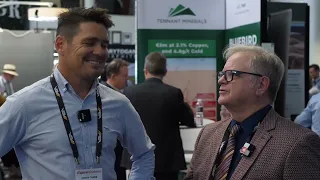
THE CONFERENCE CALLER: Wally Graham and Jaxon Crabb of Vertical Events recap on the 2023 RIU Explorers Conference with a special guest cameo appearance.

Lifting Gold Bars at the 2023 RIU Explorers Conference

THE CONFERENCE CALLER: Wally Graham tries his hand at lifting ABC Refinery gold bars at the 2023 RIU Explorers Conference.

Neometals Capitalising on Dying Batteries

THE CONFERENCE CALLER: Looming European battery recycling regulations have driven Neometals’ (ASX: NMT) pivot away from mining into materials recovery and recycling, managing director Chris Reed told the 2023 RIU Explorers Conference. By Ngaire McDiarmid

“Our aim is to be the leading provider of recycling solutions to the OEMs, be they car makers or cell makers,” he said.

“More of the cars are becoming electric … and as they get to the end of their life, we model 10 years, there will be a tsunami in terms of the number of batteries coming back that need to be recycled.

“So, what we’ve developed is plants that can process the scrap.”

He said recycling was compulsory in the EU, carmakers were faced with declaring their carbon footprint and meeting minimum recycled content requirements, which was why miners like Glencore were getting into recycling.

Neometals is recycling at a 10 tonne per day refinery hub in Germany through Primobius, its 50:50 Joint Venture with the SMS Group.

Aside from producing nickel, cobalt, manganese and lithium, the tailings were ammonium sulphate, a fertiliser product, which Reed said was one of the revolutionary parts of the patent-pending process.

He said 79 per cent of the cost of a traditional lithium-ion cell was in the raw material.

“So, if I’ve got a ton of these batteries … it’s the same as having a ton of ore in front of a concentrator – that’s 15 per cent nickel, 15 per cent copper, 2 per cent cobalt and 2 per cent lithium and at our operation in Germany now, we get paid to take that,” he said.

Reed believes emerging lithium supply was unlikely to meet the growing demand and said by 2040, recycled material would be the main source of lithium.

Neometals also had a flexible business model and would do plant supply, including a partnership with Mercedes Benz, plus technology licences, Reed said.

He pointed to a “catalyst-rich year”, including the Mercedes partnership progressing and advancing a 50tpd plant with Stelco in Canada, with the economics due in the June quarter.

Aside from its core battery materials business units, Neometals has the large-scale Barrambie titanium and vanadium project in Western Australia.


Accelerate Resources Poised to Drill Manganese Project

THE CONFERENCE CALLER: Accelerate Resources (ASX: AX8) announced recent mapping has confirmed the discovery of two large, mineralised manganese corridors at the Woodie Woodie North project, ahead of managing director Yaxi Zhan’s presentation to the 2023 RIU Explorers Conference today. By Ngaire McDiarmid

The new corridors represented “persistently mineralised trends” analogous to the mineralisation at the Area 42 discovery and were extensions of the world class Woodie Woodie mine corridor, Accelerate said.

Zhan told Resources Roadhouse on the sidelines that the news was quite significant and indicated the potential for a large-scale deposit at Woodie Woodie North.

The project, consolidated exactly 12 months ago, is about 70km from the long-life Woodie Woodie manganese mine in Western Australia’s Pilbara.

Recent drilling at Area 42 confirmed the presence of large and well-developed hydrothermal “Woodie Woodie style” zones, Zhan said.

Results included 1m at 50.8 per cent manganese from 1m, within 5m at 33.7 per cent from surface.

The company is planning to start an aggressive drilling program in April ahead of a maiden resource expected before year-end, Zhan said.

“Today’s announcement basically demonstrates that we can potentially … duplicate the success that we’ve had at Area 42 to all the other corridors,” she said.

Accelerate is aiming to become the next Australian manganese producer.

Zhan said manganese was a critical mineral, irreplaceable in steel production and increasingly in demand for the growing battery and renewable technologies sector.


READ MORE HERE

Matsa Resources Aims for 1Moz ‘And Beyond’ at Lake Carey

THE CONFERENCE CALLER: Drilling results announced today give Matsa Resources (ASX: MAT) confidence its Lake Carey gold project will increase beyond 1 million ounces, executive chairman Paul Poli told the 2023 RIU Explorers Conference. By Ngaire McDiarmid

Results included 14m at 2.87 grams per tonne gold and 19m at 3.77g/t from Fortitude North, at the project in Western Australia’s Goldfields.

“We didn’t expect to find these types of grades, it’s completely opened up the ground to the north,” Poli told the conference.

The nearby permitted Fortitude deposit holds 489,000oz of the project’s current 886,000oz.

Describing Matsa as “a gold company with a twist of lithium”, Poli said whether it remained a company with two prongs was yet to be seen.

Its second focus is as a lithium “trailblazer” in Thailand.

Poli said Matsa had amassed just under 1,200 square kilometres, pointing to DSO potential at Phang Nga which was “littered with lithium occurrences throughout that pegmatite”.

He was at pains to dispel the misconception that processing lepidolite was difficult.

“I say to all the naysayers, lepidolite is valuable, the proof is here,” he said.

The company had announced a lithium testing agreement this week, for 80kg of its Thai samples, with Yongxing Special Materials Technology, one of China’s largest lepidolite miners and processors.

“We’ve had a bit of fun with our share price this week,” Poli noted.

“It’s up 50 per cent – and little bit of luck, that will continue.”


READ MORE HERE


CSA Fractures the Lithium Goldilocks Zones Fairytale

THE CONFERENCE CALLER: CSA Global Mining Industry Consultants associate partner Ian Stockton shared some tips for Western Australian lithium hunters on the final day of the 2023 RIU Explorers Conference. By Ngaire McDiarmid

He noted exploration for lithium had increased dramatically in recent years in line with the move to electrification and the demand for lithium-ion batteries, creating both supply and exploration challenges.

“We cannot recycle our way out of the shortage,” he said.

“Lithium mines are limited, production is constrained … therefore lithium production needs to catch up with current demand, which can only happen through exploration.”

However, the lithium knowledge base was relatively new for the broader exploration community, making it a steeper learning curve for geologists in the field “which is also quite exciting,” Stockton said.

Drawing on his circa 30 years of experience and input from the CSA team, including principal geologist Ralph Porter, Stockton said greenstone belts were better hosts of lithium than granites or granite gneiss in WA due to greater permeability.

“Beware – pegmatites are very common,” he said.

“In your tenement less than five per cent of your pegmatites may contain minerals of interest and less of these may be large enough to exploit, so therefore it’s important to quickly and accurately target only the most prospective pegmatites.”

The rock temperatures at the time of melt generation were important as it impacted how far the fractionated pegmatite melt could move away from the source granite, he explained.

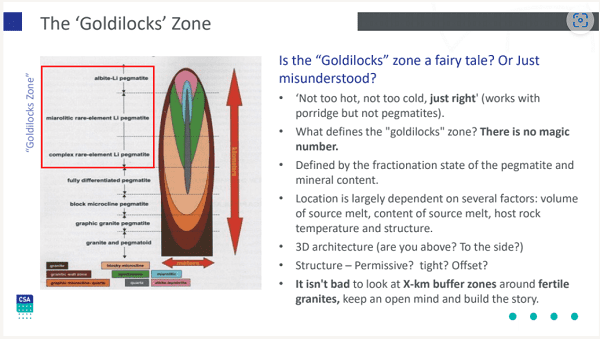
Stockton spoke of a “Goldilocks” zone – not too hot, not too cold but just right – that worked with porridge not pegmatites.

“There is no magic number,” Stockton said.

“So, keep an open mind and build the mineral system – the pegmatites do come in all shapes and sizes.”

As for whether source rocks were fertile or barren, Stockton’s technical advice included saying using the potassium-rubidium ratio [K/Rb (<30)] was “fairly robust” for identifying potential mineralised pegmatites.

“Fractionation is a relatively simple, but effective approach,” he said.

“Finally, there’s no substitute for time on the ground.”


Oar Resources’ Fresh Look Shows Battery Potential at Oakdale Graphite Project

THE CONFERENCE CALLER: One of Oar Resources’ (ASX: OAR) original projects is coming to the fore as the company reshapes its focus on battery and critical minerals, the 2023 RIU Explorers Conference heard. By Ngaire McDiarmid

Metallurgical test work, announced this morning ahead of CEO Paul Stephen’s presentation, identified ultra-fine flake graphite in historical drill core from Oar’s Oakdale graphite project on South Australia’s Eyre Peninsula.

Ultra-fine flake graphite is increasingly in demand and seeing price growth due to its suitability for producing spherical graphite, used in battery manufacturing, Stephen noted.

Historically jumbo flakes had attracted higher prices so the fine material at Oakdale had made the project less attractive in the past, Stephen told Resources Roadhouse on the sidelines of the conference.

“Let’s go look at the project with different eyes,” he said of the company’s new approach.

“Let’s look at the grade, let’s look at the potential increase in tonnages and then let’s look at the processing advantages of having a clay-based product, it’s not going to need the capital costs some of the other plants.

“It’s early days, we’ve got a lot of work to do.”

In keeping with its new focus, Oar acquired the Denchi lithium project in Western Australia in the December quarter, divested an iron ore project and was actively seeking partners for its Douglas Canyon gold-silver project in the US.


Time For Tin and a New Nickel Target: Venture Minerals

THE CONFERENCE CALLER: Venture Minerals (ASX: VMS) is excited to start drilling a new nickel target next week at its tenements in northwest Tasmania, managing director Andrew Radonjic told the 2023 RIU Explorers Conference. By Ngaire McDiarmid

The company announced the drilling program today ahead of Radonjic’s presentation.

The target was described as sitting within the same ultramafic belt that hosts the 264,000 tonne Avebury nickel deposit, 25km to the southwest.

Venture has a diverse portfolio, including a Joint Venture with Chalice Mining in Western Australia, the Riley iron ore mine on care and maintenance and the Mount Lindsay tin-tungsten project in Tasmania.

The company was looking to have the second tin mine in Australia, Radonjic told delegates.

“Tin is three times the price of copper [about US$33,000 per tonne],” he said.

“The time for tin is now.”

He said tin was dubbed a spice metal, as it was used in minor amounts but was vital in electronics applications, including mobile phones.

Venture is refocusing its development approach at Mount Lindsay, which also hosts the Reward rare earth element (REE) discovery and the Cruncher REE-tin exploration target.


READ MORE HERE


Lady Colleen Study Exceeds Austral Resource’s Expectations

THE CONFERENCE CALLER: Austral Resources’ (ASX: AR1) Lady Colleen copper project in Queensland is economically viable, according to a scoping study result announced today ahead of the miner’s presentation to the 2023 RIU Explorers Conference. By Ngaire McDiarmid

The study indicated total production of about 44,000 tonnes of copper and a pre-tax internal rate of return of about 38 per cent over five years.

It put the pre-tax net present value (7.5 per cent discount) at A$60 million – ranging from $15 million to $94 million with a median estimated value of $55 million.

In the company’s ASX announcement, managing director and CEO Dan Jauncey said the initial study had exceeded expectations and demonstrated the project’s potential.

He said a mine at Lady Colleen would boost revenue and further cement Austral’s position as both a copper producer and an explorer with a highly prospective project book.

The company recently reported a record revenue month, as production from its Anthill copper mine in Queensland ramped up to 1,003 toones in January, driving sales revenue to $12.6 million.

Exploration manager Ben Coutts told RIU Explorers delegates Anthill’s cathode production enabled Austral’s self-funded exploration program.

“The company had an inventory of 140 mineral assets and had a clear focus on “closing the development gap”, he said.

One of the first projects the company wanted to advance from pre-development was Lady Colleen, Coutts said.