Mutiny secures Widgie South

THE BOURSE WHISPERER: Mutiny Gold has secured 100 per cent ownership of the Widgie South tenement.

The company settled the acquisition for a combined $200,000 comprising a $100,000 cash payment and the issue of shares to the value of $100,000.

The company considers the Widgie South Project to hold excellent potential to contribute to its pipeline of projects, once first production from the Deflector deposit has commenced.


Widgie South nickel project – geological map. Source: Company announcement


“We’ve elected to negotiate a settlement of the Widgie South Joint Venture, given that at the moment the company is 100 per cent focused on getting the Deflector deposit into production,” Mutiny Gold managing director John Greeve said in the company’s announcement to the Australian Securities Exchange.

“With buying the Widgie South tenement outright the company retains a keen future interest in the tenement and obtains control of the exploration prospect with the option to develop, Joint Venture or sell the tenement at a future point in time that suits Mutiny and our strategic growth objectives.”

Under the farm-in agreement announcement in February, Mutiny was obliged to spend $300,000 to earn a 51 per cent stake in the tenement with the option of spending another $700,000 to increase that to 80 per cent.

The Widgie South nickel sulphide project is situated within the Widgiemooltha district and lies entirely within an exploration licence located on the northeast edge of the Widgiemooltha Dome, an area Mutiny said hosts a large number of promising nickel projects.

The Widgiemooltha area has produced nickel mines, including the Miitel mine, which has produced over 47,000 tonnes of nickel, the Mariners Mine with over 28,000 tonnes nickel in resources at a grade of four per cent nickel and Redross with production of 12,453 tonnes nickel (compiled from historical data).

Mutiny’s confidence the project it is farming into is highly likely to host economic resources of nickel stems from the success of these deposits within the immediate area of Widgie South.

Mutiny recently completed a follow-up TEM survey during the June 2010 quarter.

The company said this survey confirmed the conductor defined by the initial survey has a steep dip and is confined to Mutiny’s tenement.

Brazilian Metals Group snaps up Carrapato deposit

THE BOURSE WHISPERER: Brazilian Metals Group has entered into an agreement with Larf Consultoria e Administracao Ltda to acquire 100 per cent of the Carrapato iron deposit, situated in the Quadrilátero Ferrífero (Iron Quadrilateral) close to Belo Horizonte, Minas Gerais State, Brazil.

“This acquisition is a significant step in the company’s strategy to complement its existing large scale iron projects in Northern Minas Gerais with smaller scale, high grade projects with near term production potential,” Brazilian Metals Group said in its announcement to the ASX.

“The company is also reviewing some other opportunities in the region that meet these criteria.”


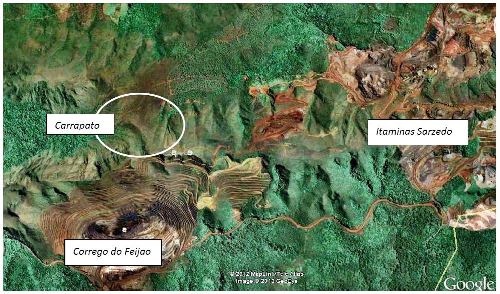
Location of Carrapato tenement, Itaminas Sarzedo Mine to the east;
Vale’s Corrego do Feijao mine to the south. The tenement is about 1000
metres wide east-west. Source: Company announcement

The Carrapato project adjoins, and is an extension of, the Sarzedo mine currently operated by Itaminas.

The Sarzedo mine has a reported resource of 1.3 billion tonnes and was recently sold to Chinese state-backed East China Mineral Exploration and Development Bureau (ECE), for $1.2 billion.

The project is in a good neighbourhood located immediately adjacent to the Corrego do Feijao mine of international mining house Vale.

The Corrego do Feijao mine produced direct ship iron ore at a grade of 66.6 per cent iron.

Continuity of the mineralisation from the Sarzedo and Corrego do Feijao mines into the Carrapato project area has been confirmed and a significant iron ore deposit has also been delineated.

Brazilian Metals indicated the project’s proximity to domestic steel mills and rail infrastructure will enhance its future domestic or export options for early development of a significant iron ore operation.

The company has established an Exploration Target of 53 to 62 million tonnes at 35.2 per cent to 41.1 per cent iron including a high grade zone at surface of 3.7 to 4.3 million tonnes at 51.1 per cent to 59.7 per cent iron.

Following due diligence the company plans immediate pre-feasibility studies leading to an application for a Special Mining Permit and early production.

Centaurus delivers high-grade iron ore from Brazilian plant trial

THE BOURSE WHISPERER: Centaurus Metals has produced a high-grade sinter feed iron ore product grading 65.6 per cent iron with low impurities (2.8 per cent silica, 0.01 per cent phosphorus) from initial pilot scale beneficiation testwork conducted on ore from the company’s Jambreiro iron ore project in Brazil.

The results stem from a 2.5 tonne pilot run of ore, which Centaurus said has confirmed the effectiveness of the two-stage magnetic separation processing route it has proposed for the Jambreiro project.


A summary of the test results. Source: Company announcement


“The initial pilot plant results are very encouraging, confirming that the proposed processing route is a robust and reliable choice for the production of a high-grade, low-impurity product suitable for sale to the domestic steel industry in Brazil,”  Centaurus Metal managing director Darren Gordon said in the company’s announcement to the Australian Securities Exchange.

“This gives us great confidence that the process route we have selected is capable of delivering a high quality product which we expect will be in high demand within the domestic steel industry in Brazil.

“We are now planning a final pilot plant test work program utilising a sample of around 100 tonnes which will provide the domestic steel industry market with a much larger sample of material to test within their own sinter feed blend test facilities and value-in-use models.”

Diatreme signs Clermont MOU with Antofagasta

THE BOURSE WHISPERER: Diatreme Resources’ 100 per cent-owned subsidiary, Chalcophile Resources has entered into a Memorandum of Understanding with Antofagasta Minerals S.A.

Antofagasta Minerals S.A. is the mining division of London-listed Antofagasta plc.

The MoU is in respect of a proposed farm-in over Diatreme’s Clermont copper project in central Queensland, which hosts the Rosevale Porphyry Corridor (RPC).

Clermont project location plan showing prospects. Source: Company announcement

Diatreme discovered the Rosevale Corridor in 2008, when it identified the corridor to have potential for large buried porphyry copper – gold – molybdenum mineralised systems.

The company has carried out significant exploration since this time, including geological mapping and sampling, ground geophysics and over 6,000 metres of diamond drilling.

These efforts discovered mineralisation at a number of individual prospects within the RPC, and many prospects still require further drill testing.

“Within the Clermont tenements, Antofagasta will specifically target the highly prospective “Rosevale Porphyry Corridor”, a geological zone hosting copper, gold, silver and molybdenum porphyry-style mineralisation, along with adjacent geologically related mineralisation,” Diatreme Resources said in its ASX announcement.

Under the agreed terms, Antofagasta will commit US$400,000 over a six month period (nominated as the Initial Assessment Phase) to fund exploration mainly over the RPC.

This will include geological mapping of outcrop, relogging of all Diatreme’s RPC diamond drill core and reprocessing and assessment of existing data.
“Diatreme considers the exploration funding and expertise that Antofagasta brings to the Clermont tenements to be of immense value in advancing the identification, delineation and development of a large polymetallic porphyry-style mining operation in the Clermont area,” the company continued.

“With Antofagasta recognising the high prospectivity of the Clermont tenements and in particular the Rosevale Porphyry Corridor, Diatreme believes its commitment to enter into a farm-in arrangement has added confidence to realizing the potential of this new Queensland porphyry copper/gold belt.”

Trafford Enters into Iron Ore Agreement with Independence Group

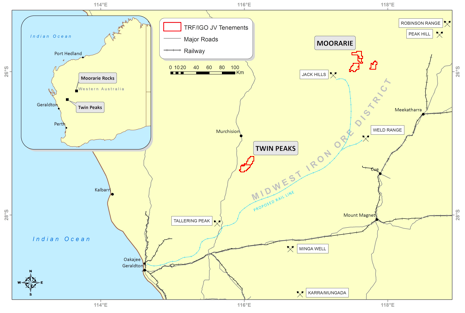
THE BOURSE WHISPERER: Trafford Resources has announced to the ASX that it has signed a letter agreement with Independence Group NL whereby Trafford can enter into a Joint Venture for the iron ore rights of two Mid-West iron ore projects, Twin Peaks and Moorarie, northwest of Geraldton, Western Australia.
 
The Twin Peaks project covers over 20kilometres of a highly prospective, north-south striking, Banded Iron Formation (BIF) belt.


Midwest Iron Ore Projects and proposed Trafford/Independence JV tenements . Source: Company announcement

No drilling for iron ore has been undertaken on the Twin Peaks tenements and only minimal drilling targeting iron ore has been completed on the Moorarie tenements.

However, recent exploration programmes of aeromagnetics, ground gravity and rock chip sampling have been completed over the entire belt identifying large Direct Shipping Ore (DSO) potential.

The Moorarie iron ore project is approximately 40km northeast of the Jack Hills iron ore mine and infrastructure, currently being developed by Mitsubishi Corporation.

As part of Trafford’s due diligence process, a massive hematite outcrop was located at the Woolbung Well prospect within the Twin Peaks project.

Assays of grab samples returned up to 67.7 per cent iron with low impurities.

Trafford intends to identify all iron targets within the tenements and and prioritise the Direct Shipping Ore (DSO) targets for drilling later this year.

Trafford may earn up to 80 per cent of the iron ore rights in the project through milestone exploration expenditure.

Trafford will manage the joint venture, the document for which will be drawn up and signed by both parties in the coming weeks.

Silver Lake to acquire Phillips River assets

THE BOURSE WHISPERER: Gold exploration and production company Silver Lake Resources announced today that an agreement had been reached for Phillips River Mining to sell its assets to Silver Lake for a transaction value of approximately 20 million dollars.

The agreement comes after a proposed Scheme of Agreement was terminated on 12 March 2012.

Under an Agreement for Sale of Assets and extension of Exclusivity Deed, Silver Lake has agreed to purchase Phillips River’s Kundip gold project and other mining tenements and assets unrelated to the Trilogy project.

Silver Lake has also agreed to purchase Phillips River’s Trilogy polymetallic project in exchange for the issue of 2,294,118 SLR shares.

The Asset Sale Agreement also provides Silver Lake with certain notification and matching rights regarding competing proposals, including that Phillips River will give Silver Lake five business days to match any genuine competing offer received by Phillips River.

Atlas aquires remaining Daltons iron ore rights at Mt Webber

THE BOURSE WHISPERER: Atlas Iron has announced that it has entered into a binding Heads of Agreement to acquire the remaining 25 per cent of the iron ore rights on the relevant Daltons joint venture tenements it does not already own from Haoma Mining.

“The acquisition of this remaining interest in the Daltons tenements is another important step along the path to developing Mt Webber,” Atlas managing director Ken Brinsden said.

Mt Webber is a crucial piece of the Atlas growth strategy, which will involve the construction of several new mines to increase our total production rate to 12 mega tonnes per annum by June 2013 and which will ultimately see the company use rail transport for the first time as it targets increasing annual production to 46 million tonnes by 2017.”

The other exploration tenements remain subject to the existing exploration joint venture between Atlas and Haoma.

Haoma holds the rights to all non iron ore minerals across all the tenement groups.

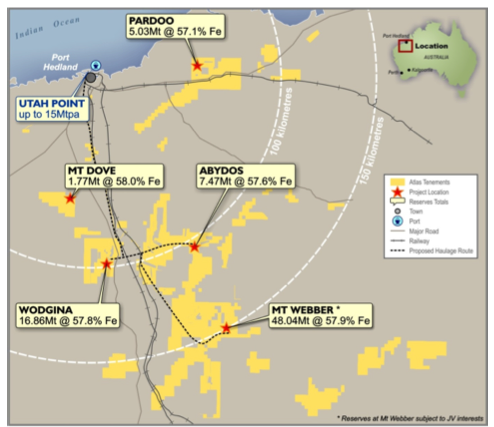
 Northern Pilbara project locations / project reserves 30 June 2011. Source: Company announcement

The Mt Webber project will be brought into operation as part of Atlas’ plan to increase its total production rate to 12 million tonnes a year by June 2013.

Mt Webber will also play a key role in Atlas’ plan to begin transporting iron ore by rail, a move which will see the company targeting production of 46 million tonnes a year by 2017.


Disclaimer: The Roadhouse holds shares in Atlas Iron

Accountants on watch as pollies play MRRT word bingo

THE BOURSE WHISPERER: As politicians from both sides of the House on the Hill in Canberra set sail on a point-scoring free-for-all over the passage of the MRRT on national accounting firm reminded us all of what it means.

The Minerals Resource Rent tax passed through the Australian Senate on Monday giving the perfect opportunity for Prime Minister Julia Gillard and Opposition Leader Tony Abbott to provide the nation with their respective line of reasoning for supporting or opposing its introduction.

 

Julia Gillard stated her case as often as she could in as many different ways as she could.

First up on the ABC Radio Am program she said, “We’re going through a spectacular resources boom.

“That’s good for our economy but it also means we need to share the benefits of that boom right around the country.”

Her message was fairly similar when confronting the toast and coffee audience of Today on the Nine Network.

“We’re going through a remarkable resources boom,” Gillard said.

“Those minerals belong to everyone. They belong to our nation. They belong to each of us and we want to make sure Aussies around the country get their fair share.”

 

Of course her opposite number was also hardly able to add anything new to his argument, except perhaps to take the opportunity to fit the word ‘tax’ into as many phrases as possible.

In a doorstep interview with Canberra journalists Abbot said, “I think the only people who are celebrating the mining tax are the Labor Party.

“The Labor Party always chooses to celebrate when they’re hitting us with a big new tax.

Come the 1st of July, Australians will be hit with two big new taxes, the mining tax and the carbon tax and these two big new taxes.

Speaking Perth Radio station 6PR he wasn’t holding back.

“Well, she has hit Australians with yet another big tax and if she thinks that’s something to celebrate, good luck to her, but I don’t think too many Australians will be celebrating the evil twins of tax – the carbon tax and the mining tax,” he said.

Not satisfied, Abbott went onto the Ten Network’s Breakfast show.

“We don’t need the world’s biggest carbon tax,” he said.

“We don’t need a success tax. These taxes send all the wrong signals to the world.”

Had any player of a MRRT word bingo drinking game and avid watcher or listener of television and radio political broadcasts been on their game they would have been unable to operate heavy machinery by 10am that morning.

As tiresome as the political game playing is, the realisation that the MRRT has been passed and will quickly come into operation is something national accounting firm BDO said Australia’s junior mining sector should be already gearing up for.
 

BDO said all iron ore and coal miners have been well warned in regard to the MRRT and should start preparing now in order to meet compliance and reporting obligations as well as position themselves to adopt the most tax effective structure for MRRT assessment and payment.

The accounting firm said the MRRT heralds the start of a new regime that emerging miners in particular must be prepared for.

BDO warned companies of the complicated nature of the MRRT and it requires careful consideration, as irrevocable choices made by management about their companies now will have an on-going impact upon application of the tax from 1 July 2012.

BDO corporate tax director John Murray said although concerns about the impact of the tax on smaller miners remained, affected companies had little choice but to comply.

He said his firm was concerned about the MRRT tax take from the emerging sector as opposed to the mature sector, as the Federal Government had not acted on its recommendations to address inequities in the structure of the MRRT.

“Now that it is law, it is important that companies affected by the tax get ready,” Murray said.

BDO has highlighted a range of information companies should consider prior to the introduction of the tax, noting that unless combined [at the election of the taxpayer], the tax will be imposed on a project-by-project basis.

In the lead-up to 1 July 2012, affected companies must consider:

–    Need for independent valuations (from a small number of independent valuers);

–    Resolution of potential project and business consolidations;

–    Determination of valuation methodology;

–    Structures for lodgement of returns at predetermined times; and

–    Review of record-keeping procedures.  

“It is crucial that taxpayers, particularly emerging miners, are prepared for this new regime, and have the information and structures in place to make the right choices for their companies,” Murray said.

BDO said its interest in the MRRT debate rose out of concern of the new regime’s structure, in that it grants significant cost advantages to big miners to the detriment of smaller operators.

In a discussion paper supplied to the Federal Government in October 2011, BDO recommended rate and timing proposals to provide a level tax playing field by ensuring small miners are not financially disadvantaged by the MRRT, and that the Federal Government should defer levying the MRRT on small miners until at least one of the big miners begins paying the tax.

Taruga unearths historic Kossa data

THE BOURSE WHISPERER: Recently-listed West Africa-focused exploration play Taruga Gold has gained access to a trove of historic drill results for the company’s Kossa project in Niger.

Taruga recovered the data through the Niger Ministry of Mines from archival searches, which was not available at the time of the company’s Initial Public Offering in February.

The historic drill hole data relates to exploration drilling completed by TSX-listed Orezone Gold Corporation in the Kossa–Borobon trend between 2005 and 2008.


Kossa project – Borobon prospect showing gold mineralised trend,
artisanal workings and proposed RC drilling. Source: Company
announcement

Taruga has classified the newly-identified gold mineralised trend as a high‐priority target as surface geochemistry, artisanal workings and wide‐spaced reconnaissance drilling has defined it as a zone extending for more than 10 kilometres.

Gold intersections from the historic data include:

–    1 metre at 278.8 grams per tonne gold from 70 metres;

–    1m at 8.96g/t gold from49m;

–    1m at 7.77g/t gold from 62m; and

–    2m at 7.54g/t gold from 34m.

Taruga consider the recently received information confirms a high‐grade gold trend open along strike with no drilling testing of artisanal workings.

The company also believes the continuity of the gold mineralisation zone at the Borobon prospect been highlighted and extended.

Multiple gold mineralised targets over the 10 kilometre trend have also been identified having limited, wide –spaced drill testing.

“Taruga’s 100 per cent‐owned, under‐explored Kossa project has multiple advanced targets and opportunities for the discovery and delineation of gold mineralisation,” Taruga Gold executive chairman Bernard Aylward said in the company’s announcement to the Australian Securities Exchange.

“An extensive program is now underway to define and extend the known gold mineralised zones at Kossa.

“The program will include a combination of reverse circulation (RC) drilling, aircore drilling and aims at delineating new prospect areas with extensive auger geochemical sampling.

“The recognition of high‐grade gold structures is important and we will be following these up with exploration reverse circulation drilling.

“The initial drill results indicate a narrow zone, however the target has only been tested to a shallow depth and remains open along strike where artisanal workings are indicating a potential thickening of the zone.”

Kaboko signs offtake with Sinosteel

THE BOURSE WHISPERER: Zambia-focused manganese play Kaboko Mining has signed a strategic offtake agreement with Sinosteel Australia for exports of high quality, high grade lump manganese ore to China.

 Sinosteel Australia is a subsidiary of Chinese conglomerate Sinosteel Corporation, one of China’s largest State-owned enterprises.

Under the terms of the binding off-take agreement with Sinosteel, Kaboko has agreed to sell an initial 180,000 tonnes of a minimum 48 per cent manganese ore to Sinosteel on an exclusive basis from the Company’s Zambian manganese projects.

Pricing will be based on BHP Billiton’s reference price (expressed in US$ per dry metric ton unit manganese content), CIF China basis.

Kaboko has forecast the first exports under the offtake agreement to commence later this year.

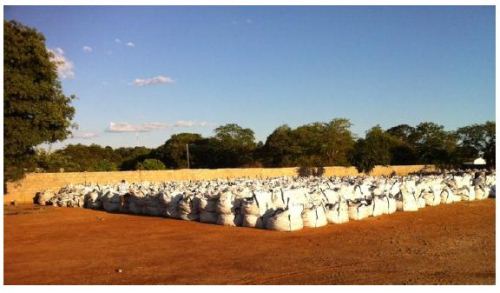
The agreement follows successful testing by Sinosteel of a trial shipment of approximately 210 tonnes of manganese ore Kaboko shipped to Xinagang in China, which confirmed the high grade and quality of the ore.


Kaboko bagged manganese ore. Source: Company quarterly report.


“The signing of our first off-take agreement with such a well-known and significant end user is a key milestone for the company and will significantly underpin our mining and development plans and our debt funding arrangements that we are progressing,” Kaboko Mining executive director Jason Brewer said in the company’s announcement to the Australian Securities Exchange.

Kaboko has earmarked production from its Emmanuel and Peco projects in Zambia to be the primary source of product for the offtake agreement.

The company is currently undertaking resource definition drilling at these projects with further exploration work ongoing.

Detailed mine optimisation studies at the Emmanuel project continues with additional new mining and beneficiation equipment ordered.