WA royalty incentive for magnetite producers

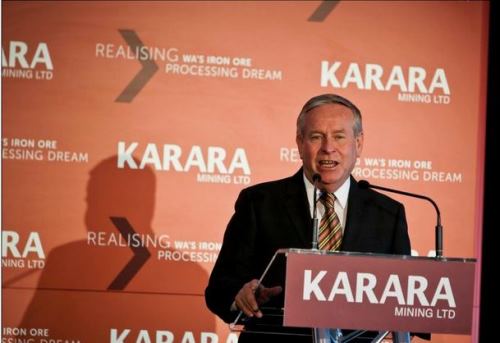
THE BOURSE WHISPERER: Western Australian Premier Colin Barnett officially opened the Karara iron ore project this week.

While doing so, Barnett took the opportunity to announce the state’s magnetite projects can now apply for up to 50 per cent royalty.

The new magnetite royalty rebate is to be considered on a project-by-project basis, which Barnett said would provide a much needed boost for the poorer cousins of the Western Australian iron ore industry sector.

Hematite iron ore has long been the favourite of WA based iron ore producers, however Barnett chose the optimum time to announce the new deal while opening the Karara iron ore project of Gindalbie Metals (ASX: GBG), the state’s first producing magnetite iron ore mine.

Karara is the second largest magnetite project in Australia, with production currently being ramped up to its nameplate capacity of eight million tonnes per annum of high-grade magnetite concentrate grading 68 per cent iron.

The project also comprises a substantial direct shipping ore (DSO) hematite business, currently producing at the rate of 2Mtpa.


“Western Australia has vast magnetite resources and this ore is preferred by many Chinese steel mills,” Barnett apparently said – according to his press release after the event.
 
“This industry has the potential to stimulate new investment and construction activity throughout the state.
 
“However, bringing magnetite ore to grades suitable for export is capital and energy intensive, so this royalty rebate will assist in recovering the massive investment required to achieve production.
 
“This means a rebate of up to 50 per cent of royalties paid will apply for the first 12 months of magnetite production, before returning to the full royalty rate of 5 per cent.”
 
The policy will apply for a three year period from now.

Under the Magnetite Royalty Rebate up to 50 per cent of the 5 per cent royalty on magnetite will be returned to the producer;

There are currently 29 potential magnetite mines at different stages of planning and development in WA;

In 2011, Deloitte Access Economics estimated that a magnetite industry could add $4.5 billion and 4,000 jobs to Australia’s economy – mostly in Western Australia;

The 5 per cent royalty rate for magnetite, compares with a 7.5 per cent rate for haematite, the ore currently exported from Western Australia;

The Karara iron ore project minesite is 320km north-east of Perth, and 200km east of Geraldton;

In addition to the mine and processing facilities, project infrastructure includes 85km of new railway plus upgrades to the existing network; 180km of 330 kV power line from Eneabba to Karara; 140km water pipeline from Mingenew to Karara; and train unloader, storage and handling facilities and berth at Geraldton port.

The announcement was described by Association of Mining and Exploration Companies chief executive officer Simon Bennison as, “most timely.”

“AMEC has been working closely with the WA Government over the past two years in order to develop realistic industry wide royalty concessions that would foster development and growth of the emerging magnetite industry throughout the state,” Bennison said.
 
“Although the proposed royalty rebate will apply on a case by case basis, it is a very positive initiative that will be welcomed by magnetite producers, particularly noting the high up front capital costs in establishing a magnetite mine.
 
“The complex and high processing costs of magnetite beneficiation have also been recognised by this decision.
 
“Despite the fact that the rebate will only apply for the first year, before returning to the full royalty rate of 5 per cent, it will provide magnetite miners welcome financial and cash flow relief and allow companies to develop their business.
 
“The payback to the government will be significant through the flow on effects of job creation and associated economic benefits.”

From what we can gather WA Mines and Petroleum Minister, Bill Marmion, wasn’t allowed to attend the event for some reason but he did, via the Premier’s press release, grab the opportunity to ingratiate himself to his new portfolio participants by claiming the $2.57billion Karara project would produce many benefits for local communities, the region and the state over its expected 35-year life.
 
“In addition to creating important new employment and business opportunities, Karara has made a significant investment in community projects, in Morawa and the Mid-West,” Marmion said in Barnett’s release.
 
WA’s newly-anointed Minister informed us the project employed more than 2,400 people at peak construction and had generated 500 direct permanent jobs.
 
With all the limelight shining on him, Barnett relished the opportunity to relate the good news the opening of the Karara project had to offer saying the project was a major step forward for WA and for the Mid-West region.
 
“The State Government has worked closely with the proponents to get this project up and running and I congratulate them on getting to the production stage,” he said.
 
“Karara is an outstanding example of the positive impact Chinese investment is having in WA.
 
“It is a significant achievement in terms of Chinese investment and a major example of Chinese confidence in Western Australia.”
 

Red Sky Energy secures site for SOLEIR solar power project

THE BOURSE WHISPERER: Red Sky Energy (ASX: ROG) has secured an option to purchase a site for a major solar power station in south west New South Wales.

The deal has emerged via solar energy company, SOLEIR, which Red Sky acquired in November last year.

SOLEIR has negotiated a three year option over a 269 hectare site located at Darlington Point, located approximately 150 kilometres west of Wagga Wagga, which may accommodate a 100 megawatt (MW) photovoltaic (PV) solar power project.

SOLEIR is a developer of utility scale PV solar power projects, and is already well advanced with its first project, the Dubbo Solar One project in central New South Wales.

The first module of the Dubbo Solar One project is on schedule to be installed by mid-year.

As part of its growth plans, SOLEIR has been negotiating rights to a number of suitable project sites in regional NSW, and the Darlington Point site is proposed to be part of its project portfolio.

The Darlington Point area was one of five shortlisted for detailed study after being the focus of a report commissioned by NSW Department of Environment, Climate Change and Water in December 2010, entitled “Pre-Feasibility Study for a Solar Power Precinct”.

The report identified the area as a good solar resource, concluding a 250MW project would have low connection costs into the TransGrid sub-station at Darlington Point.

“The optioned Darlington Point site is ideally situated adjacent the major TransGrid sub-station, which has 330 kilovolt (kV) and 220kV power transmission lines connected to it,” Red Sky Energy said in its ASX announcement.

“Based on the abovementioned study, it is reasonable to assume 100MW could be readily accommodated by the existing sub-station.

“This would need to be validated through the connection agreement process with TransGrid.”

Red Gum explained the agreement on the Darlington Point site gives SOLEIR the option to purchase the land at any time over the next three years, at a pre-agreed price.

The purchase price is less than one per cent of the solar project capital cost.

Red Gum anticipates SOLEIR commencing the process to secure development consent with the NSW State Government and a connection agreement with TransGrid in the coming months.

In addition to regulatory approvals, SOLIER will be seeking the involvement of a major financial institution to arrange the project funding.

Mutiny Gold makes quick $11M on gold market

THE BOURSE WHISPERER: Mutiny Gold has booked a profit of $11 million following a recent strategic gold transaction.

Mutiny, along with its adviser Noahs Rule, used a $75 million gold buying facility the company has been provided by Credit Suisse to take advantage of, what it perceived to be a recent weakness in the gold price.

Mutiny stepped up to the gold market of the London Metals Exchange and purchased 50,000 ounces of gold at an average price of $1,491 per ounce.

The company explained the strategy behind the acquisition will enable it to deliver the recently-acquired gold into a current 50,000 ounce hedge put in place in December 2011.

This has resulted in Mutiny achieving a total gain of $11 million, which would be used to repay an existing $11 million short-term Credit Suisse loan.

Mutiny Gold managing director John Greeve said the short-term loan provided by Credit Suisse had provided important momentum for the company.

“The $11 million loan allowed us to complete the purchase of the Deflector gold project from ATW Gold Corporation Ltd and fund the highly successful drill programs and Feasibilities Studies at Deflector,” Greeve explained in the company’s announcement to the Australian Securities Exchange.

“The hedge developed in December 2011 was an important component of the facility agreement with Credit Suisse and it is strategically significant that the company has improved its balance sheet in anticipation of securing a Senior Debt Funding Agreement for project financing.

“We believe that the value of the Deflector gold project has increased significantly since we negotiated our initial short term loan, and hedging position.

“By using the profits from this transaction to retire our short term debt, we have an opportunity to simplify our funding arrangements and reduce the level of financial exposure to our lenders.”

The company outlined the three key considerations behind the Mutiny Directors’ decision as being:

1.    The company believed that the 2011 hedges had served their purpose and Mutiny had maximised their value;

2.    Ongoing economic instability in Europe and America – plus the growing potential for a resumption of hostilities on the Korean Peninsula and the impact these would have on global market sentiment – are expected to see the gold price rally from its current low levels; and

3.    The company has an opportunity to use the profit to reduce short-term debt and simplify its balance sheet as part of completing its project financing agreements.

Fox Resources completes JV with Pilbara Minerals

THE BOURSE WHISPERER: Fox Resources (ASX: FXR) has completed the definitive Farm-In and Joint Venture Agreement announced in January with Pilbara Minerals Limited (ASX: PLS).

The JV is focused on the development of 10 of the latter’s 14 exploration tenements located in the West Pilbara region of Western Australia.

The two companies are now working with mining and exploration services provider Newexco to finalise an initial exploration program to carry out exploration activities within the tenements.

The JV considers the Pilbara Minerals tenements to be prospective for base metals, platinum group elements and/or gold mineralisation.


West Pilbara tenements held by Fox Resources and the tenements under the Joint Venture. Source: Company announcement


“The Fox – PLS joint venture provides the foundation to firm up a number of anomalies previously identified on the PLS tenements, and also identify new anomalies which will provide new additional drill targets,” Fox Resources chief executive officer Bruce Garlick said in the company’s announcement to the Australian Securities Exchange.

“A significant VTEM program is being prepared which will cover new areas of the PLS tenements that have not been subject to VTEM previously.

“This represents a great opportunity for Fox and PLS to develop these assets, which are close to Fox’s other projects and current landholding in the Pilbara.”

Under the agreement, Fox Resources is entitled to acquire up to an 80 per cent interest in the tenements, in return for carrying out extensive exploration activity.

The farm-in remains subject to the agreement of the initial exploration work program and obtaining necessary regulatory and governmental approvals.

Once in place the farm-in program will be implemented over three stages.

Fox is to make an upfront cash payment of $150,000 to Pilbara Minerals to earn a 40 per cent interest in the tenements.

The company can earn the remaining 40 per cent in three stages over a period of three years for yearly expenditure of $565,000 in each of the first two years (each to earn an additional 15 per cent interest) and $839,000 in the third (to earn the final 10 per cent interest).

Fox can elect to withdraw from the JV after spending a minimum of $565,000 in the first year of the joint venture at no additional cost.

Fox will serve as the manager of the joint venture.

BCD Resources and Malachite Resources join forces for Lorena JV

THE BOURSE WHISPERER: BCD Resources (ASX: BCD) and Malachite Resources (ASX: MAR) have agreed to strike up a Joint Venture for the development of the Lorena gold mine following the successful completion of due diligence by both parties.

The JV will follow the terms announced by the companies under a Heads of Agreement in November 2012.

According to an announcement released by BCD to the Australian Securities Exchange the decision keeps on track the target of commencing production from Lorena before the end of this year, subject to the necessary statutory approvals.

As the due diligence period progressed BCD completed metallurgical test work and engineering feasibility work, from which it said it is satisfied it can successfully recover gold from gold concentrate produced at Lorena at its Beaconsfield facility in Tasmania.


Lorena gold project – Tenement plan. Source: Company announcement


The overall recovery of gold from ore mined at Lorena to doré is expected to be between 75 per cent and 80 per cent based on the test work carried out to date.

“Both BCD and Malachite believe that there are considerable regional opportunities once the plant is operating at Lorena,” BCD Resources said in its ASX announcement.

“Following the Stage One open cut operations both Malachite and BCD anticipate that operations may continue beyond the initial 16 month term based on potential extensions of the current Lorena resource at depth, potential new resources from surrounding prospects, and the toll treatment of third party ores.

“As previously announced, BCD has already commenced the refurbishment of its flotation cells at Beaconsfield in preparation for their being relocated to the Lorena site.

“This is part of ongoing work being carried out by BCD in order to ensure the delivery of the project by the end of 2013 as previously forecast.”

Southern Cross Goldfields and Polymetals Mining to merge

THE BOURSE WHISPERER: Polymetals Mining (ASX: PLY) and Southern Cross Goldfields (ASX: SXG) have agreed to combine the two companies to create a new Australian gold company.
 
The merged entity will result in a gold company with a combined Mineral Resource inventory of 1.69 million ounces, as well as encouraging exploration upside and an experienced and proven management team.
 
The companies have labelled the merger as a “merger of equals” by way of a scheme of arrangement, under which Southern Cross will offer 11 of its shares for every single Polymetlas share on issue.

Southern Cross shareholders will collectively hold approximately 47 per cent of the shares in the merged company, while Polymetals shareholders will collectively hold approximately 53 per cent.
 
The merged entity will own a diversified gold and base metal portfolio in Western Australia, South Australia and New South Wales, including a pipeline of production assets at Marda in Western Australia (SXG) and Mt Boppy in NSW (PLY).

Polymetals shareholders are expected to vote on the proposed merger around 24 July 2013.
 
“This represents a tremendous opportunity for two emerging gold companies to be proactive in the current environment and therefore to remain in control of their own destiny,” Polymetals Mining chairman David Sproule said announcing the deal.

“This merger provides a truly complementary blend of assets, cash and skill-sets that will create a new Australian gold company with genuine investor relevance
 
“The merger creates a clear pathway for shareholders in each company to realise value from an accelerated development timetable for the Marda and Mt Boppy assets.

“I believe that both companies share a similar culture of executing projects quickly and efficiently, and Polymetals has a proven track record in doing this. I strongly believe that this combination will create an excellent platform for growth.”
 
Sproule, along with fellow Polymetals directors Jon Parker and Frank Terranova will join the Board of the merged entity, while Southern Cross chairman Samantha Tough will take up the same position with the merged entity.

Southern Cross directors John Rowe and Graham Brock will also join the Board to be joined by Glenn Jardine as chief executive officer.
 
The company headquarters will remain in Perth, Western Australia.
 
The merged entity is expected to have 867.45 million shares on issue, with combined cash reserves as at 31 March of $13 million and debt of $7 million.

“This is a compelling transaction for shareholders in both companies, creating a platform to bring two significant Australian gold assets in Marda and Mt Boppy into production within the next two years, together with a strong longer term pipeline of development and exploration opportunities in some of Australia’s most prospective mineral provinces,” Southern Cross Goldfields chairman Samantha Tough said.
 
“Southern Cross shareholders will benefit from exposure to Polymetals’ near-production assets on the East Coast of Australia, as well as the skills and expertise of their management team in developing efficient gold operations.

“The combined group will have a strong balance sheet and the ability to fast-track development of its key assets while also funding aggressive exploration programs.”

MZI Resources secures landowner agreements for Keysbrook Mineral Sands project

THE BOURSE WHISPERER: MZI Resources (ASX: MZI) has secured the remaining landowner agreements it needs to start development of the company’s Keysbrook Mineral Sands project in the south-west of Western Australia.

The agreements, which have been made with three landowners, give MZI the right to access and mine minerals on the properties involved.

One of these properties is the designated site where the concentrator, site access road and associated infrastructure will be located.

MZI said the access and mining rights under the landowner agreements have combined with existing landowner agreements and company owned property to support the Ore Reserve life of the project.

The company said it was now very close to securing the finance for Keysbrook.

“This project has a short construction period compared with most resource projects,” MZI Resources chief executive officer Trevor Matthews said in the company’s announcement to the Australian Securities Exchange.

“With the key agreements either finalised or very close to completion, Keysbrook is now only about a year away from generating substantial cashflow for the company and its shareholders.”

The landowner agreements follow MZI’s announcement earlier this week that the Board of the Bunbury Port Authority (BPA) has authorised BPA management to negotiate a Port Services Agreement with the company.

MZI said the completion of these agreements continue the achievement of project milestones as it finalises financing arrangements for Keysbrook, including the debt facilities currently being negotiated with two leading banks.

This puts MZI on track to start construction of Keysbrook in this quarter, with first production set for the March quarter of 2014.

Centaurus Metals secures Installation Licence for Jambreiro project

THE BOURSE WHISPERER: Centaurus Metals (ASX: CTM) has secured the key Installation Licence (LI) for the company’s Jambreiro iron ore project in south-east Brazil, clearing the way for on-site construction to proceed.
 
The granting of the LI – following approval of the Project’s Environmental Control Plans (PCA) – has been achieved ahead of schedule, based on the company’s proposed development timetable.
 
Centaurus said the granting of the LI marked the final regulatory milestone required to enable construction to commence on site.
 
“With the Installation Licence now to hand, we are in a position to begin on-site construction,” Centaurus Metals managing director Darren Gordon said in the company’s announcement to the Australian Securities Exchange.

“Initial development work is already underway and actual site works are planned to begin at the end of this month, subject to completion of a suitable off-take arrangement and finalisation of the overall funding mix.”
 
Centaurus explained the LI approval enables it to operate at a production rate of three million tonnes per annum of final saleable product.

However, the company initially intends to commence operations at a rate of 2Mtpa.
 
The PCA was lodged at the end of October 2012 following development of the detailed environmental programs proposed in the EIA/RIMA.

The LI includes all the water permits and vegetation clearing authorisations required to facilitate the development of the project.
 
“In conjunction with the timely delivery of the necessary Government approvals for the project, the company has continued negotiations with a number of potential customers in relation to off-take in order to facilitate a suitable debt financing package for project development,” Gordon explained.

“These off-take discussions are progressing well and the company is working to conclude a strong off-take position over the next month.”

Phase one of East Pilbara independent railway study completed

THE BOURSE WHISPERER: Brockman Mining (ASX: BCK) has announced the completion of the first phase of an Alliance study, being conducted in conjunction with Aurizon Operations and Atlas Iron (ASX: AGO).

The study is evaluating a new, independent, multi-party railway to connect iron ore mines in the East Pilbara to Port Hedland.

Brockman said the Alliance study conclusions have demonstrated the merits of a new, standard-gauge railway in the East Pilbara, connected to dedicated port facilities at Port Hedland to deliver production from a number of operating and prospective miners, including Brockman and Atlas.

“The study has demonstrated the benefits of working with aligned parties to provide infrastructure solutions,” Brockman Australia chief executive officer Russell Tipper said in the company’s announcement to the Australian Securities Exchange.

The results have encouraged the parties involved to extend the existing Alliance Study Agreement to 1 July 2013, to examine the East Pilbara rail development and the proposed North West Infrastructure port development in South West Creek in Port Hedland, as a single integrated infrastructure project.

The study has acknowledged synergies the companies involved can achieve across the supply chain, which has formed the basis for the next stage of evaluation, being an integrated rail and port Pre-feasibility Study.

The Alliance participants are aiming to agree the scope and timing of a pre-feasibility study for the combined port/rail project.

Australian Bauxite signs term sheet agreement with major Chinese offtake partner

THE BOURSE WHISPERER: Australian Bauxite (ASX: ABZ) has executed a term sheet with major Chinese aluminium company, Xinfa Group for two State-Significant bauxite projects.

The parties have commenced an exclusive negotiation and due diligence period (Exclusivity Period) to finalise formal agreements.
 
Australian Bauxite (ABx) and Xinfa have agreed to commercial terms with respect to the early development and operation of the Tasmanian and Goulburn South bauxite projects.

The two companies will also share information concerning the prospective Binjour project in Queensland.


ABx project locations. Source: Company announcement


A data room was established and publically announced in December 2012.

The participants executed confidentiality agreements and were given access to a database and field visits.

The data room is now closed during the Exclusivity Period with Xinfa.

Preparation of the Mining Lease Application for ABx’s first mine in Tasmania is well underway, with the expectation that mining will commence in the second half of 2014.

“This partnership combines the discovery skills of ABx with the financial and operational strengths of Xinfa in the bauxite-alumina-aluminium business so that new export businesses can be created both in Tasmania and southern New South Wales, Australia,” Australian Bauxite CEO and managing director Ian Levy said in the company’s announcement to the Australian Securities Exchange.

“As supportive offtake partner, Xinfa will greatly reduce market risk for our first two projects, especially in the early years whilst each project establishes consistent production.

“The plan is for our Tasmania project to be the first new bauxite mine in Australia for more than 35 years.

“Bauxite shipments are planned to commence in the second half of 2014 when the bauxite market is expected to be favourable as Indonesian exports of our type of low-temperature, gibbsite-rich bauxite are reduced and Indonesian export taxes are increased from 20 per cent to 50 per cent.”

Under terms of the agreement Xinfa will pay $500,000 by 8 April 2013 as an exclusivity payment for a five-month due diligence period to 31 August.

The Exclusivity Period can extend to a maximum of nine months through an additional payment by Xinfa of $100,000 per month for each month beyond August.

An MOU is to be executed at the end of the Exclusivity Period, at which time Xinfa will pay an additional $2 million for 5.8 per cent equity in ABx through the issue of 6.58 million shares at 38 cents per share.

The Exclusivity Payment will fully convert to shares as part of this placement.

The $500,000 Exclusivity Payment is half-convertible to 657,900 shares in the event Xinfa elects not to proceed. These shares will be escrowed until 31 December 2015.

In the event that ABx elects not to proceed after the Exclusivity Period, ABx will, at Xinfa’s election, either pay a $250,000 termination fee to Xinfa or issue Xinfa with 657,900 shares, escrowed until 31 December 2015.

Negotiations concluding in an MOU are to be conducted under the principal of mutual benefit.

“Xinfa has operated bauxite mines in China, Indonesia and Fiji to supply low-temperature bauxite to Xinfa’s low-temperature alumina refinery in Shandong, which in turn, supplies alumina to Xinfa’s several large aluminium smelters across China,” Xinfa Group Chairman Zhang Gang said in the ASX announcement.

“Additional production from Australia has been an objective for Xinfa and it is hoped that bauxite projects in Tasmania and Goulburn South can be successfully developed.”