Alloy Resources Begins RC Drilling At Ophara

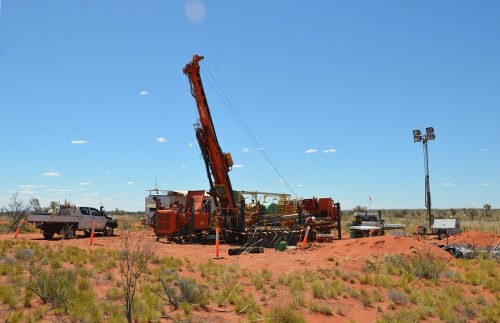
THE DRILL SERGEANT: Alloy Resources (ASX: AYR), with all approvals in place, has commenced RC drilling at the company’s Ophara project located 50 kilometres west of Broken Hill in New South Wales.

Alloy Resources explained the drilling is targeting discrete bedrock EM anomalies of moderate to strong conductance defined by the recent helicopter-borne VTEM survey.

Alloy is testing its concept that the conductors are likely to represent moderate to shallowly dipping ‘stratabound’ sulphide mineralisation, which it claims is similar to the geometry and geology of mineralisation observed by drilling at the Great Goulburn prospect and also at the very large Thackaringa cobalt deposits which contain 50,000 tonnes of cobalt in a 54.9 million tonne Mineral Resource.

“The conductance of the targets is much greater than the Thackaringa deposits and the Great Gouburn prospect and drilling is required to explain the source of the targets,” Alloy Resources said in its ASX announcement.

“Five priority conductor targets have been selected for initial drill testing by nine RC drill holes.

“As depth of weathering in the area is generally 20 to 60 metres, drilling will aim to intersect the conductive body at approximately 100 metres depth.”

Email: info@alloyres.com

Website: www.alloyres.com

Sayona Mining Lodges Authier Drilling Permits

THE DRILL SERGEANT: Sayona Mining (ASX: SYA) announced the lodgement of drilling permits for a Phase 3 resource expansion drilling program to be undertaken at the company’s Authier lithium project in Quebec, Canada.

Sayona Mining indicated it is planning a diamond drilling program of up to 3,000 metres commencing in early November.

The objectives of the drilling program, include:

Collecting up to 5 tonnes of drill core for a pilot metallurgical testing program. The pilot program data will be used for inputs into the process plant design in the Definitive Feasibility Study (DFS);

Infill definition drilling within the main resource zone where the mineralisation is not well defined and is currently treated as waste. This has the potential to reduce the waste to ore ratio;

Potential expansion of the northern pegmatite zone which intersected 7 metres at 1.36 per cent lithium oxide from 15 metres in the last drilling program; and

Completion of geotechnical drilling to enable finalisation of the pit wall slopes for the DFS.

“The drilling and pilot metallurgy programs will be the last major work programs before completion of the DFS in early 2018,” Sayona Mining said in its ASX announcement.

Email: info@sayonamining.com.au

Website: www.sayonamining.com.au

Mincor Resources Updates Widgiemooltha Gold Resources

THE DRILL SERGEANT: Mincor Resources (ASX: MCR) updated the gold Mineral Resources at the company’s Widgiemooltha gold project (WGP) in Western Australia.

Mincor Resources said the update was part of the progress the company is making with its plans to bring the 100 per cent-owned Widgiemooltha gold project into production in early 2018.

The company has received key regulatory approvals from the Department of Mines, Industry Regulation and Safety (DMIRS) allowing the commencement of mining operations at the WGP and the Mineral Resources have been updated to incorporate the results from two drilling programs.

Gold Mineral Resources at Widgiemooltha now stand at 267,100 ounces of gold, an increase of 29,070 ounces at a discovery cost of $9.60 per ounce.

Mincor’s global Gold Resources inventory sits at approximately 328,660 ounces of gold.

“The updated Gold Mineral Resources show how the Widgiemooltha project rewards drilling, with a respectable discovery cost of less than $10 per ounce achieved,” Mincor Resources managing director Peter Muccilli said in the company’s announcement to the Australian Securities Exchange.

“The Flinders West discovery could underpin an improved mining schedule with enhanced start-up economics. Importantly, the mineralisation trends around Flinders remain open.

“Results from the latest drilling program will give further insight into this potential.

“On the nickel front, we have also been very encouraged with the recent rises in the nickel price and we are closely monitoring the fundamentals behind the growing positive sentiment for the commodity.

“Mincor has a high-quality nickel sulphide asset base in a Tier-1 nickel province.

“Our pipeline for growth is quite exceptional for a junior company.”

Website: www.mincor.com.au

Metalicity Conducting Lithium Review

THE DRILL SERGEANT: Metalicity (ASX: MCT) is conducting a geological review of its four lithium projects in Western Australia.

Metalicity has appointed CSA Global to conduct the review charged with the aim of generating new targets and prioritising existing targets for future drilling.

Metalicity has put together a sizeable landholding in Australia’s two key lithium producing districts, the Greenbushes district and the Wodgina-Pilgangoora district.

Previous targeting work conducted by Metalicity has focussed on mapping of pegmatites at its Pilgangoora North project and the Stannum prospect within its Wodgina South project.

This area represents approximately 20 per cent of the company’s lithium-prospective land package and it believes there to be potential to generate new targets for drilling within these two hard rock lithium producing regions.

From recent field work at the Pilgangoora North project, Metalicity confirmed that pegmatites interpreted from satellite imagery, are present; some of which host anomalous lithium values.

An initial four-hole 600m reverse circulation percussion (RCP) drill program was undertaken aimed at testing pegmatites in the southern portion of the project area the company had interpreted to be extensions of the Lynas Find deposit pegmatite system.

Although this was a very limited drill program, pegmatites were intersected in every hole.

No significant levels of lithium were encountered in this program, however Metalicity said it had been encouraged by the continuity and thickness of the pegmatites, which it determined to be comparable to the Pilgangoora deposits to the south.

“The initial four-hole drill program at Pilgangoora North targeted the most accessible pegmatites which represent a small fraction of the mapped or interpreted pegmatites that have been identified at the project, some of which are confirmed from rock chip sampling as lithium bearing,” Metalicity managing director Matt Gauci said in the company’s announcement to the Australian Securities Exchange.

“Given the size of the company’s lithium portfolio and interest from end users in the sector, we believe this is a right time to appoint lithium experts from CSA Global to conduct a targeting review of our entire lithium portfolio and determine the best strategy to progress these assets.”

Website: www.metalicity.com.au

Azure Completes Inital Mexican Drill Program

THE DRILL SERGEANT: Azure Minerals (ASX: AZS) completed the first drilling program on the company’s 100 per cent-owned Sara Alicia gold-cobalt project, located in the northern Mexican state of Sonora.

Azure Minerals said the reconnaissance drilling was designed to test a zone of high-grade gold and cobalt mineralisation, which was historically exploited by small-scale underground mining in the 1930s.

The area was further outlined by Azure’s sampling of surface outcrop and underground exposures which returned high-grades up to maximum values of 39 grams per tonne gold and 7 per cent cobalt.

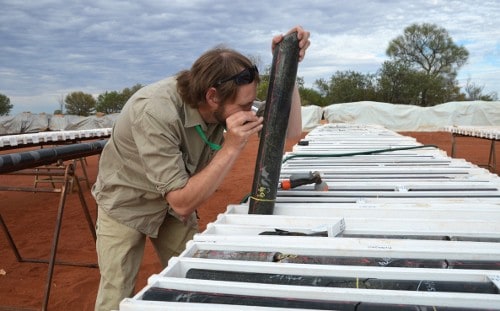
The company explained the initial drilling program comprised six holes of diamond core designed to test around the old mine workings and beneath the outcropping gold and cobalt mineralisation to determine potential grade, width and orientation of the mineralised zone.

“Core logging identified carbonate rocks intruded by a granodiorite porphyry, causing strong alteration and mineralising reactions in the limestones, forming a skarn horizon enriched with garnets, magnetite and sulphides,” Azure Minerals said in its ASX announcement.

“Each drill hole was sampled in its entirety and dispatched to the Bureau Veritas laboratories in Hermosillo, Mexico, and Vancouver, Canada for precious metal and base metal analyses respectively.

“Due to a very busy northern hemisphere field season, the turnaround time for sample analysis in Vancouver is currently between four and six weeks.

“Assay results for the Sara Alicia holes are expected between late November and early December.”

Website: www.azureminerals.com.au

Peel Mining Persistence Pays Off

Tuesday, October 31, 2017
THE INSIDE STORY: There is no argument that modern exploration techniques assist in the discovery of new deposits, but it also helps to be exploring in the right area.

Persistence also helps, and for coming up to eight years, Peel Mining (ASX: PEX) has been focused on the company’s Cobar Basin projects in New South Wales where it has made systematic discoveries of copper and base metals, most notably at the Mallee Bull and Wirlong deposits.

Peel has always had confidence in both prospects, however it was a recent announcement from the Wagga Tank prospect area that set the market abuzz.

Peel acquired tenements EL6695 and EL7226 last year and quickly designated Wagga Tank as the ‘prospect most likely’.

“When we conducted our initial review of the historic results at Wagga Tank we quickly realised the previous owners probably hadn’t given the area the attention it deserved,” Peel Mining managing director Rob Tyson told The Resources Roadhouse.

“Results from our own drilling this year provided the impetus for us to conduct further drilling, mainly because we thought we were on to something and the best way to confirm such opinions is to drill.”

The Wagga Tank drilling provided the company with plenty to think about, including:

WTRCDD023
11m at 7.15 per cent zinc, 2.31 per cent lead, 58 grams per tonne silver from 396m;

WTRCDD020
6m at 8.52 per cent zinc, 2.97 per cent lead, 12g/t silver from 282m; and

WTRCDD022
6m at 1.5 per cent copper from 92m.

“As part of the program we drilled step-out hole WTRCDD021, in what was then known as Wagga Tank South, basically to test coincident chargeable IP and magnetic geophysical anomalies,” Tyson explained.

“The IP chargeability looked particularly compelling, so we decided to drill and see what was there.”

The 456.6m hole was collared one kilometre south of the Wagga Tank deposit at what is now called the Southern Nights area, intersecting a broad zone of deformation, alteration and sulphide mineralisation, including a zone of variable zinc-lead-silver (sphalerite-pyrite-galena) breccia/stringer sulphide mineralisation between 390m and 410m downhole.

The hole was a combination of RC and diamond drilling, demonstrating highly anomalous zinc, lead, copper, silver and gold present over the greater part of the diamond tail (234.1m to 418m).

Highlights included:

4m at 3.38 per cent zinc, 1 per cent lead, 13g/t silver from 289m;

3m at 3.07 per cent zinc, 1.23 per cent lead, 26g/t silver from 346m; and

20m at 2.40 per cent zinc, 0.8 per cent lead, 44g/t silver from 390m.

Peel quickly followed-up drilling of the WTRCDD021 discovery hole at Southern Nights, and at time of writing had completed four RC drillholes (WTRC031, WTRC033-035).

Assays are pending, but better hand-held XRF results included:

21m at 24.5 per cent zinc, 8.6 per cent lead, 102g/t silver from 194m in WTRC035

70m at 4.8 per cent zinc, 1.0 per cent lead, 18g/t silver from 128m (including 8m at 14.9 per cent zinc, 2.2 per cent lead, 15g/t silver from 188m) in WTRC033

The latest drilling was concentrated near WTRCDD021 with the furthest (WTRC031) just 160m south and 80m to the west.

WTRC031 (depth 185m) was designed to further test the Southern Nights chargeable IP anomaly, and to test along strike and up-dip of WTRCDD021.

The hole intersected a broad zone of strongly anomalous zinc-lead-arsenic-silver-copper from approx. 70m below surface through to end-of-hole at 185m.

WTRC033 (200m) was collared 80m west of WTRCDD021 to test immediately up-dip of WTRCDD021, intersecting a broad zone of strongly anomalous zinc-lead-arsenic-silver-copper from approx. 80m below surface through to end-of-hole (200m), intercepting the broad, strong zone of mineralisation highlighted above.

WTRC034 (199m) was collared 40m west of WTRC033 to test immediately up-dip of WTRC033.

WTRC034 intersected a broad zone of weakly anomalous zinc-lead-arsenic from surface to end-of-hole, which was interpreted to suggest the hole was positioned too far west to intersect mineralisation.

WTRC035 (216m) was collared 40m south of WTRC033 to test along strike of WTRC033.

WTRC035 intersected a broad zone of strongly anomalous zinc-lead-arsenic-silver-copper from approx. 40m below surface through to end-of-hole (216m).

The drillhole intercepted several strong zones of mineralisation including:

19m at 3.2 per cent zinc, 0.7 per cent lead, 21g/t silver from 126m and 21m at 24.5 per cent zinc, 8.6 per cent lead, 102g/t silver from 194m (as highlighted above).

Holes WTRC031, WTRC033 WTRC035 were all terminated prematurely in mineralisation due to high water inflows.

Diamond tail drilling is planned for each in due course.

“The true width of these mineralised intercepts is unknown due to the early stage of investigation, however, of importance, is that the mineralisation present in all drillholes appears to be related to the Vivigani Formation,” Tyson said.

“The Vivigani Formation is host to the mineralisation present at Wagga Tank.”

The Vivigani Formation a stratigraphic unit comprising volcanic sandstones, conglomerate, sedimentary breccia, interlayered low energy turbidites, epiclastics, rare felsic lavas, ignimbrites, and bioclastic limestone debris.

“The exciting aspect of these latest results is that they demonstrate Wagga Tank could be a much larger system than previously thought to be,” Tyson said.

“We have drilling at Southern Nights ongoing with a minimum of 10 additional RC drillholes planned in the near term.

“These drillholes will be designed to primarily test for strike extensions.”

The Southern Nights discovery garnered a good deal of market interest with the company’s share price enjoying an almost 50 per cent rise on announcement.

That doesn’t mean, though, the company has taken its eye of the Mallee Bull deposit, located near Cobar in western NSW.

Peel has also had the drill bit spinning at Mallee Bull, releasing results relating to prefeasibility work into the development of a high-grade, near surface T1 zinc-lead-silver lens.

Peel is undertaking a pre-feasibility study on the high-grade, near-surface zinc-lead-silver-gold T1 lens at Mallee Bull in Joint Venture (50:50) with CBH Resources.

The study is investigating conceptual development of T1 as a ‘dig and truck’ operation, where ore would be milled at CBH’s Endeavor mine approximately 150km away, where surplus milling capacity exists.

The PFS is looking at open pit and underground mining scenarios, followed by the development of an exploration decline to approx. 300m below surface to enable underground drilling of the primary Mallee Bull copper mineralisation.

The JV believes this scenario could allow for a reduction in total capital expenditure and the staged mining development of the Mallee Bull deposit.

Recent drilling under the PFS included 39 RC/diamond drillholes charged with infilling a maximum 20m by 20m drill spacing, and to define the limits of T1 mineralisation.

T1 resource definition drilling returned:

MBRC085
9m at 20.82 per cent zinc, 10.64 per cent lead, 338g/t silver and 1.91g/t gold from 88m;

MBRC089
9m at 10.80 per cent zinc, 6.89 per cent lead, 337g/t silver and 0.45g/t gold from 129m;

MBRC088
3m at 12.74 per cent zinc, 6.93 per cent lead, 263g/t silver and 1.25g/t gold from 119m;

MBRC073
10m at 7.10 per cent lead, 19g/t silver and 0.53g/t gold from 46m; and

MBRC084
3m at 5.98 per cent zinc, 3.33 per cent lead, 54g/t silver from 77m.

“We have received all the results for that drilling, which are currently being included in an updated geological and resource model for T1,” Tyson said.

“Prefeasibility work is continuing.”

Peel Mining Ltd. (ASX: PEX)
… The Short Story

Unit 1
34 Kings Park Road
West Perth WA 6005

Ph: (08) 9382 3955

Email: info@peelmining.com.au
Web: www.peelmining.com.au

DIRECTORS
Rob Tyson, Simon Hadfield, Graham Hardie

Impact Metals Joins Pilbara Gold Rush

Thursday, October 26, 2017
THE INSIDE STORY: Diversified exploration play, Impact Minerals (ASX: IPT) has made a move into the famous Pilbara iron ore region of Western Australia, but this company has a golden gleam in its gaze.

Ever since Paddy Hannan rode into town with saddle bags bursting with gold nuggets, Kalgoorlie and its immediate surrounds have been the hub of Western Australian gold mining.

The region has provided plenty of gold since to keep gold bugs interested, which has left the bulk of the biggest state in the country open to mining of other commodities.

The Pilbara has long been synonymous with iron ore, however there is an emerging group of companies starting to believe it also hosts a wealth of the yellow stuff.

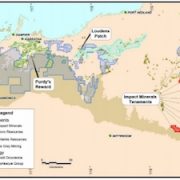
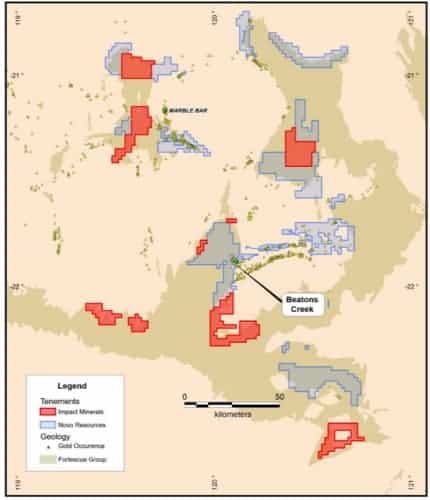
In August, Impact Minerals joined the latest WA gold rush by applying for nine new 100 per cent-owned Exploration Licences in the Pilbara covering 1,300 square kilometres it considers prospective for Witwatersrand-style conglomerate-hosted gold.

The company’s interest was sparked by a review of the Purdy’s Reward discovery in the West Pilbara at base of the geological Fortescue Group by Artemis Resources (ASX: ARV), leading to its Joint Venture with Novo Resources Corporation.

This was followed by the discovery of nuggets and conglomerates in the Central Pilbara by De Grey Mining (ASX: DEG).

The excitement generated from the Artemis/Novo work stemmed from the indication of the possible presence of Witwatersrand-style gold in the Pilbara

For those unfamiliar with the Witwatersrand Basin in South Africa – the region holds the world’s largest known gold reserves and has produced 1.5 billion ounces.

“Although I have been in the industry for a very long time, it’s a little-known fact that I did my PhD on age equivalent basins on the Witwatersrand in South Africa,” Impact Minerals managing director Dr Mike Jones told The Resources Roadhouse.

“So, I’m very familiar with a lot of the history of the Witwatersrand and how it was formed.”

Impact’s new licences cover various parts of the prospective contact between the older Pilbara granite-greenstone terrain and the overlying Fortescue Group rocks in the East Pilbara region including areas close to, and adjoining, licences held by Novo Resources Corporation

Anybody with an extensive knowledge of the Witwatersrand region such as Jones, was sure to take interest in the increasing recognition hitting the market of extensive conglomerate-hosted gold across the entire Pilbara region at several different horizons within the Fortescue Group.

In fact, the interest just served to confirm his, and the company’s, long-held opinion that the area holds much potential for Witwatersrand-style gold.

Of note is that gold in the age equivalent Witwatersrand Basin of South Africa occurs mostly within the middle part of a six-kilometre-thick sedimentary sequence where it mostly occurs as fine to coarse gold associated with carbon seams.

It also produces the region’s characteristic ‘watermelon seed’ nuggets.

“The breakthrough that Nova made was to demonstrate there are a lot of synergies with the Witwatersrand happening in the Fortescue Group basin as it was forming,” Jones said.

‘So, when the announcements came out earlier this year about the shape of the nuggets – the so-called watermelon seed nuggets – that grabbed everybody’s attention, we subsequently pegged all the available ground, which is located mostly in the East Pilbara region.”

The new Impact licences are located in a part of the East Pilbara where gold-bearing conglomerates were first recognised and mined 130 years ago.

This is in the Beatons Creek area where they form part of the Hardy Formation in the lower to middle parts of the Fortescue Group.

“Most people have been focused on the granite greenstones terrain in the area, which is known for its hard rock deposits,” Jones explained.

“Not many people have looked up into the Fortescue area for gold as the conglomerate unit that hosts it is relatively narrow in places and doesn’t look encouraging for traditional gold prospecting activities.

“But you don’t find gold unless you look for it!”

Jones explained that the De Grey results came from the same stratigraphic horizon as Purdy’s Reward below the basalt

“It is 130 kilometres away from Purdy’s Reward in exactly the same position,” he said.

“If you wanted any more proof that this thing has any regional extent – there it is.

“The question is how thick it is and all the other exploration questions that we need to ask.”

Impact Minerals has taken a great deal of encouragement from what it considers to be an overlooked breakthrough made by Novo’s CEO Dr Quinton Hennigh.

Hennigh determined that many of the nuggets in the Witwatersrand may have been sourced from the reworking of gold deposited by microbial activity and basinal fluids early in the history of the sedimentary basin.

According to Jones, this removes the requirement for a source for the nuggets from the underlying granite-greenstone terrain.

“That was one of the criticisms levelled at the potential for these conglomerates to host significant gold,” Jones explained.

“This was an important breakthrough by Dr Hennigh and, once we understood that we acted quickly to acquire the ground.”

Impact currently has a review of previous exploration at the Pilbara gold project underway, from which it will design a program of initial on-ground activities expected to commence in early November under a Miners Right.

Impact has indicated it will be considering options for funding exploration on this new project.

As exciting as the Pilbara gold project could be, the company’s main focus remains its emerging high-grade gold and silver discovery at Commonwealth-Silica Hill 100 kilometres north of Orange in New South Wales.

Impact has continued to produce encouraging results from the Silica Hill prospect.

Recent drilling identified east-west trending structures as an important control of the high-grade zones and shoots within the overall north east trending zone of mineralisation.

It demonstrated the entire vertical extent of the mineralised system has been preserved from an upper barren silica-pyrite zone that passes progressively down and laterally through low grade silver gold veins.

Higher grade gold and silver veins and a lower zinc-lead-copper zone containing ‘feeder veins’ of massive base metal sulphides also have high-grade gold and silver in places.

The most recent results were achieved at Silica Hill, where drill hole CMIPT071 intersected a 30-metre-thick zone of quartz-pyrite-arsenopyrite veins from 83 metres down hole.

This intersection was encountered some 30 metres down plunge from a gold-rich zone the company had identified in previous holes CMIPT063 and 060.

Results from these holes included:

CMIPT063
returned 98 metres at 0.7 grams per tonne gold and 53g/t silver from 58m down hole, including 31m at 1.3g/t gold and 70g/t silver from 58m down hole, which included 0.6m at 0.8g/t gold and 2,090g/t silver and 0.2 per cent zinc from 85.4m; and

0.3m at 6.2g/t gold, 149g/t silver, 8.4 per cent zinc, 3.9 per cent lead and 0.2 per cent copper; (feeder vein)

CMIPT060
37m at 1g/t gold and 31g/t silver from 51m ending in mineralisation.

“We expect to be back drilling at Commonwealth mid-December,” Jones said.

“We have drilled a lot of holes at Silica Hill already, through which we have learned a lot about the prospect.

“This really is developing into being a major regional system – it’s not just one small lens, it is part of something much bigger.”


Impact Minerals (ASX: IPT)
… The Short Story

HEAD OFFICE
26 Richardson Street
West Perth WA 6005

Ph: +61 (8) 6454 6666

Email: info@impactminerals.com.au
Web: www.impactminerals.com.au

DIRECTORS
Peter Unsworth, Dr Mike Jones, Paul Ingram, Markus Elsasser, Felicity Gooding

Cassini Resources Set to Ride the Nickel Cycle High

Thursday, October 12, 2017
THE INSIDE STORY: Cassini Resources (ASX: CZI) is well-positioned to take advantage of the expected growing global demand for nickel and copper created by the emerging electric vehicle industry.

There was a time in the not-to-distant past when it was thought that stalwart metals such as nickel and copper were to become the horse-and-cart of modern battery technology as demand grew for a fresher suite of commodities.

That was until technology overlord and Tesla CEO Elon Musk was reported on the Benchmark Mineral Intelligence Blog to have said:

“Our cells should be called nickel-graphite, because primarily the cathode is nickel and the anode side is graphite with silicon oxide… [there’s] a little bit of lithium in there, but it’s like the salt on the salad.”

It was a moment that made the market stand back and take notice of the position nickel could once again occupy on the global stage.

As analysts and market watchers realised the importance of nickel and its capacity as a critical input for electric vehicle battery manufacturers, Musk’s words and the subsequent response were not lost on mining giant BHP, which flagged its intention to take its share of the electric vehicle inspired nickel pie by building the world’s biggest nickel sulphate plant.

BHP Nickel West will spend $US43.2 million on a downstream processing plant at Kwinana, south of Perth, as part of a broader plan to reposition the business around the lithium-ion battery market.

BHP Nickel considers demand from the battery market could account for about 90 per cent of BHP’s nickel output within five or six years.

The conversation in the nickel market has been driven by this demand, particularly surrounding the industry’s preferred feedstock – high purity nickel sulphate.

It is becoming apparent that an insufficiency of sulphate production capacity exists to meet even the conservative demand growth scenarios being developed.

“There is a demand for good sulphide feed,” Cassini Resources managing director Richard Bevan told The Resources Roadhouse.

“Through our original scoping study and the current Further Scoping Study, we have demonstrated that we can produce a high-quality, clean concentrate that will be very marketable.

“The other thing presently in our favour, is that there are very few projects like ours in the pipeline.

“Now that the Nova operation of Independence Group (ASX: IGO) has come online, we haven’t been able to find another nickel sulphide project to be at the same stage we are – one that is funded, and of the same scale as the West Musgrave Project.”

Cassini Resources’ focus of late has been centred on the company’s West Musgrave Project, which is subject to a farm-in and Joint Venture deal with OZ Minerals (ASX: OZL)

The WMP is a world-class asset with a current Resource boasting over 850,000 tonnes of contained nickel and 1.8 million tonnes of contained copper within the Nebo and Babel deposits.

It also contains the 156 million tonnes at 0.6 per cent copper Succoth deposit

The farm-in and Joint Venture Agreement entitles OZ Minerals to earn up to 70 per cent of the project by spending $36 million towards feasibility studies and exploration.

The first stage of the farm-in is currently underway and involves Further Scoping Study (FSS) activities aimed to follow-up results achieved in an earlier Scoping Study completed by Cassini in 2015.

The latest work includes metallurgy, mining optimisation and alternative power solutions, and is due for completion during Q4 this year.

The testwork carried out by Cassini in the 2015 scoping study was focused on the relatively high head grade ore domains, which would be processed through a 1.5 million tonnes per annum treatment plant.

The FSS testwork program has been looking at whole ore composites and variability samples, representative of the ore domains and average head grades aligned with the increased project size development options.

To date, the JV has been able to increase its understanding and confidence in the metallurgical performances across a complete range of mineralisation types within the Nebo-Babel deposits.

This was achieved through focussing on lower head grade samples across the primary and weathered ore domains, some of which were not previously tested.

A major component of the testwork included optimisation of the process flow sheet, and testing of alternative reagent regimes, all of which were aimed at further improving nickel and copper recoveries and concentrate grades.

The program has produced separate, saleable nickel and copper concentrates from all mineralised domains, from which Cassini expects to receive by-product credits for cobalt, platinum, palladium and gold.

“When we commenced the FSS we were targeting two key technical outcomes to ensure the viability of the project – the identification of a near-by groundwater source, and confirmation that the metallurgy results we had previously achieved could be reproduced at lower nickel and copper grades and throughout the weathered zones,” Bevan said.

“We were extremely pleased to achieve positive outcomes in both endeavours.

“The most important outcomes were that the metallurgical program confirmed there to be no fatal flaws in the mineralogy and that the processing flowsheet will be comparable to other nickel and copper sulphide projects globally

“With the amount of metallurgical work for a scoping level study we have carried out through the course of the FSS, we are extremely confident that we will continue to improve these outcomes as we progress through the next study phases.”

Cassini has no desire to rest on its metallurgy laurels and is preparing further work on the optimisation of concentrate grades and recoveries by completing additional locked cycle tests on multiple master composites, representing run of mine material across different ore domains and nickel and copper grades at various stages through the mine plan.

Cassini also completed a trial magnetic separation test on Nebo massive sulphide mineralisation as an alternative processing method aimed at improving nickel concentrate grade in the final step of the process flow sheet.

This produced encouraging results, including a 11.7 per cent nickel concentrate with greater than 80 per cent recovery.

This proof of concept will be applied to the disseminated styles of mineralisation, and if proven successful could potentially lead to lower capital and operating costs.

An important aspect of the deal with OZ Minerals that should not be overlooked is that as a junior exploration and development company, Cassini is free carried through to a Decision to mine at the WMP.

The farm-in/JV also includes OZ to undertake a minimum of $8 million expenditure on regional exploration in Stages 2 & 3.

All of which, provides the company with a clear and defined development pathway to cashflow.

“The thing that we have always believed with the West Musgrave Project, which we have demonstrated and now confirmed with this latest work, is that we are going to have a project that has a long mine life – that allows us to take advantage of the cyclical nature of commodity prices,” Bevan said.

“A really key decision for us will be whether OZ Minerals wants to proceed or not.

“It’s always been a big project, so for a company like Cassini the question has always been – how do we fund that?

“Should OZ decide to push the button on the next phase that immediately provides more certainty around the funding pathway.”

Cassini Resources Limited (ASX: CZI)
… The Short Story

HEAD OFFICE
10 Richardson Street
West Perth WA 6005

Phone: +61 8 6164 8900

Email: admin@cassiniresources.com.au
Web: www.cassiniresources.com.au

DIRECTORS
Mike Young, Richard Bevan, Dr Jon Hronsky, Phil Warren, Greg Miles

Blackham Resources Executes Funding Plan


THE INSIDE STORY: Despite the recent efforts of the Western Australian government to hamstring the state’s gold sector, the commodity has been enjoying a buoyant 2017.

Globally, the actions of governments of larger scale and influence have provided a boost to the gold price resulting in it having gained nine per cent in just the past two months, and 17 per cent for the calendar year to date, to be hovering above the $1600 (US$1300) per ounce range.

For any local company currently catalogued in the ‘gold producer’ category this is good news, especially if its project can demonstrate it has room to improve and has the support of strong financial backers.

Blackham Resources (ASX: BLK) recently completed an Expansion Preliminary Feasibility Study (PFS) on the company’s 100 per cent-owned 6.2-million-ounce Matilda and Wiluna gold operation in Western Australia.

The PFS demonstrated robust economics, a large increase in reserves and improved economies of scale supporting the operation’s expansion.

Over the last six years, Blackham has consolidated the Wiluna Goldfield with a tenement package covering over 1,100 square kilometres, into one operation that has historically produced over 4.3 million ounces.

Blackham recommenced production in October 2016, and for the period from commencement until 30 June 2017, has produced 39,402 ounces of gold, with production for the coming September quarter expected to increase due to both higher tonnes processed and a higher-grade profile from mining to commence in the project’s open pits.

Blackham is the latest in a line of owners of the project, however, the company’s renewed approach to the operation has enabled to breathe life into it where previous owners had struggled.

Historically, over the last 20 years, the Matilda operation had relied predominately on underground feed.

Blackham has established 15 million tonnes at 2.3 grams per tonne gold (85 per cent at Reserve classification) in open pit feed, which is included in the current Expansion PFS Mine Plan.

Where the company has been particularly successful to date is having identified consolidating, and defining orebodies all located within 20 kilometres of the existing Wiluna gold plant.

From the large existing Resource base of JORC 2012-compliant 61 million tonnes at 3.1g/t gold for 6.2 million ounces of gold, the Expansion PFS brings Reserves at the Wiluna and Matilda operation to 1.2 million ounces of gold (15Mt at 2.5g/t) – representing an increase of 116 per cent in the space of one year.

The Wiluna and Matilda Expansion PFS outlines an economic plan to process both oxide ore (1.8Mtpa) and sulphide ores (1.5Mtpa) for a combined processing capacity of between 2.3 and 3.3 million tonnes per annum.

Key operating parameters to emerge from the PFS include:

Gold Production of 1.47 million ounces of gold from processing 19.1 million tonnes at 2.8g/t gold at an 86 per cent recovery over nine years;

The first six years of expanded plant gold production to average 207,000 ounces of gold at 3.1g/t gold;

Base load open pit production (including stockpiles) to underpin plant feed, which totals 15.1 million tonnes at 2.3g/t gold with an average stripping ratio of 11.7:1 mined over nine years; and

An initial underground production total of 4 million tonnes at 4.7g/t mined over nine years, which is likely to be extended from the large underground resources currently sitting outside the mine plan of 3 million ounces (20Mt at 4.8g/t gold);

The study determined the is expected to take 15 months from commencement and is assumed to be completed in June 2019.

“The Expansion PFS also provided an initial assessment of alternate processing routes to the base case expansion scenario while also providing an indication as to where the business model can further be improved,” Blackham Resources managing director Bryan Dixon told The Resources Roadhouse.

“As we move into the Expansion Definitive Feasibility Study, we will run some of these other possible cases as parallel investigations to benchmark capital cost and return metrics to verify the best possible case for the Board to consider.

“There are not many operations sitting in premium mining jurisdictions that have the geology on a scale such as what Wiluna and Matilda boasts.

“We have the potential to support a plus-200,000-ounce operation with strong grade profile and long mine life as the expanded Wiluna processing facility will have the ability to process a variety of ore types.”

The work completed by Blackham and the potential it has revealed may have bypassed the attention of local sophisticated investors, but not that of The Australian Special Opportunity Fund, a New York-based institutional investor, managed by The Lind Partners.

Lind Partners has come on board to the tune of $72 million in funds to enable Blackham to continue to advance the Expansion DFS and, more importantly, to manage its balance sheet whilst it implements improving operational cash flows from the operation.

“We have been following Blackham since Lind’s first investment in 2012, shortly after it bought into the Matilda gold project and have seen them evolve from an explorer with a 300,000 ounce resource to a gold producer with a 6.2 million ounce resource and an impressive growth story.” Lind Partners managing director Jeff Easton said when the deal was announced.

“We are excited to return at this crucial point to fund Blackham and back management as they demonstrate the next chapter of their significant growth story.”

Although it has access to the funds, Blackham doesn’t expect it will need to draw down on them anytime soon as it plans to utilise its operating cash flows to fund the Expansion.

Of course, this will require a suitable funding solution, but what the Lind Facility provides is time to choose the optimal funding solution without Blackham needing to head back to the market, tapping its loyal shareholder base in a capital raising.

“Our final funding solution for the Expansion will ideally mean that we can secure a fully-funded solution that minimises dilution to existing Blackham shareholders,” Dixon said.

“The Lind funding basically allows a flexible funding solution that ensures we continue with the exploration and reserve definition work we have been carrying out.

“It also increases our current hedge facilities, allowing us to manage gold price risk.”

The agreement allows Blackham to carry out additional private placements of equity and debt funding facilities without restricting the company’s ability to enter into strategic industry partnerships.

As the Wiluna and Matilda operation’s production profile grows, Blackham has the flexibility to manage its funding requirements monthly, letting it monitor gold price fluctuations and feasibility and resource/reserve drilling requirements.

The Lind Fund facility provides Blackham with certainty of a flexible base level of funding over the next 24 months.

“The Lind Partner funding has given us more than cash, it has provided us with valuable time, with which we can take the robust economics defined by the Expansion PFS to enter into discussions with potential financiers to allow financing to be gained on attractive financing terms,” Dixon said.

“We have appointed a financing advisor who has opened discussions with potential financiers with a view to re-sizing the current debt facility.

“We have received a number of expressions of interests for the financing of the Expansion and we intend to continue discussions with financiers in parallel to the completion of the Expansion DFS.”

Blackham Resources Limited (ASX: BLK)
… The Short Story

HEAD OFFICE
Level 2, 38 Richardson St
West Perth WA 6005

Ph: +61 8 9322 6418

Email: info@blackhamresources.com.au
Web: www.blackhamresources.com.au 

DIRECTORS
Milan Jerkovic, Bryan Dixon, Alan Thom, Greg Miles, Peter Rozenauers


Pioneer Resources poised for Lithium-Caesium-Tantalum success


THE INSIDE STORY: Amidst the glut of LCT hopefuls, Pioneer Resources (ASX: PIO) is poised to reward shareholders on multiple fronts.

Pioneer Resources has declared a clear and committed focus on exploring for and developing new-technology minerals.

The commodities in question for Pioneer – lithium and cobalt – are both core components of the next generation battery technologies which are poised to become a mainstream energy and power source in the not too distant future.

“As a company, we formed a view some 18 months ago, that the future growth in the demand minerals is highly likely to come from these ‘technology metals,” Pioneer Resources managing director David Crook told The Resources Roadhouse.

“The new end uses being developed for lithium, cobalt and graphite in the battery and energy storage sectors, and the looming exponential commercial adoption of these technologies on a global scale, make a compelling case for these commodities.”

With this aim in mind and a highly experienced Board with wide reaching industry contacts, Pioneer has accumulated a portfolio of high quality lithium and cobalt assets in Western Australia and Canada, and has moved rapidly to add value to these assets.

The core focus is the Pioneer Dome lithium-caesium-tantalum (LCT) project in the eastern goldfields of Western Australia.

To date, 19 targets have been identified and prioritised along a current strike length of 20km, and drilling at Pioneer Dome has confirmed the company’s view of the project’s strong potential for the discovery of a significant lithium spodumene deposit – the pursuit of which will be a focus for the next phase of drilling.

Highlight drilling intersections to date include:
11 metres at 2.63 per cent lithium dioxide (Li2O) from 44m;
6m at 3.66 per cent Li2O from 47m; and
5m at 2.22 per cent Li2O from 47m.

The Pioneer Dome project covers an area of approximately 341 square kilometres comprising six exploration licences plus a mining lease which has been pegged over the Sinclair caesium Zone, and it is the caesium which is the main current value driver for Pioneer.

The small resources sector is familiar with lithium-caesium-tantalum projects, but it is generally taken as a given that the ‘L’ in ‘LCT’ is what it is all about.

Not so for Pioneer.

The company made a world class caesium discovery at the Sinclair Zone, while drilling at Pioneer Dome in October 2016.

Specifically, it is a pollucite deposit; pollucite is a rare caesium mineral found in extremely differentiated LCT pegmatite systems.

The world’s supply of pollucite is highly constrained and Pioneer is committed to the rapid commercial development of the deposit.

Pollucite is primarily used in the manufacture of caesium formate brine, a high-density fluid used in high temperature-high pressure oil and gas drilling.

It acts as a lubricant and helps deliver higher production rates, and is non-corrosive on drilling equipment and can enhance hydrocarbon recovery, plus it is largely non-detrimental to the environment.

“The company’s priority is to expedite the commercialisation of the Sinclair caesium Zone,” Crook said.

“A Mining Lease application has been submitted and the next step is the development of an exploration decline to facilitate the extraction of a 5,000 tonne bulk sample of direct shipping quality pollucite for metallurgical processing.

“We will then move to select the mining contractor for the bulk sample mining and then go ahead with the extraction of the bulk sample, and our timetable indicates we will complete this work in the second half of the 2017.”

Global specialty chemicals and materials giant Cabot Corporation (NYSE: CBT) is the dominant caesium formate manufacturer, producing around 8,500 barrels per annum, which equates to an annual EBITA of approximately $40 million for Cabot’s Specialty Fluid’s division.

It is not uncommon for caesium formate to be recycled after its initial use and be used again, such is the scarcity of supply and the key role it plays in oil and gas drilling operations.

Pioneer confirmed a maiden pollucite Mineral Resource Estimate at the Sinclair Zone in March this year, of: 10,500 tonnes of pollucite at 17.1 per cent caesium oxide (Cs2O) in the Measured category.

This makes the Sinclair Zone the world’s third largest known pollucite deposit, and with next phase of drilling planned for the current quarter, there is upside potential.

Pioneer’s caesium discovery and the fact it is potentially highly valuable has not gone unnoticed.

The company is currently in ongoing, advanced negotiations with potential off-take partners, and aims to conclude these arrangements by the end of the calendar year.

With the pollucite in production, Pioneer plans to utilise the free cashflows generated to accelerate the exploration and development of its other main projects.

At Pioneer Dome, this will include further drilling of multiple lithium spodumene targets.

Also at Pioneer Dome, the company has a Farm-in Agreement with Lepidico (ASX: LPD) over the PEG009 lepidolite target within the project area. Lepidolite, as distinct from spodumene, carries with it a perception of being difficult to extract.

The Farm-in provides Pioneer with a solution to unlock the potential lepidolite value at Pioneer Dome, and so far results from the work undertaken by Lepidico have identified that the lepidolite mineralisation at Pioneer Dome is suitable for extraction via Lepidico’s L-Max process, which produces lithium carbonate directly from lepidolite.

This work will continue under the Farm-in Agreement.

In Canada, Pioneer has an Option Agreement and Strategic Alliance with International Lithium Corp (TSX.V: ILC) to earn up to an 80 per cent interest in the Mavis Lake and Raleigh lithium projects, in the province of Ontario.

An exploration budget of C$1 million has been allocated to these projects, and Pioneer has completed a highly successful maiden 12 hole drill program at Mavis Lake.

Four holes were drilled at the Fairservice target and all intersected thick spodumene-bearing pegmatites.

Seven holes were drilled at the PEG018 target and all intersected spodumene pegmatites with thicknesses between 1.5m and 9.85m, and the target remains open to the east and west and at depth.

Plans are currently underway for follow up drilling at Mavis Lake, which is planned for the current quarter.

Closer to home, Pioneer recently completed a review of the cobalt potential at the Blair Dome project, 35 km south east of Kalgoorlie.

This resulted in the delineation of six cobalt targets with multiple, broad zones of high-grade cobalt mineralisation, from historic drilling.

Highlight results included:
12m at 0.266 per cent cobalt from 106m; and
10m at 0.257 per cent cobalt from 34m.

These cobalt results represent an extra string to the Pioneer bow, and the company is planning a targeted exploration campaign at Blair Dome, including drilling, to unlock its full cobalt potential.

Pioneer has its foot on the right mix of projects, at the right time.

“Simply put, our strategy is to discover and develop high value mineral resources within our project areas to maximise the value of the assets and deliver strong value to shareholders – and we are of the view that we are now in an excellent position to do so,” Crook said.

Pioneer Resources Ltd. (ASX: PIO)
… The Short Story

HEAD OFFICE
21 Ord Street
West Perth WA 6005

Ph: (08) 9322 6974

Email: pioneer@pioresources.com.au
Web: www.pioneerresources.com.au

DIRECTORS
Craig McGown, David Crook, Wayne Spilsbury, Allan Trench