
Market Movements Encourage Brownfield and Greenfield Explorers

COMMODITY CAPERS: The renewed optimism for the resources sector is built on the resurgence of interest in brownfield expansions and exploration of greenfield projects.

The Department of Industry, Innovation and Science, in its Resources and Energy Quarterly for December 2017, informs us that the mining industry has continued to account for a decent share of Australia’s overall economic growth in 2017.

The mining industry’s main concern is that the government bean counters place it in the same basket as the oil and gas sector, which does make it difficult to get a reliable reading on mining’s current standing.

Investment in oil and gas took a big hit last year, which DIIS suggests – when coupled with declining export values – could see the mining industry make a smaller contribution to overall economic activity in the coming two years.

“Steel production cuts in China have placed downward pressure on the price of Australia’s biggest export — iron ore — in the December quarter,” DIIS chief economist Mark Cully said in the report.

“Continued moderation in Chinese steel production, coupled with increased supplies from both Australia and Brazil, are expected to weigh further on iron ore prices over the next two years.

“The outlook for base metals prices are generally more optimistic than for iron ore and coal (although mixed across the individual commodities).

“Strong growth in global industrial production — particularly the manufacturing of stainless steel, vehicles and aluminium-based packaging — and infrastructure development, particularly in China, has boosted demand.”
Minelife founder, and old friend of The Roadhouse Gavin Wendt, recently noted that commodities prices moved higher by just under eight per cent during 2017.

This considered the performances of all the various sectors – including precious metals, base metals, energy, grains, soft commodities and animal proteins.

However, it was the drop in agricultural prices that dragged down the composite returns as many industrial commodities prices soared.

“When looking at the performance of the commodities sector as an asset class during 2017, many industrial commodities that are the building blocks of infrastructure around the world outperformed the major equity indices,” Wendt said.

“For example, the price of palladium – both an industrial and precious metal – appreciated more than 56 per cent over the course of the year.

“In addition, aluminium and copper both posted better than 30 per cent gains, whilst zinc, nickel and lead were all up more than 20 per cent on the year.

“As 2018 is upon us, I believe there are strong prospects for a continuation of a broad-based commodities rally.”

Of course, where it all begins is on the ground with exploration the first step in any long march towards mining project development.

Exploration is more than just throwing a dart at a map and saying, ‘let’s see what’s there’, it is an educated decision based upon gained knowledge about the location, type, quantity and quality of deposits, which helps to inform future development.

This means explorers need consider a range of factors to ensure the outcomes of their exploration activities exceed the costs involved.

Judgements need to be made in terms of include initial and long-term land access agreements, current and predicted commodity prices, regulatory environments, geological prospects, and tax and royalty arrangements.

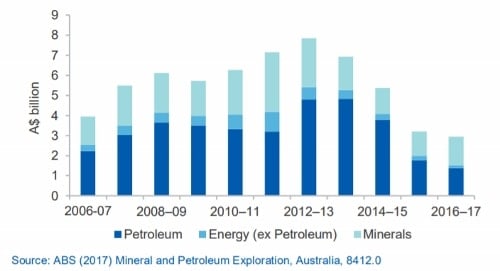
The Western Australia, Department of Mines, Industry Regulation and Safety (DMIRS) tells us that Australia’s mineral exploration expenditure was $1.6 billion in 2016–17, up from $1.4 billion in 2015–16.

“Western Australia contributed over $1 billion of this spend with the gold and iron ore sectors attracting the largest share,” DMIRS said.

“Gold exploration expenditure in Western Australia increased significantly from $385.9 million in 2015–16 to $509.5 million in 2016-17.

“Iron ore exploration also increased (but only marginally to) $281.6 million.”

As well as WA exploration appears to be going, DIIS reckons the nation is lagging in terms of overall exploration expenditure.

Australian exploration expenditure fell by eight per cent in 2016–17 to $2.9 billion with the pesky petroleum industry emerging as the main culprit with its exploration expenditure decreasing by 23 per cent to $1.4 billion.

Minerals exploration managed to offset this marginally with a rise of 10 per cent in 2016–17 to $1.6 billion.

The increase in minerals exploration was largely driven by nickel, cobalt, and gold, all of which were credited to favourable movements in commodity prices.

“After five consecutive years of declines since 2012, exploration expenditure on iron ore has stabilised, remaining unchanged from 2015–16 levels of $291 million,” DIIS said.

“Growing global supply and expectations of low prices have discouraged a rebound in exploration activity.”

In 2016–17, Australian resources sector mineral exploration expenditure targeting new and existing deposits increased by 17 and 7 per cent, to $0.5 and $1.1 billion, respectively.

The positive movement in market conditions encouraged exploration at new deposits.

Greenfield exploration was also on the rise as mineral deposits not previously drilled – or known to exist – suddenly coming into vogue as commodity prices increased.

The old standard of commodities, gold, featured high in exploration expenditure, increasing by 26 per cent in 2016–17 to $689 million — accounting for 44 per cent of Australia’s total minerals exploration expenditure during the fiscal year.

Gold exploration activity was stimulated by higher world gold prices and a lower AUD/USD exchange rate, which improved the profit margins of Australian gold producers.

Base metals exploration expenditure rose by 17 per cent in 2016–17 to $271 million, again riding a wave of higher commodity prices, producing the first yearly improvement since low prices triggered a steady decline back in 2012.

Australia’s copper exploration expenditure was driven by an improved outlook for copper prices and was one area to enjoy the rise in battery metal interest and increased by 5 per cent, to $136 million — accounting for 50 per cent of Australia’s total base metals exploration expenditure.

The battery metal curiosity surrounding cobalt dragged nickel along for the ride with exploration expenditure for both also recording a strong rise in 2016–17, up by 59 per cent to $81 million.

Nickel prices also enjoyed more traditional support following stronger than expected demand growth in China, which is seeking to increase its output of stainless steel.

Other base metals recorded a rebound in exploration activity in 2016–17 resulting in an increase in exploration expenditure on zinc, lead and silver by 10 per cent, to $55 million.


Azure Minerals Identifies Gold and Cobalt Anomalies at Sara Alicia

THE DRILL SERGEANT: Azure Minerals (ASX: AZS) reported results from a recent close-spaced soil sampling program undertaken across the company’s Sara Alicia property in Mexico.

Azure Minerals said the program identified areas of strong gold, cobalt and zinc anomalism.

Additionally, a ground magnetic survey defined a highly magnetic zone, which the company interpreted to represent the skarn body hosting the high-grade gold and cobalt mineralisation.

Soil samples were collected on a 25m by 50m grid spacing, defining a discrete zone strongly anomalous in gold and cobalt, with highest values of 1.26 grams per tonne gold and 1,469ppm cobalt (0.15 per cent cobalt).

The company highlighted these as being both very high values for soil samples.

The anomalies for both elements are coincident, are approximately 200m long and 100m wide, and align along the eastern flank of a well-defined northwest-southeast trending structural zone.

The western flank also hosts a very high-grade zinc-in-soil anomaly in the southwestern quadrant of the project area.

All 26 samples taken from within the 200m by 100m anomalous area returned assays exceeding 1,000ppm zinc (>0.1 per cent zinc) up to a maximum value of 35,400ppm zinc (3.54% Zn), with an overall average zinc grade of 0.45 per cent zinc.

“This very strong zinc anomaly is hosted in a different geological setting from the gold and cobalt mineralised skarn, providing Azure with another target horizon to follow-up,” Azure Minerals said in its ASX announcement.

Azure claimed the results of the ground magnetic survey and magnetic susceptibility measurements of the drill core from its first drilling program confirmed the close spatial association of the magnetic skarn body with high-grade gold and cobalt mineralisation.

“The surface dimensions of the magnetic anomaly are similar in area to the gold and cobalt anomalies identified by the soil sampling,” Azure said.

“Encouragingly, modelling of the data indicates that the magnetic body which represents the mineralisation has considerable depth extent, particularly to the north and northeast where it dips beneath an overlying limestone horizon, providing excellent targets to extend the gold and cobalt mineralisation in those directions.”

Azure indicated it is currently designing a drilling program to follow-up these positive results by testing for along-strike and down-dip extensions and the depth potential of the high-grade gold and cobalt mineralisation.


Website: www.azureminerals.com.au


Gascoyne Resources on Schedule for May Gold at Dalgaranga

THE BOURSE WHISPERER: Gascoyne Resources (ASX: GCY) informed the market of progress on construction activities at the company’s Dalgaranga gold project in Western Australia.

Gascoyne Resources said that GR Engineering (GRES) has progressed design, engineering and construction of the 2.5 million tonnes per annum Dalgaranga processing plant.

“Design and engineering is complete and construction is well advanced with completion expected in around three months – approximately one month ahead of schedule,” Gascoyne Resources said in its ASX announcement.

“Construction of the project has progressed ahead of the original schedule, and will now see commissioning and first gold production in May 2018.”

Activities to have been undertaken within the process plant so far, include:

Concrete and civil works have been completed;

SAG mill installation is well advanced;

The Crusher and ROM bin have been delivered to site and installation is underway;

CIL tank erection is complete;

Steel erection on Site is nearing completion;

The Elution and gold recovery circuit installation has progressed on schedule with electrical cabling and terminations underway;

Reagent storage area has been completed with the final electrical and piping connections underway; and

Water services area is nearing completion, including reverse osmosis treatment plant, fire system, raw and process water pumps.

Gascoyne advised that electrical and instrument installation is almost complete with commissioning of this portion of the plant scheduled for late February.

“The Mining Contractor (NRW) has commenced site establishment and mobilisation of the mining equipment,” the company said.

“To date one of the excavators, a number of trucks and ancillary mobile equipment has been mobilised.

“NRW are on schedule to commence mining in early March.

“As part of the mining contract, NRW have purchased a number of new truck trays that will increase the payloads of the trucks and improve efficiency.

“A number of these new trays have been fabricated and are scheduled to arrive on site in the next few weeks.”

The Dalgarange gold project contains a Measured, Indicated and Inferred Resource of 31.1 million tonnes at 1.3 grams per tonne for 1.32 million ounces of contained gold, which is inclusive of Proved and Probable Ore Reserves of 15.3 million tonnes at 1.3g/t for 612,000 ounces of gold.


Email: admin@gascoyneresources.com.au

Website: www.gascoyneresources.com.au


Sayona Mining Commences Authier Pilot Plant Program

THE BOURSE WHISPERER: Sayona Mining (ASX: SYA) has commenced a pilot plant program for the company’s Authier lithium project in Canada.

Sayona Mining said the pilot program is being completed by SGS Canada (SGS), a company with extensive experience in developing spodumene concentration flowsheets, at Lakefield, Ontario.

The company explained that over the last ten years, SGS has operated pilot plants for several Canadian hard rock lithium deposits.

Sayona collected around 5.5 tonnes of mineralised pegmatite ore during the Phase 3 drilling program carried out in December 2017, from which the diamond drill core was assayed and stage-crushed to the appropriate particle size to feed the pilot plant.

Two composite pilot plant feed samples have been prepared to represent Years 0 to 5 and Years 5+ of the operation.

The pilot plant flowsheet comprises grinding, de-sliming, magnetic separation, mica and spodumene flotation.

The pilot plant is scheduled to operate for 100 hours at a feed rate of 50 kilograms per hour.

The objectives of the piloting program are to produce a six per cent lithium oxide concentrate at recoveries of greater than 80 per cent and confirm:

Finalisation of the flowsheet and processing parameters for spodumene concentrate production developed during the Pre-Feasibility Study;

Produce engineering data for equipment sizing and plant design; and

Generation of spodumene concentrate for downstream lithium carbonate testing and marketing purposes.

Sayona intends using the data collected from the piloting program for a Definitive Feasibility Study, which is expected to be completed during the 2Q 2018.

“The objective of the pilot program is to further refine the design and confirm the operating parameters for the Authier process plant, in order to de-risk the plant construction, commissioning and ramp-up,” Sayona Mining chief executive officer Corey Nolan said in the company’s announcement to the Australian Securities Exchange.

“The company is focused on the rapid progression of the project towards production to capitalise on the strong projected price outlook for spodumene concentrates.”


Email: info@sayonamining.com.au

Website: www.sayonamining.com.au


Azure Minerals Extends Oposura Potential

THE DRILL SERGEANT: Azure Minerals (ASX: AZS) announced completion of resource definition drilling of the known eastern mineralised zone (East Zone) at the company’s Oposura project, located in the northern Mexican state of Sonora.

Azure Minerals explained the drilling of the East Zone was part of a broader resource drill-out program at Oposura designed to delineate mineralisation previously identified by historical exploration.

The company has previously released results from the first 36 of the 76-hole East Zone resource drill-out program and samples from the remaining holes are currently being processed and assays will be released soon.

Azure now has drilling well advanced in the West Zone with 48 holes having been drilled to date with the resource drill-out expected to be completed within the next two weeks.

“The first batch of assay results from the West Zone is expected to be released shortly,” Azure Minerals said in its ASX announcement.

“Geological modelling and resource estimation has commenced with the maiden resource on-track to be completed in April 2018.

“This, along with other project development studies, will lead into the Scoping Study / Preliminary Economic Assessment, scheduled for the third quarter of 2018.”


Website: www.azureminerals.com.au

Middle Island Resources Strikes HoA to Divest Reo Gold Project

THE BOURSE WHISPERER: Middle Island Resources (ASX: MDI) has executed a Heads of Agreement relating to divesting the company’s 100 per cent-interest in the Reo gold project in West Africa to Tajiri Resources Corp. (TSX-V: TAJ) via an Option to Purchase Agreement.

Middle Island Resources declared summary commercial terms involve aggregate cash payments to Middle Island of US$335,000 and the issue of 5 million shares, representing eight per cent of Tajiri’s then post-issue expanded capital, plus a two per cent net smelter return (NSR) royalty, which can be purchased by Tajiri for US$5 million.

On completion, the Reo project transaction Middle Island will have divested all of its remaining gold interests in West Africa, allowing the company to fully focus on its advanced Sandstone gold project development in Western Australia.

“The transaction structure allows Middle Island shareholders to retain a significant indirect interest in the upside potential of the Reo project via the Tajiri equity and royalty components,” Middle Island Resources managing director Rick Yeates said in the company’s announcement to the Australian Securities Exchange.

“Middle Island looks forward to working closely with Tajiri to facilitate remaining aspects of the due diligence and documentation, in order to complete the transaction and progress the Reo project towards feasibility.

“Middle Island will keep shareholders updated on progress with the Reo project transaction during 2018.”


Email: info@middleisland.com.au

Website: www.middleisland.com.au

Southern Gold Expands Bluebird Merchant Ventures Agreements

THE BOURSE WHISPERER: Southern Gold (ASX: SAU) announced it has extended its Farm In and Joint Venture arrangement with London listed Bluebird Merchant Ventures (LON: BMV).

Southern Gold said the extension would now include the Kochang project in South Korea with terms for the Kochang gold project being broadly in line with what was previously agreed for the Gubong and Taechang gold projects – being:

A farm-in stage where BMV is to invest US$0.5 million in compiling a high level report on project feasibility targeting capital expenditure of no more than US$10 million, or less than US$5 million each;

The report may or may not provide for several projects to be developed in parallel or potentially as stand-alone operations but Kochang’s relatively high gold and silver grades may enable transport of ore over distance; and

BMV (or one of its associates) is to complete a placement in Southern Gold shares to the value of $0.25 million and at the same price agreed for the other projects, or 38.6 cents per share, by 31 May 2018.

Southern Gold said this takes the potential investment by BMV to US$1.5 million across three projects (Gubong, Taechang and now Kochang) should they take all of them through the farm-in and joint venture process.

It also potentially means a total equity investment in Southern Gold of $0.75 million at the 38.6 cents share price, with $0.25 million having already been completed.

After the completion of the farm-in investment, the share placement and the report on project feasibility, a contributing Joint Venture will be formed with BMV as the operator.

This is expected to occur within approximately 12 months.

“Bluebird is the right group to get underground at Kochang and move this project forward more aggressively,” Southern Gold managing director Simon Mitchell said in the company’s announcement to the Australian Securities Exchange.

“Drilling from the steep hills would be expensive but given there is substantial mine infrastructure in place it isn’t necessary.

“We can get to the vein face and work out the system from underground, and given the high grades seen here historically there may be the potential for a low tonnage, very high-grade development.

“Southern Gold acquired the South Korean projects in July 2016 for around $2 million in scrip.

“It is pleasing to extract in excess of this value inside 18 months on only a portion of our Korean portfolio.

“And there is much more value yet to be released – something that will become quite apparent during the course of 2018.”


Email: info@southerngold.com.au

Website: www.southerngold.com.au

Intermin Resources Consolidâtes Kalgoorlie Ground

THE BOURSE WHISPERER: Intermin Resources (ASX: IRC) has consolidated its ground holding at the company’s Lakewood gold project, south east of Kalgoorlie-Boulder in Western Australia.

The Lakewood project currently comprises 42 prospecting licence applications and one exploration licence application with a total area of 115 square kilometres on the greenstone belt south of Kalgoorlie-Boulder’s Golden Mile and adjacent to the one million tonnes per annum Lakewood toll milling facility.

On final grant of the applications, which Intermin indicated it expects to eceive in the second half of 2018, the company’s 100 per cent-owned project area will increase to 472sqkm.

Intermin has commenced data compilation and initial drill targeting on several high quality targets identified that remain untested.

“We have been extremely fortunate to pick up such a large contiguous block of prospective greenstone belt in the heart of the Kalgoorlie goldfields which is consistent with our strategy of low cost acquisition of assets on major geological structures,” Intermin Resources managing director Jon Price said in the company’s announcement to the Australian Securities Exchange.

“Preliminary assessment has highlighted a number of high quality targets that remain untested and we look forward to commencing drilling on the project once the tenements have been granted.”

The company is currently mining and generating cash from its Teal gold mine, which it will use to soon commence a self-funded 50,000 to 60,000 metre new discovery and resource growth drilling program.


Email: iadmin@intermin.com.au

Website: www.intermin.com.au

Impact Minerals Encounters High-Grade Gold and Highest Silver to Date at Silica Hill

THE DRILL SERGEANT: Impact Minerals (ASX: IPT) declared high-grade gold and very high-grade silver assays from the southern mineralised zone at the company’s emerging gold-silver discovery at the Silica Hill prospect, north of Orange in New South Wales.

Impact Minerals explained the assays came from three diamond drill holes, and claimed that the grades of gold and silver, particularly the gold, are increasing with depth below surface.

Assays from CMIPT077 returned:
22.5 metres at 1.7 grams per tonne gold and 276g/t silver from 166.7m down hole, including 0.3m at 1.8g/t gold and 4200g/t (135 ounces or 0.42%) silver from 174.4m, including 0.8m at 13.6g/t gold and 40g/t silver from 187.7m.

Impact Minerals said the results confirm the southern mineralised zone to be a steeply dipping mineralised vein system that trends east-west and is open down dip and down plunge to the south east.

The continuity of the gold and silver mineralisation from surface was confirmed from further assays returned from the other two diamond drill holes which were drilled up dip of CMIPT077.

CMIPT074
21.8m at 0.6g/t gold and 273g/t silver from 137.9m down hole, including 0.5m at 0.5g/t gold and 1,485g/t (48 ounces) silver from 143m, and
0.4m at 1.6g/t gold and 6240g/t (200 ounces or 0.62%) silver from 148.5m.

CMIPT073
75.3m at 0.4g/t gold and 62g/t silver from 75m down hole, including 10.8m at 1.4g/t gold and 243g/t silver from 134m, which includes 4.3m at 2g/t gold and 566g/t silver from 134m, and including 0.3m at 6.9g/t gold and 1,485g/t silver from 136m.

Impact Minerals said the results, together with previously reported results from Holes CMIPT011 and CMIPT043 confirm the continuity of gold and silver mineralisation in the southern zone from surface to about 200m true depth and over a strike length of 150m.

“These results are an exciting further breakthrough for us at Silica Hill as they indicate the mineralised system is getting better at depth and to the east,” Impact Minerals managing director Dr Mike Jones said in the company’s announcement to the Australian Securities Exchange.

“The silver grades and minerals within the vein system we have discovered are exceptional and confirm the unique nature of this deposit in Australia.

“These are the highest assays returned so far at the project and they occur within robust zones of mineable width and grade.

“We are excited for the 2018 exploration program.”


Email: info@impactminerals.com.au

Website: www.impactminerals.com.au

Ausgold Demonstrates Gold Mineralisation Continuity

THE DRILL SERGEANT: Ausgold (ASX: AUC) announced results of air core drilling (AC) at the company’s 100 per cent-owned Katanning gold project (KGP) in Western Australia’s south-west.

Ausgold said the 331-hole drilling campaign had demonstrated strong continuity of mineralisation within the central project area around existing Resources along three laterally extensive mineralised lodes.

21 AC holes were drilled 400 metres along strike from the Jinkas Resource, with 12 holes delivering intercepts greater than 0.1 grams per tonne gold.

A further 38 AC holes were drilled over a strike length of 2,600m to test the continuity of the mafic gneiss host rocks southeast from the Jinkas deposit, 18 of which returned anomalous gold grades over 0.1g/t gold, including intercepts of:

BSAC1778
10 metres at 0.34g/t gold from 16m; and

BSAC1781
19m at 0.15g/t gold from 0m.

At Devil’s Elbow, AC drilling starting 200m south along strike from the Lone Tree Resource delineated mineralisation a further 1,600m south, with gold anomalism intersected along strike from Lone Tree south to the Fraser prospect.

Ausgold claimed the drilling tested the contact between the footwall granite to the west and the prospective mafic granulite to the east along the 1,600m of strike length and the new results have confirmed the western portion of Fraser to be the strike continuation of the Jackson-Lone Tree trend, located structurally beneath and parallel to the White Dam-Fraser mineralisation.

Ausgold has previously encountered high-grade gold intercepts from wide-spaced AC drilling in the western Fraser prospect.

The company explained the latest drilling infilled this wide-spaced (100m by 100m) drilling to a spacing of 50m by 50m to provide better controls on mineralisation, which returned the following intercepts:

BSAC1831
16m at 0.16g/t gold from 16m;

BSAC1834
14m at 0.47g/t gold from 4m, including 1m at 1.13g/t gold from 17m;

BSAC1835
12m at 0.42g/t gold from 4m, including 4m at 1 .01g/t gold from 12m;

BSAC1837
16m at 0.38g/t gold from 0m; and

BSAC1838
16m at 0.17g/t gold from 12m.

“This latest round of air core drilling has provided valuable information which has proven the existence of mineralisation along three laterally continuous trends,” Ausgold chief executive officer Matthew Greentree said in the company’s announcement to the Australian Securities Exchange.

“Using the results of the AC drill program, combined with the recently acquired ground geophysics, Ausgold has designed and commenced a significant reverse circulation drill program that has the potential to significantly grow the KGP’s mineral resources.”

Ausgold has commenced a reverse circulation drill program to test the targets generated by the AC drill program.

A ground gravity and Moving Loop Electromagnetic (MLEM) geophysics program has been completed and results are currently being processed.


Email: info@ausgoldlimited.com

Website: www.ausgoldlimited.com