Corazon Mining Identifies new Cobalt Anomalies at Mt Gilmore

THE DRILL SERGEANT: Corazon Mining (ASX: CZN) claimed discovery of three new cobalt anomalies at the company’s Mt Gilmore cobalt-copper-gold project in New South Wales.

Corazon Mining identified the anomalies while conducting an ongoing soil sampling program at Mt Gilmore.

The anomalies are located in the northern extent of the project at the Lantana Downs prospect approximately 12 kilometres north of the priority drill-defined Cobalt Ridge cobalt-copper-gold sulphide deposit.

The company said the discovery of the three high tenor soil anomalies – with up to 949ppm cobalt – further highlights the potential of the Mt Gilmore project to host a much larger cobalt system than it initially considered.

The current phase of exploration at Mt Gilmore is designed to identify new areas of cobalt mineralisation that have the potential to compliment the Cobalt Ridge deposit.

“The current area of exploration was historically explored for volcanogenic massive sulphide (VMS) deposits, with cobalt not previously tested,” Corazon Mining said in its ASX announcement.

“The basement rocks between Lantana Downs and Cobalt Ridge host numerous historical copper-gold sulphide workings, which provide the discovery potential for multiple Cobalt Ridge ‘lookalike’ deposits.”

Three soil anomalies have been defined based on geochemical signature and location.

The Southern Lantana Anomaly is very similar in tenor and multi-element association to that seen in the Cobalt Ridge soil-sampling program.

The cobalt-copper-gold anomaly is at the intersection of at least two mineralised trends and returned a peak cobalt assay of 151ppm.

The Central Lantana Anomaly has a cobalt-antimony-zinc-lead multi-element association with a peak cobalt result of 224ppm and in general appears to be a higher tenor than that observed in soil sampling at Cobalt Ridge.

The Northern Lantana Anomaly is located over what is interpreted to be a lateritic (weathered) serpentinised ultramafic.

Within the soil sampling results, cobalt peaks at 949ppm and nickel at 0.7 per cent, with the tenor of mineralisation increasing towards the north and east, yet to be closed off.


Email: info@corazon.com.au

Website: www.corazon.com.au


Ventnor Resources Eyes Bright Future Through Silica Glass

There has been a great deal of market chatter recently concerning the expected rise in production of electric vehicles and the subsequent growth in demand for commodities to manufacture them.

However, there is one commodity that is as essential to the manufacture of these new vehicles.

This commodity is commonly found, which is possibly why it has received very little market attention of late.

It’s many, varied uses include the manufacture of the PVC elements, such as dashboards and door trims as well as the window glass of internal combustion engine vehicles to meet demand from the burgeoning automotive industries of India and China.

It is also used in construction as an important ingredient of concrete and common flat glass.

This wonder commodity is also used to produce high-grade glass that provides clarity to the screens of modern computers and televisions.

It is easily mined and found in any number of locations and it is an extremely precious resource the world is rapidly running out of.

This commodity…is sand.

Current supply deficits of sand are expected to blow out due to several reasons, an important one being Asian regional governments acknowledging sand as a strategic resource.

Global demand for industrial silica sand is forecast to advance 5.5 per cent per annum to 291 million metric tons in 2018, with a value of $12.5 billion.

China is the main reason the Asia/Pacific region will remain the largest regional consumer of industrial sand through 2018.

China has the world’s largest glass industry, which is expected to sustain industrial sand consumption for production of double-glazed windows, electronic display screens, photovoltaic panels, and other flat glass products.

The contribution of India cannot be discounted where activity will include production of sand moulds to manufacture automotive, machine tool, wind turbine, and other types of metal castings.

Renewable power generation is never far from the story and the increasing demand for high purity silica sand in the production of Photo Voltaic panels and Silicon-Metal composite material for high capacity lithium-ion rechargeable batteries has been well-documented in recent times.

Demand for sand is escalating to feed infrastructure-construction programs utilising concrete in Asia – particularly China, which in the last four years has poured as much concrete as the United States has in the past 100 years.

The looming lack of supply caught the attention of Bruce Maluish, managing director of Ventnor Resources, a company previously focused on gold and base metals exploration.

In October 2017, Ventnor Resources informed the market it had acquired the Arrowsmith silica sand project, located 270 kilometres north of Perth in Western Australia.

Ventnor applied for four Exploration Licenses totalling 400 square kilometres, convinced that Arrowsmith had potential to address dwindling sand supply in the Asia-Pacific region.

It has recently had two of these tenements granted – the Arrowsmith Central and Arrowsmith South prospects.

The remaining two contiguous exploration license applications are pending, including the Arrowsmith North prospect, which the company expects to be granted in May.

“The noise emanating from the global sand markets piqued my interest and I started looking for sand deposits,” Maluish told The Resources Roadhouse.

“The first place I started looking was the Perth basin, because it is close to home and because of its geomorphology that pointed to the possibility of high-grade silica sand deposits.

“The other important aspects I was looking for were tenements sitting on vacant Crown Land with proximity to a railway line.

“The Arrowsmith project immediately ticked a lot of boxes as it has the Eneabba-Geraldton rail line running straight through it, providing direct access to ship-loading facilities at the Geraldton Port, from where we can ship up to 50,000 tonnes at a time.

“There EL applications predominantly cover Vacant Crown Land and are extensively covered by cleared tracks from historic oil exploration seismic surveys and they can be easily accessed by driving down the Brand Highway.”

Even though the tenements had yet to be granted, Ventnor was able to carry out a shallow hand auger program to collect composite representative samples from the Arrowsmith North prospect.

A five-kilogram sample was submitted to Nagrom Laboratories for an initial testwork program, replicating conventional sand processing techniques that confirmed processing to upgrade the sand to glassmaking quality would involve a low-capital intensity, low technical risk operation and eliminated the need for processing chemicals.

The feed stock in the test had a head assay of 97.7 per cent silicon dioxide (SiO2) and after attritioning, magnetic separation and sizing, the 0.425mm to 0.85mm product achieved a grade of 99.5 per cent SiO2.

The remainder of the product, 0.212mm to 0.425mm, returned an assay of 99.3 per cent, however Ventnor remains confident additional testwork will improve both product grades.

Ventnor secured an option to acquire another, potentially high-grade, high tonnage silica sand project near Muchea, also north of Perth.

Like Arrowsmith, the Muchea silica sand project is strategically located adjacent to Brand Highway with a rail connection, this time to Kwinana port.

Due diligence carried out by Ventnor confirmed the potential of the prospect with assays indicating a high-quality +99.7 per cent SiO2 deposit over an area of more than 3,400 hectares.

Ventnor has determined Exploration Targets for the Muchea silica sand project, including:

For the area previously subjected to aircore drilling: 70 Million to 125 Million tonnes silica sand grading above 99.5 per cent SiO2; and

Where Ventnor has conducted hand auger drilling: 100 Million to 150 Million tonnes silica sand grading above 99.5 per cent SiO2.

These figures are expected to be supported by Exploration Targets at the Arrowsmith project of:

Arrowsmith North: 100 million to 140 million tonnes high-quality silica sand;
Arrowsmith Central: 40 million to 80 million tonnes high-quality silica sand; and
Arrowsmith South: 40 million to 80 million tonnes high-quality silica sand.

The ASX determined the option grant constituted a change in the nature and/or scale of Ventnor’s activities and brought ASX Listing Rules 11.1.2 and 11.1.3 into play.

This meant Ventnor has been required to seek shareholder approval for the proposed transaction and that it may not proceed should that approval not be given.

The company is also required to re-comply with ASX’s requirements for admission and quotation.

“When I was looking for ‘the right sand project’ for the company, I found Muchea,” Maluish explained.

“The sand at Muchea is extremely high-grade, it is, in fact, the largest high-grade silica sand Resource in the world.

“The key number here is 99.5 per cent silica – that’s what you can manufacture glass with, but it depends on the amount of iron, aluminium, titanium in it, to what quality glass you can produce.

“Normal glass has a green tinge, which is caused by the amount of iron, usually 100 to 200ppm.

“If you can get the iron content down to 50ppm you can produce ultra-clear glass, which is the hot product known as architectural glass, our product can meet that.”

Ventnor has been investigating markets in, and fielding enquiries from, the Asia-Pacific region for the supply of high-quality silica sand.

The company is keen to take advantage of the current environment brought on by the commodity’s increasing demand and diminishing supply from both the Muchea silica sand project and the complementary Arrowsmith silica sand project.


Ventnor Resources Limited (ASX: VRX)
…The Short Story

HEAD OFFICE
Level 1
6 Thelma Street
West Perth, WA, 6005

Ph: +61 8 9226 3780

Email: info@ventnorresources.com.au
Web: www.ventnorresources.com.au

DIRECTORS
Paul Boyatzis, Bruce Maluish, Peter Pawlowitsch


Aruma Resources – Pursuing a Major New Australian Gold Discovery

Aruma Resources (ASX: AAJ) is targeting large scale sediment- hosted gold deposits at its Eastern Goldfields project area in Western Australia.

With the Slate Dam project, it may be on the cusp of the state’s next major gold discovery.

There’s no such thing as a ‘quick chat’ with Aruma’s managing director Peter Schwann once he starts talking about the company’s 100 per cent-owned Slate Dam project.

Schwann has been around the industry longer than most, and was quick declare the Slate Dam project as, “The best gold project I have had in my entire career.”

Slate Dam is Aruma’s major project and is located 40 kilometres from the Western Australian home of gold mining, Kalgoorlie.

Further north, the company also has the Beowulf gold project, which it pegged in 2017, that covers 490 square kilometres of gold prospective greenstone sediments.

Schwann draws comparisons to Slate Dam from the Invincible gold deposit, being mined by global gold major Gold Fields at its nearby St Ives operation, which set a new discovery benchmark for gold explorers in the Western Australia goldfields.

The Invincible deposit is considered by market watchers as one of the most important gold discoveries in recent decades for many reasons.

Invincible highlighted potential for new substantial gold systems within an existing gold district, hosted by an alternate geological setting.

It also readjusted the way geologists regard lithological units within the region, which were previously thought to never contain gold.

Invincible broke all the rules by being a hydrothermal gold deposit formed near the geological contact between the Black Flag Group and Merougil Sediments.

Schwann revisited Aruma’s land package paying close attention to the potential of sediment-hosted gold deposits.

He concluded that Slate Dam could also potentially be hosting gold in the Black Flag Group.
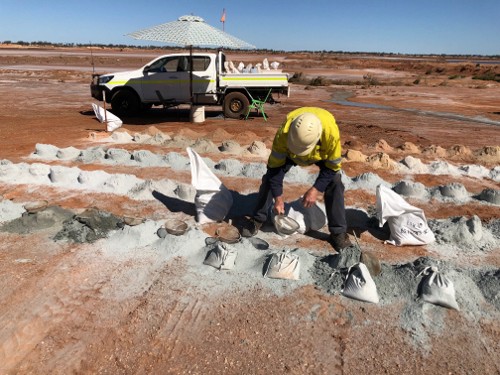
In February, Aruma received results from its maiden drilling program of Slate Dam testing the project’s large seven square kilometre historical gold anomaly.

The drilling was highly successful and identified a 20m thick zone of gold mineralisation extending from surface to a depth of around 200m, which remains open.

The first results from the drilling included:

SDRC006
5 metres at 3.8/t gold from 10m; and

SDRC020
7m at 2.1g/t gold from 11m.

The intersection from SDRC20 was part of a 16m at 1.34g/t gold from 8m hit that resulted in Aruma discovering a new mineralised gold zone.

The results also continued to draw parallels to the initial Invincible discovery drill results, which included:

LD11486
3m at 5g/t gold from 73m;

LD11486
4m at 3g/t gold from 79m; and

LD11496
6m at 2.3g/t gold from 46m.

Following the success of the maiden drill program, a second phase of drilling is already underway at Slate Dam, designed to provide further results towards what Aruma anticipates will be a substantial maiden Resource estimate.

“Our maiden drilling results immediately justified drilling the previously known gold anomalism and validated our sediment-hosted gold model at Slate Dam,” Schwann told The Resources Roadhouse.

“They also showed that the extent of that historic anomaly is limited only by the insufficient historic drilling and sampling.

“The importance of our strategy to control the whole stratigraphic belt, both at Slate Dam and Beowulf, also became evident demonstrating the favourable stratigraphic trends to the north and south could continue to extend mineralisation.”

The discovery of new large, high-grade gold anomalies at Slate Dam continued as predicted with new anomalies identified over an area of 1.3 kilometres in strike length and 250m in width, with a peak value of 444ppb gold plus 10 further gold zones of greater than 10ppb.

“The discovery of those anomalies extended the main gold system we discovered at Slate Dam,” Schwann said.

“More importantly, they provided immediate, high priority drill targets for our next phase of drilling.”

The new anomalies were identified during a recently completed geochemical program at Slate Dam, which included a soil sampling and a rock chip sampling program.

While all this was happening, Aruma added a 28sqkm exploration licence to Slate Dam covering the eastern side of the highly prospective Transfind Granite, which hosts the Trojan and Transfind open-pit gold mines.

It followed up by signing a binding Sale and Purchase Agreement with Westgold Resources (ASX: WGX) to acquire 100 per cent of the Trojan gold project (ML25/104).

Under the terms of the deal, Aruma issued six million fully paid ordinary Aruma Resources shares to Westgold as payment in full for the project.

Located approximately 55km south east of Kalgoorlie, the strategic acquisition of the Trojan project slotted into Aruma’s landholding like the vital piece of a jigsaw puzzle with anomalies traversing the tenement borders.

The Trojan lease fits the company’s belief in Slate Dam’s potential to host large sediment-hosted gold deposits.

Schwann considers the potential success lies in the geological dolerite dykes that dot the Slate Dam landscape.

“I love these dolerite dykes,” he said.

Schwann described the dolerite dykes as the old geological plumbing system of the region that the alluvial fluids emerged through.

He supported his thesis by listing the gold companies and the mines they had discovered near dolerite dykes.

The list included names such the Paddington gold mine of Norton Gold Fields that is located just south of a dolerite dyke.

He also cited the Kambalda area, host to Aruma’s benchmark Invincible deposit, which is also located adjacent to dolerite dykes

“The soil samples that returned the gold hits at Slate Dam were taken due north of a dolerite dyke,” Schwann explained.

“The Trojan open pit sits in between two dolerite dykes.

“So, we think the area we have now consolidated is very exciting.”

Trojan includes a JORC 2012 Indicated and Inferred Resource estimate of 2.8 million tonnes at 1.61 grams per tonne gold for 144,800 ounces of gold (at a 0.70g/t cut‐off) at the Trojan Open cut extension.

Aruma has received an up to date data base that it will appraise in the coming months.

The company considers there to be potential for Trojan to generate near-term cash‐flow from a resumption of mining operations at the project.

The main focus now is to evaluate the gold mineralisation under and around the Trojan open pit and undertake targeted exploration at the project.

The second phase of drilling at Slate Dam will consist of around 30 reverse circulation (RC) drill holes for a total of up to 4,000m, with planned drilling depths up to 200m.

This drilling will include extensional holes to follow up the 20m thick trend of gold mineralisation identified by the maiden drill program.

It will also include repetition holes, which are hoped to discover stratigraphic repetitions of the gold mineralised system to the east.

Drilling will endeavour to extend the dip and strike potential of the major gold shoots identified in the first phase of drilling and define higher grade lodes within these shoots.

Further drilling of a six-hole RC drilling program is also underway at the nearby Beowulf project that is to involve drilling depths of up to 100m.

Aruma’s Beowulf exploration model is the same as the model it has developed for Slate Dam, in which nuggets define the greywacke beds in between the underlying shale, which is the drill target for the discovery of gold lodes.


Aruma Resources Limited (ASX: AAJ)
…The Short Story

HEAD OFFICE
Level 1
6 Thelma St
West Perth WA 6005

Ph: +61 3 9321 0177

Email: info@arumaresources.com

Web: www.arumaresources.com

DIRECTORS
Paul Boyatzis, Peter Schwann, Dr Mark Elliott


Pioneer Resources Confirms Caesium Mineralisation Continuity

THE DRILL SERGEANT: Pioneer Resources (ASX: PIO) has been drilling at the company’s 100 per cent-held Pioneer Dome project in the Eastern Goldfields of Western Australia, which includes the Sinclair Zone caesium deposit.

Pioneer Resources completed a program of diamond-drilling to infill five sections with the strongest caesium mineralisation (in the form of the mineral pollucite) in preparation for final open pit mine design work.

Each of the key sections returned pollucite intersections in line with earlier modelling.

Caesium (Pollucite) intersections included:

PDD162
11.15m at 17.43 per cent caesium oxide (Cs2O) from 38.2m;

PDD166
5.7m at 29.61 per cent Cs2O from 37.7m;

PDD167
2.68m at 27.11 per cent Cs2O from 40.82m and 7.18m at 16.04 per cent Cs2O from 47.88m;

PDD170
7.45m at 16.58 per cent Cs2O from 43.6m; and

PDD174
4.3m at 20.89 per cent Cs2O from 43.5m.

Lithium mineralisation (petalite and lepidolite), occuring peripheral to the caesium mineralisation, included:

PDD161
25.02m at 2.14 per cent lithium oxide (Li2O) from 41.98m;

PDD163
16.43m at 2.27 per cent Li2O from 40.57m;

PDD164
16.1m at 2.64 per cent Li2O from 39.9m;

PDD168
16.5m at 1.75 per cent Li2O from 40.5m;

PDD173
26.7m at 1.82 per cent Li2O from 34.3m;

PDD175
23.1m at 1.94 per cent Li2O from 41.9m; and

PDD176
19m at 1.62 per cent Li2O from 38m.

The program totalled 20 drill holes and produced 1,333.29 metres of core.

Of these, 15 holes targeted caesium or lithium mineralisation with most holes intersecting potassium (microcline).

With lithium and caesium results to hand, Pioneer’s geological consultants from the Mitchell River Group are revising the Mineral Resource Estimate for caesium.

Potassium (microcline) samples, which require specialised processing, are currently being analysed, with results expected before the end of April.

The company said its open pit design and confirmation economic study are on track to be concluded by the end of May 2018.

Pioneer has the next pass of RC drilling underway, designed to test targets to the immediate north of the Sinclair Zone caesium deposit, principally targeting lithium minerals but also supplying information to enable future targeting for caesium.

“The Sinclair deposit is proving to be an exciting opportunity for the company as it moves towards its first mining operation,” Pioneer Resources managing director David Crook said in the company’s announcement to the Australian Securities Exchange.

“This round of drilling confirmed the continuity of the pollucite mineralisation, significantly de-risking the project from an ore supply perspective.

“The company is entirely focussed on advancing the Mine Plan (environmental) and Project Management Plan (safety) and moving towards production.”


Website: www.pioresources.com.au


Lithium Australia Completes VSPC Acquisition and Identifies Lithium in Lepidolite Hill Waste

THE BOURSE WHISPERER: Lithium Australia (ASX: LIT) has completed procurement of advanced cathode material production technology by way of acquiring 99.7 per cent of technology company VSPC.

Lithium Australia took over the Brisbane-based VSPC, which has spent 14 years and approximately $30 million developing some of the world’s most advanced manufacturing techniques to produce cathode materials.

LIT explained these materials are critical components of lithium-ion batteries, the growing demand for which is currently driven by rapidly increasing demand for EVs and consumer electronics.

The advanced battery materials being developed by VSPC are also applicable to green energy solutions, including as back-up for sources of renewable energy.

Since completing the takeover in February, LIT has undertaken re-commissioning of the company’s cathode plant, including negotiating time-critical service agreements, recruitment of technical and operating staff and service agreements have been arranged with universities to support the technical demands of the project.

The VSPC facility is a two to four tonnes-per-annum pilot plant, incorporating an integrated laboratory, coin-cell production facility and battery-testing equipment.

LIT indicated that plant inspections and servicing are underway, as is evaluation of equipment upgrades, to prepare for resumption of production in July 2018.

“Recommissioning the VSPC pilot plant is a challenging task, but many of the past scientific and operating staff have made themselves available to ensure success,” Lithium Australia managing director Adrian Griffin said in the company’s announcement to the Australian Securities Exchange.

“We welcome their assistance and participation in our plan to provide the world’s battery producers with the best available cathode materials.”

Lithium Australia has also completed further testwork on ore-sorting products from its Lepidolite Hill lithium project that it said indicates successful separation of lithium micas using an X-ray transmission ore-sorting method.

The company said existing stockpiles at Lepidolite Hill are potentially an attractive source of feed for its proposed large-scale pilot plant (LSPP), either as supplementary feed or a major source of feed.

On the basis of these initial results Lithium Australia believes potential exists to not only separate out petalite, as well as lepidolite, from surface stockpiles but also to undertake further exploration at the project; the latter would target possible in-situ lithium resources outside and/or below the current historic open-pit mine workings.

“Although our aim at Lepidolite Hill is exploitation of lithium mica, it’s not surprising to find such abundant petalite in the mine dumps,” Griffin said.

“Lepidolite Hill operated as a petalite mine in the 1970s, and perhaps the recovery of the target minerals was not as good as the operators would have liked!

“Ore-sorting will certainly enhance rapid separation of the lepidolite.

“That said, we’ll also devote significant attention to the recovery of other lithium minerals that result in a grade of about 1.8 per cent lithium dioxide in the reject material.

“We’ll probably drill at the south end of the existing pit, to see how far the lithium mineralisation extends beyond what was left in the pit wall.”


Email: info@lithium-au.com

Website: www.lithium-au.com

Thundelarra Wraps up Garden Gully AC Drilling

THE DRILL SERGEANT: Thundelarra (ASX: THX) reported the completion of an Air Core (AC) drilling program at the company’s Garden Gully project in the Murchison region of Western Australia.

Thundellara has submitted samples from the drilling for assaying.

The company said the objective of the AC program was to test for near-surface extensions of known mineralised structures and to provide geological data over zones that its initial interpretation suggested might host previously unrecognised structures with the potential to be mineralised.

The drilling consisted 274 AC holes drilled for 14,025m, including 20 AC traverses across seven prospects testing for near-surface extensions of mineralised structures.

Reverse Circulation (RC) and diamond drilling (DD) rigs are currently on site conducting follow-up drilling.

“When all assay results have been received and collated then the resultant geological interpretations will be reported to the market, together with any significant findings,” Thundelarra said in its ASX announcement.

“Our initial shallow scout drilling at Garden Gully, which began in mid-2016, aimed to identify targets below the transported cover.

“The approach proved very successful, delivering several new prospects that were previously unknown, with Lydia a prime example.

“Given the positive outcomes of that initial exploration, we remain confident that these recently-completed air core traverses will identify multiple additional targets for more detailed follow-up in subsequent programs.”


Email: info@thundelarra.com.au

Website: www.thundelarra.com.au


Aruma Resources Drilling at Slate Dam

THE DRILL SERGEANT: Aruma Resources (ASX: AAJ) has commenced the second phase of drilling at the company’s 100 per cent-owned Slate Dam gold project in the Eastern Goldfields of Western Australia.

Aruma Resources informed the market that the drilling is progressing and to date has nine holes for a total of approximately 1,000 metres of Reverse Circulation (RC) drilling, out of a planned program of up to 30 holes for approximately 4,000 metres has been drilled.

“In line with our sediment-hosted gold model at the Slate Dam project, alteration and structure with stratigraphy are visible in drill chips from the current program, with fine grained pyrites evident in shales,” Aruma Resources said in its ASX announcement.

Aruma also announced the acquisition of Exploration Licence (EL) E25/526, in the southern region of the project.

The new EL comprises six blocks and covers an area of 19 square kilometres and hosts the historic Transville (and Mt Juglah) gold mines, which are reported to have historically produced 970 tonnes of gold ore at 26.7g/t gold for 25.76 kilograms of gold.

“The Slate Dam project now covers some 330 square kilometres of very prospective sediments situated on granite centres,” the company said.

“The leases are mostly granted and cover a strategic 330 square kilometres situated only 40 to 60 kilometres from Kalgoorlie.

“These leases contain over 60 kilometres of strike of the prospective beds that host Trojan and Majestic.

“Aruma’s exploration program has been designed to locate the mineralisation centres that will exist along these trends and potentially host several major centres capable of supporting mining operations.”


Email: info@arumaresources.com

Website: www.arumaresources.com


Intermin Resources Hits Immediate Results at Teal Gold Project

THE DRILL SERGEANT: Intermin Resources (ASX: IRC) released results from reverse circulation (RC) being carried out on the company’s 100 per cent-owned Teal gold project, northwest of Kalgoorlie-Boulder in Western Australia.

Intermin Resources is conducting the self-funded $4 million, 55,000 metres drilling program across its Kalgoorlie gold projects focussed on new discoveries and resource extensions at the key Teal, Anthill and Blister Dam projects.

As part of the program, 20,000m of RC and diamond drilling is planned for the Teal project area to grow the current Resource base and test new discovery targets identified by the company’s 2017 program.

Intermin has completed 31 holes of infill and extension drilling to date at the Jacques Find and Yolande prospects.

High-grade downhole RC intercepts at Jacques Find include:

JFRC18039
8m at 10.31 grams per tonne gold from 123m including 5m at 15.21g/t from gold 123m;

JFRC18026
8m at 5.7g/t gold from 64m;

JFRC18034
3m at 10.28g/t gold from 102m;

JFRC18038
6m at 4.72g/t gold from 54m and 6m at 4.34 g/t gold from 42m;

JFRC18008
5m at 1.26g/t gold from 36m and 8m at 1.60 g/t gold from 44m;

JFRC18037
9m at 1.69g/t gold from 34m; and

JFRC18028
5m at 1.81g/t gold from 53m.

The drilling has extended the Jacques Find strike length to over 500m intercepting new areas of hallow oxide gold mineralisation with mineralisation remaining open at depth and to the north.

High-grade downhole RC intercepts at Yolande include:

JFRC18010
37m at 2.16g/t gold from 90m including 12m at 2.51g/t gold from 90m;

JFRC18010
9m at 4.45g/t gold from 118m;

JFRC18011
7m at 2.12g/t gold from 145m; and

JFRC18011
3m at 2.79g/t gold from 124m and 1m at 5.6g/t gold from 136m.

Intermin said the results from Yolande demonstrate potential for multiple parallel structures as part of a large mineralised system across the Teal project area.

The company has drilling continuing with two RC rigs on site to complete the 20,000m Teal program in the June Quarter with further results expected in coming weeks.

Drilling at the Binduli and Anthill prospects is planned to commence in June with results expected in the September Quarter 2018.

“These latest drilling results further demonstrate the potential scale and quality within the Teal project area and certainly justifies the priority placed on this large mineralised system just 15 minutes’ drive from the city of Kalgoorlie-Boulder,” Intermin Resources managing director Jon Price said in the company’s announcement to the Australian Securities Exchange.

“The ongoing drilling program at Teal will test the full extent of this system to add free milling oxide to our production profile and determine the scale of the deeper, higher grade, primary sulphide mineralisation to enable assessment of future development options.”


Email: iadmin@intermin.com.au

Website: www.intermin.com.au


Venture Minerals to Reassess Mt Lindsay Tin Potential to Meet Electric Vehicle Demand

THE BOURSE WHISPERER: Venture Minerals (ASX: VMS) has responded to industry chatter regarding the expected high demand from the fast growing (electric vehicle) EV market.

Venture Minerals indicated it has commenced a detailed reassessment of the high-grade tin and tungsten resource base at the company’s Mount Lindsay project in Tasmania.

Venture presented data indicating tin being independently ranked as the number one metal most impacted by modern technology demand.

The company considers itself as being uniquely positioned with Mount Lindsay being one of the largest undeveloped tin projects in the world, containing in excess of 80,000 tonnes of tin metal.

The Mount Lindsay project also hosts, within the same mineralised body, a tungsten resource containing 3.2 million MTU (metric tonne units) of tungsten trioxide (WO3).

Venture declared it has a large resource base to draw from and indicated it intends to look at strategies to optimise the higher-grade portions at Mount Lindsay, which previously reported resources included 4.7 million tonnes at 0.4 per cent tin and 0.3 per cent WO3.

Venture said it would now look to focus on assessing the underground mining potential of this high-grade Resource.

“Knowing that the Mount Lindsay project has a large tin resource that could be harnessed to meet applications in Electrical Vehicles and renewable energy has refocussed the company to revisit its approach in developing this asset,” Venture Minerals managing director Andrew Radonjic said in the company’s announcement to the Australian Securities Exchange.

“With Mount Lindsay, Venture is now well placed to take part in the EV revolution.”


Email: info@ventureminerals.com.au

Website: www.ventureminerals.com.au

Calidus Resources Extends Klondyke Mineralisation

THE DRILL SERGEANT: Calidus Resources (ASX: CAI) provided an update on drilling of 12 RC holes along a reconnaissance traverse directly East of the company’s Klondyke gold deposit, located in the Pilbara of Western Australia.

Calidus Resources claimed the broad-spaced RC drilling program had outlined the continuation of the main Klondyke mineralised shear zone up to two kilometres further East from where the current 654,000 ounce resource ends.

Assays from the latest RC holes above a 10gm include:

18KLRC095
16 metres at 2.34 grams per tonne gold from 136m;

18KLRC099
10m at 3.67g/t gold from 58m;

18KLRC095
7m at 4.58g/t gold from 175m;

18KLRC096
6m at 3.32g/t gold from 167m;

18KLRC104
13m at 1.24g/t gold from 104m; and

18KLRC104
2m at 5.44g/t gold from 39m.

“The Klondyke East maiden drilling campaign has confirmed that the main Klondyke Shear is proving up as a substantial gold system,” Calidus Resources managing director Dave Reeves said in the company’s announcement to the Australian Securities Exchange.

“Drilling has intersected outcropping gold mineralisation for over two kilometres from the eastern limit of the existing 2.6 kilometres long, 654,000 ounce resource.

“With deep drilling underway beneath the existing resource, the true scale of Klondyke is beginning to be revealed.

“Mapping of the shear to east of this shows a continuation of the host rock sequence for a further two kilometres along strike from this drilling.

“These results increase our confidence that with the extensional drilling planned this year, we will see a significant increase in defined resources at the Klondyke Prospect.”

Calidus has completed detailed field mapping and pXRF sampling that will allow the company to commence further infill and further extensional drilling in May.

The field work has also highlighted similar geology continues for a further 2km east of this drilling.


Website: www.calidus.com.au