Marindi Metals Claims LCT Outcrop Discovery at Forrestania

THE DRILL SERGEANT: Marindi Metals (ASX: MZN) claimed an exploration breakthrough at the company’s 100 per cent-owned Forrestania project in Western Australia.

Marindi Metals announced the discovery of multiple outcropping specialised pegmatites, which the company declared to represent priority drill targets.

The company believes the outcropping (in-situ) lithium-caesium-tantalum LCT-type pegmatites could be the likely source of both the Tillerson and Scaramucci anomalies.

These were identified by the company’s newly-appointed managing director and CEO Simon Lawson, during an orientation site visit to the Forrestania project.

Lawson asserted the discovery of the potential source of the previously identified Tillerson and Scaramucci anomalies to be a pivotal breakthrough for the company, providing a series of drill-ready targets and reducing the need for further reconnaissance exploration work.

“This is an important step forward in our aggressive lithium exploration strategy at Forrestania,” Lawson said in the company’s announcement to the Australian Securities Exchange.

“These newly-defined outcrops are fixed-position, drill-ready specialised pegmatite targets that can be rapidly evaluated using definitive RC and diamond core sampling.

“On the basis of these finds, we will now pivot the majority of the planned reconnaissance-style aircore expenditure, as well as the costs for the associated drill-line establishment earthworks, and instead use those funds to undertake drilling to rapidly define the potential value of these pegmatites for shareholders.

“We have effectively eliminated the need for additional reconnaissance work by refining the geochemical soil sampling anomalies using simple boots-on-ground geological investigation – a great outcome for the company.

“We can now move immediately to begin planning an RC and diamond drill program, which we are aiming to kick off later this quarter.

“The potential of this belt for world-class lithium discoveries is amply demonstrated by the Earl Grey and Bounty lithium deposits, located around 50 kilometres along strike to the north.”


Email: info@marindi.com.au

Website: www.marindi.com.au


Sunstone Metals Encouraged by Limon Prospect Trenching Results

THE DRILL SERGEANT: Sunstone Metals (ASX: STM) received encouraging initial results from a surface trenching program at the Limon prospect, part of the company’s Bramaderos gold-copper project in Ecuador.

Sunstone Metals said the first batch of assays from the initial trench (LM-01) at Limon from trench LM-01 intersected 35.9 metres at 0.92 grams per tonne gold and 0.4 per cent copper, with the intersection at surface remaining open on all sides.

Peak copper and gold assays were 1.94m at 1.2g/t gold and 1.25 per cent copper and 2.06m at 1.74g/t gold and 0.41 per cent copper from separate samples.

The company explained that geological mapping, alteration mapping using spectral analysis, as well as soil and rock geochemistry all support its interpretation of the results of an outcropping window of a more extensive mineralised diorite body.

Sunstone said the results indicate that there are multiple targets for porphyry gold-copper mineralisation at the extensive Limon prospect.

“These initial trench results from Limon are extremely encouraging,” Sunstone Metals managing director Malcolm Norris said in the company’s announcement to the Australian Securities Exchange.

“This is a breakthrough result for our Bramaderos project, where we have now identified higher grade porphyry mineralisation at surface within a very large area of altered rock.

“Limon will be amongst the first areas to be drill tested, together with Bramaderos Main and West Zone targets.”


Email: info@sunstonemetals.com.au

Website: www.sunstonemetals.com.au


Metallica Minerals Makes Loan With Intent to Purchase

THE BOURSE WHISPERER: Metallica Minerals (ASX: MLM) has entred a loan agreement with South West Pacific Bauxite (HK) Ltd (SWPB), 75 per cent owner of the advanced Wagina bauxite project in the Solomon Islands.

Metallica Minerals is lending SWPB $120,000, in exchange for which Metallica has been granted an option to carry out exclusive due diligence on Wagina with a view to ultimately completing a transaction involving the project.

Metallica is also progressing its Urquhart bauxite project on Queensland’s Cape York Peninsula towards production.

The company explained it has been canvassing growth options to enable it to increase its production profile towards the previously stated target of five to seven million tonnes per annum of bauxite, over three to five years.

Metallica said its initial assessment of Wagina suggests the project meets its criteria as an advanced long-life, low-cost asset that has the potential to deliver long term value for shareholders.

“After an extensive and disciplined search in Australia and overseas, we are excited to have identified the Wagina bauxite project as an asset that is potentially the right fit for the company,” Metallica Metals managing director Simon Slesarewich said in the company’s announcement to the Australian Securities Exchange.

“This project has the ability to significantly extend our current Reserve life and lift the production profile beyond what Urquhart will deliver when it comes online.

“Similar to Urquhart, Wagina has the potential to be developed at a relatively low capital cost and in a manner that could deliver outstanding returns.

“We have been selective with growth opportunities and we intend to be thorough in our due diligence on Wagina as the Solomon Islands is a new jurisdiction for the company.

“We look forward to commencing this process and expect to announce the results later this year.”


Email: admin@metallicaminerals.com.au

Website: www.metallicaminerals.com.au


Marindi Metals Resumes 100 Per Cent Control of Yalco Project

THE BOURSE WHISPERER: Marindi Metals (ASX: MZN) has resumed sole control of the Yalco exploration project in the Northern Territory.

Marindi Metals said the resumption of control over the project followed it receiving notification from Teck Australia Pty Ltd of its intention of withdrawing from the Yalco Joint Venture.

Teck has spent over $3 million on the Yalco project since the JV was established in 2013, and Marindi now intends to conduct an independent review of all work completed by Teck to determine the optimum path forward.

“Marindi’s primary focus in the Northern Territory is on its highly prospective Caranbirini zinc project, adjacent to the world-class McArthur River zinc mine,” Marindi Metals said in its ASX announcement.

“As announced on 27 March 2018, major Japanese resources group, Japan Oil, Gas and Metals National Corporation (JOGMEC) has entered a farm-in agreement enabling it to earn up to a 70 per cent interest in the Caranbirini project by sole funding up to $4 million in exploration over three years.”


Email: info@marindi.com.au

Website: www.marindi.com.au


Draig Resources Eager to Develop Tribune Gold Discovery

THE INSIDE STORY: Draig Resources (ASX: DRG) aspires to fast track development of a high-grade underground and open pit operation at the company’s Bellevue project in Western Australia.

Draig Resources set a cracking exploration pace in 2017 at the company’s Bellevue gold project, located 400 kilometres north west of Kalgoorlie in Western Australia.

In March 2017, Draig appointed Steve Parsons as executive director and charged him with the responsibility of advancing Bellevue.

Parsons came well-qualified for the job, having been managing director of Gryphon Minerals, which under his watch grew to be included on the ASX200 group of companies, eventually being taken over for $100 million by a North American gold company in late 2016.

Parsons oversaw the discovery and delineation of Gryphon’s 3.6 million ounce Banfora gold project in West Africa.

“After I joined Draig, we spent the first six months looking to find what projects and opportunities were sitting out there waiting to be ‘rediscovered’ – ones that hadn’t been drilled to death and had exploration upside with high-grade mineralisation,” Parsons told The Resources Roadhouse.

“It has only been 12 months since I joined Draig, at which time the company owned just two mining licences covering 20 square kilometres of ground.

“These licences did, however, include the old Bellevue gold mine.”

The Bellevue gold mine stood out as an obvious starting point for the company, having been one of Australia’s highest-grade historical gold mines producing approximately 800,000 ounces of gold at 15 grams per tonne gold before it closed in 1997.

High-grade gold was mined at Bellevue for over 100 years through to 1997 when the operation shut down.

After the mine closure in 1997 it changed hands between some of the industry’s biggest-hitting companies yet very little modern exploration was undertaken as it never fell into their collective portfolio considerations.

This ultimately benefitted Draig Resources, which kicked off the first systematic exploration at Bellevue in the last 20 years.

“The Bellevue project was an amazing standout opportunity,” Parsons said.

“When we first looked at it, we were stunned to find it was a project with almost nothing done on it in 20 years, as it was, after all, one of the highest-grade gold projects of its day and has been sitting there idle.

“We always thought there was a very good chance we would find more high-grade gold – not just more, but a significant amount.

“There’s an old saying in the gold exploration community – one that a lot of people stick by – and it is one that does tend to ring true: if you want to find high-grade gold go to an old high-grade gold mine.”

Draig completed a small program of shallow diamond holes at Bellevue in August 2017 within the high priority Western Mineralised Corridor to gain an understanding of the project’s geology.

Two RC holes from this program confirmed previous historical intersections and provided confidence the company was drilling in the right area.

These holes returned intersections of:

DRRC0018
2 metres at 8.67g/t gold from 30m and 2m at 3.66g/t gold from 109m; and

DRRC0017
3m at 2.17g/t gold from 70m.

The company started a second phase of targeting drilling in November, and in December announced a new discovery.

The Tribune Lode is a Bellevue parallel structure located immediately to the west of the Highway Fault and about 300m to the west to the historic Bellevue underground mine.

It is in a relatively untested area mostly under the Western Mineralised Corridor shallow transported sand cover.

The Tribune Lode was intersected by drill hole DRRC0024, which returned assays of:

7m at 27.4g/t gold from 92m, including 5m at 37.5g/t gold from 92m.

This was followed up by drill hole DRDD0004 collared 80m south of the Tribune discovery drill hole, which returned:

5m at 16.5g/t gold.

Continued step-out extensional drilling further confirmed the high-grade mineralised system to be extended to the south, at depth and down plunge, with numerous high-grade drill intersections received from the latest round of results.

These include:

DRDD010
12m @ 12g/t gold from 68m downhole; and

DRCD020
2.5m at 29g/t gold from 147.5m and 3.8m at 5.2g/t gold from 133m;

DRCC033
4m at 9g/t gold from 57m downhole; and

The company recently completed a fully underwritten institutional placement raising $8 million, which will allow it to carry out an aggressive drill program at the Tribune Lode and explore for further high-grade zones within the highly prospective Western Corridor and beyond.

The placement resulted in new institutional investors enrolling on the company share register as well as strong support from existing shareholders.

“We see a real opportunity to significantly grow the Bellevue gold project into a standout high-grade gold project,” Parsons said.

“We took the approach that it would most likely be a two-year exercise to put some real geological thinking into the project, to bring in new, modern techniques and ideas and then go and test those ideas.

“Then, with pretty much with the first drillhole of our second drill program, we made the Tribune discovery that is in an entirely new parallel structure to what Bellevue sat in.

“So far we have defined it over about 550 metres strike length and since the start of the year the plan has been to drill that out on 80 metres by 40 metres spacings down to about 300 metres vertical depth.

“We expect that will enable us to calculate a maiden Inferred category JORC Resource, which we are hoping to release sometime in the middle of this year.”

Draig will launch into a second phase of exploration activity in the second half of this year that will focus on stepping out on the broader project area and systematically testing the shear Shear Zone that continues for about 20km to the north.

The second half of the year will also afford the company time to start looking at its recently acquired South Yandal project.

Draig exercised an option agreement to acquire 100 per cent of the highly prospective and underexplored Yandal South project, located between Echo Resources (ASX: EAR) Bronzewing project and gold processing plant as well as Red 5’s (ASX: RED) Darlot gold project and gold processing plant.

The project is only 40km to the east of the Bellevue gold project.

Draig has reviewed historical data at the Yandal project and identified targets for follow up exploration in a highly prospective greenstone belt.

The company intends to return to a first principles approach on the project conducting an extensive regolith and geological review of the project to assist targeting similar to the work leading up to the Tribune Lode discovery.

“Exploration is what we are good at and the company geologists and I wanted to develop a bigger footprint for the company,” Parsons said.

“We were interested in finding a complementary project within a 100 kilometre radius consisting good exploration ground that hadn’t been looked at closely.

“The Yandal project fell into that category and we have now grown our land position to over 1,400 square kilometres.

“It’s great to have a second project and our geologists can’t wait to get stuck into it however as the potential size Tribune starts to unfold the key focus for the company right now is the Bellevue gold project.”


Draig Resources Limited (ASX: DRG)
…The Short Story

HEAD OFFICE
Suite 3, Level 3
24 Outram Street
West Perth, WA, 6005

Ph: +61 8 6424 8077

Email: admin@draigresources.com
Web: www.draigresources.com

DIRECTORS
Ray Shorrocks, Steve Parsons, Guy Robertson


BCI Minerals Creating Tasty Iron-Salt Mix

THE INSIDE STORY: BCI Minerals (ASX: BCI) is determined to once again, as in the heydays of the iron ore boom, become a medium sized mining company.

The company hopes to achieve its aim by generating earnings from its iron ore and industrial mineral projects located in the Pilbara region of Western Australia.

True to its roots, iron remains at the heart of the company in its Iron Valley mine near Newman and the 100 per cent-owned Buckland iron ore project near Pannawonica.

Iron Valley is a producing mine with a mine life of approximately 15 years based on current production rates.

It is operated and managed by BCI’s operating partner, Mineral Resources (ASX: MIN), which recently executed an all scrip takeover for Atlas Iron.

At 30 June 2017, Iron Valley’s Mineral Resource measured 229.9 million tonnes at 58.4 per cent iron with Ore Reserves of 113 million tonnes at 58.7 per cent iron.

The mine is operated and funded by MIN, which pays BCI a royalty as a percentage of MIN’s FOB realised sale price.

The Iron Valley mine generated revenue of $63.5 million and EBITDA of $18.3 million for BCI Minerals in FY17.

Although 60 per cent iron products have recently attracted historical discounts to the 62 per cent iron index, Iron Valley is still providing a steady income stream.

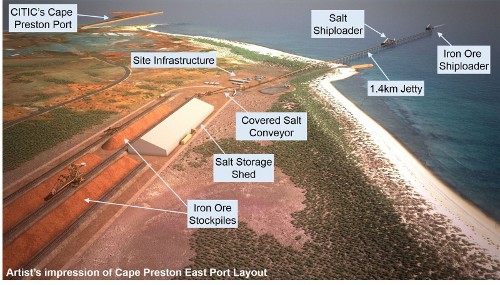
BCI is advancing the Buckland iron ore and Mardie salt projects, which are both proposed to export product through the company’s planned 20 million tonnes per annum Cape Preston East Port facility.

BCI expects Cape Preston to become a multi-commodity, multi-user port exporting 15 million tonnes per annum of ‘Buckland Blend’ iron ore and more than three million tonnes per annum of salt and a small component of potash from the Mardie salt project.

“The immediate focus for BCI Minerals is to develop and grow our iron ore business,” BCI Minerals managing director Alwyn Vorster told The Resources Roadhouse.

In January, BCI Minerals inked a non-binding memorandum of understanding (MoU) with Sinosteel Australia to support development of the project.

The MoU provides a framework for facilitating discussions between BCI and potential offtake partners, and potential direct offtake by Sinosteel Australia as well as facilitating discussions with potential funding partners and possible JV investment by Sinosteel.

Results from drilling at Buckland (at the newly acquired Kumina Tenements) have been encouraging.

The first program identified several targets BCI considers to potentially host greater than 58 per cent iron channel iron deposits (CID) as well as greater than 60 per cent iron bedded iron deposits (BID).

The results initiated a major drilling program on the Kumina Tenements.

“This drilling at Kumina is to consist of at least another 300 holes to be drilled into the Kumina deposit,” Vorster explained.

“The Buckland project already has the Bungaroo South Resource, however, that is too small to support our envisaged 15 million tonnes per annum over 15 years operation.

“We bought the Kumina tenements targeting at least 100 million tonnes mining inventory additional to the Bungaroo South tenement, which should provide sufficient scale to make the entire Buckland project stack up to our investment hurdles and long-term ambitions.

“We anticipate releasing a maiden Kumina Mineral Resource estimate at the by mid-year.”

The drilling will test high-grade outcropping BID mineralisation at Kumina targets E and J.

Earlier rock chip sampling at these target areas returned grades of greater than 62 per cent iron from most of results with best results of up to 67 per cent iron.

Channel iron deposit targets B and C will also be included in the program.

“This tenement has had no drilling activity for over three decades,” Vorster said.

“We identified outcropping high-grade bedded iron deposits – which is different to most other deposits in the Western Pilbara region that are channel iron deposits normally containing around 57 to 58 per cent iron.

“In the new iron ore world with higher discounts if your product clears the 60 per cent iron level you immediately move to selling into a different market segment at a different price point.

“It shifts the whole market risk, revenue risk and confidence of potential project investors.”

Such is the BCI emphasis on higher grade discovery, that should the Kumina drilling program achieve, hopefully exceed, its objective of identifying 100 million tonnes of excellent quality mining inventory, it may be feasible for BCI to consider developing Kumina as a separate, standalone operation like the company ran in its early days at Nullagine, by shaping an infrastructure partnership with an existing player.

“The significant difference will be the grades…Nullagine was 57 per cent iron, but we are expecting to see much higher quality at Kumina,” Vorster said.

BCI Minerals also sees potential upside within its 100 per cent-owned Mardie salt and sulphate of potash (SOP) project that sits on the WA coast between Onslow and Karratha.

A Scoping Study for the 300sqkm Mardie project in July 2017, demonstrated potential technical and economic viability for a three to 3.5 million tonnes per annum operation producing high purity industrial-grade sodium chloride salt from seawater via solar evaporation, crystallisation and raw salt purification.

BCI has progressed its Pre-Feasibility Study enhancing the viability of the Mardie salt project.

BCI plans producing a high purity salt for use in industrial applications, specifically targeting the Asian market, where analysts predict salt consumption in the Asian chlor-alkali and soda ash industries to grow by approximately 4.3 per cent per annum from around 110Mtpa in 2016 to approximately 170Mtpa by 2026.

This total demand growth over 10 years would require increased supply equivalent to approximately two new Mardie sized operations each year.

“We believe the Mardie salt project is one of the last available sites of its size in one of the best locations in the world for a solar salt operation,” Vorster said.

“One change being covered in the PFS is that we are planning the processing circuit to also produce a component of sulphate of potash as a by-product.”

This turns the usual way a sulphate of potash (SOP) project operates upside down.

Many current Australia-based SOP projects produce lower quality salt as a by-product that ends up as waste due to the distances these projects are from port.

BCI will produce a high-grade industrial salt with SOP by-product that will both be within an economically viable distance from its Cape Preston East port.

Because the capex to establish the Mardie salt project will be high, BCI is open to discussion with JV partners, be they other producers or buyers.

Another option is the possible spin out of Mardie in an IPO.

“The rationale behind that is that Mardie has a long lead time to production but then has a 50-year plus mine life,” Vorster said.

“It is therefore a type of investment where very specific investors should be targeted, rather than the same investors who are attracted to quicker earnings from more volatile commodities.

“The reality is that while Mardie is sitting within BCI, we really won’t realise full value for the project.”

Targeting technical and ownership solutions for both projects during 2018 appears like an ambitious target, but Vorster says with an excellent management team and supportive board positive progress is being made on all fronts.


BC Iron Limited (ASX: BCI)
…The Short Story

HEAD OFFICE
Level 1
15 Rheola Street
West Perth WA 6005

Ph: +61 8 6311 3400

Email: info@bciminerals.com.au
Web: www.bciminerals.com.au

DIRECTORS
Brian O’Donnell, Alwyn Vorster, Michael Blakiston, Jennifer Bloom, Martin Bryant, Andrew Haslam


Lithium Australia Moves SiLeach LSPP closer to completion

THE BOURSE WHISPERER: Lithium Australia (ASX: LIT) reported on progress on construction of the company’s large-scale pilot plant (LSPP) to demonstrate its SiLeach® process at commercial scale.

Lithium Australia indicated the front-end engineering and design (FEED) for the plant is on track.

The FEED undertakings include preliminary equipment specifications, material selection, infrastructure, assessment of contracting strategies, discussion with vendors selected for the supply of specialised equipment, and logistic and scheduling activities.

The FEED study is scheduled for completion in Q3 2018.

Detailed metallurgical test work – designed to confirm final process design criteria in key areas of the flowsheet, including beneficiation, acid digestion and removal of impurities – is also well advanced.

Flotation test work on a master composite of the expected LSPP feed has focused on identifying the optimum combination of flotation feed particle size, mass recovery, stage efficiency, concentrate grade and re-grind product particle size.

Past test work indicated the importance of removing ultrafine particles from the flotation feed, since these can lead to poor mica recovery.

Results of the latest test work show lithium recoveries of 86 to 94 per cent, with 60 to 73 per cent of the mass reporting to rougher concentrate at a grade of 3 to 3.6 per cent Li2O (lithium oxide) from a feed grade of 2.5 per cent Li2O.

“The FEED study is advancing well and the improvements in lithium recovery are very encouraging,” Lithium Australia managing director Adrian Griffin said in the company’s announcement to the Australian Securities Exchange.

“We’re pleased with the increase in confidence around by-product recovery, which is an important aspect of the SiLeach® revenue stream – we believe it will allow us to produce lithium chemicals from minerals but at the same low unit cost as that of the brine producers.

“Preliminary discussions with potential off-take partners have been encouraging and our planned laboratory-scale pilot run at ANSTO, while aimed primarily at finalising the flowsheet for construction, will generate significant amounts of lithium chemical product for testing by potential off-take partners.”


Email: info@lithium-au.com

Website: www.lithium-au.com


Intermin Resources Claims New Teal Project Gold Discovery

THE DRILL SERGEANT: Intermin Resources (ASX: IRC) claimed a new gold discovery from reverse circulation (RC) drilling being carried out on the company’s 100 per cent-owned Teal gold project, located 11 kilometres northwest of Kalgoorlie-Boulder in Western Australia.

Intermin Resources explained the drilling program is focussed on new discoveries and resource extensions at the company’s Teal, Anthill and Blister Dam projects.

As part of the program, 20,000 metres of RC and diamond drilling is underway for the Teal project area to grow the current resource base and test new discovery targets identified in the 2017 program.

Intermin has completed 26 holes for 3,156m to date testing high-priority new discovery targets, which has resulted in the discovery of a new prospect 200m east of Peyes Farm named Wills Find.

Wills Find returned promising gold mineralisation including:

PFRC18012
18 metres at 2.69 grams per tonne gold from 96m, including 11m at 4g/t gold from 96m;

PFRC1805
23m at 1.29g/t gold from 67m, including 10m at 2.13g/t gold from 78m; and

PFRC18013
3m at 1.28g/t gold from 128m.

Further new mineralisation was identified 400m north west of Yolande and 250m west of Teal, also returning encouraging levels of gold mineralisation including:

JFRC18012
4m at 2.6g/t gold from 54m.

Intermin Resources said the results confirm the presence of multiple parallel structures.

The company has extension drilling and testing of further new discovery targets ongoing.

“These latest drilling results provide further evidence of multiple parallel structures across the entire Teal project area and demonstrate the potential scale of the mineralised system,” Intermin Resources managing director Jon Price said in the company’s announcement to the Australian Securities Exchange.

“We are less than 20 per cent the way through our 55,000 metre drill program and look forward to testing the remaining new discovery targets and continuing with our resource growth program across 2018.”


Email: iadmin@intermin.com.au

Website: www.intermin.com.au


Azure Minerals Increases Recoveries and Concentrate Grades at Oposura

THE BOURSE WHISPERER: Azure Minerals (ASX: AZS) completed further metallurgical testwork at the company’s 100 per cent-owned Oposura zinc-lead-silver project in Mexico.

Azure Minerals reported the testwork has continued to make improvements on the already positive results it has achieved to date at Oposura.

Locked cycle flotation tests, simulating the continuous operation of a typical sulphide flotation circuit, demonstrate that Oposura can expect increased zinc and lead recoveries with higher concentrate grades than those reported previously.

“The successful production of clean, commercial grade concentrates at high recoveries has eliminated a possible major project risk and strongly enhances the project potential,” Azure Minerals said in its ASX announcement.

The latest testwork comprised a locked cycle test involving a typical lead-silver and zinc sulphide flowsheet which represents an industry standard flotation circuit.

The result of the locked cycle test was a zinc concentrate grading a high 57.2 per cent zinc with a zinc recovery of 85.6 per cent and a lead concentrate grading 61.4 per cent lead at a lead recovery of 84 per cent.

Silver recovery to the lead concentrate was 67.1 per cent silver at a concentrate grade of 323.8 grams per tonne silver (10.4 oz/t silver).

Both the zinc and the lead concentrate grades achieved in the locked cycle test were high above the typical industry benchmark grades of 53 per cent zinc and 60 per cent lead, thereby improving the marketability of both products.

“Azure expects that, under standard operating parameters, recovery of zinc and lead into their respective concentrates would be greater than those achieved in the locked cycle test, should the company wish to produce concentrates at the lower benchmark quoted concentrate grades,” the company said.


Website: www.azureminerals.com.au


Blackstone Minerals Commences Little Gem Drill Program

THE DRILL SERGEANT: Blackstone Minerals (ASX: BSX) commenced drilling at the company’s very high-grade Little Gem cobalt-gold project in British Columbia, Canada.

Blackstone Minerals explained the first hole in the current program is planned to intersect the entire target zone on the same section to the company’s previous drill hole which was abandoned halfway through the target zone yet encountered and intersection of 1.1 metres at 3 per cent cobalt and 44 grams per tonne gold, within 4.3m at 1 per cent cobalt and 15g/t gold.

Blackstone is planning an initial six diamond drill holes to test the original strike target zone of approximately 300m at Little Gem before looking to explore a strike extension of over one kilometre to the east and plus-500m strike extension to the west.

The company recently completed the final payment for Little Gem and is now the 100 per cent owner of project.

Blackstone indicated the initial results from its maiden drilling have been consistent with historic drilling and adit channel sampling, which returned average grades of 3 per cent cobalt and 20g/t gold.

“Blackstone is pleased to announce the company has commenced drilling at the very high-grade Little Gem cobalt-gold project in British Columbia, Canada,” Blackstone Minerals managing director Scott Williamson said in the company’s announcement to the Australian Securities Exchange.

“It has been a great effort by the team at Radius drilling in conjunction with our exploration team on site to establish the drill pad in the winter conditions.

“We look forward to the first assay results to be reported over the coming weeks, shareholders can expect more consistent news flow throughout the drill season as we explore the full potential of the Little Gem cobalt-gold project.”


Email: admin@blackstoneminerals.com.au

Website: www.blackstoneminerals.com.au