Ramelius Resources Completes Marda Acquisition

THE BOURSE WHISPERER: Ramelius Resources (ASX: RMS) finalised the acquisition of the Marda gold project in Western Australia.

Ramelius Resources explained the completion of the acquisition came after the receipt of Federal Court approval to transfer the shares of Black Oak Minerals Limited to Ramelius on 31 January 2019.

Ramelius subsequently paid the final consideration of $11 million, marking completion of the transaction.

The Marda gold project is located 191 kilometres north-northeast of Ramelius’ Edna May operations.

The company considers it to represent a shear-controlled gold system within trucking distance of Edna May.

Ramelius indicated that work on development studies will now be finalised, with results to date demonstrating that utilising Marda as a satellite ore source to supply high-grade feed will extend mine life and maximise the value of existing infrastructure at Edna May.

“The successful acquisition of the Marda gold project secures additional high-grade ore within trucking distance of the Edna May processing facility, reinforcing Ramelius’ commitment to growth, and well and truly establishing Edna May as a new production hub,” Ramelius Resources managing director Mark Zeptner said in the company’s announcement to the Australian Securities Exchange.


Email: ramelius@rameliusresources.com.au

Website: www.rameliusresources.com.au


Saturn Metals Resumes Apollo Hill Resource Drilling

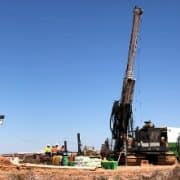
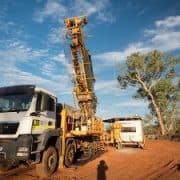
THE DRILL SERGEANT: Saturn Metals (ASX: STN) is back out on the ground having resumed resource extension and infill drilling at the company’s 100 per cent-owned Apollo Hill gold project, near Leonora in the Western Australian goldfields.

Saturn Metals is undertaking a new program of up to 3,600 metres of reverse circulation (RC) drilling at Apollo Hill as it looks to rapidly grow the project’s Mineral Resource, which currently stands at 20.7 million tonnes grading 1 gram per tonne gold for 685,000 ounces.

This round of drilling follows broad-spaced step-out drilling the company carried out last year that confirmed the continuation of the Apollo Hill system, to the north and south.

The company explained the new program will seek to infill these corridors of mineralisation.

“Significant potential exists to find higher grade zones between the step-out intersections reported in December last year and the northern and southern ends of the current Apollo Hill resource envelope,” Saturn Metals managing director Ian Bamborough said in the company’s announcement to the Australian Securities Exchange.

“That is what particularly excites us about this new program.”

Saturn indicated it would provide further information from the resource extension drilling and the regional aircore program that is taking place concurrently at Apollo Hill as results are received and analysed.


Email: info@saturnmetals.com.au

Website: www.saturnmetals.com.au


Australian Mines Increases Sconi Project Mineral Resource

THE DRILL SERGEANT: Australian Mines (ASX: AUZ) released an updated Mineral Resource estimate for the company’s 100 per cent-owned Sconi cobalt-nickel-scandium project in North Queensland.

Australian Mines said it anticipated the new Mineral Resource estimation to result in substantial flow-through benefits to the project’s overall development economics.

A recent expansion drilling program delineated consistent high-grade nickel and cobalt zones across the project area, with some assays from the program exceeding previous results.

The Greenvale nickel deposit’s in-situ material now stands at 24.4 million tonnes, up 63.2 per cent from 14.95 million tonnes in the previous estimate with the adjacent Lucknow deposit now at 14.62 million tonnes, up 94.6 per cent from 7.51 million tonnes previously.

The two deposits, combined with the Kokomo deposit, take the project’s total to 75.71 million tonnes at 0.6 per cent nickel, 0.08 per cent cobalt (0.83 per cent nickel equivalent) for 455,579 tonnes nickel, 57,157 tonnes cobalt (627,945 tones nickel equivalent).

“This Mineral Resource update for the Sconi project is a major boost for the company’s development plans, as we head towards our target of first construction activities at Sconi later this year, pending a final investment decision on the project,” Australian Mines managing director Benjamin Bell said in the company’s announcement to the Australian Securities Exchange.

“With an updated Mineral Resource, Australian Mines is positioned to become a significant cobalt, nickel and scandium supplier through the Sconi project – a project that has already shown to be commercially viable via the November 2018 Bankable Feasibility Study.

“This updated Mineral Resource is likely to further enhance the economics of the project, and in turn provide additional long-term benefits for our investors and off-take partner.

“The fact we have managed to almost double the Resource tonnage at the Lucknow deposit, which will be our initial primary source of cobalt production and added significant tonnes at the previously-mined Greenvale deposit is testimony to the world-class nature of the Sconi project, as well as the scale and grade of the mineralisation contained within our broader tenement package.”


Email: info@australianmines.com.au

Website: www.australianmines.com.au


Antipa Minerals Identifies Havieron Lookalikes

THE DRILL SERGEANT: Antipa Minerals (ASX: AZY) reported news from ongoing exploration at the company’s 100 per cent-owned North Telfer and Paterson projects which are both close to Newcrest Mining’s Telfer gold mine and Rio Tinto’s Winu discovery in Western Australia.

Antipa Minerals recently expanded its greenfield exploration program to include a high-resolution aeromagnetic survey covering a total strike length of 60 kilometres and a combined area of 260 square kilometres.

The company explained its objective was to both refine existing, and also define new, magnetic high anomalies with potential to represent semi-massive to massive sulphides associated with gold and/or copper mineralisation, including Havieron deposit lookalikes.

The Havieron deposit is an aeromagnetic anomaly discovered by Newcrest in 1991 that Antipa described as ‘visible sitting under 430 metres of cover

Antipa claimed its December aeromagnetic survey identified several Havieron lookalike targets.

“We are pleased to confirm that the recent aeromagnetic survey, completed during December as part of our expanded greenfields exploration program, has identified several Havieron gold-copper deposit lookalike magnetic anomalies,” Antipa Minerals managing director Roger Mason said in the company’s announcement to the Australian Securities Exchange.

“These aeromagnetic targets along with the AEM targets identified in 2018 will be systematically evaluated this year with the aim of making a world-class discovery in Western Australia’s under explored Paterson Province.”

Aerial Electromagnetic (AEM) and aeromagnetics have played pivotal discovery roles in the Paterson Province, and are considered by Antipa as effective geophysical exploration techniques for revealing gold and/or copper deposits concealed beneath barren cover in the region.


Website: www.antipaminerals.com.au


Galan Lithium Claims Argentina Lithium Discovery

THE DRILL SERGEANT: Galan Lithium (ASX: GLN) claimed a new lithium discovery based on results from the first samples taken from the maiden drillhole (C‐01‐19) at the company’s Candelas lithium brine project in Argentina.

Galan Lithium indicated the ongoing drillhole is currently at 354 metres having encountered a substantial intercept of brine from depths of approximately 235m to 354m within coarse clastic sediments to 311m and fractured basement lithologies from 311m to 354m.

The exploration program is being led by the company’s chief geologist, Francisco Lopez, with onsite QA/QC control and technical support provided by Camilo de los Hoyos from SRK Consulting (Argentina) a specialist in hydrogeology and in the exploration of lithium brines.

Hoyos declared the initial results as exceptional, adding they confirm the presence of high‐grade lithium bearing brines within a geological setting unique to the Hombre Muerto salar.

“Preliminary field measurements and laboratory analyses on brine suggests that the Candelas project has the potential to become a world‐class soluble lithium deposit hosted in a unique geological setting,” Hoyos said in Galan Lithium’s announcement to the Australian Securities Exchange.

“Further results from exploration must be assessed step by step to define matrix specific yield and hydraulic conductivity, brine quality and aquifer geometry.”

Acknowledging that the exploration is in its early days, the company said it was greatly encouraged by this initial success and now awaits confirmation of these results from further samples and testing.

Galan will aim to fast track the exploration at Candelas with the goal of targeting a resource as soon as practicable.

Th e current maiden drill program is planned to comprise five holes drilled along the approximate 15-kilometre extent of the Candelas channel.

“To encounter lithium grades of this tenor with low impurities in our first hole is remarkable and has given us further encouragement that the Candelas project has the potential to host a significant resource of lithium bearing brines,” Galan Lithium managing director Juan Pablo Vargas de la Vega said.


Website: www.galanlithium.com.au


Gold Road Updates Gruyere Resources and Reserves

THE DRILL SERGEANT: Gold Road Resources (ASX: GOR) released its annual Mineral Resource and Ore Reserve statement as at December 2018.

Gold Road Resources made the point that all Resources and Ore Reserves are currently located within the Gruyere Project Joint Venture tenements.

The Gruyere JV is a 50:50 JV managed by Gruyere Mining Company Pty Ltd, a member of the Gold Fields Limited group.

Gold Road, on behalf of the Gruyere JV, manages all exploration activities and resource development to pre‐feasibility completion on the JV tenements other than the Gruyere gold project.

The company explained the Ore Reserve is derived from Gruyere, and the Golden Highway deposits which include Attila, Alaric, Argos and Montagne, all of which are in the Gruyere JV.

The Gruyere estimate is based on ongoing operational studies, while the Golden Highway estimate is based on Pre‐feasibility Studies (PFS) completed by Gold Road.

The Ore Reserve totals 97.2 million tonnes at 1.25 grams per tonne gold for 3.92 million ounces of gold.

Ore Reserves are reported on a 100 per cent basis at a $1,600 per ounce gold price (US$1,200 at US$0.75:A$1.00).

The Ore Reserve increased by 176,000 ounces (+5%) from the previous Ore Reserve at December 2017.

The Mineral Resource is derived from the Gruyere deposit, the Golden Highway deposits, YAM14 and Central Bore, all of which are in the Gruyere JV.

As at December 2018, the Mineral Resource is 155.37 million tonnes at 1.32g/t gold for 6.61 million ounces, an increase of 2 per cent from the Mineral Resource reported at December 2017.

Mineral Resources are reported on a 100 per cent basis and are constrained within optimised pit shells or underground stope shapes based on a $1,850 per ounce gold price and deposit‐specific modifying factors and cut‐off grades.

The Gruyere Mineral Resource decreased by 1.7 per cent to 139.56 million tonnes at 1.29g/t gold for 5.78 million ounces due to changes to the geology model and estimation methodology.

“Positive exploration results and excellent technical work by the Gold Road exploration and Gruyere JV operational teams has increased the reserve by five per cent to almost four million ounces, including the Maiden Ore Reserve additions on the Golden Highway,” Gold Road Resources managing director and CEO Duncan Gibbs said in the company’s announcement to the Australian Securities Exchange.

“Encouragingly the Golden Highway Mineral Resource increased by 17 per cent to almost 700,000 ounces, and the addition of a robust high‐grade underground resource at Central Bore increases the mineralisation options available to the Gruyere JV.

“The increased reserve grade and ounces has the potential to add further value to the recently updated Gruyere Mine Plan.”


Email: perth@goldroad.com.au

Website: www.goldroad.com.au


Musgrave Minerals: New year…New Gold

THE INSIDE STORY: Musgrave Minerals started 2019 as it finished 2018, by announcing further positive drilling results from the company’s Cue project in the Murchison district of Western Australia.

Late in 2018, Musgrave Minerals completed a maiden reverse circulation (RC) drilling program at the Lake Austin North target.

Lake Austin North is located approximately three kilometres north of the Break of Day/Lena targets, which have been the subject of earlier Musgrave exploration activities.

Lake Austin North sits within a 28km-long prospective corridor that hosts the Break of Day and Lena gold resources of 868,000 tonnes at 7.15 grams per tonne gold for 199,000 ounces of gold and 2.68 million tonnes at 1.77g/t gold for 153,000 ounces of gold respectively.

The maiden Lake Austin Drilling consisted 18 holes focused on the A-Zone and C-Zone that led to the discovery of thick, high-grade basement gold mineralisation at A-Zone with results including an intercept of:

18MORC057
94 metres at 2.2g/t gold from 156m to end of hole (EOH), including;

52m at 3.8g/t gold from 198m to EOH, including;

29m at 5.1g/t gold from 198m.

A program of follow-up diamond drilling focused on establishing the true thickness, tenor and extent of the gold mineralisation in unweathered basement rock to help define the potential of the A-Zone system concluded just before Christmas.

It didn’t take long for the news to flow from the drill bit with diamond drill hole 18MODD008 returning an exceptionally thick intercept with a high-grade core on the southern-most basement drill traverse at A-Zone of:

242m at 1g/t gold from 61m down hole, including;

45m at 3.3g/t gold from 70m, including;

9m at 4.6g/t gold from 70m and 18.9m at 4.7g/t gold from 96.3m.

Other intersections from 18MODD008, included:

5.8m at 4.5g/t gold from 199.8m.

“The diamond drilling is confirming the grade and thicknesses seen in the RC drilling as well as extending the mineralisation where it remains open along strike,” Musgrave Minerals managing director Rob Waugh told The Resources Roadhouse.

“Our southern-most drill hole 18MODD012 returned thick mineralisation with a high-grade core at A-Zone and demonstrated that the basement mineralisation remains open and untested to the south and at depth.”

18MODD012
128.1m at 0.5g/t gold from 133.3m down hole, including 32m at 1.5g/t gold from 133.3m, including 9.7m at 3.1g/t gold from 133.3m.

“That encouraged us to ramp up our diamond drilling so we could step out and test the limits of the mineralisation along strike with the aim to further outline the size and grade of this potentially large and exciting gold discovery,” Waugh continued.

As part of the program, drill hole 18MODD005 was conducted on the discovery cross section as a scissor hole.

This hole also confirmed the previously released RC results and steep east dip of the mineralisation, intersecting:

80m at 1.3g/t gold from 102.2m downhole, including;

20m at 4.5g/t gold from102.2m, including higher-grade zones of:

2.6m at 11g/t gold from 102.8m; and

7.4m at 6.5g/t gold from 114.9m.

From the drilling carried out to date, Musgrave has determined the A-Zone consists of a broad regolith gold halo extending up to 300m wide and covering a strike extent of over 800m.

The fresh rock gold mineralisation beneath the regolith halo is steeply east dipping and open to the north, south and down dip below approximately 50m of transported cover.

The A-Zone mineralisation is proximal to a tonalite-mafic contact within a foliated silica-sericite-carbonate-albite-pyrite alteration zone with multi-phase quartz veining.

Having scored such encouraging results, it was no surprise the company was able to raise $5.5 million to accelerate drilling of the new Lake Austin North gold discovery, even at a time when the market was suffering pre-Christmas doldrums.

“The funding enabled us to secure three drill rigs in the new year to accelerate drilling at the new Lake Austin North discovery as well as our other Cue project targets,” Waugh said.

While most folk were still on holidays, Musgrave Minerals was delivering new reports to the ASX as its next round of diamond drilling extended the basement gold mineralisation at A-Zone to more than 350m in strike where it currently remains open in all directions.

Musgrave Minerals’ drilling campaign shows no signs of slowing down with a phase 2 program of diamond drilling at A-Zone, Lake Austin North already underway.

This program will consist of a minimum of 15 drill holes for approximately 4,000m and drilling will continue until April.

The company anticipates receiving its next lot of assay results in late February.

In concert with the diamond drilling, the company is conducting a regional lake aircore drilling program to define the extents of the A-Zone and C-Zone mineralisation to enable accurate diamond drill targeting along strike.

The lake aircore program is also carrying out preliminary first pass testing of new lake gold targets.

While all this is developing, Musgrave Minerals is continuing negotiations with Westgold Resources (ASX: WGX) regarding a mining and processing profit sharing agreement over the existing gold resources at Cue that does not include Lake Austin North.

Musgrave Minerals signed a non-binding Term Sheet with Westgold Resources last year that provides a near term development pathway for the existing gold resources at the Cue project.

The Term Sheet outlines a Mine Management and Profit Sharing arrangement, under which Musgrave would receive 50 per cent of profits from operations that would be financed, managed and operated by Westgold.

The arrangement would be restricted to the existing JORC code-compliant gold resources at the Lena, Break of Day, Jasper Queen, Gilt Edge and Rapier South deposits on Musgrave’s 100 per cent-owned tenements at Cue.

Musgrave would retain 100 per cent of the exploration interests and upside outside of the defined resources.

“This deal with Westgold reduces the technical and capital risk for Musgrave and provides the potential for a near term development option,” Waugh explained.

“Musgrave would retain a 100 per cent interest in all the exploration upside and the potential development is expected to generate positive cashflow that can be utilised to fund exploration, resource growth and discovery for the benefit of Musgrave shareholders.”

“The relationship would also enable Musgrave to focus on its exploration strengths and accelerate our drilling programs across a range of high-grade targets, including our exciting gold discovery at Lake Austin North.”

Musgrave Minerals has plenty of confidence in the potential to extend existing mineralisation and discover new mineralisation within the Cue project area, which it believes it has demonstrated by its combined successes at Break of Day, Lena and now, Lake Austin North.

In a nutshell, Musgrave is exploring for systems of a size that have the potential to deliver a substantial Resource increase and may in the future define a stand-alone operation.


Musgrave Minerals Ltd (ASX: MGV)
…The Short Story

HEAD OFFICE
Ground Floor
5 Ord Street
West Perth WA 6005

Ph: +61 8 9324 1061

Email: info@musgraveminerals.com.au
Website: www.mugraveminerals.com.au

DIRECTORS
Graham Ascough, Rob Waugh, Kelly Ross, John Percival


Like Stories Of Old: Southern Nights Has More to Tell

THE INSIDE STORY: Since discovering the high-grade zinc-lead-silver Southern Nights prospect in October 2017, Peel Mining (ASX: PEX) has confirmed it to be one of Australia’s most important zinc polymetallic discoveries.

The original discovery came on the back of some good old-fashioned detective work carried out on historic data, from which Peel Mining identified a near surface oxide gold zone, beneath which sat some supergene copper, gold and silver.

However, the primary mineralisation that caught the company’s attention was the deeper zinc-lead-silver rich massive sulphide.

An 18-hole program validated the historical results, demonstrating around 300 metres of strike and a system defined to 350 metres below surface and open in all directions.

Furthermore, the alteration and mineralisation in the drill core indicated this was likely to be a much larger system than initially thought.

Peel was encouraged to conduct further exploration, primarily geophysics conducting aeromag, surface EM, IP and gravity surveys that led to the discovery of the Southern Nights deposit.

Subsequent drilling produced high-grade mineralised intercepts at Southern Nights, and from the intervening zone between Wagga Tank and Southern Nights.

Most importantly, the drilling confirmed the Wagga Tank and Southern Nights deposits to be linked together, essentially as parts of one large mineral system.

Peel Mining’s most recent drilling at the Wagga Tank-Southern Nights project have provided more evidence to support the company’s growing belief in the project to be emerging as one of the most significant zinc polymetallic discoveries in Australia in recent years.

Assay results Peel recently received for drilling completed prior to the Christmas/New Year shutdown returned multiple new thick, high-grade zinc-lead-silver mineralised intercepts from the Southern Nights Central Zone, expanding the geometry of the known zinc-rich mineralisation.

Three drillholes: WTRCDD165, WTRCDD166 and WTRCDD167 were completed as part of an infill and extensional resource definition drilling program and were specifically designed to target the Southern Nights Central Zone where a coherent body of high-grade mineralisation is taking shape.

Assays from the Southern Nights Central Zone drilling encountered thick, high-grade intercepts including:

WTRCDD166
40 metres at 10.2 per cent zinc, 2.83 per cent lead, 0.61 per cent copper, 49 grams per tonne silver, 1.04g/t gold from 365m, including 16.21m at 16.91 per cent zinc, 5.01 per cent lead, 0.43 per cent copper, 87g/t silver, 0.98g/t gold from 366.23m, and

5.63m at 17.23 per cent zinc, 3.75 per cent lead, 1.02 per cent copper, 49g/t silver, 1.44g/t gold from 392.42m;

WTRCDD165
26.63m at 5.39 per cent zinc, 1.36 per cent lead, 0.2 per cent copper, 48g/t silver, 0.34g/t gold from 217.37m including 12m at 9.28 per cent zinc, 1.99 per cent lead, 0.19 per cent copper, 59g/t silver, 0.37g/t gold from 218m, and

5.5m at 7.21 g/t gold, 0.59 per cent copper, 13g/t silver, 0.78 per cent zinc, 0.14 per cent lead from 325m to EOH; and

WTRCDD167
13.17m at 7.78 per cent zinc, 3.6 per cent lead, 0.12 per cent copper, 248g/t silver, 0.55g/t gold from 329m, including 9m at 10.81 per cent zinc, 5.11 per cent lead, 0.18 per cent copper, 343g/t silver, 0.75g/t gold from 330m.

Further assays for drillholes WTRCDD153 and WTRCDD157 extended previous high-grade mineralised intercepts, returning intersections of:

WTRCDD153
20.65m at 9.92 per cent zinc, 4.83 per cent lead, 0.51 per cent copper, 104g/t silver, 0.53g/t gold from 355.35m, including 8.29m at 16.91 per cent zinc, 10.26 per cent lead, 0.7 per cent copper, 210g/t silver, 0.63g/t gold from 355.35m; and

WTRCDD157
53m at 7.43 per cent zinc, 3.46 per cent lead, 1.48 per cent copper, 114g/t silver, 1.47g/t gold from 218m, including 18.1m at 20.37 per cent zinc, 9.77 per cent lead, 0.36 per cent copper, 238g/t silver, 1.09g/t gold from 218m, and

18m at 3.04 per cent copper, 2.49g/t gold, 81g/t silver, 0.93 per cent zinc, 0.06 per cent lead from 252m.

The copper-gold mineralisation intersected in WTRCDD157 is the most substantial copper-gold intercept Peel Mining has achieved to date at Wagga Tank-Southern Nights.

The zinc-rich mineralised intercepts Peel Mining has encountered at Southern Nights Central has enabled the company to interpret the presence of an important zone of very high-grade mineralisation.

The true widths of mineralisation encountered has been estimated at about 70 to 80 per cent of the downhole widths.

The high-grade mineralised zone is thought to be covering up to around 180 metres of strike and has been defined from approximately 120m below surface to around 350m below surface.

Importantly, this mineralisation remains open downdip/plunge.

Peel is eager to continue to target this area with close-spaced infill drilling to better define the geometry and scale of the high-grade mineralisation in anticipation of the commencement of a scoping study.

Peel is carrying out drilling, comprising approximately 20,000m of RC and diamond drilling, designed to enable the completion of a maiden JORC-compliant mineral resource estimate by the end of the 2018/19 financial year.

The program is also designed to test for extensions to the mineralised system, which remains open along strike and at depth.

Two multi-purpose (RC/diamond) drill rigs have been drilling away on site to systematically infill and extend the current two-kilometre long footprint of the Wagga Tank-Southern Nights mineral system.

The program has revisited drillhole WTRCDD006, which was extended with further diamond drilling resulting in the intersection of zinc-lead-silver mineralisation.

Drillhole WTRCDD006 was originally drilled in 2016, however, this time it was targeted at the southern end of the Wagga Tank deposit to return a mineralised intercept of:

19.3m at 7.32 per cent zinc, 3.38 per cent lead, 0.3 per cent copper, 183g/t silver, 0.69g/t gold from 243m, including 12m at 10.36 per cent zinc, 4.75 per cent lead, 0.2 per cent copper, 265g/t silver, 0.71g/t gold from 250.3m.

Although the Wagga Tank-Southern Nights project represents a potentially major zinc-rich polymetallic Cobar-type discovery and is currently the company’s primary focus, Peel Mining boasts a healthy portfolio of projects with just as much potential.

Mallee Bull is an advanced copper- polymetallic deposit that is subject to a feasibility study; the deposit remains open in many directions.

It contains a JORC compliant Mineral Resource Estimate of 6.76 million tonnes at 1.8 per cent copper, 31 grams per tonne silver, 0.4g/t gold, 0.6 per cent lead and 0.6 per cent zinc (2.6% copper equivalent) containing approximately 119,000 tonnes of copper, 6.6 million ounces silver, 83,000 ounces gold, 38,000 tonnes lead and 38,000 tonnes zinc (175,000t copper equivalent) (using a 1% copper equivalent cutoff).

The Cobar Superbasin project Farm-in Agreement with Japan Oil, Gas, and Metals National Corporation (JOGMEC) presents funded, highly-prospective and strategic greenfields exploration potential and includes the Wirlong copper discovery.

Wirlong has returned drill results that in other portfolios would make it a higher-ranked project, such as:

WLDD001
9m at 8 per cent copper, 17 g/t silver, 0.21g/t gold from 616m and 38m at 1.18 per cent copper, 4g/t silver from 450m;

Peel Mining also holds a 36.3 per cent shareholding in Saturn Metals (ASX: STN) that offers exposure to the Apollo Hill gold project in the WA goldfields.

Peel originally acquired the Apollo Hill gold assets hoping to become a West Australian gold producer; however, its discoveries in the Cobar region of New South Wales shifted its focus.


Peel Mining Ltd. (ASX: PEX)
… The Short Story

HEAD OFFICE
Unit 1
34 Kings Park Road
West Perth WA 6005

Ph: (08) 9382 3955

Email: info@peelmining.com.au
Web: www.peelmining.com.au

DIRECTORS
Rob Tyson, Simon Hadfield, Graham Hardie


Neometals Commences Lithium Battery Recycling Pilot

THE BOURSE WHISPERER: Neometals (ASX: NMT) completed commissioning of stage 1 of the company’s lithium‐ion battery (LIB) recycling pilot plant in Canada.

Neometals engaged SGS Canada Inc. (SGS) to construct and operate the pilot in that company’s fully accredited Lakefield facility, which is recognised worldwide for housing pre‐eminent expertise in the development, optimisation and piloting of mineral processing and chemical extraction processes.

SGS will undertake Pilot front‐end feed preparation (shredding, removal of metal casings and plastics) as part of the Stage 1, as well as the subsequent hydrometallurgical processing and refining stage to deliver high‐purity battery materials for market qualification (Stage 2).

Neometals explained the Pilot is intended to demonstrate and showcase its mixed feed flowsheet which can accommodate a variety of LIB types from multiple sources including consumer electronics, electric vehicle batteries and the emerging stationary storage sector.

The Pilot aims to verify assumptions Neometals made at bench scale, it will generate marketing samples of products and will also provide essential data required for a front‐end engineering design study (FEED).

The proposed FEED study will support a subsequent feasibility study and enable consideration of an investment decision on a commercial plant (FID).

“We are delighted to see our battery recycling project back on track,” Neometals managing director Chris Reed said in the company’s announcement to the Australian Securities Exchange.

“The commissioning of the Pilot represents a significant milestone and marks the culmination of extensive research and development into a flowsheet to process multiple battery chemistries, from consumer electronics to electric vehicle applications.

“With ever increasing volumes of commercial LIBs reaching their end of life, we are focussed on proving at scale, then qualifying our scale‐able and modular recycling solution with industry as early as possible.

“The Pilot will serve as a showcase facility for potential partners as well as provide strong independent data for future engineering and financial studies.”

Despite regions like the European Union (EU) being heavily regulated under battery recycling compliance schemes, it is estimated that only approximately five per cent of LIBs are currently recycled globally.

Worldwide regulation tightening coupled with corporate requirements for ethical sourcing and disposal of LIBs, thus creating an opportunity for Neometals to recover critical / non‐renewable resources while reducing environmental impacts associated with battery disposal.

Neometals has developed a process flowsheet to recover greater than 90 per cent of all battery materials (plus recycle water and minimise plastic and graphite waste) from targeted end of life LIBs that could otherwise find their way to land fill or inefficient base metal recovery circuits.

Neometals’ process flowsheet targets the recovery of cobalt from consumer electronic batteries (devices with lithium cobalt oxide cathodes (“LCO”) as well as nickel‐rich EV and stationary storage battery chemistries (lithium‐nickel‐ manganese‐cobalt (NMC) cathodes).

This mixed feed flowsheet is the subject of the Pilot.


Email: info@neometals.com.au

Website: www.neometals.com.au


Australian Mines Pumped by Independent Study Results

THE BOURSE WHISPERER: Australian Mines (ASX: AUZ) released the findings of an independent study of the company’s Sconi cobalt-nickel-scandium project in North Queensland.

Australian Mines commissioned the independent nickel and cobalt sulphate Market Study that was undertaken by commodity research specialist CRU International.

CRU forecasts that the 2025 value-adjusted business costs of the Sconi project would place it in the 1st quartile compared to other existing and proposed analogous operations globally, based on the outcomes of financial modelling Australian Mines released in its base case Bankable Feasibility Study (BFS)

Australian Mines described Sconi as a late-stage, laterite-hosted cobalt-nickel-scandium project with payable metals expected to be produced annually, on average (based on an 18-year mine life), of 8,500 tonnes of cobalt sulphate and 53,300 tonnes of nickel sulphate.

The company completed a Mineral Resource extension drilling program in late 2018 and expects to be able to release an updated Mineral Resource Estimate for Sconi in the March quarter, which will feed into an optimised BFS on the project.

“We felt it was prudent to get an updated expert view of the medium and long-term market forecasts for nickel and cobalt, and confirm our BFS modelling that pointed to Sconi being a 1st quartile low-cost producer, hence giving Australian Mines a competitive advantage if commodity prices do fluctuate in the medium term,” Australian Mines managing director Benjamin Bell said in the company’s announcement to the Australian Securities Exchange.

“CRU International is a respected commodity research firm when it comes to detailed analysis of battery and technology metals in particular, and provided deep insight into the forecast supply, demand and pricing dynamics for cobalt and nickel sulphate products.

“The Market Study serves to demonstrate that there will be a very significant opportunity for new nickel sulphate and cobalt sulphate market entrants, including Australian Mines, and the price environment is expected to be very favourable for low-cost producers.

“Sconi is on track for first production in 2021 and CRU International’s modelling of our operating expenditure versus likely competitors based on the base case BFS for Sconi is highly encouraging at a critical time for the project as we work to progress project financing arrangements.

“The characteristics of the Sconi Resources, being able to produce a high-value cobalt sulphate product alongside the larger scale nickel sulphate production, places our project firmly at the bottom of the cost curve, which of course translates to greater future profitability and insulates us from potential nickel sulphate price shocks.”


Email: info@australianmines.com.au

Website: www.australianmines.com.au