THE DAILY ROADHOUSE


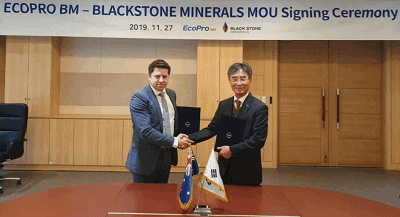
Blackstone Minerals signs MoU with Korea’s Largest EV Battery Cathode Producer

THE BOURSE WHISPERER: Blackstone Minerals (ASX: BSX) has entered a memorandum of understanding (MoU) with Korea’s largest electric vehicle (EV) battery cathode manufacturer.

NTM Gold Hits High-Grade Gold at Hub Prospect

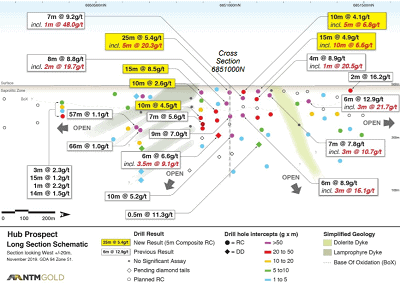
THE DRILL SERGEANT: NTM Gold (ASX: NTM) has recently completed a round of RC drilling at the Hub prospect at the company’s 100 per cent-owned Redcliffe gold project located near Leonora in Western Australia.

Trigg Mining Doubles Lake Throssell Project

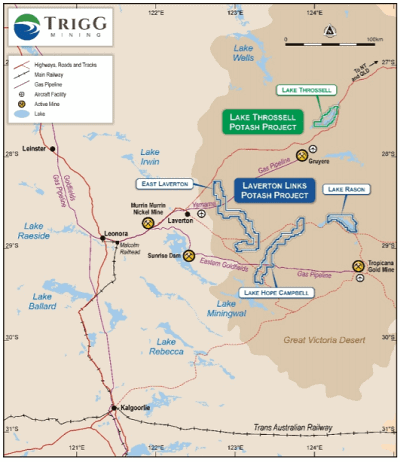
THE DRILL SERGEANT: Trigg Mining (ASX: TMG) has wasted little time since listing to complete three in-field exploration milestones at the company’s two Sulphate of Potash (SOP) projects near Laverton in Western Australia.

Red 5 Signs Option Agreement to Purchase Cables and Mission Gold Deposits

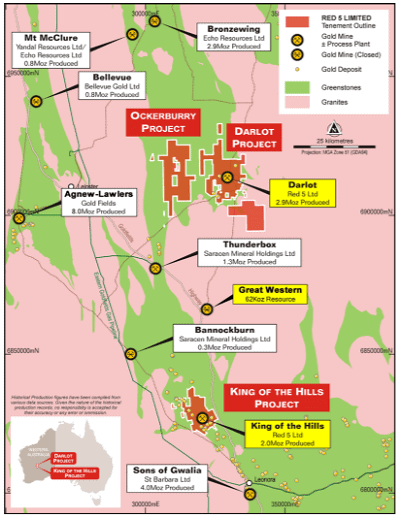
THE BOURSE WHISPERER: Red 5 Limited (ASX: RED), via its wholly-owned subsidiary, Darlot Mining Company (DMC), has entered into an Option and Sub-lease Agreement for the right to acquire a sub-lease over the 13 blocks of Exploration Licence E37/1220 in Western Australia.


Trigg Mining Doubles Lake Throssell Project

THE DRILL SERGEANT: Trigg Mining (ASX: TMG) has wasted little time since listing to complete three in-field exploration milestones at the company’s two Sulphate of Potash (SOP) projects near Laverton in Western Australia.

Trigg Mining completed a heritage survey with the Ngaanyatjarra traditional owners at the Lake Throssell SOP project, which led to the completion of the very first SOP sampling program across Lake Throssell, from which results are expected early in the next quarter.

The company was encouraged enough by the early sampling results produced that it has now applied for two additional tenements to the north and the south of Lake Throssell along the interpreted underlying palaeochannels, securing the palaeo-system and taking the project area to 752 square kilometres.

Elsewhere in the company’s portfolio, the first drilling program at Lake Hope Campbell within Laverton Links has also been completed with 1463metres of air core drilling across 20 holes testing the entire 100 kilometres of the palaeochannel.

Drilling targeted the gravity lows detected by the recently completed ground gravity survey in combination with the existing publicly available aerial electromagnetic (AEM) survey.

Trigg declared the drilling encountered traditional Goldfields style palaeovalley sediments including a lacustrine clay aquitard up to 50m thick and basal sand and gravel aquifer beneath the clay up to 40m thick.

The drill rig has now moved to Lake Rason where 500m of drilling is planned to supplement previous air core drilling results and will allow for an initial Mineral Resource estimate to be calculated.

“In just a few weeks since listing we have completed multiple significant milestones,” Trigg Mining managing director Keren Paterson said in the company’s announcement to the Australian Securities Exchange.

“At Lake Throssell – a heritage survey, reconnaissance sampling and additional tenement applications covering the Lake Throssell system have been completed.

“At Laverton Links we’ve finished the first drilling program at Lake Hope Campbell which encountered multiple intersections of up to 40 metres of basal sands and gravels.

“Assay results for the sampling programs are expected next quarter and initial mineral resource estimates to follow.

“I would like to take this opportunity to extend our gratitude to the of the Ngaanyatjarra, traditional owners of Lake Throssell, for their support in helping us to achieve the heritage clearance and for the cultural exchange we experienced.

“The field program will continue over the next few weeks with further drilling planned at Lake Rason and East Laverton and I look forward to keeping the market up to date on our rapid progress across both Projects with assay results and initial mineral resource estimates due next quarter.”


Email: info@triggmining.com.au


Web: www.triggmining.com.au


Red 5 Signs Option Agreement to Purchase Cables and Mission Gold Deposits

THE BOURSE WHISPERER: Red 5 Limited (ASX: RED), via its wholly-owned subsidiary, Darlot Mining Company (DMC), has entered into an Option and Sub-lease Agreement for the right to acquire a sub-lease over the 13 blocks of Exploration Licence E37/1220 in Western Australia.

The acquisition area totals 38.7 square kilometres and includes the Cables and Mission gold deposits, which were last reported by Leopard Resources on 5 February 2014 to contain total combined JORC 2004 Inferred Resources of 185,000 ounces.

Red 5 will pay a total acquisition cost of $2 million, with a further $500,000 payable on delineation and reporting of a 500,000 ounce JORC 2012 Resource.

The deposits are located 10 kilometres from Red 5’s Darlot gold mining and processing operations.

According to Red 5 managing director Mark Williams the proposed acquisition represents another strategic low-risk opportunity to grow the company’s Resource base in the area surrounding the Darlot gold processing plant.

“We are delighted to have the option to acquire the southern portion of E37/1220,” Williams said in the company’s announcement to the Australian Securities Exchange.

“It is last reported to contain JORC 2004 Inferred Resources totalling 185,000 ounces and is located adjacent to our existing Darlot operations.

“Significantly, the rock units hosting the Cables and Mission deposits are similar to those that host the Centenary orebody, which is currently being mined from underground at Darlot.

“This agreement over the Cables and Missions deposits follows the option agreement we recently secured over the Great Western deposit, with these proposed acquisitions having the potential to provide additional sources of ore feed for the Darlot processing plant.”

The agreement entitles Red 5 to conduct due diligence and drilling activities within the Sub-lease Area to determine the potential of the Cables and Mission deposits to be upgraded to Indicated ± Measured Resource status, and to be mined and trucked to the company’s Darlot processing plant.

The company indicated that should the due diligence be completed to its satisfaction and the option exercised, Red 5 intends to conduct drilling programs and other activities to produce a JORC 2012 compliant Resource as quickly as possible.


Email: info@red5limited.com


Web: www.red5limited.com


NTM Gold Hits High-Grade Gold at Hub Prospect

THE DRILL SERGEANT: NTM Gold (ASX: NTM) has recently completed a round of RC drilling at the Hub prospect at the company’s 100 per cent-owned Redcliffe gold project located near Leonora in Western Australia.

NTM Gold is carrying out the drilling to test northern and southern extensions as well as shallow grade continuity.

The first holes of the program tested shallow mineralisation and returned excellent grades close to surface.

These holes also targeted the up-dip mineralisation to test the grade continuity close to surface.

Better results from the initial five-metre composite samples include:

15 metres at 8.5 grams per tonne gold from 25m;
25m at 5.4g/t gold from 20m, including 5m at 20.3g/t gold;
15m at 4.9g/t gold from 20m, including 10m at 6.6g/t gold; and
10m at 4.1g/t gold from 25m, including 5m at 6.8g/t gold.

Two holes testing deeper grade continuity returned positive results from initial five-metre composites, including:

10m at 4.5g/t gold from 135m; and
10m at 2.6g/t gold from 105m.

The results are from the first eight of a planned 37 RC hole program the company expects to continue until Christmas.

NYM indicated that on completion of the shallower holes, RC drilling will next focus on a number of diamond pre-collars, before moving to extensional drilling along strike.

Diamond drilling has also commenced and is testing for deeper extensions to the gold mineralisation and will also provide valuable geological information.

“These shallow RC results highlight the substantial value of Hub with exceptional grades close to surface,” NTM Gold managing director Andrew Muir said in the company’s announcement to the Australian Securities Exchange.

“Hub has continued to grow with each program and we are optimistic this continues with the current program.

“RC and diamond drilling remains ongoing with more results due in the following weeks after completion of the pre-collars.”


Web: www.ntmgold.com.au


Blackstone Minerals signs MoU with Korea’s Largest EV Battery Cathode Producer

THE BOURSE WHISPERER: Blackstone Minerals (ASX: BSX) has entered a memorandum of understanding (MoU) with Korea’s largest electric vehicle (EV) battery cathode manufacturer.

Blackstone has inked a non-binding MoU with Ecopro BM Co Limited that outlines an alliance structure whereby Ecopro BM and Blackstone will work in partnership to develop a downstream processing facility in association with the company’s Ta Khoa nickel project in northern Vietnam.

The MoU is a boon for both entities in that Blackstone wishes to engage a development partner to provide funding to commercialise the Ta Khoa nickel project, while Ecopro BM has indicated its willingness to enter into an alliance with Blackstone with a view to formalising a Joint Venture on the downstream processing infrastructure project in association with the project.

The intention of the MOU is for the parties to enter into an alliance to form a Joint Venture with the intention to develop a suitable nickel, cobalt or other battery mineral product for lithium-ion battery manufacturing.

“We are pleased to announce an MoU with Korea’s largest cathode manufacturer,” Blackstone Minerals managing director Scott Williamson saidn in the company’s announcement to the Australian Securities Exchange.

“Our Ta Khoa nickel project has significant potential to deliver the critical raw materials required for Ecopro’s cathode manufacturing process and meet the ever-increasing demand for high-nickel content cathodes driven by the imminent electric vehicle (EV) revolution.

“We look forward to finalising a formal agreement with Ecopro over the coming months.

“In the meantime, we continue the exploration and development of our flagship Ta Khoa nickel project in northern Vietnam.”

Blackstone is keen to deliver a maiden resource on the disseminated sulphide (DSS) at Ban Phuc over the coming months as it investigates the potential to restart the existing Ban Phuc concentrator through focused exploration on both massive sulphide veins (MSV) and DSS deposits.

The company has commenced a scoping study on the downstream processing facility at Ta Khoa, the purpose of which is to provide detail for potential JV partners to formalise a binding agreement.

Blackstone has commenced metallurgical testing on the Ban Phuc DSS orebody with an aim to develop a flow sheet for a product suitable for the lithium ion battery industry.

In addition, Blackstone intends to investigate the potential to develop downstream processing infrastructure in Vietnam to produce a downstream nickel and cobalt product to supply Asia’s growing lithium ion battery industry.

The Ta Khoa nickel project in Vietnam includes an existing modern nickel mine which has been under care and maintenance since 2016 due to falling nickel prices.

Existing infrastructure includes an internationally designed 450,000 tonnes per annum processing plant.


Email: admin@blackstoneminerals.com.au


Web: www.blackstoneminerals.com.au


Matsa Resources Records Multiple Gold Hits at Red October

THE DRILL SERGEANT: Matsa Resources (ASX: MAT) declared multiple intersections of very high-grade gold from recent drilling undertaken at the company’s Red October gold project in the Eastern Goldfields of Western Australia.

Matsa Resources completed 11 underground diamond drill holes, for a total of 1,451 metres focussing on extensions in the main mining area (ROSZ North).

The company said the gold assays produced confirm the high-grade potential of the Red October gold mine.

Gold intercepts for new zones include:

2.5 metres at 48.7 grams per tonne gold; and
2.55m at 4.89g/t gold.

Additional Red October Shear Zone (ROSZ) intercepts include:

6m at 2.21g/t gold; and
4.4m at 3.3g/t gold.

“We can again prove that substantial new mining opportunities remain at the Red October gold project,”

“The results achieved by this drilling program are extremely exciting for the company.

“Our belief continues to be, that substantial gold zones remain undiscovered and abundant opportunities exist to develop a long term, highly rewarding, underground gold mining operation at Red October.

“This belief was the core reason we acquired Red October.

“We will enthusiastically continue to grow and develop Red October and we expect many more exciting results.”


Email: reception@matsa.com.au

Web: www.matsa.com.au


Lithium Australia and Neometals Leading the Australian LIB Recycling Pack

THE BOURSE WHISPERER: There is little doubt that the world is currently in the thrall of the lithium-ion battery (LIB).

They help us survive the modern struggles that we encounter on a daily basis, such as maintaining a charge on our mobile phones or computer-related devices, thus keeping us contacted with the rest of the world and our family members in the next room.

They are, presently, our greatest source of portable power.

They are also, ironically, creating an environmental nightmare.

Analysts who like to make themselves important have made some big predictions in recent years, especially in regard to the market penetration of LIBs, particularly in the electric vehicle (EV) sector.

Through all the noise in this space, it has generally filtered through that it is likely that the availability of spent batteries will rise to more than seven million tonnes annually over the next 20 years.

Diligently, we sort our household rubbish each week, or fortnight, depending on the generosity of your local council, into different levels of importance, filling any number of bins to assuage our collective waste related guilt.

On a global basis, however, only around nine per cent of spent LIBs are recycled to keep them out of landfill and recover valuable metals.

In Australia, which is supposedly one of the recycling powerhouses, the recycling rate is embarrassing, some would say woeful, coming in at less than three per cent.

What this all means is that the world is missing out on a great opportunity – that being the large quantity of batteries discarded globally actually represents a potentially significant resource.

Australia is a long way behind the countries that are presently leading the battery recycling wars.

Belgium, South Korea, China and Canada recycle the most batteries, with the metals they contain generally recovered by smelting – or as it is referred to by those in the know – pyrometallurgical processing.

Pyrometallurgical processing of spent LIBs can efficiently recover nickel, copper, cobalt and manganese from LIBs, but not the lithium or graphite.

Research and development into the science by Western Australia-based battery recycling company, Lithium Australia (ASX: LIT) realised that a potential alternative to the downsides associated with pyrometallurgical processing is to take a hydrometallurgical approach.

Lithium Australia is developing a hydrometallurgical technique that recovers all metals, including lithium, from spent LIBs.

Lithium Australia has openly declared that its corporate intentions include shoring up an ethical and sustainable supply of energy metals to the battery industry, thus enhancing energy security in the process.

The company is eager to create a circular battery economy and has highlighted the recycling of old lithium-ion batteries to new is intrinsic to this plan.

In October 2019, Lithium Australia announced it had increased its equity in Envirostream Australia Pty Ltd (EA) to 23.9 per cent.

Envirostream is the only company in Australia with the integrated capacity to collect, sort, shred and separate all the components of spent LIBs.

Another string to Lithium Australia’s LIB bow is it 100 per cent-owned subsidiary company, VSPC Ltd that has developed advanced processes for manufacturing lithium-ferro-phosphate (LFP) cathode powders at its R&D and pilot plant facility in Brisbane, Queensland.

The cathode powders produced by VSPC possess simple nanotechnology that produces superior battery cathodes, provides control of composition and particle size in a precise manner and highly reliable quality control with low production costs.

Recent evaluation of VSPC’s Gen 4 LFP cathode material was undertaken at Chinese battery producer DLG Battery Co., Ltd. That saw the materials assessed in a commercial 18650 battery-cell format under a range of electrochemical and temperature conditions and subjected to long-term cycle testing.

The testing concluded that VSPC’s LFP material met DLG’s stringent specifications for use in LIB cells for both power and energy applications.

VSPC also received positive feedback from Japanese battery-cell producers, which are evaluating its LFP products at laboratory scale with the electrochemical performance of VSPC’s LFP material meeting the rigorous Japanese requirements.

“This year has seen a significant shift in the Chinese battery markets, with greater demand for LFP for use in short-range electric vehicle and energy-storage applications,” Lithium Australia managing director Adrian Griffin said.

“The test results from battery producers in China and Japan show clearly that the performance of VSPC cathode powders is comparable to other materials currently supplied for the production of LFP LIBs.

“We look forward to furthering our partnerships within the battery industry and, ultimately, supplying products that meet not only VSPC’s stringent quality specifications but those of its international customers.”

Lithium Australia anticipates the market for LFP to grow strongly in the next 10 years, due to its particular suitability for energy storage and certain types of transportation, which includes being a replacement for lead-acid batteries in various automotive applications and as back-up for power supplies.

Another Western Australian company that was an early battery recycling proponent is Neometals (ASX: NMT).

Neometals has been also carrying out LIB Pilot test-work, however its focus is the recovery of very high-purity (+99.9%) nickel-sulphate solution from the hydrometallurgical processing stage of its patent pending recycling technology.

The latest tests produced nickel recovery from shredded battery feed into nickel product that exceeded 98 per cent.

The Pilot test-work being is being undertaken on behalf of Neometals by SGS Canada Inc.

The work represents part of the pre-development activities for a proposed commercial LIB recycling venture targeting greater than 90 per cent recovery of LIB materials from electric vehicle and consumer electronics production scrap and end-of-life cells.

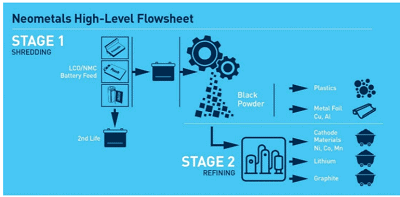
Neometals shredded and processed 2.3 tonnes of spent commercial LIBs during the initial Feed Preparation Stage of the Pilot test-work.

A total of 980 kilograms of mixed cathode and anode materials, known as Black Powder, fed the subsequent hydrometallurgical processing stage, from which chemical products are recovered and refined into high-purity cathode intermediate materials.

The Hydrometallurgical Processing stage leaches the Black Powder and sequentially recovers cathode materials, which are refined to generate high-purity chemical products for potential sale directly into the battery supply chain.

As the Pilot test-work program draws towards completion, it does so having recovered a suite of materials, including copper, manganese, cobalt and nickel-sulphates.

“The Pilot test-work continues to deliver very encouraging results that support the Neometals desire to sell high-purity cathode materials back into the battery supply chain,” Neometals managing director Chris Reed said.

“With provenance, ethical supply and material scarcity concerns, a sustainable, secure supply chain will be key for leaders in energy storage.

“Eco-friendly recycling will play that vital role and our development timing aligns well with global forecast cell capacity against the projected supply deficit in traditional mine-sourced battery minerals.”

Neometals said the purity and the recovery rates of the nickel product materially had exceeded its expectations, enabling it to tick off another milestone in the confirmation of the technical feasibility of the company’s proprietary process.
The company explained that the recovery of cobalt and nickel are key drivers of the project economics adding that the Pilot purity/recovery data strongly supports the validity of previous economic evaluations.

Neometals expects to hit its remains on schedule for completing the bulk of the Pilot stage by December 2019.

It is also expected that the recovery of lithium will be due to commence prior to year-end and be concluded in January 2020 along with outcomes from final purification and crystallisation to produce ultra-high purity, cathode materials.

Successful completion of the Pilot and confirmation of the mass-energy balances are the key technical considerations for SMS Group’s due diligence for a 50:50 joint venture decision.


Email: info@lithium-au.com
info@neometals.com.au


Web: www.lithium-au.com
www.neometals.com.au


Encounter Resources Generates New Paterson Province Copper Targets

THE DRILL SERGEANT: Encounter Resources (ASX ENR) has recently completed the application of advanced exploration technologies at the company’s Yeneena copper-cobalt project in the Paterson Province of Western Australia.

Encounter Resources, in collaboration with Independence Group (ASX: IGO) conducted a large scale (approx. 100-line km) magnetotelluric (MT) survey at the Yeneena project.

The MT survey was part of the company’s 2019 program that was designed to define the 3D geology and identify large scale copper targets by applying several advanced exploration technologies for the first time at the Yeneena project including:

The large-scale (MT) survey to better define the Yeneena basin architecture and further advance 3D target definition;

Detailed 3D audio-magnetotelluric (AMT) inversion modelling over the Aria iron oxide copper-gold prospect in order to better define possible conductive zones associated with significant Cu sulphide mineralisation;

End-of-hole trace multi-element geochemistry of historical AC drilling to define alteration footprints of copper deposits and the host rocks, which remains in progress; and

Application of new surface geochemistry techniques to detect base metal anomalies through shallow sand cover, the trial phase of which is complete with follow up sampling programs in progress.

The work completed to date has generated a suite of new copper targets at Yeneena.

“The Paterson Province is a highly fertile district with enormous potential for new copper discoveries under thin sand cover,” Encounter Resources managing director Will Robinson said in the company’s announcement to the Australian Securities Exchange.

“Applying new technologies is providing us with an improved understanding of the geological framework in areas where we have already drilled high grade copper mineralisation.

“These new targets generated are now being integrated and refined to be ready for drilling in the 2020 field season.”

The Yeneena project is an alliance between Independence Group and Encounter, under which IGO may, at any time before 1 March 2020, elect to enter an earn-in agreement to spend up to $15 million to earn a 70 per cent interest in the project.

The Yeneena project was recently expanded by 20 per cent through an option agreement completed covering 235 square kilometres of ground adjacent to Yeneena.


Email: contact@enrl.com.au

Web: www.enrl.com.au


Peel Mining Identifies New Southern Nights Mineralised Zone

THE DRILL SERGEANT: Peel Mining (ASX: PEX) claimed discovery of a new high-grade zone to the south of the Southern Nights deposit at the company’s 100 per cent-owned Wagga Tank-Southern Nights project, located south of Cobar in western New South Wales.

Peel Mining reported the discovery was made during an ongoing resource upgrade drilling program underway at Wagga Tank-Southern that had been primarily designed to develop higher confidence resources and to progress the project towards development.

The company said the new high-grade zone was encountered around 500 metres south of the high-grade Southern Nights Central Zone in an area that has been subjected to limited drilling, near the boundary of the existing resource model.

Drillholes WTRCDD229 and WTRCDDD238 intercepted healthy zones of very high-grade zinc and lead mineralisation, which the company said were similar to the intercepts returned from the Southern Nights Central Zone.

“The new high-grade intercepts at the southern edge of Southern Nights continue to underline the incredible quality and scale of these mineral systems,” Peel Mining managing director Rob Tyson said in the company’s announcement to the Australian Securities Exchange.

“The latest intercepts are on the edge of the current resource model offering excellent exploration upside.

“Most importantly, this mineralisation adds further weight to the future development prospects of the project, highlighting the opportunity to increase the grade and tonnage profile of the deposit.”

Elsewhere at Southern Nights, Peel received results from several drillholes targeting infill and extensions at the northern end of the Southern Nights Central Zone.

WTRCDD186 returned several zones of mineralisation including:

10.66 metres at 4.27 per cent zinc, 1.32 per cent lead, 242 grams per tonne silver, 0.24g/t gold from 390.11m, including 5.22m at 7.39 per cent zinc, 2.25 per cent lead, 454g/t silver, 0.44g/t gold from 390.11m.

WTRCDD221 also returned several zones of mineralisation including:

6.6m at 4.37 per cent zinc, 2.02 per cent lead, 26g/t silver and 0.13g/t gold from 367.9m; and
6.04m at 3.89 per cent zinc, 0.23 per cent lead, 0.21 per cent copper, 10g/t silver and 0.46g/t gold from 381.46m.

Drilling at Wagga Tank was carried out to test for north-south extensions to the existing resource, shallower up-dip extensions to the resource, and also to provide infill drilling to improve the confidence of the resource.

The company said results it has received to date generally confirm the grade and continuity of mineralisation, and the modelled geometry of the deposit.

WTRCDD214 returned several zones of mineralisation including:

18.6m at 1.1 per cent copper, 0.32g/t gold from 124.4m, including 9m at 1.7 per cent copper, 0.39g/t gold from 134m; and
2m at 4.44g/t gold, 0.85 per cent copper, 20g/t silver from 275m.


Email: info@peelmining.com.au

Web: www.peelmining.com.au


THE DAILY ROADHOUSE


Stavely Minerals Expands Thursday’s Gossan Mineralisation

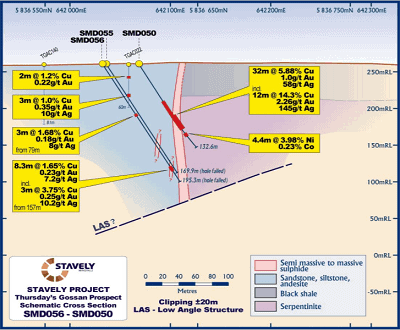
THE DRILL SERGEANT: Stavely Minerals (ASX: SVY) received assay results for further diamond drill holes undertaken at the Thursday’s Gossan prospect, part of the company’s 100 per cent-owned Stavely copper-gold project in Victoria.

Musgrave Minerals Intersects High-Grades at Mainland

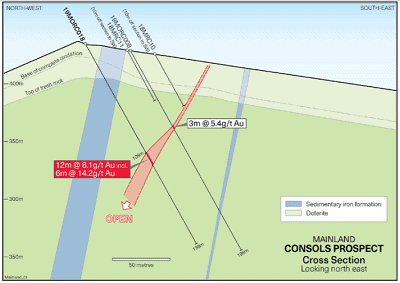
THE DRILL SERGEANT: Musgrave Minerals (ASX: MGV) reported high-grade gold results from reverse circulation (RC) drilling at Mainland on the company’s Cue gold project in Western Australia, where it has an option agreement to acquire 100 per cent of the basement gold rights.

Corazon Mining Adds Further Nickel to Lynn Lake Resource

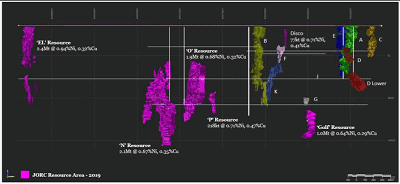
THE DRILL SERGEANT: Corazon Mining (ASX: CZN) announced an upgraded Mineral Resource Estimate for the comapy’s Lynn Lake nickel-copper-cobalt sulphide project in Canada.

Matador Mining Progresses Cape Ray Environmental Assessment

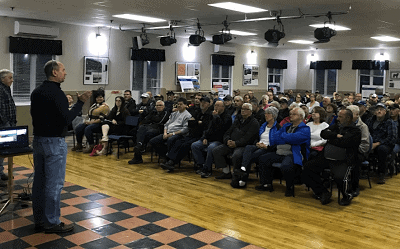
THE BOURSE WHISPERER: Matador Mining (ASX: MZZ) updated the market on progress of the Environmental Assessment (EA) process for the company’s Cape Ray gold project in Newfoundland, Canada.