


And the winners are…
The Western Australian State Government has drawn the names out of the Co-funded Exploration Drilling Program hat.
A total of 42 companies and individuals applied for help with drilling 53 different exploration plays up and down the state.
The list includes company names such as Hancock Prospecting and Fortescue Metals Group demonstrating how much easier it must be to accept money from government coffers than it is to stoke them up.
Gold stood out as the commodity of choice for exploration plays by featuring in 49 per cent of applications.
There were 26 projects listing it as the main target, or as one of the, cl9osely followed by copper in 17 projects, nickel in 10 and iron for nine projects.
Other commodities being explored include platinum group elements, zinc, lead, uranium and manganese.
The list also included one geothermal project and an oil and gas project among the successful applications.
WA Mines and Petroleum Minister Norman Moore said the program provided companies an extra incentive to drill in underexplored areas, which was the key to the continuity of the WA mining industry.
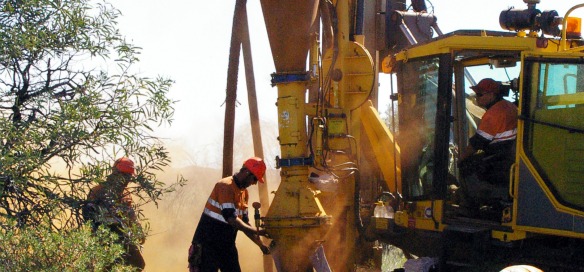
Successful companies included Chrysalis Resources, which scored twice for its Doolgunna West and Pioneer projects.
Chrysalis was awarded $155,000 for a deep diamond hole (500 metres) to be drilled at its Doolgunna West project in the Narracoota Volcanics in the Bryah Basin and a further $28,000 for a RC drill programme at our Pioneer project in Norseman.
Beadell Resources also hit the jackpot twice with funding headed its way for drilling of it Hercules and Pleiades prospects.
Beadell has previously identified a new anomalous gold trend at Hurcules during wide spaced targeted reconnaissance aircore drilling.
This drilling recorded results including 1m at 0.7 grams per tonne gold from 55m, 1m at 0.2 g/t gold from 41m and 3m at 0.1 g/t gold from 42m.
Holes were drilled on three consecutive wide-spaced drill traverses defining a strike length of at least one kilometre.
Wide spaced aircore drilling on approximately one kilometre by 250m hole spacing at Pleiades Lakes has intersected a large low tenor gold anomaly 20km east of the Tropicana deposit.
Laconia Resources put its hand up and received funding to continue drilling on its 100% owned Barramine gold and base metals project.
Geophysical data and interpretation from Barramine has indicated a number of electromagnetic (EM) anomalies.
Laconia has carried out further evaluation of these geophysical anomalies via a preliminary geochemical orientation survey with the preliminary data.
Sampling focused over EM anomalies provided strong encouragement for base metal mineralisation in this area.
“We have had some really good exploration success at Barramine over the past twelve months,” Laconia Resources managing director Ian Stuart recently told The Roadhouse.
“We have been able to successfully move Barramine from being something with very little work having been conducted over it, to an exploration project that has undergone an EM survey, good geological mapping and geochemical sampling.
“As a result we now have a number of drill targets identified there.”
Gold Road Resources had its ticket drawn to enable it to drill at its 100%-owned Golden Sands project is located about 25km north of AngloGold-Ashanti / Independence’s Tropicana deposit and covers approximately 1,500 square kilometres with a strike length of about 65kms.
The Golden Sands project is considered highly prospective for gold and uranium mineralisation.
Gold Road also scored funding to drill at its Dorothy Hills prospect.
The most recent application round closed on March 25 and resulted in 53 successful applications.
Applications included nine from prospectors for drilling programs which will be carried out between July 2011 and the end of June 2012.
General applicants will share in $4.5million while prospectors are being offered $196,000.
The Co-funded Industry Drilling Program provides co-funding of up to 50 per cent of direct drilling costs with caps of $150,000 for a multi-hole project, $200,000 for a single deep hole and $30,000 for a prospector’s project.
Payment is made to successful applicants after the completion of their drilling programs.
Information acquired by the companies through the drilling programs is publicly released on the Department for Mines and Petroleum’s website after a short confidentiality period.
The information adds to the geological knowledge of the State and helps reduce risks for subsequent explorers.
Another round of co-funded drilling will be advertised from August 2011 – calling for applications in September-October 2011 for projects to be undertaken between January 2012 and the end of December 2012.