


White Rock Minerals Chasing Global Commodities
COMMODITY CAPERS: White Rock Minerals (ASX: WRM) describes itself as being a near-stage gold producer and poly-metallic and precious metals explorer.
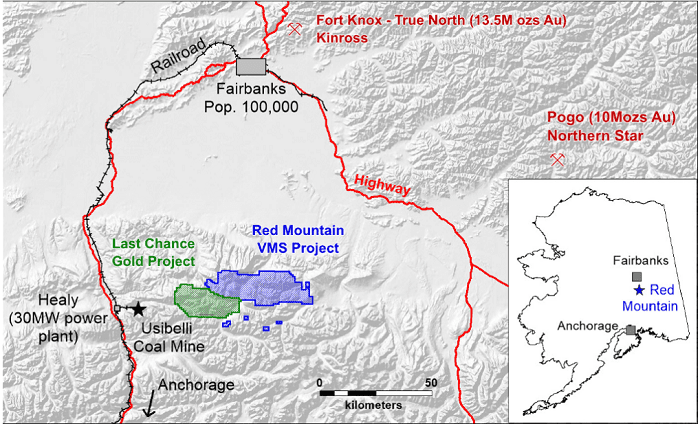
The company’s aspirations are spread across a portfolio of three projects: the Woods Point gold project in Victoria, the Red Mountain silver-zinc VMS and Last Chance IRGS gold projects in Alaska USA, and the advanced gold and silver Mt Carrington project in News South Wales.
White Rock believes its portfolio provides investors with diversification through high-quality projects at differing developmental stages, exposed to different commodities, in two first world jurisdictions.
White Rock recently updated the Inferred Mineral Resource estimate for the Red Mountain project thanks to a doubling of the Dry Creek deposit high-grade Inferred Mineral Resource to 4.9 million tonnes at 8.4 per cent zinc equivalent or 393 grams per tonne silver equivalent (at a 3% Zn cut-off).
Dry Creek joins the West Tundra Flats as the most significant deposits within the Red Mountain project combining for a high-grade Inferred Resource of 11.6 million tonnes at 12 per cent zinc equivalent or 555g/t silver equivalent (at a 3% Zn cut-off).
The global Inferred Mineral Resource for Red Mountain now stands at 21.3 million tonnes at 8.5 per cent zinc equivalent for 1.8 million tonnes of contained zinc equivalent or 393g/t silver equivalent for 207 million ounces of contained silver equivalent.
Much of White Rock’s attention of late, however, has been focused on advancing its Woods Point gold project north-east of Melbourne in Victoria, which the company acquired in 2021.
Woods Point contains 660 square kilometres of highly prospective exploration ground that has seen historical production of more than 1,600,000 ounces of gold.
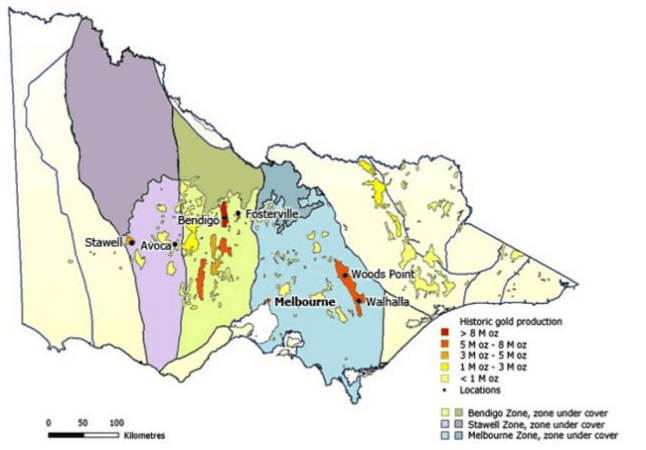
Along with the land holding, Woods Point also contains the Morning Star gold mine, which came complete with mining licenses, operational shaft and winder, underground workings, and a gold processing plant.
Over its lifetime, the Morning Star mine produced over 883,000 ounces of gold at an average grade of 26.5g/t.

With production now halted, White Rock has taken on the project with its focus on in-mine exploration, with the goal of following up high-grade gold potential in specific zones of the mine to define a long-term resource and mine plan, before considering a restart of production.
The most recent news from Morning Star came from an underground drilling foray that produced further assay results from the Kenny’s target area.
The Kenny’s target area includes multiple high-grade gold structures including the Whitelaw Reef, the Upper and Lower Burns Reefs, and the Upper and Lower Campbell Reefs.
This target area is located between 6 Level and 9 Level, where existing development provides access to the Whitelaw Reef and the immediate high-grade target area that White Rock is currently assessing for its future mining potential.
Recent drill intersection assay results from the Whitelaw Reef, include:
22KPL9002
4.3 metres at 9.3 grams per tonne gold, including 0.3m at 68.3g/t gold (true width); and
22KPL9004
0.2m at 56.6g/t gold (true width).
These results followed previous drilling results from the Whitelaw Reef, which included:
21L7006
0.8m at 34.1g/t gold, including 0.3m at 107g/t gold (true width); and
MS402
0.6m at 74.8g/t gold (true width).

White Rock has since moved the underground drill rig to the southern end of the mine, still on 9 Level, where it is completing definition drilling on extensions to the recently mined McNally Reef with a view to re-commencing mining in the near term.
The underground drill rig will then resume drill testing the prospective Gap Zone between 10 Level and 14 Level in conjunction with continuing to drill nearer-term production targets above 9 Level as it progresses through different drill sites along 9 Level.
While the McNally Reef is being drilled, White Rock will undertake a mining assessment of the Whitelaw Reef to determine whether it can be included in future development and production plans or requires additional drilling to reach a decision point.
The company believes these current drill programs potentially deliver four working areas for future mining, dependent on the outcome of an assessment of drilling results for each, providing a pathway to recommence mining at:
1. McNally Reef extensions where development is in place to commence mining immediately;
2. Dickenson Reef where sufficient development is in place to commence mining in the short term;
3. Stacpoole / Age of Progress Reefs where development is in place and minor infrastructure requirements will allow mining to commence in the short term; and
4. Whitelaw Reef where minor development is required, and more substantial infrastructure is needed to enable mining to commence in the mid-term.
Email: info@whiterockminerals.com.au
Web: www.whiterockminerals.com.au
Directors: Peter Lester, Matt Gill, Jeremy Gray, Lord Christopher Wellesley, Paul McNally