Mining Group confirms high-grade copper at El Roble

THE DRILL SERGEANT: Mining Group Limited (ASX: MNE) has received results from follow-up due diligence channel sampling conducted at the Paraguay underground mine at the company’s El Roble copper project in Chile.

Mining Group claims the close-spaced channel sampling results confirm grade continuity at Paraguay over 30m along strike and delineation of a high-grade copper zone.


Plan view of the Paraguay mine showing recent high-grade results
in red. Results in blue announced to ASX on 18 February 2014. Source:
Company announcement


Results include:

2.1 metres at 6.89 per cent copper, 0.57 grams per tonne gold, 2815ppm cobalt and 16.36 per cent iron, including 1.5m at 8.59 per cent copper, 0.69g/t gold, 3657ppm cobalt and 13.3 per cent iron and 0.5m at 17.2 per cent copper, 0.88g/t gold, 3230ppm cobalt and 13.7 per cent iron;

1.5m at 6.92 per cent copper, 0.4g/t gold, 4103ppm cobalt and 14.93 per cent iron including 1m at 9.74 per cent copper, 0.39g/t gold, 3120ppm cobalt and 12.9 per cent iron.

Mining Group has an exclusive option to acquire up to 90% of the El Roble Copper project, which is located in the iron oxide copper gold (IOCG) Coastal Cordillera Belt of Chile.

The project covers approximately 6,000 hectares and is currently being actively mined on a small scale by the owner.

The company has assessed the Paraguay underground mine to be a high-priority area following initial high-grade copper samples were announced earlier this year.

The mine is located approximately one kilometre south west of the Panga mine, for which Mining Group has signed a production agreement and is currently assessing the viability of commencing mining for copper.

“This close-spaced sampling has been very effective in delineating a strike-continuous, high-grade zone of copper mineralisation at Paraguay, displaying grades and widths well in line with what we can potentially mine at El Roble,” , Mining Group managing director Zeff Reeves said in the company’s announcement to the Australian Securities Exchange.

“The Paraguay vein has been exploited by the owner of the concession on a very small scale, on a single level.

“There appears to be significant potential to expand this underground area both along strike and deeper to expose more high-grade copper zones, especially considering current underground workings at Paraguay extend only eighty metres along the thirty kilometres of prospective veins already mapped.

“This sampling provides us with further confidence that the veins do thicken, in conjunction with some very healthy copper grades, which justifies our strategy of beginning mining at the project on a small scale in the very near future.”

Mining Group indicated it is negotiating access to mine at Paraguay with the current owner, who also owns the Panga concession.

The company explained it intends on signing a production agreement, following which it will submit the appropriate applications to gain an operating licence permitting it to extract up to 5,000 tonnes of copper-bearing rock per month and commence further underground assessment work.

Email: admin@mininggroup.net.au

Website: www.mininggroup.net.au

Hi Ho, Hi Ho, it’s off to work we go

THE DRILL SERGEANT: Each week any number of junior exploration plays set out to drill their ground. Here’s a small selection of what’s been happening this week.

West Melton copper-gold project

Marmota Energy (ASX: MEU) has commenced drilling on the company’s
West Melton copper-gold project on the Yorke Peninsula in South Australia.

The program is designed to test for the source of a copper and gold geochemical anomaly Marmota defined on the project earlier this year.

The target is also strongly coincident with shallow modelled geophysical anomalies.
 
A 2000 metre maiden drilling program is underway, which is expected to take three weeks to complete.

The drilling will focus on key target areas within a 1.2 kilometre long coincident gold and copper-in-calcrete zone where individual sample assays ranging up to 197ppm copper were returned.

Rubianna kicks of drilling at Ruby Well

Rubianna Resources (ASX: RRE) has commenced an Reverse Circulation (RC) drill program at the Ruby Well project, within its Murchison tenements northeast of Meekatharra, Western Australia.

The drill program, which comprises approximately 56 RC drill holes for 5,000metres, has been designed to test multiple targets along known gold mineralised quartz vein horizons, in several areas, across the Ruby Well tenement.

“We are excited to be further testing the mineralised gold system at Ruby Well,” Rubianna Resources managing director Dr Steve Batty said.

“It will be interesting to see whether we can emulate the success of Doray Minerals who have a similar, high-grade quartz vein hosted gold system at their Andy Well deposit, located approximately 25 kilometres to the south of Ruby Well.”

Results are expected within three to four weeks from completion of drilling.

Resource upgrade drilling commences at Epanko deposit

Kibaran Resources (ASX: KNL) has commenced a resource upgrade drilling program at its Epanko deposit in the Mahenge graphite project in Tanzania.

The aim of the drilling program is to upgrade a portion of the existing JORC Inferred Mineral Resource of 14.9 million tonnes at 10.5 per cent TGC (total graphitic carbon) for 1.56 million tonnes of contained graphite to a JORC
Indicated/Measured Resource category.

Drilling will focus on two areas: along strike of the eastern zone drill holes – where shallow, thick, robust zones of high graphite mineralisation have previously been identified – and within the western zone between existing drilling and where the company reported its best trench result measuring 117 metres at 10 per cent TGC.
 
Planned drilling will focus on the shallow oxidised material to a depth of between 50 and 100 metres.

Successfully upgrading the Inferred Resource to an Indicated/Measured classification will allow the company to report its 2013 Scoping Study findings and commence work on a feasibility study which will progress the project to a development decision.

Drilling commences at Blair North northern zone

Northern Mining (ASX: NMI) has commenced a single reverse circulation (RC) drillhole BNRC095 with planned depth of approximately of 200 metres at the Blair North Northern Zone prospect (BNNZ), located at the East Kalgoorlie project.

The drillhole is targeting the northward extension of previous encouraging intersections.

The geology and existing drillholes support the hypothesis that the mineralisation continues to the north of drillholes BNRC066 and BNRC085 and intersections of gold mineralisation may improve the continuity of mineralisation and could also increase the potential for the establishment of a mineral resource at the prospect.

Thin intersections of high-grade gold were previously encountered in BNRC066 at 235.43m for 0.47m at 30.98g/t gold and in BNRC066 at 253.67m for 0.21m at 67.97g/t gold within a halo of lower to moderate grade halo of mineralisation in drillholes BNRC066 and BNRC085, visible gold was noted during core logging.

Should the planned drillhole BNRC095 finishes in mineralisation, it may be extended at a later date by diamond drilling if warranted.

Classic Minerals doubles Mammoth ‘hot zone’

THE DRILL SERGEANT: Classic Minerals (ASX: CLZ) is currently reviewing geophysical data including historic geochemistry to the south of its Mammoth discovery within the company’s Fraser range project in Western Australia.

The company said the review has now has highlighted a three kilometre extension to the conductive target zone extending the conductive target ‘hot zone’ around Mammoth to over six kilometres in length.


VTEM image showing growing hot zone for exploration through northern end of Fraser Range tenement. Source: Company announcement


The company indicated it will commence a new geochemistry program by the end of the month and fly new aeromagnetic survey during April to continue to refine its exploration targeting.

“It’s very clear that what we have seen close to surface at Mammoth is only the very tip of a larger system at work through our Fraser Range tenement,” Classic Minerals managing director Justin Doutch said in the company’s announcement to the Australian Securities Exchange.

“Our latest geophysics interpretation at the northern end has highlighted multiple high priority targets, including EM conductors and aeromagnetic anomalies, through what is now a six kilometre long conductive target zone.”

Classic explained the latest series of drilling at Mammoth, proving up depth and strike extensions to the North East, were part of the approved 100 holes for the area.

The company has applied to drill additional holes along strike to the south west where it has five priority, untested targets.

“Off the back of further analysis of historic geochemistry that has discovered nickel, copper and zinc calcrete anomalies at the southern end of the six kilometre hot zone, we will also introduce aircore drilling in the coming weeks to undertake further geochemistry at bedrock,” Doutch said.

“This activity, in combination with our plan to fly a far more detailed aeromagnetic program over the whole of the tenement in April will provide a more detailed structural interpretation to help us direct future ground EM surveys which are in planning to look 300 to 400 metres below surface to get a far stronger understanding of what is lighting up this area.”

The six holes completed so far at Mammoth, to test along strike and at depth, have demonstrated continuity of mineralisation well below 140m which had been the previous depth extent of drilling undertaken.

Samples have been submitted for analysis and results are awaited.

The sulphide mineralisation at the Mammoth nickel-copper deposit now extends 240m along strike.

Email: admin@classicminerals.com.au

Website: www.classicminerals.com.au

Inca Minerals hits multiple copper intersections at Chanape

THE DRILL SERGEANT: Inca Minerals (ASX: ICG) has received assay results for the third deep hole to be drilled at the company’s Chanape project in Peru.

The drilling has encountered four broad zones of mineralisation, averaging between 0.58 per cent copper equivalent (CuEq) and 0.43 per cent CuEq, forming a contiguous down-hole section of 177 metres from 770 metres.

Inca clarified this composite section includes down-hole intersections greater than one per cent CuEq over 62m between 770m and 1,047m.

These zones of mineralisation are contained within a broader zone of mineralisation with a down-hole intersection of 283m at 0.32 per cent copper, 6.73 grams per tonne silver and 83ppm molybdenum [0.41 per cent CuEq] from 764m.

Intersections include:

97m down-hole interval at 0.46 per cent copper, 9.48g/t silver , 106ppm molybdenum [0.58 per cent CuEq], from 770m, including:

11m interval at 1.39 per cent copper, 29.93g/t silver and 263ppm molybdenum [1.76 per cent CuEq] from 770m;

7m interval at 1.17 per cent copper and 24.47/t silver [1.4 per cent CuEq] from 809m; and

8m interval at 0.94 per cent copper, 16.98g/t silver and 286ppm molybdenum [1.19 per cent CuEq] from 837m.

30m down-hole interval at 0.93 per cent copper, 18.72g/t silver, [1.11 per cent CuEq] from 886m;

24m down-hole interval at 0.37 per cent copper, 6.5g/t silver, [0.43 per cent CuEq] from 970m; and

26m down-hole interval at 0.5 per cent copper, 10.88g/t silver, [0.60 per cent CuEq] from 1,021m, including:

6m down-hole interval at 1.18 per cent copper, 25.37g/t silver, [1.42 per cent CuEq] from 1,040m.

Anomalous metre intervals (individual samples) returned:

770m-771m at 2.98 per cent copper;

773m-774m at 1.38 per cent copper, 21.4g/t silver, 450ppm molybdenum [1.73 per cent CuEq];

774m-775m at 1.28 per cent copper, 23.7g/t silver, 464ppm molybdenum [1.65 per cent CuEq];

775m-776m at 1.37 per cent copper, 28g/t silver, 258ppm molybdenum , 0.22g/t gold [1.83 per cent CuEq];

812m-813m at 4.96 per cent copper;

838m-839m at 4.01 per cent copper, 900ppm molybdenum [4.3 per cent CuEq]; and

890m-891m at 2.44 per cent copper.


The favourable topography at Chanape means an open-cut design
that mines the vein style gold-silver-copper-lead and breccia style
gold-silver-copper occurrences before mining the deeper
copper-molybdenum-silver porphyry style mineralisation is possible.
Source: Company announcement


“The results signal that the porphyry system at Chanape contains copper, silver, molybdenum grades of potential economic importance,” Inca Minerals said in its ASX announcement.

“As such, Chanape is confirmed as a genuine copper-silver-molybdenum porphyry discovery of regional significance.”

Inca has paused its drilling at Chanape in order to collate data from recent drilling.

“Using results from detailed logging, alteration, geochemistry and hydro-thermal clay mapping the next phase of drilling will target further extensions of the mineralised porphyry system now building at Chanape,” the company said.

Email: info@incaminerals.com.au

Website: www.incaminerals.com.au

Laconia Resources identifies Favi copper extension

THE DRILL SERGEANT: Laconia Resources (ASX: LCR) has identified additional high-grade copper-gold-silver values at the Favi prospect extending 400 metres north of the Española 1 prospect within the company’s Kimsa Orcco project in Peru.

The Kimsa Orcco project is the combination of the company’s Rasuhuilca and Huaco Cucho projects.


Plan View of the Indigena, Favi and Española 2 prospects extending
to the north from the Española 1 prospect, showing surface channel
sample locations (coloured by copper content). Source: Company
announcement


Laconia explained the Española 1 vein system was originally recognised as a gold and silver prospect, but was increased in priority after its exploration plan established an historic adit channel sampling intersection of:

24.9 metres at 3.88 per cent copper, 2.98 grams per tonne gold and 66.63g/t silver, including 15.5m at 6.54 per cent copper, 4.77g/t gold and 103.86g/t silver.

Further compilation of historic results into modern geological software by Laconia includes mapping and surface channel sampling of a series of copper-gold-silver rich veins and breccias extending 400 metres north.

This extension includes the Indigena vein, the Española 2 vein and the Favi vein.

Surface sample results at Favi include:

1.6m at 8.8 per cent copper, 0.66g/t gold and 95.5 g/t silver;

0.55m at 5.9 per cent copper, 6.07g/t gold, 0.19 per cent lead and 179.3g/t silver;

0.35m at 12.9 per cent copper, 2.27g/t gold, and 273g/t silver;

0.5m at 6.9 per cent copper, 0.89g/t gold, and 146.4g/t silver;

0.55m at 7.5 per cent copper, 11.84g/t gold and 241.94g/t silver;

0.4m at 4.2 per cent copper, 2.52g/t gold and 81.28g/t silver; and

0.4m at 1.9 per cent copper, 1.59g/t gold, 0.48 per cent lead and 96.6g/t silver.

Laconia said a central region at Kimsa Orcco, containing copper-rich mineralisation has now been recognised through the systematic review of data using up-to-date 3D computer software.

This has consolidated Laconia’s understanding of the broad zone of mineralisation and its geological controls.

“The company continues to identify further high-grade copper-gold-silver mineralisation from our Kimsa Orcco project,” Laconia Resources managing director Ian Stuart said in the company’s announcement to the Australian Securities Exchange.

“The project clearly contains a large, highly mineralised system and our understanding and knowledge of the wider system continues to grow through the systematic processing and follow up of the excellent historical data.

“The presence of high-grade copper, in conjunction with the gold and silver epithermal veins already identified, adds significantly to the potential of Laconia’s project interests.”

Email: info@laconia.com.au

Website: www.laconia.com.au

Adelaide Resources identifies second Alford West target

THE DRILL SERGEANT: Adelaide Resources (ASX: ADN) has received initial assay results from a program of aircore program conducted at the Alford West prospect, located in the northern part of the company’s Moonta cooper gold project on the Northern Yorke Peninsula of South Australia.

The results have delivered an early highlight with hole ALWAC171 encountering a high-grade intersection of:

23 metres at 1.47 per cent copper

Adelaide Resources called attention to the location of hole ALWAC171, which is approximately 1000 metres west southwest of the western limit of the area the company tested by drilling in 2013.


Alford West target showing drillhole locations and contoured historic auger copper geochemistry. Source: Company announcement


Adelaide claimed the result represents the discovery of a second high-grade target zone at Alford West, additional to the high-grade zone discovered in the 2013 drill program.

The mineralisation encountered by hole ALWAC171 commences from seven metres downhole, a vertical depth of just six metres below surface.

The intersection includes higher grade sub zones of:

11m at 2.23 per cent copper from 10m downhole; or

5m at 3.36 per cent copper from 10m downhole.

“Further copper mineralisation has been observed in nearby holes, with sampling and laboratory assaying of samples from these holes now underway, while additional drilling is also planned to follow-up this significant exploration result,” Adelaide Resources said in its ASX announcement.

Adelaide Resources said it has completed drilling of the initial traverses at Alford West that comprised the first part of its current drilling program.

The company now plans to assess results from all of these traverses before finalising the design of the second follow-up stage of aircore drilling.

The company indicated it is already clear further drilling in the vicinity of hole ALWAC171 will form part of this second stage.

Drilling of the second stage is scheduled to commence around early April, while receipt of further laboratory assays from the initial drill traverses are anticipated in the coming weeks.

Email: adres@adelaideresources.com.au

Website: www.adelaideresources.com.au

Cobre Montana hits high-grade copper

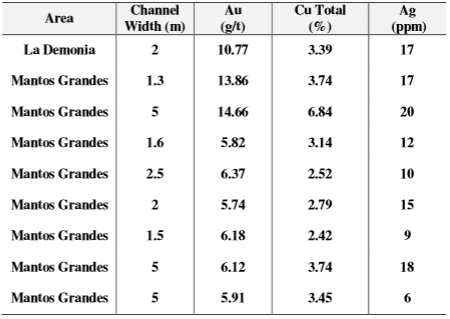
THE DRILL SERGEANT: Cobre Montana (ASX: CXB) has received results from a recently-conducted surface sampling program at the company’s Mantos Grandes project in Chile.

The program has taken a total of forty-three channel samples from the area immediately surrounding the Mantos Grandes mine as well as the La Demonia and Agua del Minero prospects.


Source: Company announcement


Cobre Montana has geological reconnaissance and sampling continuing at other prospective zones within the project area including the El Verde copper porphyry target.

In February Cobre Montana announced it had commenced diamond core drilling at the project, which didn’t take very long to encounter visible intersections of copper mineralisation in the core.

The company said the latest reported sampling program has not only confirmed the tenor of the copper mineralisation but, just as importantly, it also highlights the potential for the occurrence of high-grade gold intersections.

“The surface sampling supports observations from underground exposures and from drill core and provides encouragement that further high-grade mineralisation may be located close to surface,” Cobre Montana managing director Adrian Griffin said in the company’s announcement to the Australian Securities Excghange.

Cobre Montana said the gold tends to be fine grained and generally evident only from assays.

The Agua del Minero deposit is located along a major, sub-vertical east-west fault exposed in newly developed road cuttings and drill platforms.

Cobre Montana explained how carbonate sequences are commonly represented by garnet skarn lithologies.

It went to describe how there appears to be some evidence the late stage Agua del Minero fault has acted as a conduit for mineralising fluids with emplacement of minerals where the structure traverses suitably prepared host lithologies.

At the La Demonia deposit, glacial till and colluvial rubble obscure much of the underlying rocks where mapping and sampling has focused on locating extensions of favourable lithologies.

Tunnels dating back to the 1930s were driven into the steep terrain and exploited a rich chalcocite/gold occurrence hosted by garnet skarn, some of which has been intersected in recent drilling.

Assay results of this drilling are pending.

Email: info@cobremontana.com.au

Website: www.cobremontana.com.au

Argent Minerals confirms third VMS Lens at Kempfield

THE DRILL SERGEANT: Argent Minerals (ASX: ARD) has released assay results for the first phase of a diamond drilling program recently undertaken at the company’s Kempfield polymetallic silver project in New South Wales.

The company declared base metals have been intersected at depth by two holes.

The first – an extension of West McCarron hole AKDD159, which included results of:

18m at 9.8 per cent lead/zinc, 113g/t silver and 0.26g/t gold from 100.8m, including 5m at 17.9 per cent lead/zinc, 259g/t silver and 0.34g/t gold; and

4m at 2.6 per cent lead/zinc and 25.8g/t silver from 124m.


West McCarron AKDD177 section AB and plan view shows a ‘scissor’ formed
by the assay results from AKDD159 and historical drillhole AKRC136.
Source: Company announcement

The second was Causeway hole AKDD177, which returned:

13 metres at 0.22 per cent lead/zinc, 4.6 grams per tonne silver and 0.09 grams per tonne gold from 321 metres, including 1m at 1.1 per cent lead/zinc, 15.1g/t silver and 0.21 g/t gold from 33m.

Argent claimed the results have confirmed the presence of a third volcanogenic massive sulphide (VMS) system lens group immediately to the west of the company’s current open cut mine plan.

This third lens group has been interpreted to extend from West McCarron to Causeway, a strike length of approximately 500m, and remains open to the north east, to the south west, and at depth.

“There are two key aspects of these assay results,” Argent Minerals managing director David Busch said in the company’s announcement to the Australian Securities Exchange.

“Firstly, the existence of the new third interpreted VMS lens group has been verified, featuring base metals and providing significant exploration potential both within and beyond the interpreted 500 metre strike length.

“The rich base metal and silver grades in the West McCarron area are particularly encouraging, and we look forward to exploring this area further as a top priority for the company.

“Secondly, the assay results from the Causeway hole have confirmed the base metal detection method devised by Professor Ross Large as a potentially valuable tool for guiding exploration at Kempfield.

“We are making excellent progress with our search for VMS feeder zones in the project area, and the data from these holes contains a suite of important information which will be employed in the planning of the next phase of drilling at Kempfield.

“Plans are now under way for the next phase of the Kempfield drilling program, targeting April/May 2014.”

Email: admin@argentminerals.com.au

Website: www.argentminerals.com.au

Midas Resources updates Kalman Resource estimate

THE DRILL SERGEANT: Midas Resources (ASX: MDS) has released an updated JORC Code 2012-compliant Mineral Resource Estimate by RungePincockMinarco (RPM) for the company’s 100 per cent-owned Kalman deposit near Mt Isa in North West Queensland.

The Resource comprises a combined 30 million tonnes at 1.3 per cent copper equivalent (CuEq) at 0.54 per cent copper, 0.28 grams per tonne gold, 0.08 per cent molybdenum and 2.2 grams per tonne rhenium in the Inferred category at revised cut-off grades for 165,000 tonnes of copper, 274,000 ounces of gold, 25,000 tonnes of molybdenum and 2.1 million ounces of rhenium in estimate.

“This updated resource estimate lays the foundations for further resource definition drilling and mining studies into Kalman and we consider there to be excellent potential for Kalman to become a significant producer of copper and molybdenum concentrates with gold and rhenium credits,” Midas Resources chief executive officer Alexander Hewlett said in the company’s announcement to the Australian Securities Exchange.

Midas holds a tenement position covering approximately 1,900 square kilometres within the Mount Isa region and surrounding Kalman.

The company recently completed a program of drilling at its Overlander North copper deposit, situated 6km west of Kalman, for which a maiden mineral resource is presently being estimated.

 “Our early exploration success at Overlander North provides additional confirmation of the project’s exploration potential,” Hewlett said.

“Kalman also has the advantage of being located in an established mining district.

“The extensive geological, environmental and metallurgical studies already completed on Kalman will assist in fast-tracking the project towards production.”

Midas explained that as part of the 2014 update RPM undertook a high level pit optimisation exercise over the Kalman deposit model to determine if a portion of the project would have reasonable prospects for eventual economic extraction by open pit mining methods.


Perspective of Kalman conceptual optimised pit shell showing drill traces. Source: Company announcement


The results from this analysis indicate a healthy portion of the Kalman deposit has reasonable prospects for economic extraction using open pit methods.

RPM also carried out a high-level underground mining analysis exercise on the Kalman block model, the results of which indicated a substantial portion of the deposit has reasonable prospects for economic extraction using underground mining methods.

Email: info@midasresources.com.au

Website: www.midasresources.com.au

West African Resources hits high-grades at Mankarga 5

THE DRILL SERGEANT: West African Resources (ASX: WAF) has encountered further high-grade results from ongoing reverse circulation (RC) and diamond core drilling programs at the Mankarga 5 deposit.

The Mankarga deposit is located on the Tanlouka Permit, which is part of the company’s Boulsa project, in Burkina Faso.

Since early February West African has reported a run of high-grade results along 800m of strike at Mankarga 5.


Mankarga summary plan. Source: Company announcement


The latest results stem from 600 metres of strike situated on the southwest portion of the deposit and include:

TAC0029:
28 metres at 1.87 grams per tonne gold from 8 metres, including 1 metre at 6.02 grams per tonne gold, 1 metre at 15.61 grams per tonne gold and 9 metres at 5.95 grams per tonne gold from 40 metres, including 5 metres at 9.7 grams per tonne gold ending in mineralisation;

TAC0034:
8m at 0.94g/t gold from 19m;

TAC0038:
6m at 3.54g/t gold from 53m including; 1m at 17.16g/t gold;

TAC0040:
9m at 0.81g/t gold from 35m and 1m at 6.15g/t gold from 56m;

TAC0042:
14m at 1.1g/t gold from 10m and 11m at 3.11g/t gold from 27m, including 1m at 15.16g/t gold and 3m at 4.54g/t gold.

“Drilling programs in conjunction with a reinterpretation of the Mankarga 5 deposit will lead to a resource update towards the end of this month,” West African Resources said in its ASX announcement.

“The combination of the results of the work programs will enable West African to complete a Preliminary Economic Analysis (PEA) and Scoping Study in the first half of 2014.”

“The recent results from West African drilling complement historic diamond drilling and RC high-grade results on the same sections.”

West African’s current work program at Mankarga 5 includes shallow RC drilling over 25 sections along 2.8 kilometres of strike as well as six diamond core holes targeted beneath open zones at depth, plus metallurgical test work drilling along the strike of the deposit.

The product from four metallurgical test work holes has arrived in Perth, upon which test work is to commence this week to determine expected recoveries from heap leach processing.

Historic test work on Mankarga 5 mineralisation has returned results including up to 95.3 per cent gold recovery from oxide and up to 92.3 per cent gold recovery from sulphide material in bottle roll tests.

West African Resources explained it is focussed on near-term production with its immediate attention on the Mankarga 5 deposit and existing nearby gold prospects.

The company has set a goal of being a +50,000 ounces per annum gold producer within two years, subject to study outcomes, via a low-cost heap leach starter project.

West African recently announced the acquisition of a second-hand 1.6 million tonnes per annum heap leach plant as part of its plan to fast-track development of Mankarga 5.

Email: info@westafricanresources.com

Website: www.westafricanresources.com