Potash West improves Dinner Hill economics

THE DRILL SERGEANT: Potash West (ASX: PWN) has updated the economic model for the production of single superphosphate (SSP) at the company’s wholly-owned Dandaragan Trough project north of Perth Western Australia.

The latest results update a Scoping Study the company completed on the project last year and follow on from a re-estimation of the Dinner Hill phosphate resource, which the company achieved after improvements to the metallurgical flowsheet, enabling the processing of the chalk.


Process Flowsheet. Source: Company announcement


In February Potash West announced a breakthrough in the metallurgical testwork program, which it claimed demonstrated the potential to recover phosphate from the chalk by implementing a selective flotation regime.

Based on these results the Dinner Hill phosphate deposit was re-estimated to contain an Indicated Mineral Resource of 120 million tonnes at 2.8 per cent phosphate, 3.1 per cent potassium, and 8.2 per cent calcium above a lower cut-off grade of 2.15 per cent phosphate.

The company explained the updated results take into account the ability to process the chalk seam.

A mine production rate of 3.8 million tonnes per annum to produce an average of 340,000 tonnes per annum SSP has been considered.

The project is based on the current JORC compliant resource outlined at Dinner Hill, which the company emphasised is only a small part of the Dandaragan Trough project area, where it considers potential exists to expand the resource to the north and northeast.

Key outcomes from the updated study are:

Processing rate of 3.8 million tonnes per annum;

Mine life 20 years;

Average revenue per year $124 million;

Operating cash costs per year (inclusive of royalties) $82.1 million ($241 / tonne of SSP);

IRR 29.5 per cent;

NPV   $331 million; and

Payback period of less than four years.

“The ability to process the chalk has resulted in a significant improvement in the economic modelling outcomes for the project,” Potash West managing director Patrick McManus said in the company’s announcement to the Australian Securities Exchange.

“The fact that the chalk can be processed simplifies the mining and significantly reduces those costs.

“Excitingly, this recent work has made a very robust project, with good payback, IRR and NPVs even stronger.

“Our studies have also identified that the phosphate mineralisation can be significantly upgraded relatively simply and cheaply, which allows for relatively small downstream processing units and significantly reduced start-up costs.

“Importantly, the positive outcomes of the study provide Potash West with the confidence to move forward towards a Definitive Feasibility Study.”

Email: info@potashwest.com.au

Website: www.potashwest.com.au

Scoping Study determines Thunderbird a GO!

THE DRILL SERGEANT: Sheffield Resources (ASX: SFX) has received results of a Scoping Study recently completed at the company’s 100 per cent-owned Thunderbird deposit, located near Derby in northwest Western Australia.

Sheffield said the Study has determined Thunderbird to be a world-class, long life mineral sands project, which is anticipated to provide exceptional financial returns with modest capital requirements.


Location of Thunderbird deposit. Source: Company announcement


The study concluded projected and estimated production and financial parameters for the Thunderbird deposit to include:

An initial mine life of 32 years, targeting first production in 2017;

Life of mine (LOM) revenue of $10 billion;

LOM operating cash flow of $5 billion ($204 million per annum for first 10 years of production);

Average LOM annual EBITDA of $140 million ($187 million per annum for first 10 years of production);

Pre-production capital expenditure of $257 million plus $37 million of contingency, with identified opportunities that may reduce capital expenditure with capital payback in two years; and

Average annual production of 118,200 tonnes zircon, 545,000 tonnes ilmenite, and 21,700 tonnes of HiTi80 leucoxene.

The study follows an updated mineral resource for Thunderbird of 2.62 billion tonnes at 6.5 per cent heavy minerals (HM) (Measured, Indicated and Inferred) for 170 million tonnes of contained HM, including a high-grade component of 740 million tonnes at 12.1 per cent HM.

Sheffield underscored the scoping study has only incorporated Thunderbird’s Indicated and Measured Mineral Resources.

The company considers the high-grade Inferred segment of the Resources and mineralisation that remains open in several directions, which was not included in the current study, provides Thunderbird with a healthy amount of upside potential.

The company has commenced pre-feasibility studies with completion anticipated Q1 2015.

“The Scoping Study has demonstrated Thunderbird has the potential to generate consistently strong cash margins from globally significant levels of production over a 32 year mine life,” Sheffield Resources managing director Bruce McQuitty said in the company’s announcement to the Australian Securities Exchange.

“At the current modelled production rates, Thunderbird will supply approximately eight per cent and four per cent of the global zircon and ilmenite markets respectively.

“Furthermore, the large scale and favourable geometry of the deposit are conducive to significant production expansions.

“The strong LOM cash flows are supported by a 30 per cent higher cash flow in the first 10 years of operations, advantaging estimated capital payback and project financing.

“We look forward to progressing towards the development of the project, targeting initial production in 2017.”

Email: info@sheffieldresources.com.au

Website: www.sheffieldresources.com.au

Apollo Minerals commences major exploration program

THE DRILL SERGEANT: Apollo Minerals (ASX: AON) has kicked of its largest exploration program at the company’s new iron-oxide-copper-gold (IOCG) frontier in the northern Gawler Craton, South Australia.

Apollo said the exploration program is being conducted across the company’s various joint venture project areas associated with its Titan project in the Gawler Craton.

The program will be working on Apollo’s two new joint venture areas; at Mars Aurora Tank and the Eagle Hawk Joint Venture.


Titan project – Apollo tenement and farm-in JV areas. Source: Company announcement


On top of this Apollo also indicated it will continue to work closely with High Powered Exploration Inc (HPX) to finalise exploration plans for the proposed Commonwealth Hill farm-in and joint venture with that was struck in February 2014.

This will include a High Power Super Induced Polarisation (IP) survey over the Bundi North and Wirrida Intrusive Complex targets.

Apollo said this is anticipated to be the one of the largest and highest powered IP surveys ever undertaken in South Australia.

The company stressed that the HPX farm-in and JV transaction does not affect its existing joint venture arrangements, including the adjacent Eaglehawk farm-in JV and the Aurora-Tank farm-in JV.

The work being conducted under Apollo’s upcoming exploration program includes:

Mars Aurora Tank JV (EL4433 – Apollo earning 75 per cent)

Apollo has commenced a trial IP survey across the gravity and magnetic anomalies at Mars Aurora Tank to determine if copper and/or gold sulphides are detectable and targetable with drilling.

A RAB drilling program has also commenced to test for copper and/or gold anomalism beneath the pervasive sand cover.

Eaglehawk JV (EL4932 – Apollo earning 75 per cent)

A ground based gravity survey has recently been completed across the Bundi South prospect (within the Eaglehawk JV area).

This area is directly adjacent to the Commonwealth Hill farm-in JV with HPX.

The survey is primarily targeting a possible southern extension to the Bundi anomaly and will also evaluate areas south of Bundi which have not previously been covered by Apollo and are also in prospective IOCG terrain.

Email: info@apollominerals.com.au

Website: www.apollominerals.com.au

Chesser encounters further high-grade gold at Kestanelik

THE DRILL SERGEANT: Chesser Resources (ASX: CHZ) has taken receipt of the second batch of results from a 2014 sawcut sampling program at the company’s Kestanelik gold project in north-western Turkey.

Chesser described the aim of the program was to further define the near surface high-grade gold mineralisation at Kestanelik and it will use the results as part of the current resource update, which is due in the June quarter.

“These results from the K zone confirm previous widely spaced surface sampling and demonstrate the strong continuity of near surface high-grade gold mineralisation at Kestanelik,” Chesser Resources managing director Dr Rick Valenta said in the company’s announcement to the Australian Securities Exchange.

“The resource update is proceeding on schedule and these results will provide additional confidence for the near-surface portions of the resource.”


Composite results from sawcut sampling on the K1 and K2 vein, within the K zone. Source: Company announcement


Chesser said the new assay results are from sawcut samples taken from the K1, K2 and K3 veins within the K zone at the centre of the property, explaining they have been designed to provide a more closely spaced surface sample dataset, which is hoped will improve confidence in the near-surface part of the resource.

Additional sawcut sampling is being carried out on other zones on the property including the K1, K4 and Topyurt veins.

The company is also continuing to progress a number of work streams supporting the planned development and expansion of the Kestanelik project.

These include a detailed rocksaw sampling of all veins, as well as a further phase of drilling for new targets.

This drilling is being planned based on additional drill permits for which the company has received formal notification of approval from the Turkish General Directorate of Forestry.

Work is also continuing on mine, process and tailings design as part of the Kestanelik pre-feasibility study which is on time and on budget.

Chesser said it remains on track to submit the project description for the Kestanelik Environmental Impact Assessment to the relevant Turkish Authorities early in the June 2014 quarter.

Email: info@chesserresources.com.au

Website: www.chesserresources.com.au

Hi Ho, Hi Ho, it’s off to work we go

THE DRILL SERGEANT: Each week any number of junior exploration plays set out to drill their ground. Here’s a small selection of what’s been happening this week.

Julius gold discovery drilling

Echo Resources (ASX: EAR) has commenced a Reverse Circulation (RC) drilling program at the Julius gold discovery.

The Julius gold discovery is located in the Yandal Gold Province, approximately 750 kilometres northeast of Perth, Western Australia.

The drilling program will test for potential extensions to high-grade gold mineralisation located in step-out RC drill holes collared 300m west of the main drilling area at Julius, which yielded intercepts of:

16m at 19.8 grams per tonne gold from 276m, including 4m at 75.6g/t gold (ERC222)

5m at 21.6g/t gold from 235m, including 3m at 35g/t gold
(ERC186)

The drilling will also be testing for near-surface gold lodes in central and north-eastern parts of the mineralised system, which recently yielded RC drill intercepts of:

19.1m at 8.1g/t gold from 49m, including 5m at 21.7g/t gold
(ERCD208)

44m at 3.8g/t gold from 24m, including 4m at 29g/t gold
(ERC217)

24m at 5.3g/t gold from 44m, including 4m at 22.6g/t gold (ERC212)

Duckhead mining resumes

Beadell Resources (ASX: BDR) announced the temporary suspension to carry out mining at Duckhead has been lifted with mining activities resuming immediately.

The company also said step out exploration drilling of the Duckhead high-grade main lode is now underway.

The company said production guidance and costs at Duckhead for CY 2014 remains unchanged at 200,000 to 220,000 ounces of gold with cash costs of US$535 to $585 per ounce (including royalty and by-product credits), well within the lowest cash cost quartile globally.

Diamond drilling underway at Red Bore

Thundelarra (ASX: THX) has commenced a diamond drilling program at the company’s 90 per cent-owned Red Bore prospect (M52/597) in the Doolgunna region of Western Australia.

The program has two main objectives, the first of which is to obtain core samples through and beyond the known mineralisation so that orientation data may be collected to allow the structural and lithological controls on the mineralisation to be identified and re-interpreted.

This information will allow a better understanding of the geometry of the mineralisation and help in targeting possible extensions and/or repetitions.

The second objective is to obtain a continuous core sample from a deep hole in the north-west part of the tenement that will assist in identifying the local geological controls in that area and thus generate some understanding of any potential for repetitions to or extensions of the DeGrussa mineralisation, particularly the Conductor 5 deposit.

Millers Creek magnetic survey completed

Monax Mining (ASX: MOX) has completed a heli-borne magnetic survey on the Millers Creek designated project, located within the Woomera Prohibitive Area (WPA) in South Australia.

The Millers Creek DP is a joint project between the company and its strategic alliance partner, a wholly-owned subsidiary of major Chilean copper producer Antofagasta plc, via Monax’s own wholly-owned subsidiary, Monax Alliance Pty Ltd.

The Millers Creek DP comprises three Alliance tenements together with four Maximus Resources (ASX: MXR) tenements totalling 3165 square kilometres.

Modelling of the magnetic and the recently acquired detailed gravity data will be carried out, after which the results will be presented to the Monax: Antofagasta Technical Committee for a decision to drill.

Renaissance Minerals samples high-grade rock chips

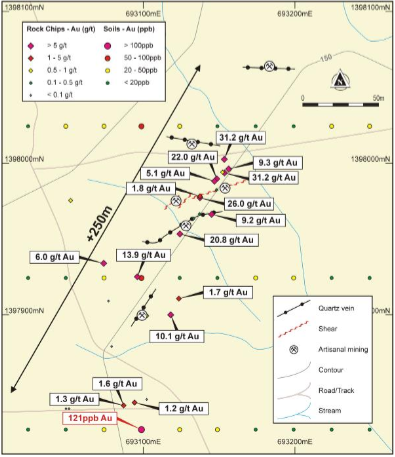
THE DRILL SERGEANT: Renaissance Minerals (ASX: RNS) has reported high-grade rock chip sample results from Okvau North-West prospect, part of the company’s Okvau gold project in Cambodia.

The Okvau North-West prospect is a new target area located less than two kilometres from Renaissance’s 100 per cent-owned 1.2 million ounces of gold Okvau deposit.

The company’s current focus at Okvau is to build a pipeline of exploration targets around the deposit, to which end it has recently undertaken further mapping and surface sampling with particular focus within a five kilometre radius.

Renaissance explained the area is defined by coincident geochemical (soils) and geophysical (gradient array IP-chargeability) anomalies, with current artisanal workings mining multiple gold-bearing veins.


Okvau North-West rock chips. Source: Company announcement


Samples recently taken from these veins and associated dump material have returned results of 31 grams per tonne, 26g/t, 21g/t, 14g/t and 10g/t gold.

“Mineralisation appears to be associated with north-east trending geological structures, similar to those that host mineralisation at the Okvau deposit,” Renaissance Minerals said in its ASX announcement.

“Further prospect mapping and surface sampling will be undertaken to improve the geological interpretation of this area before drill testing.”

Renaissance has also completed a first pass Reverse Circulation (RC) drilling program of 17 holes at the Area 1 prospect.

This initial drill program was designed to check the geological interpretation and test for shallow mineralisation beneath anomalous surface geochemistry.

Results included:

2 metres at 2.5g/t gold from 2 metres;

1m at 2.9g/t gold from 14m;

2m at 1.5g/t gold from 89m;

2m at 1g/t gold from 75m.

“Results from this drilling does not fully explain the widespread anomalous soil geochemistry (gold, arsenic, bismuth and tellurium) and further work is required,” Renaissance said.

“The company is undertaking additional trenching to provide more detailed geological information to improve the interpretation.

“In particular, the trenching is designed to better define the contact between the diorite and hornfelsed sediments, which is considered to be a key control of mineralisation at the Okvau deposit.”

Email: admin@renaissanceminerals.com.au

Website: www.renaissanceminerals.com.au

Encounter kicks off diamond drilling at Yeneena

THE DRILL SERGEANT: Encounter Resources (ASX: ENR) has commenced a 9,000 metre diamond drilling program at the company’s Yeneena base metals project in Western Australia.

BM2 zinc prospect (100 per cent Encounter)

Encounter has kicked off its 2014 diamond drill program at the BM2 zinc prospect at Yeneena.

The company said the initial hole in the program will test the up dip position of high-grade zinc sulphide mineralisation it previously intersected in hole EPT1854, which was drilled at the end of the 2013 drill campaign, returning:

0.7 metres at 36.5 per cent zinc from 430.05 metres.
 
The current diamond hole EPT1855 is targeting mineralised carbonate and shale contact 100m up dip from EPT1854.

This targeted contact is located 100m down dip of a broad zone of iron-manganese oxide material that was intersected in EPT1831.


BM7 Cross Section 7539400mN with planned diamond hole traces. Source: Company announcement


BM7 Copper Prospect (Antofagasta Earning in)

Last year exploration work on the BM7 prospect outlined a 6km by 3km copper system that remains open to the south.
 
The final diamond hole in 2013, EPT1719, intersected a 5.3 metre zone, with locally massive copper sulphides forming as breccia cement near the upper boundary of a narrow carbonate unit.

This zone returned an assay of:

5.3m at 2.5 per cent copper from 387.6m including 0.7m at 10.7 per cent copper from 388.6m.

“The initial three diamond holes at BM7 are planned to test the area down dip and to the east of high-grade copper sulphide mineralisation in EPT1719,” Encounter Resources said in its ASX announcement.
 
“The initial three 800 metre spaced holes have been designed to confirm the broad scale geological model and provide lithogeochemical and structural vectors to high grade copper sulphide mineralisation.

“This initial drilling will also provide the first diamond drilling at the BM7 East regolith anomaly.

“This is a late rally extensive plus-five per cent copper anomaly that extends over two kilometres in strike.

“The planned exploration under the Antofagasta earn in agreement during the June 2014 quarter includes 4,000 metres of diamond drilling and 5,500 metres of aircore/RC drilling.”

Email: contact@enrl.com.au

Website: www.enrl.com.au

St George adds EM targets to upcoming drilling campaign

THE DRILL SERGEANT: St George Mining (ASX: SGQ) has identified additional EM (electromagnetic) conductors at the Stella Range ultramafic belt in Western Australia.

The EM anomalies were detected by a MLEM survey carried out at the company’s 100 per cent-owned East Laverton Property.

Dragon 1is a new conductor at the Desert Dragon nickel prospect.

Windsor 1 and Windsor 2 are new EM conductors at the Windsor nickel prospect.

DDN2 is a new EM conductor at the Desert Dragon North nickel prospect.


High priority nickel prospects being covered by the MLEM
survey. Cambridge, Desert Dragon North, Desert Dragon and Windsor have
been completed. The target currently being surveyed is Bristol. Source:
Company announcement


The company said the new EM conductors are coincident with known magnetic anomalies and it considers them to be highly prospective for massive nickel sulphides.

The new group of EM conductors coincides with a nickel sulphide bearing ultramafic on the Stella Range belt, previously identified by three RC drill holes  ‐  DRAC35, DRAC38 and DDNRC002.

St George believes the intersections are evidence of a nickel mineralising process within the Stella Range belt, increasing potential for the EM conductors to be massive nickel sulphide deposits.

In addition to the new EM conductors, St George claims the MLEM survey has also identified further strong EM anomalies along the Stella Range belt.

These anomalies will be followed‐up with FLEM surveys.

St George said it anticipates final modelling will result in the identification of further high quality EM conductors for drill testing.

“We are generating an outstanding suite of EM conductors for our next drilling campaign,” St George Mining executive chairman John Prineas said in the company’s announcement to the Australian Securities Exchange.

“This will be our first ever drill testing of EM conductors along the Stella Range belt.”

Email: info@stgm.com.au

Website: www.stgeorgemining.com.au

Aus Tin Mining PFS advances Taronga tin project

THE DRILL SERGEANT: Aus Tin Mining (ASX: ANW) has released the results of a Pre‐Feasibility Study (PFS) for the company’s Taronga tin project, located in northern New South Wales.

Aus Tin Mining said the PFS has confirmed the technical and economic viability of the project while highlighting areas of potential economic upside.

The company has previously reported a Mineral Resource (JORC 2012) of 36.3 million tonnes at 0.16 per cent tin for 57,000 tonnes of contained tin.

A Probable Ore Reserve (JORC 2012) has been estimated of 22 million tonnes at 0.16 per cent tin for 35,600 tonnes of contained tin or 96% of the production target.

Aus Tin Mining explained the PSF proposes processing the relatively simple ore at 2.5 million tonnes per annum using conventional practices and is expected to achieve an overall tin recovery of 70 per cent and generate an average 2,815 tonnes of tin in concentrate per annum over a 9.3 year mine life.

The company said medium grade concentrate (55 per cent tin) acceptable to tin smelters will be produced and will likely be exported into the Asian market.


Taronga tin project PFS operating parameters. Source: Company announcement


“We are pleased with the results of the pre‐feasibility study confirming the technical and economic viability of the Taronga tin project and are excited by the extent of upside opportunities identified during the work,” Aus Tin Mining chief executive officer Peter Williams said in the company’s announcement to the Australian Securities Exchange.

“Approaching the study from the perspective of not simply generating a technically sound project but also one that can be financed is expected to be rewarded as we move forward with our funding discussions.”

Email: info@austinmining.com.au

Website: www.austinmining.com.au

Impact expands land holding around Commonwealth project

THE DRILL SERGEANT: Impact Minerals (ASX: IPT) has expanded its land holding around the company’s high-grade gold-silver-base metal Commonwealth project in New South Wales from eight square kilometres to 315sqkm.

The expansion is the result of two new 100 per cent-owned exploration licences being granted and follows a review of previous exploration data both at Commonwealth and the surrounding area within the mineralised Molong Volcanic Belt.


Geology and mineral occurrences in the Molong Volcanic Belt and
showing Impact’s licences that now cover 315sqkm. Source: Company
announcement


“Impact now has 100 per cent-ownership of a large ground holding in one of the most prolific mineralised areas in Australia,” Impact Minerals managing director Dr Mike Jones said in the company’s announcement to the Australian Securities Exchange.

“Our work at Commonwealth and a review of previous exploration data in the surrounding area has shown that there has been limited exploration in the northern part of the Molong Volcanic Belt.

“There is significant potential for the discovery of a number of different mineral deposit styles in our new licences, in particular porphyry copper-gold deposits similar to the nearby world-class Cadia-Ridgeway mining centre as well as volcanogenic massive sulphide deposits similar to the 300 million tonne Windy Craggy copper-gold-silver deposit in British Columbia.”

Impact believes potential for porphyry copper-gold-silver deposits exists due to the number of copper, gold and silver occurrences both at Commonwealth and within the company’s new licences, which are hosted in granite and porphyry intrusive rocks.

At Silica Hill, close to Commonwealth, Impact has recently identified a pyrite-silica alteration zone 300m thick associated with a previously unrecognised quartz-feldspar porphyry intrusion.

Here, a significant silver-and gold-in-soil anomaly covering at least 200m by 200m has also been identified in previous soil geochemistry data.

Further assays from soil and rock chip samples taken during recent field checking are due within a few weeks.

Impact said this data will be used to identify additional drill targets for a maiden drill program at Commonwealth, which is anticipated to commence later this Quarter.

Email: info@impactminerals.com.au

Website: www.impactminerals.com.au