Latin Resources confirms 1.1km copper strike at Ilo Este

THE DRILL SERGEANT: Latin Resources (ASX: LRS) has completed the third drill hole at the company’s 100 per cent-owned Ilo Este project in Peru.

The hole (IE-JDD-003) was completed to a depth of 629.2 metres with results concluding it to be consistently mineralised from surface to 472m down hole depth.

Assays have returned uncut average grades of 472m at 0.11 per cent copper, 0.09 grams per tonne gold, 11ppm molybdenum and 1.6g/t silver.

Latin said the mineralisation encountered by IE-JDD-003, clearly verifies the porphyry system to be mapped over more than three square kilometres as a large mineralised system with substantial scope for improved grades within the overall envelope of alteration and mineralisation the company has mapped to date.


Long section parallel with the strike of the Northern Intrusive Belt
showing copper assay results (red) from drill holes IE-JDD-001,
IE-JDD-002 and IE-JDD-003. Source: Company announcement


The company indicated the three holes drilled so far each host porphyry copper mineralisation, covering 1.1km of strike in the northern intrusive belt.

“Our third hole at Ilo Este reinforces the size and continuity of the mineralised porphyry system and also highlights the opportunity for securing a strong joint venture partner to help properly evaluate its full potential in a timely manner,” Latin Resources managing director Chris Gale said in the company’s announcement to the Australian Securities Exchange.

“We look forward to bringing such a partner to the project soon and thus enable value to be unlocked more rapidly for Latin shareholders.”

Email: info@latinresources.com.au

Website: www.latinresources.com.au

White Cliff intersects high-grades in second Canach gold system

THE DRILL SERGEANT: White Cliff Minerals (ASX: WCN) has reported the intersection of multiple zones of high-grade gold mineralisation in the second mineralised system the company has identified at its Chanach project, located in the Kyrgyz Republic.

The second zone is known as the Copper-Gold Zone (CGZ) and occurs 120 metres above and parallel to mineralisation White Cliff previously identified at the Lower Gold Zone (LGZ).

The latest results were achieved with drill hole CH14-28, which was drilled along strike from previous reported mineralisation in drill holes CH14-17 and CH14-18.

According to White Cliff gold mineralisation occurs within multiple shear zones and starts at surface.


Copper Gold Zone (CGZ) map showing completed drill-hole locations, roads
in blue, mineralised zones in red hatch. New results in yellow text
box. Source: Company announcement


New assay results (CH14-28) include:

5 metres at 4.7 grams per tonne gold from 20m;

6m at 7.5g/t gold from 36m, including 1m at 30.6 g/t gold;

4m at 6g/t gold from 80m;

5m at 2.5g/t gold from 127m and;

2m at 2.3 g/t gold from 148m.

The company believes the new results support its previously results from the CGZ where the first six reverse circulation drill holes identified high-grade mineralisation within two shear zones.

These earlier assay results included:

4m at 13.6g/t gold, including 1m at 30.1g/t from 50m;

3m at 11.5g/t from 36m;

5m at 4.2g/t gold from 55m;

4m at 23.8g/t gold from 85m; and

2m at 22g/t gold from 102m.

“The continued high-grade gold results from drilling demonstrate the outstanding potential of the Aucu gold deposit to develop into a major gold discovery,” White Cliff Minerals managing director Todd Hibberd said in the company’s announcement to the Australian Securities Exchange.

“The company has now confirmed that high-grade gold mineralisation occurs within both the Copper-Gold Zone and the Lower Gold Zone.

“The possibility of further parallel systems remains untested.

“Mineralisation starts at the surface and has been identified to at least 100 metres vertical depth in both systems and is open along strike in both directions.

“The company is currently planning extensive exploration activities for the 2015 field season.”

Email: info@wcminerals.com.au

Website: www.wcminerals.com.au

Mincor encounters nickel hits across three sites

THE DRILL SERGEANT: Mincor Resources (ASX: MCR) has reported high-grade nickel intersections at all three of the company’s potential new development opportunities in the Kambalda Nickel District of Western Australia.

The company encountered the intersections at its Cassini and Voyce discoveries and at the Durkin North deposit.

At Cassini, a step-out drill-hole intersected strong and thick nickel mineralisation 130 metres down-plunge of previous drilling, with mineralisation now defined over a 430m plunge length, returning: 6.73m at 4.81 per cent nickel (estimated true width 6.21m).

At Voyce, drilling hit a high-grade and thick nickel intersection at shallow depth, linking the N02 and N03 ore pods returning: 8.81 at 7.72 per cent nickel (estimated true width 7.62m).


Voyce long section. Source: Company announcement


At Durkin North, the first drill-hole completed as part of a resource infill and upgrade program intersected better-than-expected mineralisation within the resource envelope returning: 2.39m at 6.45 per cent nickel (estimated true width 2.04m).

“While it is still early days, the grade and predictability of the mineralisation at Cassini is extremely positive, with this latest intersection all-but confirming a very significant new nickel sulphide discovery,” Mincor Resources managing director David Moore said in the company’s announcement to the Australian Securities Exchange.

“At Voyce, the sheer quality of the latest intersection is breathtaking – and to have that so close to surface strengthens our growing belief that a viable and profitable operation may be possible there, only a few kilometres south of Mariners.

“And then there is Durkin North, where we already have 20,000 tonnes of nickel metal in a high-grade resource.

“We think there is potential to add significantly to the resource and this first hole has given us the hoped-for positive start to the drilling program.

“With six rigs at work – three on surface and three underground – we hope to continue a strong news flow as exploration advances on these very promising projects.”

Website: www.mincor.com.au

Cardinal hits 51m gold intersection at Namdini

THE DRILL SERGEANT: Cardinal Resources (ASX: CDV) has encountered a further high-grade gold intersection at the Namdini Mining Licence, located within the company’s Bolgatanga project in Ghana.

Cardinal recorded the 51 metres at 3.58 grams per tonne gold from 85m vertical intersection approximately 25m north along strike from a 43m gold intersection the company announced in November 2014.

“This 51 metre wide gold intersection is the widest zone located since drilling started at Namdini,” Cardinal Resources managing director Archie Koimtsidis said in the company’s announcement to the Australian Securities Exchange.

“Additionally we are greatly encouraged that this intersection also has high gold grades and is located approximately 25 metres north along strike from the recently announced 43 metre gold intersection.

“This confirms the northern extension along strike of the amalgamated Zones 1 and 2, which continues to produce promising grades and intersection lengths.”


Namdini plan view of drill hole collars and projected gold zones. Source: Company announcement


“This very encouraging result provides additional information that will guide the next stage of the drill plan to test for further strike and depth extensions of the three gold zones which are anticipated to expand the gold potential at Namdini.

“We have drilled a further approximately 900 metres and the samples will be sent to the SGS laboratory in Ouagadougou, Burkina Faso this week.”

Website: www.cardinalresources.com.au

Doray confirms Suzie mineralisation and extends Judy

THE DRILL SERGEANT: Doray Minerals (ASX: DRM) declared recent drilling carried out at the company’s Andy Well gold project in Western Australia has confirmed the potential for mine life extensions.

Doray said shallow RC drilling at the Suzie Zone and, what it labelled, ‘opportune’ diamond drilling at the Judy Lode, both confirmed the continuance of high-grade mineralisation at these prospects.


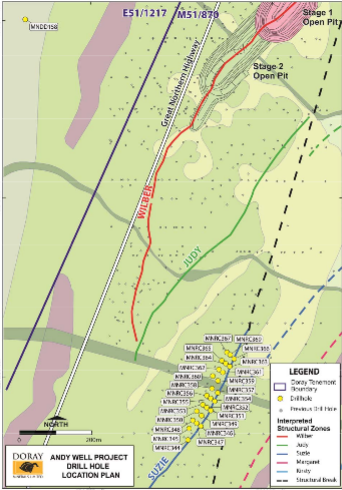
Location plan for Suzie Shallow RC drilling and Judy Deeps diamond drilling (extension to MNDD158). Source: Company announcement


The Suzie Zone is Doray’s third high-grade gold discovery at Andy Well and is located parallel to the Wilber and Judy Lodes, with similar host rocks and styles of mineralisation.

Early RC and diamond drilling at Suzie focussed on definition of the mineralised structure and targeting of fresh rock mineralisation primarily suited to underground mining.

The latest program of shallow RC drilling was undertaken to test for mineralisation amenable to small-scale open pit mining as the company considers this style of mineralisation has the potential to be exploited as part of its upcoming stage 2 open pit mining campaign at the Wilber Lode.

A total of 26 RC holes were drilled highlighting several zones of shallow high-grade gold mineralisation hosted in oxidised bedrock.

Results received include:

MNRC352
2 metres at 76 grams per tonne gold from 22 metres down hole (mdh);

MNRC355
1m at 47.4g/t gold from 26mdh;

MNRC356
1m at 14g/t gold from 38mdh; and

MNRC347
2m at 11.1g/t gold from 27mdh.

Doray said these new drilling results will be compiled to evaluate the potential for open pit mining.

If all goes well the company will conduct further grade control activities and seek relevant regulatory approvals to allow mining to proceed.

At the Judy Lode, Doray followed-up drilling of six step-out diamond holes deep beneath the Wilber Lode by extending one of the holes (MNDD158) a further 300m.

This drilling has intersected the interpreted northern zone of the Judy Lode at approximately 800m below surface, a result that is a step-out of approximately 600m below the previous extent of drilling.

Assays of the Judy Lode vein returned gold results including: 0.5m at 17.3g/t gold from 1104.95mdh.

“The deep intersection of the Judy Lode is considered highly significant as it confirms that the Judy Lode structure and, by inference, the other structures present at Andy Well continue at significant depths below the current drilling and hence provide further evidence for potential extensions to the mine life at Andy Well,” Doray Minerals managing director Allan Kelly said in the company’s announcement to the Australian Securities Exchange.

“The change in geology at depth also indicates the potential below some of the previously drilled porphyry-hosted structures which host lower grade and/or variable mineralisation.

“The success of this drilling provides added incentive to persist with testing of these ‘live’ mineralised structures at depth to delineate additional pods of high-grade mineralisation.”

Email: info@dorayminerals.com.au

Website: www.dorayminerals.com.au

Independence hits massive sulphide at Moran South

THE DRILL SERGEANT: Independence Group (ASX: IGO) was in a hurry to announce a drilling hit from an ongoing program at the Moran South target, part of the company’s long project at Kambalda Western Australia.

IGO announced the drilling has intersected 5.4 metres at 12.38 per cent nickel of massive sulphide (true width 3.5m) in drill hole LSU-493.

The intercept is 1140m below surface, 320m south of the Moran nickel ore body and 90m below recently completed Moran South Drill Drive platform.

The company explained the intercept consists of massive sulphide in an ultramafic-basalt contact position and is co-incidental with a downhole electromagnetic (DHEM) geophysical response identified from recently completed drill hole LSU-492, drilled down dip of LSU-493.


Long Operation – Longitudinal projection showing target areas, DHEM
conductors and significant intercepts (>0.5% Ni). Source: Company
announcement


This intercept comes from the third underground diamond drill hole out of a proposed nine hole exploration program to identify the Long-Moran komatiite channel south and down plunge of the Moran orebody, east of the Moran East fault.

Further step out drilling to the south is planned to test down plunge of the current intercept in the coming months.

“Although one drill hole does not make a discovery, this is an important step in dentifying the potential southern extensions of the Moran orebody,” Independence Group managing director Peter Bradford said in the company’s announcement to the Australian Securities Exchange.

“We are particularly pleased at the high tenor of mineralisation, which is similar to Moran, and look forward to further drill testing of this target position by the Long exploration team in the coming months.”

Email: contact@igo.com.au

Website: www.igo.com.au

Parmelia identifies bedrock conductor at Dunnsville nickel prospect

THE DRILL SERGEANT: Parmelia Resources (ASX: PML) has recently completed a moving-loop electromagnetic (MLEM) survey completed at the Dunnsville nickel prospect within the company’s Jaurdi Hills project near Coolgardie in Western Australia.

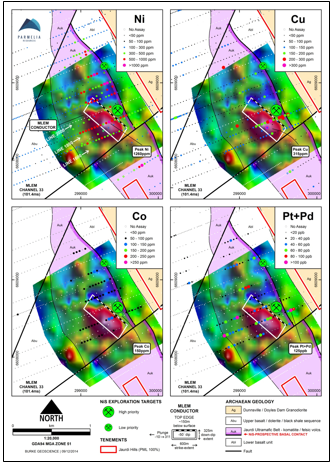
The company announced the survey confirmed the presence of a moderate to strong bedrock conductor down-dip of anomalous nickel and nickel-sulphide pathfinder soil geochemistry in a nickel-sulphide prospective geological setting at the Southern High Priority Target.

The high power, deep-penetrating B-field MLEM survey was carried out by Gap Geophysics during November for the purpose of testing for conductivity responses indicative of nickel-sulphide mineralisation.

The survey identified a moderate to strong bedrock conductor at the Southern High Priority Target.

Parmelia said follow-up 3D geological modelling suggests the conductor is located on the basal contact of the Jaurdi Ultramafic Belt and centred down-dip of an historical nickel and nickel-sulphide pathfinder soil geochemistry anomaly.

Results from the survey achieved 1260ppm nickel, 315ppm copper, 150ppm cobalt and 125ppb platinum and lead.


Southern High Priority Target map featuring nickel, copper, cobalt and
platinum + palladium soil geochemistry. Source: Company announcement


The top of the conductor is approximately 150m below surface with a strike-extent of 600m and a more conductive central core detected over about 400m.

A down-dip extent of 325m dips towards the south-west in agreement with stratigraphy, which mapping suggests dips towards west-south-west and it plunges shallowly towards the north-west.

The company said the orientation and location of the MLTEM model is relatively consistent with a previously modelled GEOTEM conductor, which it considers to confirm the source is a genuine bedrock conductor.

“Confirmation of a bedrock conductor down-dip of anomalous nickel and nickel-sulphide pathfinder surface geochemistry at the basal contact of the Jaurdi Ultramafic Belt points to significant potential for a nickel-sulphide discovery at the Southern High Priority Target,” Parmelia Resources executive chairman Nigel Gellard said in the company’s announcement to the Australian Securities Exchange.

“We continue to be encouraged by developments at Dunnsville and look forward to drilling the conductor to determine its source.”

Website: www.parmeliaresources.com

Doray hits encouraging gold at Horse Well JV

THE DRILL SERGEANT: Doray Minerals (ASX: DRM) has completed a round of RC drilling at the Horse Well project Joint Venture in the North East Yilgarn of Western Australia.

According to the company the drilling intersected high-grade gold mineralisation within the NW trending Dusk til Dawn Shear.

Doray signed a farm-in Agreement with Alloy Resources (ASX: AYR) over the Horse Well gold project in May where it can earn up to 80 per cent through the expenditure of $4 million within three years.

The Dusk til Dawn Prospect forms part of the Horse Well JV project and is considered by Doray to have potential to host a substantial gold deposit.

The prospect occurs in a structural embayment on the western edge of a granitoid body, in a similar setting to the Granny Smith gold deposit.

The recently completed RC drilling targeted the structure between holes ACDD001 and DDAC054 with two holes drilled towards the south west (azimuth 225 degrees), aiming to intersect the interpreted Dusk til Dawn mineralised shear structure at right angles for the first time.

DDRC001 intersected a wide zone of alteration and mineralisation and returned 65 metres at 2.6 grams per tonne gold from 50m, including a zone of high-grade gold in oxide material which returned 13m at 8.17g/t gold from 50m.

DDRC002, collared approximately 50m to the NE of DDRC001, intersected the Dusk til Dawn shear approximately 55m down dip and returned 21m at 0.7g/t gold from 140m.


Dusk til Dawn prospect, showing recent drilling. Source: Company announcement


“Dusk til Dawn was the first of a number of prospects identified for testing within the project and the latest results vindicated the company’s decision to enter into a Joint Venture with Alloy over the Horse Well project,” Doray Minerals managing director Allan Kelly said in the company’s announcement to the Australian Securities Exchange.

“These results highlight the significant potential of the project and confirm our belief that it could host economic, high-grade gold mineralisation.”

Doray said follow-up drilling is being planned for various targets at Horse Well, including at Dusk til Dawn, and will be scheduled to commence once heritage clearances are completed.

Email: info@dorayminerals.com.au

Website: www.dorayminerals.com.au

Cassini’s Babel drilling delivers high-grades near surface

THE DRILL SERGEANT: Cassini Resources (ASX: CZI) has received the first assay results from a recent drill program at the Babel deposit, part of the company’s 100 per cent-owned West Musgrave project.

The Babel deposit is located approximately one kilometre west of the Nebo deposit and according to Cassini both deposits are part of one ore body.

The company explained the Babel drill program was designed to infill existing, very broad drill spacing to approximately 100m by 100m, which it anticipates will enable the current Inferred resource estimate to be upgraded to an Indicated resource.

The company’s primary goal with the recent program was to validate its belief consistent higher‐grade zones of mineralisation can be defined at Babel within the broad mineralised envelope.


Startmeup Shoot. Source: Company announcement


Best results from the Startmeup Shoot, which comprises a relatively higher‐grade zone, close to surface, within the broader Babel deposit, include:

CZC0091
22 metres at 0.68 per cent nickel, 1.19 per cent copper and 0.34 grams per tonne platinum group elements (PGE) from 4m;

CZC0088
20m at 0.47 per cent nickel, 1.12 per cent copper and 0.22g/t PGE from 36m; and

CZC0092
12m at 0.75 per cent nickel, 1.45 per cent copper and 0.26g/t PGE from 72m within 22m at 0.51 per cent nickel, 0.94 per cent copper and 0.22g/t PGE from 64m.

Drilling results also include a number of intercepts from the main body of Babel, returning widths of disseminated mineralisation, in‐line with previous drilling results.

Better intercepts from the main body of Babel include:

CZC0104
26m at 0.57 per cent nickel, 1.02 per cent copper and 0.17g/t PGE from 34m;

CZC0102
4m at 2.17 per cent nickel, 0.44 per cent copper and 0.25g/t PGE from 92m within 20m at 0.77 per cent nickel, 0.46 per cent copper and 0.21g/t PGE from 92m; and

CZC0106
46m at 0.42 per cent nickel, 0.44 per cent copper and 0.34g/t PGE from 94m.

“Cassini’s first results from the maiden drill program at Babel clearly demonstrate the presence of significant, near surface mineralisation which provides further confidence in our high-grade strategy for the project,” Cassini Resources managing director Richard Bevan said in the company’s announcement to the Australian Securities Exchange.

“They are great results and show this is a very large system and parts of it are very shallow.

“The updated mineral resource statement, which will be prepared following receipt of all assays, will provide a strong platform for demonstrating the significant value of the West Musgrave project.”

Email: admin@cassiniresources.com.au

Website: www.cassiniresources.com.au

White Cliff defines further gold mineralisation at Aucu

THE DRILL SERGEANT: White Cliff Minerals (ASX: WCN) has encountered further high-grade gold mineralisation at the Aucu prospect within the company’s Chanach project in the Kyrgyz Republic.

According to the company the latest results are adjacent to previous reported mineralisation at the Lower Gold Zone (LGZ).

The drilling has indicated gold mineralisation occurs within multiple shear zones and starts at surface.


Lower Gold Zone (LGZ) map showing completed drill-hole locations, roads
in blue, mineralised zones in red hatch. New results in yellow text box.
Source: Company announcement


Assay results include:

6 metres at 8.6 grams per tonne gold, including 1m at 21.9g/t from 95m;

9m at 1.73g/t gold from 68m; and

15m at 1g/t gold from 80m.

White Cliff explained the new results were achieved adjacent to previously announced results from the LGZ where the first six reverse circulation drill holes identified high-grade mineralisation within two shear zones.

“High grade gold mineralisation at the LGZ has been identified in seven drill-holes and at surface in road cuttings over a distance of 300 metres along strike,” White Cliff Minerals said in the company’s ASX announcement.

“The new results have identified that portions of the mineralised system now appear to be related to the intersection of the vertical NNW trending major shear zones and intrusive mineralised felsic porphyries.

“North-south faulting appears to have offset mineralisation such that four holes only intersected minor or trace mineralisation.

“Further drilling will be required to identify the location of the offset mineralisation however, rock chip sampling along strike on the adjacent hills to the northwest and southeast has identified mineralised quartz veins and shear zones.

“This suggests that although offset, mineralisation extends along strike in both directions.”

White Cliff said it has now confirmed high-grade gold mineralisation occurs within both the copper-gold Zone (CGZ) and the Lower Gold Zone (LGZ).

The two mineralised systems are parallel and approximately 100m apart.

Mineralisation starts at the surface and has been identified to at least 100m vertical depth in both systems and is open along strike in both directions.

Email: info@wcminerals.com.au

Website: www.wcminerals.com.au