Lincoln awarded new EL

THE BOURSE WHISPERER: Emerging iron ore miner, Lincoln Minerals has been granted an additional iron ore prospective Exploration License, named Nantuma, located near Warramboo on South Australia’s central Eyre Peninsula.

Nantuma is immediately adjacent Iron Road’s 2.1 billion tonne iron ore deposits.

Lincoln said the new license adds to its portfolio of near mining and advanced iron ore deposits and tenements throughout the Peninsula, including proposed maiden production from Gum Flat near Port Lincoln.

“Nantuma adds to Lincoln Minerals’ portfolio of iron ore projects in the highly prospective Gawler Craton where iron ore has been mined for more than 110 years,” Loncoln Minerals said in its ASX announcement.

Lincoln’s current Eyre Peninsula iron holdings comprise more than 120 million tonnes of JORC classified Inferred and Indicated iron ore resources, with additional high priority iron ore exploration targets in excess of 1 billion tonnes, at Gum Flat, in the Cummins-Wanilla district and at Eurilla.

The company said it aims to commence mining direct shipping (DSO) hematite iron ore from its Gum Flat project late this year to early 2013 subject to getting all necessary approvals.

Lincoln Minerals’ Managing Director, Dr John Parker:
“The new exploration license enhances Lincoln’s long-term focus on iron ore exploration targets on Eyre Peninsula,” Lincoln Minerals managing director Dr John Parker said in the company’s announcement to the Australian Securities Exchange.

“While Iron Road’s Murphy South and Boo Loo deposits are relatively low grade at an average grade of 16.2 per cent iron, Iron Road has demonstrated through prefeasibility test work that a high quality concentrate grading 67 per cent iron may be produced using a coarse grind size of  less than 106 microns.
 
“Lincoln Minerals looks forward to undertaking detailed aeromagnetic surveys and analysis at Nantuma in the near future to prioritise exploration targets for drill testing later in 2012.

“With the prospects of a potential new bulk minerals port at Port Spencer, only 120 kilometres to the southeast of Nantuma, Eyre Peninsula is shaping up to be a revitalised and substantial modern era iron ore mining district for the future and Lincoln Minerals is keen to be an integral contributor to that new resource profile in the region.”
Perseus completes Edikan commissioning

THE BOURSE WHISPERER: Perseus Mining has completed commissioning at its Edikan gold mine, located in Ghana, West Africa taking the company through the transition of becoming a commercial gold producer.

The commissioning was carried out during December 2011 and, according to the company, resulted in similar throughput and gold production as it had achieved in November 2011.

Production highlights for the month of December included:

Mill throughput – 395,500 dry tonnes for December and 1,089,000 dry tonnes for the December quarter;

Throughput rate – 674 dry tonnes per hour for December and 637dtph for the quarter;

Calculated grade – 1.29 grams per tonne for December and 1.26g/t for the quarter;

Calculated recovery – 82.6 per cent for December and 81.0 per cent for the quarter;

Gold recovered – 13,510 ounces for December and 35,801 ounces for the quarter;

The company lost a total of 90 hours during the month of December due to process water pumping issues.

Prior to the resulting plant shut-down the mill had averaged 700dtph and 14,000dt per day, which equates to 102 per cent and 93 per cent respectively of ‘nameplate’ capacity.

Since the shut-down throughput had been restricted to about 670dtph due to limited capacity of the interim pumping arrangement, however, Perseus said this hourly rate is nominally at ‘nameplate’ and daily throughput from the shutdown to the end of the month averaged 14,000dtpd.

The company said gold recoveries, grade reconciliation and mining rates are now in excess of criteria it had previously set for commercial production.

Perseus carved 1 January 2012 into the tree of history as its first day of commercial production.

“The December Quarter production was an excellent result given that we were commissioning the mill,” Perseus Mining managing director Mark Calderwood said in the company’s announcement to the Australian Securities Exchange.

“We will be in a position to give production guidance when our December quarter and half year financial reports are finalised towards the middle of next month.

“Now that commercial production has been declared we will be systematically assessing the performance in each area of the processing plant and associated infrastructure to instigate preventative management programs and carrying out upgrades where needed, to further ramp up production rates.”

Carpentaria locks up Braemar province

THE BOURSE WHISPERER: Carpentaria Exploration says it has strengthened its position as a leading tenement holder in the Braemar Iron Province.

The company’s pronouncement was supported by the announcement of a new joint venture agreement with Maosen Australia that gives Carpentaria the chance to earn a 100 per cent interest an exploration licence in South Australia.

Maosen is a private company based in Queensland, which has other iron ore interests within South Australia, and an extensive network of connections within the Chinese steel industry.

The tenement covers over 20 kilometres of the Braemar Iron Formation, which hosts Carpentaria’s $3.2 billion Hawsons iron project, and is also located adjacent to Carpentaria’s South Dam JV.

Carpentaria Exploration executive chairman Nick Sheard claimed the agreement to be a significant boost for the company’s iron ore interests, highlighting its position as first mover in the province.

“This new Braemar Joint Venture, together with the Hawsons iron project, South Dam and the Torrowangee EL in New South Wales, gives CAP a combined 1,182 square kilometres of tenement holdings and more than 81 kilometres of collective strike of the magnetite siltstone,” Sheard said in the company’s announcement to the Australian Securities Exchange.

“Carpentaria will use its extensive knowledge of the Braemar Iron Formation to fast-track exploration, giving the opportunity to potentially develop a new iron ore project just 200 kilometres from a capital city and close to rail and port infrastructure.”

Under the terms of the JV, Carpentaria is required to pay Maosen Australia a $25,000 execution payment, subject to 30 days due diligence.

On renewal of the tenement, Carpentaria is required to complete 500m of drilling and award Maosen 200,000 fully paid shares.

To earn a 60 per cent interest in the JV, Carpentaria must define a 200 million tonne magnetite resource within three years of initial access and pay Maosen $100,000.

Carpentaria may earn an 80 per cent interest by completing a prefeasibility study and making a further cash payment to Maosen of $200,000, at which time Maosen has the right to contribute on a pro rata basis.

Should Maosen then elect not to contribute to further development, Carpentaria could earn a 100 per cent interest in the project for a further $1millon cash payment to Maosen, whereby Maosen would revert to a 1.5 per cent Net Profit Royalty.

At the completion of a detailed feasibility study, Maosen could elect to regain a 10 per cent interest.

Ram identifies new Greenland targets

THE BOURSE WHISPERER: Greenland-focused rare earths explorer Ram Resources has received final results from reconnaissance exploration work recently completed at the Voskop and Drysdale targets within the company’s Motzfeldt project in South Greenland.

Ram currently holds 51 per cent of the Motzfeldt project, with the right to move to 100 per cent.

“Regional exploration during the 2011 field season has proved successful in identifying two new and extensive areas of Niobium-Tantalum-Rare Earth Elements mineralisation,” Ram Resources said in its ASX announcement

“The grades and extent of mineralisation at both Voskop and Drysdale are similar to those observed at Aries, which is recognised as a major Ta-Nb-REE occurrence.”

Ram identified Voskop to be of particular interest as it appears to show an increased level of REE mineralisation compared to other targets, and is an occurrence that can be relatively easily explored.

Its location means it could be developed alongside a future mine at the company’s Aries prospect and could share much of the same infrastructure.

Voskop is located within about 7 kilometres to the northwest of the Aries prospect.

Ram carried out sampling on profiles along the valley floor or sides at Voskop with a total of 48 surface samples taken during this last field season.

“This initial sampling at Voskop shows very encouraging results, with 13 samples (of the 48) returning assays over 2,000 parts per million niobium oxide, with an average of 1,431 ppm across all samples,” Ram said

 The best results for niobium oxide achieved at Voskop were 4,320 ppm and 4,306 ppm in two samples.

The best results the company received for Tantalum oxide were 452 ppm and 354 ppm in the same two samples.

“The distribution of tantalum mineralisation shows close correlation to that for niobium, which is to be expected,” Ram said.

“Results for REE’s are also very promising, with seven samples assaying at or close to one per cent Total Rare Earth Oxides (average 0.4 per cent TREO).

The Drysdale prospect is located about 7.5km southeast of Aries at an elevation of about 1,600m.

A total of 99 surface samples were collected along the ridge at Drysdale.

Ram said the prospect shows niobium, tantalum, zircon, and REE mineralisation in altered syenites and microsyenites over an area of some 1.4km by 0.5km, with niobium grades being particularly significant.

RNI picks up Fortnum gold project

THE BOURSE WHISPERER: Resource and Investment (RNI) has greeted the New Year by announcing following a deal to acquire the Fortnum gold project and surrounding exploration tenements in the Bryah Basin of Western Australia.

The Fortnum project, owned by BlueCrest subsidiary Grosvenor Gold, is located 170 kilometres north-west of Meekatharra in WA.

RNI has entered into a Sale & Purchase Agreement with BlueCrest Mercantile Master Fund Limited.

Under the terms of the agreement RNI will acquire all the issued capital of Grosvenor Gold for a total consideration of $35 million payable as $20 million in cash and $15 million of fully paid ordinary shares in RNI.

RNI said the deal sets it up to become a gold producer, with significant exploration upside.

“Fortnum hosts a JORC-compliant resource of 1.2 million ounces at a grade of 2.2 grams per tonne and has more than 100 walk-up drilling targets based on an extensive exploration database compiled by previous owners, offering outstanding exploration potential for both lode gold and VMS copper-gold deposits,” Resource and Investment said in its ASX announcement.

The acquisition also entails the one million tonne per annum Fortnum processing plant, which RNI said it plans to bring back into production within 12 to 18 months.

The acquisition will increase RNI’s footprint in the Bryah-Padbury Basin from its current standing of 434 square kilometres to 2,225 square kilometres.

“This will make RNI a dominant tenement holder in the region with control of a 100km strike length of the highly prospective Narracoota Volcanics, host to the world-class DeGrussa copper-gold deposit currently being developed by Sandfire Resources,” the company said.

Mining Group tops 2011 IPOs

THE BOURSE WHISPERER: Gold and base metals explorer, Mining Group listed on the ASX last year.

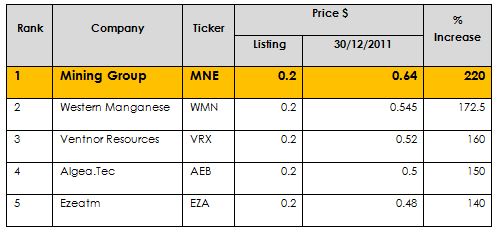
The company closed off 2011 atop the year’s IPO chart with its share price ending at an all-time high of 65c, marking an increase of 220 per cent to its listing share price of 20c.

2011 turned out to be a fairly tough assignment for IPOs with only a third of floats listed trading above their issue price in late December.


Top 5 IPOs for 2011. Source: Company announcement


Mining Group managing director Andrew Maurice said he was extremely pleased with his company’s results, which he suggested reflected the company’s strong performance in 2011 as well as providing a positive outlook for its shareholders in 2012.

“We have had strong support from shareholders which has enabled the strategic expansion of the company and the Board is eager to continue its aggressive exploration plans in 2012,” Maurice said in the company’s announcement to the Australian Securities Exchange.

“Our success to date has included entering into an agreement with Cadan Resources Corporation in which we have acquired an 80 per cent interest in the Comval copper gold project located in the Philippines with potential for large scale copper and gold mineralisation.

“We also have had positive and encouraging exploration results at our Boorara gold and Teutonic base projects located in the Western Australian Goldfields region.”

On top of a successful 2011, Mining Group said it is looking forward to adding growth in 2012 as it continues to progress its projects located in the Philippines and Australia.

Mining Group said it is focused on this growth at Comval, by moving the projet towards production through funding and delineating of a maiden JORC resource, completing at least 10,000 metres of drilling, and the completion of a scoping study.

Western Areas adds to Spotted Quoll

THE BOURSE WHISPERER: Western Areas has updated the Mineral Resource at Spotted Quoll.

The update includes the first resource estimate for the Stage 2 area at the project.

The previous mineral resource estimate for Spotted Quoll was released in January 2009.

It comprised a total of 2,021,600 tonnes at an average grade of 6.2 per cent nickel for 125,460 tonnes contained nickel.

The revised mineral resource estimate for Spotted Quoll comprises a total of 3,054,900 tonnes at an average grade of 5.9 per cent nickel containing 179,000 tonnes nickel; 85 per cent is in the Indicated Mineral Resource category.


Mineral Resource Statement 31 December 2011 Spotted Quoll Deposit
above lower cut-off of zero per cent nickel. Source: Company
announcement


The upgrade represents an increase of 78 per cent in reported contained nickel metal compared to the figures the company reported in its September 2011 Quarterly Report.

Surface diamond drilling carried out by the company during the past 24 months has defined a Mineral Resource for the Stage 2 target area, located between 630 metres and 1050 metres below surface.

This constitutes an Indicated Mineral Resource of 923,500 tonnes at 5.6 per cent nickel for 51,960 tonnes contained nickel, and an Inferred Mineral Resource of 244,900 tonnes at 5.1 per cent nickel for 12,570 tonnes contained nickel.

This has exceeded the company’s initial target for this area of 40,000 tonnes to 60,000 tonnes contained nickel.

“This resource upgrade clearly demonstrates the world class nature of the Spotted Quoll deposit and positions the recently commenced Spotted Quoll underground mine for a substantial increase in mine life,” Western Area operations director Dan Lougher said in the company’s announcement to the Australian Securities Exchange.

“Further work will now be conducted to convert this resource into a Probable Reserve.

“This will include optimisation of the production schedule with the aim of increasing the annual nickel output from the mine.

“This could also potentially lead to a mill upgrade.”

Draig relists following Mongolian acquisitions

THE BOURSE WHISPERER: Mongolian coal explorer Draig Resources has had its shares re‐listed on the Australian Securities Exchange, following the completion of a capital raising and the acquisition of eight coal licences in Mongolia’s Ovorhangay and South Gobi Provinces.

Draig completed a $17 million capital raising via the issue of 34 million shares under priority and general share offers.

The company said it has used the funds to complete the purchase of eight prospective Mongolian coal licences through the acquisition of BDBL LLC, previously a subsidiary of Peabody‐Winsway.


Location of the Ovorhangay and South Gobi province licences, Mongolia. Source: Company announcement


Draig said it now has sufficient cash on hand to pay for its 2012 exploration program, further coal acquisitions and necessary working capital.

“We now have the financial capacity to move forward with the development of what we believe will be a very good quality coal project,” Draig Resources managing director Mark Earley said in the company’s announcement to the Australian Securities Exchange.

“We will continue drilling through the coming Mongolian winter months, with the aim of establishing a JORC compliant resource on the project early this year.”

Draig recently announced the commencement of a geophysical survey designed to identify the potential black coal extensions within the Teeg licence, located in the Ovorhangay Province.

The survey is currently underway, having been halted briefly for the Christmas/New Year period.

Draig said it expects the survey will assist it in identifying drilling targets for its 2012 exploration program, which it intends to commence immediately after the geophysics analysis work has been completed.

IronClad set to commence work at Wilcherry Hill

THE BOURSE WHISPERER: IronClad Mining has finalised key infrastructure and mining contracts for its Wilcherry Hill project in South Australia.

Construction works on the project are due to commence later this month following the recent announcement by the SA Government of formal approval for IronClad’s Program for Environmental Protection and Rehabilitation (PEPR) – formerly known as the Mining and Rehabilitation Plan  (MARP) – which was the final statutory hurdle for the project.


IronClad Mining project location map. Source: Company website.


IronClad said it is on track to commence maiden production from the mine in the current March quarter, with first product to be exported to Chinese customers in the June quarter.

“We are focusing on the employment of local people in order to enhance the project’s connection with the area’s community while at the same time building a reliable workforce,” IronClad Mining executive chairman Ian Finch said in the company’s announcement to the Australian Securities Exchange.

“As the second junior mining company to move into iron ore production in SA in recent times, and the first from the state’s Eyre Peninsula region, our contracting strategy is working well for IronClad and for South Australia’s expanding resources industry and the flow-on effect from that upsurge.

“Years of planning and hard work are now only weeks away from coming to fruition for our company.”

The Wilcherry Hill iron ore project is an 80:20 Joint Venture between IronClad and its associated company, Trafford Resources.

Coziron picks up Western Australian triplets

THE BOURSE WHISPERER: Coziron Resources has entered into agreements that will result in the acquisition of three separate projects in Western Australia.

The purchases will come at the cost of a total consideration of 500 million shares at a deemed value of $15 million, together with an ongoing free carried interest for the vendors of 15 per cent through until the conclusion of any Bankable Feasibility Study on each of the three projects.

“It is rare that the opportunity to acquire project footprints of this quality is presented to a company,” Coziron Resources chairman Adam Sierakowski said in the company’s announcement to the Australian Securities Exchange.

“We believe the suite of projects have enormous exploration potential given the location of the projects are in some cases immediately adjacent to some of the world’s largest resource groups and operating mines.”

Coziron has entered into an agreement to acquire 100 per cent of Zanthus.
Zanthus holds seven contiguous granted exploration tenements and two granted prospecting licenses in the iron producing Hamersley Basin of the Pilbara region.

The second agreement the company has entered into is one to acquire 100 per cent of Buddadoo.


Buddadoo location map. Source: Company announcement

Buddadoo has 100 per cent ownership of and exploration licence located 180 kilometres east of Geraldton and 70 kilometres from existing railway at either Morawa or Pindar.

According to Coziron the exploration licence contains:

1.    A layered mafic complex with outcropping magnetite horizons on which:

–    Assays of up to 54 per cent iron have been obtained from massive magnetite outcrop over 8km strike;

–    Recent drilling intersected 108 metres at 32.9 per cent iron, 0.2 per cent vanadium and 12.1 per cent titanium;

2. A Volcanogenic Massive Sulphide copper-zinc target with past drill results of:

–    5.5 metres at 3.4 per cent zinc from 99 metres to 104.5 metres;

–     3.15 m at 3.8 per cent copper from 188.7m to 191.85m; and

–    1m at 1.75 per cent copper and 4.4 grams per tonne gold from 237.3m to 238.3m.
 
The final acquisition completing the set is KingX, which holds 12 contiguous pending tenements in the southern Earaheedy Basin on the margin of the Yilgarn craton 120km northeast of Wiluna.

The Ground holding totals 965 blocks prospective for sedimentary manganese and iron ore deposits.

KingX holds 4 granted tenements and eight applications.