Doray reaches Native Title Agreement

THE BOURSE WHISPERER: Perth-based gold company Doray Minerals has reached an in-principle agreement with the Yugunga-Nya Native Title Claimant Group.

The company said the agreement paves the way for the granting of its Mining Lease application over the Andy Well gold project (Doray 80%) in the Murchison region of Western Australia.
 
The project-wide Agreement covers:

–    The high-grade Wilber Lode gold deposit;

–    The proposed location of processing and other mine site infrastructure within the application; and

–    A significant area surrounding Andy Well, including the Side Well project (Doray 80%).
 
“Reaching this in-principle agreement with the Yugunga-Nya group is a significant milestone in the timely progression of the Andy Well gold project through development and into production,” Doray Minerals managing director Allan Kelly said in the company’s announcement to the Australian Securities Exchange.
 
“Today’s in-principle agreement includes provisions for potential community development activities as well as significant financial benefits for the claim group.

“We have been in productive discussions with the Yugunga-Nya over the last twelve months and have been very appreciative of their cooperation and desire to reach a mutually beneficial outcome, and we look forward to working with the group in the future.”
 
Following satisfaction of Native Title requirements, including execution of this Agreement, Doray said it will have met all prerequisites for granting of the above Mining Lease application.

Once the lease is granted, Doray expects it will then be able to submit applications for all required operating licences, as well as the Mining Proposal and associated Mine Closure Plan for approval by the Department of Mines and Petroleum.

Ramelius signs up for Vivien purchase

THE BOURSE WHISPERER: Ramelius Resources has continued to make its presence felt with the realms of the acquisition scene.

Following its signing of a Sale and Purchase Agreement with Breakaway Resources, Ramelius has picked up the pen again to sign a Letter of Intent to purchase the Vivien gold deposit from the Agnew Gold Mining Company a subsidiary of Gold Fields Limited.


Vivien gold deposit location plan. Source: Company announcement

The purchase price for the Vivien deal is $10 million cash and a production royalty.

Ramelius will also enter into a toll milling agreement with Gold Fields for ore produced from the project.

The purchase of the project is subject to completion of formal agreements and the consent of the relevant government authorities.

The Vivien gold deposit is located near the Agnew Gold Mine, west of the town of Leinster in Western Australia.

According to Ramelius the deposit is a high-grade vein style deposit and has an estimated Indicated Resource of 579,000 tonnes at 8.3 grams per tonne gold for 154,000 ounces of gold.

“After completion of the formal agreements and government consents, Ramelius intends to undertake a mining study for the project and to complete further drilling intended to extend the orebody at depth and down plunge,” Ramelius Resources said in its ASX announcement.

“This acquisition, if completed, allows the company to achieve its growth targets and objective of having multiple gold operations.

“In addition, the provision of toll milling by Gold Fields will reduce the capital and time frame required to develop the project, and allows the milling to be completed at a cost below that which could be achieved with a small standalone mill.”

Crusader scores good results at Borborema

THE BOURSE WHISPERER: Recent infill drilling carried out by Crusader Resources at its 100 per cent-owned Borborema gold project in Brazil has produced encouraging results.

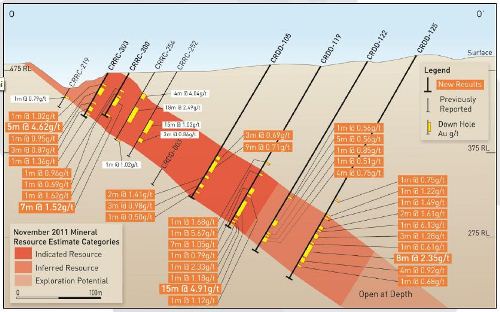
The best results were achieved from the Central and Southern zones, extending from near-surface, all the way down to the Central Deeps, a vertical depth of 265m.


Source: Company announcement


The drilling program comprised 11 diamond holes for 3,111m and 35 RC holes for 2,805m.

Crusader said all the holes drilled during the program contained significant intersections in terms of width and grade.

Best intercepts from the recent drilling include:

–    17 metres at 5.24 grams per tonne gold from 64 metre, including 4 metres at 17.75 grams per tonne gold;

–    15m at 4.91g/t gold from 190m, including 3m at 14.86g/t gold; and

–    22m at 3.15g/t gold from 104m.

“We have received some excellent results recently with thick, relatively high-grade intercepts from near surface holes, right the way down to intercepts at 265 metres vertical depth, which is really exciting,” Crusader Resources managing director Rob Smakman said in the company’s announcement to the Australian Securities Exchange.

“Especially encouraging is that all of the holes had significant intersections, which shows that the infill drilling is confirming our current interpretation of the mineralisation.

“Importantly, this increase in our level of confidence in the mineralisation should convert all of our in-pit Resources to Indicated Resources or better, providing a great foundation for the Bankable Feasibility Study of the Borborema project.”

The objective behind the infill drilling programs Crusader currently has underway is to convert the in-pit Mineral Resources to Indicated Resources or better.

The company believes this level of confidence is required for the upcoming Bankable Feasibility Study (BFS) at Borborema.

The company has accelerated drilling activities in order to meet the projected BFS time-table.

It now has four diamond drill rigs currently operating around the clock and a fifth diamond rig on the way with two RC drill rigs drilling on single shift.

The JORC-compliant Mineral Resources Estimate of the Borborema project currently stands at 68 million tonnes at 1.06 grams per tonne for 2.31 million ounces of gold.

Rio Tinto to increase spending in the Pilbara

THE BOURSE WHISPERER: Global mining giant Rio Tinto announced the commitment of a further US$3.4 billion to the expansion of its Pilbara iron ore operations in Western Australia.

Rio’s share of the expansion costs will be US$2.9 billion, which will comprise doling out US$2.2 billion to extend the life of the Nammuldi iron ore mine.

The company said this will fund increased production capacity in the Pilbara to 283 million tonnes a year, which is now fully approved.

Rio will also cough up a further US$700 million as part of the US$1.2 billion earmarked for the Cape Lambert port and rail early works, which it said was needed for the proposed capacity expansion to 353 million tonnes per annum.

This 353Mtpa expansion is in final feasibility study, with a final investment decision expected later this year.


“We believe we have the best quality iron ore expansion projects anywhere in the world,” Rio Tinto Iron Ore and Australia chief executive Sam Walsh said in the company’s announcement to the Australian Securities Exchange.

“Today we are announcing another significant milestone in our drive towards a more than 50 per cent increase in the size of iron ore operations in Western Australia.

“The program remains on track and we are bringing new iron ore production on stream at a time when demand from Asian markets is forecast to grow strongly, while industry supply growth remains constrained.”

Rio Tinto said it will reach production capacity of 283 million tonnes per annum in the Pilbara in the second half of 2013.

The Nammuldi expansion is expected to contribute its first ore in the third quarter of 2014, although the big miner indicated there will be a transitional period until then in which ore will come from other mines to reach 283Mtpa.

An interesting feature of the Nammuldi project to note is that it will extend Rio’s existing mining below the water table.

It will also increase the mine’s life by 14 years, at a production rate of approximately 16 million tonnes a year.

The funding for the expansion at Cape Lambert follows investments Rio has made in other areas that it already has underway.

The company said its plans to increase capacity at the port have been enhanced by further plans to replace an ageing car dumper with a new dual car dumper.


This will augment the Cape Lambert capacity by an additional 20Mtpa to take its capacity to 203Mtpa in 2015.

The works and plans still remain subject to a number of Joint Venture and regulatory approvals, including environmental clearances, which are expected later this year.

Rio Tinto’s schedule for expanding its integrated Pilbara operations is as follows:

–    225 Million tonnes per annum – current operating capacity;

–    230Mtpa by end of Q1 2012 – Dampier port incremental (in implementation);

–    283Mtpa by end of H2 2013 – Cape Lambert 53Mtpa increment (in implementation); and

–    353Mtpa by end of H1 2015 – Cape Lambert 70Mtpa increment (in feasibility study).

Ramelius picks up Breakaway tenements

THE BOURSE WHISPERER: Breakaway Resources has signed a Sale and Purchase Agreement with Ramelius Resources.

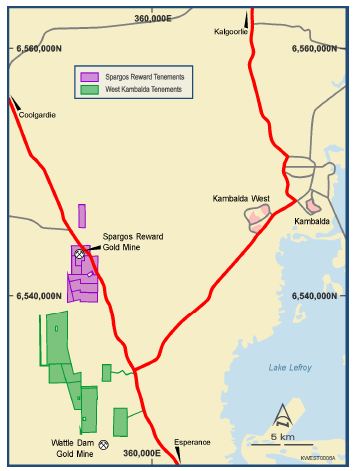
The agreement will result in Ramelius purchasing a number of Breakaway’s tenements located in the West Kambalda region of Western Australia.


West Kambalda tenement location. Source: Company announcement


Ramelius will pay $300,000 in cash and a Royalty in the form of the total of 1.5 per cent of the Net Smelter Return on all minerals other than nickel.

Breakaway will retain the Nickel Rights on the tenements.

The tenements under question are located immediately north of Ramelius’ Wattle Dam gold mine.

They comprise a total of ten exploration, prospecting, and mining licences but exclude Breakaway’s 100 per cent – owned Spargos Reward tenements, which contain the Spargos Reward gold mine.

“The tenement sale is consistent with Breakaway’s previously announced strategy of rationalising its extensive Australian minerals portfolio, thereby allowing the company to focus its ongoing exploration activities on the highly prospective Eloise copper-gold exploration project located in the Cloncurry District, Queensland,” Breakaway Resources said in its ASX announcement.

Chinalco and Xstrata JV Mount Frosty

THE BOURSE WHISPERER: Chinalco Yunnan Copper Resources has signed a binding agreement with Xstrata Mount Isa Mines (Xstrata Copper) to commence exploration activities on the Mount Frosty project.

The Mount Frosty project covers the Mary Kathleen shear zone and is located about 60 kilometres east of Mount Isa in far north west Queensland.


Source: Company announcement


The project is contiguous with Chinalco’s 100 per cent-owned Mt Isa project and with part of the Mary Kathleen Joint Venture project, in which Chinalco holds 70 per cent with the remaining 30 per cent held by Goldsearch.

Under the terms of the joint venture, Chinalco will farm in to the Mount Frosty project and can earn up to a 75 per cent interest by spending $4.5 million in the next 6 years in a two stage earn-in.

Xstrata Copper retains a right to buy back 26 per cent of the project (to give Xstrata Copper 51 per cent and Chinalco 49 per cent) by paying three times the expenditure Chinalco would have contributed in the stage two period.

“We are excited in expanding our relations with Xstrata Copper with agreements now signed in Chile and Australia,” Chinalco Yunnan Copper Resources managing director Jason Beckton said in the company’s announcement to the Australian Securities Exchange.

“This agreement with the contiguous Xstrata Copper property allows Chinalco to further target blind copper deposits associated with the Mary Kathleen shear zone.

“Chinalco and Goldsearch has had success in defining a new copper sulphide zone at the Elaine prospect situated approximately six kilometres south of the historic Mary Kathleen uranium deposit along this regional shear zone.

“We will be using our refined exploration model for the Elaine prospect to build a pipeline of copper targets to be drilled in the current and next calendar years.”

Elementos enters Chile JV

THE BOURSE WHISPERER: Elementos Limited has entered into an earn-in joint-venture with HMC Gold SCM on the Cerrillo Tamaya copper project located in Chile.

Elementos can earn a 50 per cent interest in the project by spending US$7 million on exploration and development within a three year period.

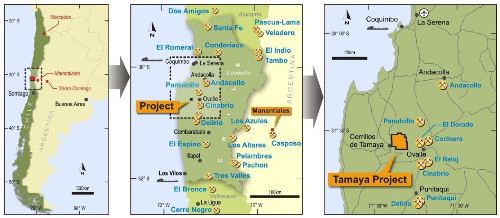
The Cerrillo Tamaya copper project comprises 5,690 hectares of mining concessions and 1,200 hectares of exploration applications.


Location map of the Cerrillo Tamaya project Chile. Source: Company announcement


It is located in the Cerrillo Tamaya historic mining district, 55 kilometres south of the regional capital and port of Coquimbo, which is endowed with exploration, mining, and development infrastructure.

Elementos described the Tamaya project’s prospective features to include:

–    Having been subjected to historic mining focused on high-grade copper ores – reported production of 2 million tonnes at 12 per cent copper (Non-JORC compliant) – leaving potentially significant volumes of lower grade material;

–    There is oxide and sulphide mineralisation evident at surface over the main four kilometre long vein system;

–    The project has potential for secondary veins and deeper mineralisation along the main trend, as well as bulk-tonnage breccia and stratiform mineralisation; and

–    The area has never been explored using modern day techniques.

“Exploration activities at Tamaya will test the remnants of the known mineralisation whilst exploring for new targets,” Elementos Limited said in its ASX announcement.

“A number of targets can be drilled quickly.

“Tamaya represents another exciting new opportunity for the Company in Chile, in addition to the recently announced Mercedes project, with the potential to discover bulk-tonnage, copper oxide and sulphide mineralisation in a proven mining district with stable jurisdiction.”

Elementos said it has plans for two parallel strategies at Tamaya, which include investigating the potential for delineating a copper oxide resource capable of development into a solvent extraction and electro-winning operation and exploration for sulphide copper-gold mineralisation for on-site treatment by flotation into concentrates.

Diatreme blows up Cylcone Reserve estimate

THE BOURSE WHISPERER: Diatreme Resources has announced a maiden ore Reserve estimate for the company’s Cyclone zircon project in Western Australia.

The Reserve estimate is part of an ongoing Prefeasibility Study the company is carrying out on the project.

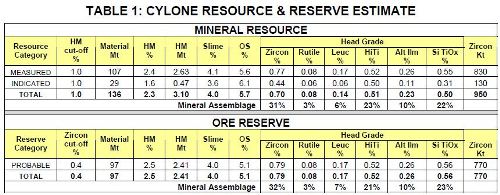
The Cyclone PFS pit design contains a Probable Ore Reserve of 97 million tonnes at 2.5 per cent heavy minerals (HM), including 0.79 per cent Zircon, containing 2.4 million tonnes HM, including 770 thousand tonnes of Zircon.


Source: Company announcement


According to Diatreme the ore Reserve is sufficient for 9.7 years of operations at a planned mining rate of 10 million tonnes per annum.

The company said it has further infill drilling and more detailed metallurgical testwork planned for the area to be carried out during the first two years of a mining operation.

“The company has reached a signal milestone with the release of a Maiden Ore Reserve estimate for the Cyclone project together with the recently announced metallurgical testwork results which indicated high value zircon and titanium mineral products,” Diatreme Resources executive chairman and chief executive officer Tony Fawdon said in the company’s announcement to the Australian Securities Exchange.

“The prefeasibility study is at the point wherein a market study currently underway will augment the Ore Reserve estimate with information on pricing for specific Cyclone mineral products.

“This market study will allow the calculation of the revenue stream from the proposed mining operation.

“Results of work to date have confirmed the company’s optimism in progressing the future development of the Cyclone project.
 
“With forecast historic high mineral price levels and supply shortfalls in zircon and titanium feedstocks expected over the coming decade, it is clearly a good time for Diatreme to bring the Cyclone project on stream.”

Stellar to raise $5.7 million

THE BOURSE WHISPERER: Stellar Resources is set to raise a combined $5.7 million, before costs, via a share placement and entitlement offer that will increase the company’s cash position to approximately $6.5 million.

Stellar has placed 39.2 million fully paid ordinary shares with institutional and sophisticated private clients of Taylor Collison at a price of eight cents per share to raise $3.1 million.

The company is also providing existing Australia and New Zealand-based shareholders the opportunity to participate in a fully underwritten one for six non‐renounceable entitlement offer, also at eight cents per share to raise an additional $2.6 million.

Stellar shareholders approved the issue of 43.5 million new shares to Gippsland Limited in January as consideration for its minority interest in the Heemskirk tin project in Tasmania.

“The acquisition removed considerable uncertainty related to the previous ownership structure and has removed a barrier to institutional investor’s interest in Stellar,” Stellar Resources said in its ASX announcement.

“Stellar is now pleased to welcome Resource Capital Funds as a cornerstone investor in Stellar through its participation in the share placement and commitment to the entitlement issue.”

Stellar said in intends using the funds raised by the placement and entitlement offer to advance the Heemskirk tin project toward the completion of a bankable feasibility study.

The company said it expects drilling to commence at the project in March that will focus on expanding the Severn deposit with a follow‐up program to the results reported in November 2011 of 6 metres grading 1.1 per cent tin.

Stellar also plans to use some funds to carry out drill testing on priority exploration targets, in particular the St Dizier tin mineralisation.

Alacer updates Higginsville Resource and Reserve

THE BOURSE WHISPERER: Alacer Gold has updated the Mineral Resource and Reserve estimates for its Higginsville gold operations in Western Australia.

The company has increased the project’s Mineral Reserve estimate by 164,000 ounces (net of mining depletion over 18 months) to 7.9 million tonnes at 3.5 grams per tonne gold, containing 875,000 ounces.


Source: Company announcement


“This updated Higginsville Reserve is the culmination of extensive drilling and other work since July 2010, Alacer Gold president and chief executive officer Edward Dowling said in the company’s announcement to the Australian Securities Exchange.

“The net increase of 164,000 ounces is quite significant considering that the Higginsville gold operations produced more than 230,000 ounces of gold during the 18 months to December 2011.”

Alacer said the increased reserves were mainly due to down‐plunge extensions of the Trident ore body, which stood at around 500,000 ounces when the company commenced mining it four years ago.

More than 500,000 ounces have now been produced from Trident, and the Trident reserve remains more than 500,000 ounces.

“It is important to note that the Measured and Indicated Resources for Trident and Chalice total a combined 5.7 million tonnes at 4.9 grams per tonne gold, containing 895,000 ounces,” Dolwing continued.

“Further drilling should progressively convert more resources to reserves as well as continuing to extend both resources.

These efforts take time, but we are excited about the likelihood of additional high‐margin ores as demonstrated by the recent high‐grade discovery at Corona within the Higginsville Line of Lode.”

The company said it expects an increasing proportion of Higginsville feed will be high‐grade ore accessed from underground mines following the ramp-up of Chalice ore production later this year.

Alacer said this will take Higginsville a long way towards its target of processing 1.5 million tonnes per annum at a head grade of 4.5g/t gold, producing approximately 200,000 ounces per annum.