Middle Island raises $10 million

THE BOURSE WHISPERER: Middle Island Resources has raised $10 million (before costs) through the placement of 25 million ordinary shares at 40 cents each.

The bulk of the new shares went to a number of large institutional investors based in Australia and North America.

The capital raising is the first undertaken by the company’s since its ASX-listing in December 2010.

The issue price represents a 60 per cent premium to the IPO issue and, the company said, is consistent with the stock’s 30 day volume weighted average price.

The placement will be completed in two tranches and will take the company’s cash position to approximately $16 million.

Middle Island said the funds raised by the placement will primarily be used to advance and accelerate exploration programs on its gold exploration properties in West Africa.

The company is currently drilling resource targets in Liberia and Burkina Faso.

“Our new shareholders were invited to participate on the basis of their strong track record as discerning long-term investors, considerably strengthening what is already an extremely solid register,” Middle Island Resources managing director Rick Yeates said in the company’s announcement to the Australian Securities Exchange.

“I thank them sincerely for their participation and support, and look forward to working closely with them as we progress our aggressive gold exploration and development strategy in West Africa.”

Trafford identifies Black Hill anomalies

THE BOURSE WHISPERER: Trafford Resources has received results from a regional soil survey the company carried out over its 100 per cent-owned Peterlumbo tenement located in the north of the Eyre Peninsula, South Australia.

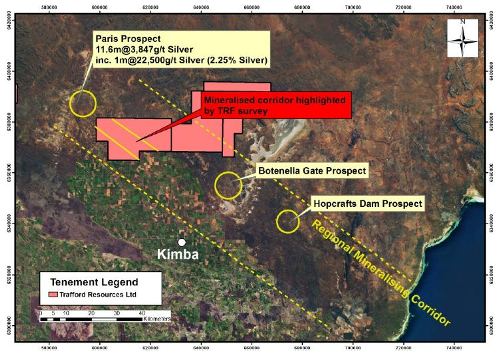
Trafford said the results have identified a number of discrete silver, gold and copper geochemical anomalies on its Black Hill prospect.

The results highlight the potential for an extension of Paris style mineralisation where the company hit intersections of high-grade silver, and reported up to 1 metre at 22,500 grams per tonne silver (2.25 per cent Silver).

The regional geochemical soil sampling program employed the same partial leach analysis method that was used by neighbouring ASX-listed company Investigator Resources in 2011 to delineate its Paris discovery located immediately to the northwest of Trafford’s Peterlumbo tenement.

The Black Hill prospect, within Peterlumbo, is approximately 15 kilometres from the Paris prospect.

Source: Company announcement

“The company will immediately follow up these successful results with further infill sampling, where necessary and a program of Rotary Air Blast (RAB) drilling,” Trafford Resources said in its ASX announcement.

“The success of this survey, alongside the 2011 Paris discovery, confirms this region of the Gawler Craton as one the most exciting, emerging exploration hot spots within Australia.”

In addition to the Black Hill prospect, Trafford indicated it is also expecting results from partial leach soil surveys undertaken at the Death Adder and Pier prospects in the coming weeks.

Northwest and Millennium ink JV agreement

THE BOURSE WHISPERER: Northwest Resources and Millennium Minerals have inked an agreement to form a formal Joint Venture Agreement relating to the companies’ 50:50 Camel Creek Joint Venture.

Northwest and Millennium are both developing gold projects in the Nullagine goldfield located in the eastern Pilbara of Western Australia.

In October 2011, Northwest and Millennium announced a non-binding heads of agreement for a 50:50 JV, under which Northwest’s Camel Creek Trend gold deposits will be mined and processed by Millennium through its Golden Eagle treatment plant, which is currently under construction.

Gold produced from the JV deposits and all mining, processing and administration costs relating to the JV will be shared by the two companies on a 50:50 basis.

Millennium will take on the role of manager of the Joint Venture, where mining is anticipated to commence in early 2015.

Northwest’s Nullagine gold and antimony project comprises the high-grade Blue Spec Shear gold-antimony deposits as well as its lower grade Camel Creek Trend gold deposits.

“Northwest is currently advancing its Blue Spec Shear deposits through feasibility studies as a standalone high-grade gold and antimony underground mining operation,” Northwest Resources said in its ASX announcement.

“The Camel Creek Trend open pit deposits do not form part of Northwest’s Blue Spec Shear development plans given their difference in mineralisation style to the Blue Spec Shear deposits, however they are a natural fit with Millennium’s project, sharing the same geology and mineralisation style as Millennium’s satellite deposits located along the Camel Creek Trend.”

Gold Anomaly discovers 900m drill target

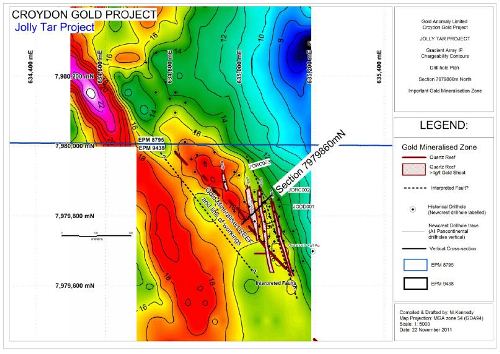
THE BOURSE WHISPERER: Gold Anomaly has claimed the discovery of a 900 metre long Induced Polarisation (IP) anomaly parallel to the existing gold zone at the company’s Jolly Tar gold project located near Croydon in north Queensland.

The discovery stems from the company’s 2011 field season of IP gradient array and dipole‐dipole surveys conducted at the Jolly Tar and the Gilded Rose‐Jumbo gold project in the same area.

Gold Anomaly said the surveys revealed an anomalous IP chargeability anomaly paralleling and west to the existing drilled gold zone at Jolly Tar.

Source: Company announcement

“The new IP anomaly extends for over 900 metres along strike and remains open to the northwest and southeast,” Gold Anomaly said in its ASX announcement (see figure 1).

“Based on the past drill hole gold assay data and recent IP surveys, drilling to test the new IP anomaly is warranted in order to define the extent of the deposit which will complement gold mineralisation already outlined at Jolly Tar.”

Gold Anomaly described the Jolly Tar prospect to be marked by prospecting pits and shallow shafts from artisanal miners.

The company said the prospect consists of several quartz veins and quartz zones hosted by granite.

“A small area of the Jolly Tar prospect has been drilled in the past by vertical aircore, RC and diamond core methods,” Gold Anomaly said it is ASX announcement.

“Assay results defined a body of gold mineralised quartz bearing material along strike for 480 metres that has been drilled down dip for approximately 140 metres (vertical depth approximately 60 metres) where it appears to have been faulted off as drilling further east failed to locate similar mineralisation.”

The company explained that drilling has shown the hanging wall of what is referred to as a ‘quartz zone’ hosts gold mineralisation and that up to 50 per cent graphite is also present in the footwall granitic rocks of this mineralisation.

The single diamond drill hole that has been drilled through this zone contains an intercept of 16.5 metres at 2.65 grams per tonne gold from 18.5m.

Sandfire kicks off underground

THE BOURSE WHISPERER: Doolgunna district measuring stick Sandfire Resources has announced that it has commenced mining of the first massive sulphide ore.

The ore is being mined from underground at the company’s DeGrussa copper-gold mine, located 900 kilometres north of Perth in Western Australia.


DeGrussa copper-gold project location. Source: Company announcement


The company said the first truckload of massive sulphide has been loaded and successfully delivered to the run of mine (ROM) pad ready for processing through the concentrator.

Processing is due to begin in the September quarter of 2012.

Sandfire said the commencement of underground ore mining represented another achievement notch on the company’s belt.

The commencement of mining activities at DeGrussa was accomplished ahead of the schedule outlined in the company’s Definitive Feasibility Study and just two weeks after the first direct shipping ore was mined in the open pit.

“This is another exciting step in our transition to production,” Sandfire Resources managing director Karl Simich said in the company’s announcement to the Australian Securities Exchange.

“I would like to commend our team once again on their efforts, with this significant milestone coming ahead of schedule and, once again, within three years of the discovery of the DeGrussa deposit.”

Aguia applies to extend phosphate zone

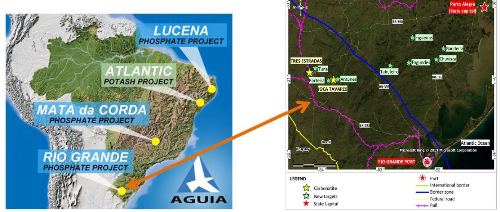
THE BOURSE WHISPERER: South America-focused potash and phosphate exploration and development company Aguia Resources has submitted an application for a tenement that covers the southern extension to the company’s recently discovered Tres Estradas (TE) phosphate project located in the state of Rio Grande do Sul in southern Brazil.

Aguia has lodged the application with the National Department of Mineral Production (DNPM) by way of a public tender process for the tenement south of TE.

Aguia said it has been advised by the DPNM that they were the only company to tender for the tenement and thus have priority on the application.

The company is now waiting to hear back from the DPNM to be advised as to when the tenement will be granted.


Location of the company’s projects in Rio Grande do Sul State, SE Brazil. Source: Company announcement


Aguia said the tenement in question hosts the southern extension of the magnetic feature co-incident with the phosphate carbonatite host rock it discovered while undertaking a recent program of diamond and auger drilling.

Results of this drilling have been previously released to the market in November 2011 and February 2012.

These demonstrated widths and grades of phosphate mineralisation over one kilometre and highlighted the area’s potential to host a near surface phosphate deposit in close proximity to infrastructure, primary agriculture customers and fertiliser blenders.

The new application has the potential to extend the prospective zone to 2.4 kilometres.

“We are excited by the recent discovery at TE and this recent application is another opportunity to expand our targeted resource.” Aguia Resources managing director Simon Taylor said in the company’s announcement to the Australian Securities Exchange.

“We look forward to announcing results of the beneficiation test work to the market in conjunction with our first Mineral Resource estimate from Tres Estradas.”

IMX increases Snaefell estimate

THE BOURSE WHISPERER: IMX Resources has announced an increased mineral resource estimate at the company’s wholly-owned Snaefell iron ore project in South Australia.

The company has increased the Snaefell estimate to 569 million tonnes at 27.1 per cent iron using an 18 per cent iron cut-off grade.

The Snaefell iron ore project is located 12 kilometres west of the Cairn Hill iron ore JV mining operation, located 55km south of Coober Pedy.


Location of Snaefell 2012 Mineral Resource, drill holes and cross section. Source: Company announcement


The new estimate represents a 184 per cent increase on the company’s maiden resource of 200 million tonnes at 27.65 per cent iron (using an 18 per cent iron cut-off grade) reported in October 2011.

IMX said the entire upgraded resource averages over 27 per cent iron, which it considers to demonstrate the consistency of the magnetite mineralisation.

“Snaefell has exceeded our expectations and is a significant and growing asset in our portfolio of iron ore projects,” IMX Resources managing director Neil Meadows said in the company’s announcement to the Australian Securities Exchange.

“Its location, in close proximity to the Cairn Hill mine and existing transport infrastructure, makes Snaefell a key component of IMX’s South Australian magnetite growth strategy.

“We expect to commence the next phase of metallurgical drilling in the next quarter and to complete scoping and pit optimisation studies during 2012.”

IMX claims the Snaefell magnetite iron ore mineralisation extends for 2.7km, with mineralisation remaining open along strike and at depth.

The company said it believes the actual size of the resource is only limited by amount of drilling it has completed so far.

The upgraded resource block model will now be optimised as part of a scoping study which is expected to be completed in 2012.

Diamond core drill planning is also underway to test the depth extent of the Snaefell mineralisation, and to obtain further core samples for ongoing metallurgical testwork.

Rox receives Teck’s Myrtle exploration timetable

THE BOURSE WHISPERER: Teck Australia has informed Rox Resources of its intentions regarding exploration activity over the latter’s Myrtle zinc-lead project, located 20 kilometres south of the large McArthur River zinc mine in the Northern Territory.
 

Teck Australia holds an option to earn up to a 70 per cent-interest in Myrtle from Rox.


Myrtle project location. Source: Company announcement


Teck recently completed a 1,200 line kilometre airborne gravity survey using the Falcon system flown at 400 metre line spacing over the project area.

The survey covered 422 square kilometres of the 669sqkm Myrtle tenements, from which data processing is now underway.

Teck has advised Rox it has budgeted approximately $2.1 million during 2012 to undertake a significant field exploration program, which includes:

–    Airborne Gravity Survey (data acquisition phase completed);

–    Completion of a drilling campaign commenced in 2011;

–    Regional target compilation and mapping;

–    Surface geochemistry;

–    3D modelling;

–    HeliSAM; and

–    Reconnaissance IP.

Rox said the drilling campaign that commenced in 2011 is set to recommence as soon as weather conditions permit.

“The 2012 exploration program proposed by Teck is exactly the reason we chose them to be our joint venture partner on this exciting project,” Rox Resources managing director Ian Mulholland said in the company’s announcement to the Australian Securities Exchange.

“Not only will they drill in and around the Myrtle deposit, but they will also give the highly prospective regional exploration the attention it deserves and this should generate a number of priority targets for further exploration.”

Preparatory work completed last year by Teck included construction of a three dimensional geological model, ground magnetics, surface geochemistry, ground gravity, ground electromagnetics (EM) and induced polarisation (IP) geophysical surveys.

Compilation of all previous work was also completed to produce a high quality geological database for the project.

Rox has established a JORC compliant mineral resource of 43.6 million tonnes at 4.09 per cent zinc and 0.95 per cent lead, which the company claims makes Myrtle one of Australia’s ten largest zinc projects, and the only such zinc project not already in the hands of major mining companies.

The company’s exploration target for Myrtle is 100 to 200 million tonnes grading between 10 to 12 per cent zinc and lead.


Silver Mines upgrades Webbs

THE BOURSE WHISPERER: Silver Mines has announced a 400 per cent upgrade to the Indicated and Measured JORC resource at its fully‐owned Webbs silver project in north‐eastern New South Wales.

Silver Mines has increased its Resource to 969,000 tonnes averaging 269 grams per tonne silver for a contained resource of 8.4 million ounces of silver.

The company said additional Inferred resources of 3.4 million ounces also exist.

Silver Mines claims the average grade of the resource provides further confirmation that Webbs is currently one of the highest grade undeveloped silver projects in Australia.

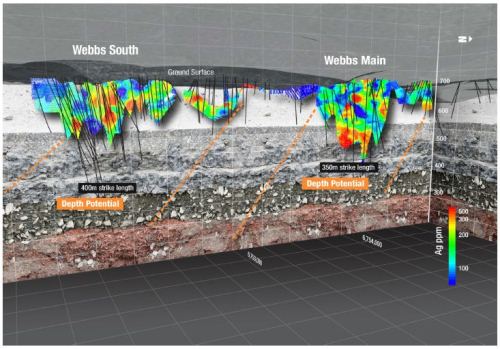
The company anticipates upgrades and increases in overall tonnage and contained silver ounces once it has completed additional deeper and extensional drilling as the deposit still remains open along strike to the south and down plunge at Webbs Main and Webbs South.


Long Section Looking west of Webbs silver deposit showing resource grade. Source: Company announcement


“We have achieved another key milestone with a 400 per cent increase in JORC Indicated and Measured resources at the Webbs project.

“As well as the significant upgrade in resource category, we are particularly pleased in maintaining an excellent high grade of over eight ounces of silver per tonne.

“Much of this resource is contained at relatively shallow depths, which augurs well for potential initial open pit development.

“With a high proportion of the current resource in the higher confidence JORC category, the Webbs silver project can now move to a more advanced stage of evaluation.

“We now look forward to our next drilling program and hope to significantly expand the resource base at Webbs.”

Goodrich commences trading on ASX

THE BOURSE WHISPERER: Exploration company Goodrich Resources has commenced trading on the boards of the Australian Securities Exchange.

The listing of Goodrich follows the completion of an initial Public offering of 17.5 million shares at 20c per share to raise $3.5 million.

Goodrich said its IPO received strong support from investors in difficult market conditions attracting two major Chinese cornerstone investors.

The first of these being Hong Kong-listed company Hanking Mining, which is one of the largest independent iron ore producers in north-eastern China.

The other key investor was Casin Group, a large Chinese conglomerate with interests including mining, environmental protection and infrastructure.

Goodrich said it intends focusing its attention on its New South Wales projects situated in the Macquarie Arc, an area which hosts a number of world class deposits and mines.


Goodrich Resources NSW Macquarie Arc projects. Source: Company announcement


In total, the company has interests in six projects in NSW and three in the Northern Territory, ranging from advanced-stage exploration assets with near-term resource potential, to early-stage projects.

The company’s lead project is the Calarie copper-gold project in central NSW.

Calarie lies in close proximity to the 2.3 billion tonne Cadia-Ridgeway copper-gold deposit of Newcrest Mining.

The Calarie project covers an area of 54 square kilometres that Goodrich considers to be a near-term resource development opportunity, with an initial exploration target of 500,000 to 515,000 tonnes at 2.0 to 2.3 grams per tonne gold.

Goodrich has already conducted additional exploration pre-listing, including Induced Polarisation (IP) geophysical surveys and a 1,000 metre drilling program.

The company plans to release a JORC-compliant resource report for Calarie as soon as it is completed.

Goodrich has also scheduled targeted exploration across all of its projects, commencing in NSW.

Goodrich also has confidence in its NT projects, which it claims represent prospective, early-stage exploration opportunities with the potential for the discovery of gold mineralisation similar to Newmont Mining’s major Callie gold deposit, which is located close to Goodrich’s South Tanami project.

“We are delighted to confirm Goodrich Resources’ ASX listing and commencement of quotation of its securities today, and it is a fantastic result in what has been a very difficult period in investment markets,” Goodrich Resources chairman Alex Alexander said in the company’s announcement.

“We have attracted a discerning group of investors, who see real value in our diverse project portfolio and our accelerated exploration plans, and we look forward to rewarding their support by delivering strong shareholder value.”