Chesser reports Kestanelik maiden resource

THE BOURSE WHISPERER: Chesser Resources has reported a maiden JORC-Code Mineral Resource estimate for the company’s Kestanelik epithermal gold project, located in Turkey.

The Resource estimate comprises an Inferred Resource of 5.9 million tonnes at 2.4 grams per tonne gold for 462,000 ounces of gold at 0.5 grams per tonne gold cutoff.

“We are particularly encouraged by the grade and tenor of this maiden resource as it is based on drilling we have carried out on only 3.5 kilometres of the more than 22 kilometres of veins that we have identified at Kestanelik and also on only eight of the more than 88 veins that we have identified on the property,” Chesser Resources managing director Dr Rick Valenta said in the company’s announcement to the Australian Securities Exchange.

“So more than 90 per cent of the veins remain untested and outside this maiden resource.

“Most of the resource is very shallow and should be mineable by open cut methods.”

Valenta said the company’s scout work had identified the next 5.5km of veins it will drill.

This is where Chesser has previously recorded some encouraging drilling results, including 6m at 46.4 g/t gold.

“There are numerous other strong indications that these veins are similar and warrant systematic drilling,” Valenta continued.

“Drilling is continuing and we would expect to be in a position to announce an increased resource, based on the current and planned follow-up program, in 2013.”


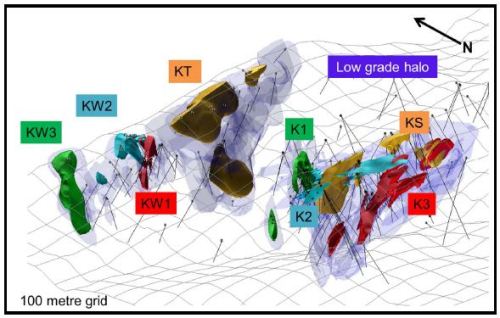
Mineralised zones modelled as part of the resource estimate. Source: Company announcement


The resource is based on mineralised zones which have been defined for the K1, K2, K3, KS, Karakovan (with three subzones) and Karatepe (KT) structures, all of which have been recognised at surface as well as in geophysical surveys and drilling.

Resources from individual high-grade zones from the project, also at a cutoff of 0.5 g/t gold, include:

–    K3 zone – 1,931,000 tonnes at 2.5g/t gold (158,000oz gold);

–    K2 zone – 1,055,000 tonnes at 3.2g/t gold (108,000oz gold);

–    KS zone – 1,132,000 tonnes at 2.5g/t gold (90,000oz gold);

–    K1 zone – 553,000 tonnes at 2.0g/t gold (36,000oz gold); and

–    Karakovan zone – 1,258,000 tonnes at 1.73g/t gold (70,000oz gold).

Quintessential confirms Semben as high-grade gold target

THE BOURSE WHISPERER: Copper – gold exploration play Quintessential Resources has claimed confirmation of high-grade gold mineralisation in trenches at the company’s Semben prospect in Papua New Guinea.

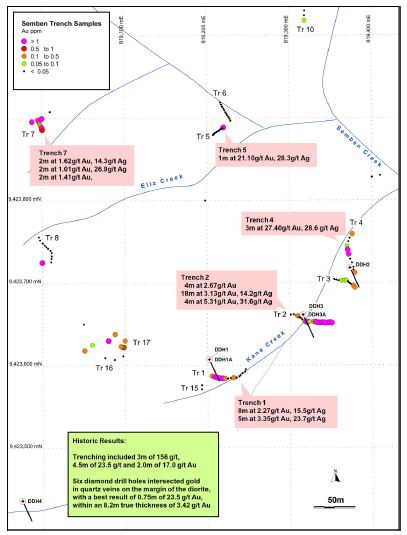
Quintessential collected 225 trench and channel samples at the Sembe prospect of between 1 metre and 3 metre lengths from historic trenches that had been cleaned and deepened.

The company also collected 19 rock chips and five rock float samples.


Semben trench sample locations and results. Source: Company announcement


Quintessential has re-assayed all trenches it has located and excavated three new short trenches on the project to ensure it has a comprehensive and valid data set from which to work with.

Six of the rock chip samples recorded greater than 1.0 grams per tonne gold, with a peak grade of 5.37g/t gold and 95g/t silver in widely dispersed areas.

The recently completed trench results include:

–    3 metres at 27.40 grams per tonne gold and 29.0 grams per tonne silver;

–    18m at 3.13g/t gold and 14.2g/t silver;

–    1m at 21.10g/t gold and 28.3g/t silver;

–    5m at 5.35g/t gold and 23.7g/t silver; and

–    8m grading 2.27g/t gold and 15.5 g/t silver.

“Quintessential are committed to aggressively exploring the Bismarck licence. Quintessential Resources managing director Paige McNeil said in the company’s announcement to the Australian Securities Exchange.

“We continue to drill at Tekem and Mal and have now completed a regional reconnaissance exploration program at the exciting Semben gold prospect.

“The mineralised structure at Semben is interpreted to be up to three kilometres long and Quintessential will now evaluate the strike potential and geometry with systematic grid based soil sampling.

“Six very short diamond core holes (282m total) were drilled on four fences at Semben in 1992/93 over a 500m strike length and results to 28.6g/t gold were returned.

“Additional trenching will also be undertaken and the cohesive and high tenor gold results will be drill tested by the company’s CSD500 diamond coring rig when possible.

“The Semben area has excellent high-grade gold potential that Quintessential intend to fully investigate.”

What the Brokers say

THE BOURSE WHISPERER: Every now and then The Roadhouse obtains research notes from different broking establishments. Here’s a few that hit our inbox this week.


Blackham Resources

Recently acquired the Matilda gold project located in the Wiluna region of W.A. The projects assets include previously operating mines, some infrastructure and a JORC resource of 12.5 million tonnes at 1.9 grams per tonne gold for 757,000oz of gold, made up from four nearby deposits.

Blackham has a near term exploration target of plus 1Moz gold with significant exploration potential at depth and along strike of the existing deposits.

A recent 4,000m RC drill campaign confirmed the prospectivity of the targets by intersecting wide zones of ‘ore grade’ mineralisation. Further opportunity exists to identify additional deposits hosted along 40km of strike over the Wiluna Mine Sequence and 10km strike along the Coles Find Mine Sequence.

The Wiluna plant, owned and operated by Apex Minerals, is located in close proximity to the Matilda project and has both oxide and sulphide treatment circuits. Potential exists to toll treat oxide ore through the plant providing Apex with additional revenue and operational efficiencies (as the plant is underutilised) while Blackham has the opportunity for early cash flow to fund additional exploration and development costs.

Blackham is also evaluating the potential of coal export and a Coal to Liquids facility to process lignite from the 1.4 billion tonnes Scaddan and Zanthus deposits located near the port of Esperance. The project is well serviced by infrastructure and may warrant a standalone mining operation for the export market should an appropriate lignite market be identified.

Recommendation: Speculative Buy

 

Tiger Resources

Tiger Resources is a copper producer with high-quality assets in the Katanga copper belt of the Democratic Republic of Congo.

It can add significant value in the near term by increasing copper production to plus 50,000 tonne per annum and by potentially buying out its 40 per cent JV partner. Katanga Province is currently a focus of corporate activity, so M&A potential is considerable.

Key Points:

–    Copper producer: Kipoi project (DRC) output is 35ktpa of copper in concentrate  with offtake by Trafigura at the mine gate.

–    Low operating cost: Stage 1 opex target $0.42 per pound copper with open pit mining of oxide and concentration by Heavy Media Separation (HMS).

–    Plans to expand production: DFS expected late 2012 for 50ktpa copper cathode (up to 100ktpa) by solvent extraction and electrowinning (SX-EW).

–    Strong forecast EBITDA: CY2013e is US$106m (P/E 1.9) based on current operation; CY2014e is $196m (P/E 1.4) after SX-EW expansion.

–    Potential to add value by acquiring remaining 40 per cent project share held by JV partner, Gécamines (DRC miner).

–    A likely takeover target: Katanga copper belt is a focus of M&A activity by majors (e.g. Minmetals/Anvil – C$1.3bn; Jinchuan/Metorex – US$1.4bn).

Our 12-month target for the stock is $0.85, based on current 35ktpa copper HMS production and a plus $150 million expansion to 50ktpa copper by SX-EW. This could increase to $1.18 if Tiger acquires the 40 per cent of Kipoi held by Gécamines.

The DRC is a challenging place to work but in our view, operational risks are outweighed by the quality of the Kipoi asset, the potential for plus 50ktpa copper production, and the possibility of corporate action.
An approximate 1 per cent sell-down by shareholder Fidelity from Nov 11 to Apr 12 affected the share price, which has now started to recover.

 Recommendation: Buy


Altona Mining

 
AOH has successfully made the transition from developer to producer at the Outokumpu project and will produce 8,000 tonnes per annum copper, 8.4k ounces per annum gold and 1.6ktpa zinc (approx. 10ktpa copper equivalent) in concentrate for approximately 9yrs at the Kylylahti underground mine via conventional flotation at the 550ktpa Luikonlahti plant.

Cash costs will average US$1.38 per pound (FSBe) which will result in operating cashflow of approx. $50m p.a. to be re-invested back into exploration at both Finland and Queensland. We also highlight the potential upside at Outokumpu with the plant fully permitted and capable of being increased to 750ktpa (to deliver approx. 15ktpa copper equivalent) for capex of $8m.

Roseby to be a large scale operation: The recently released DFS has outlined economics based on a large tonnage (7Mtpa), low grade (0.6 per cent copper) operation with ore sourced predominantly from the Little Eva open pit.

Cash costs of US$1.73/lb (previous FSBe US$1.40/lb) and capex of $320m (previous FSBe $250m) are both higher than what we had previously modelled however the project remains robust based upon our long term copper price forecast of US$2.75/lb, delivering annual average EBITDA of approx. $120m (FSBe).

We reiterate our BUY recommendation and have reduced our price target to $0.60/sh (from $0.80/sh) following a refinement to our modelling.

Recommendation: Buy

Winmar completes $3M placement

THE BOURSE WHISPERER: Winmar Resources has completed a $3 million placement to PXSteel International Asia Corporation Limited.

Winmar advised the market it has now received funds from the second tranche of the placement, being $820,000 via the issue of 4.1 million Winmar shares at 20 cents per share.

This represents a 100 per cent premium to Winmar’s share price, as of 16 May 2012.

Payment of the second tranche of the placement was subject to an independent expert’s report and shareholder approval, which was required as PXSteel’s shareholding in the company will now exceed 20 per cent.

Winmar said it will be using the funds to fast track the exploration program at the company’s Hamersley iron project, located in the Pilbara region of Western Australia.


Winmar’s Hamersley project. Source: Company web site.

The company recently commenced the next phase of drilling and metallurgical test work at the Hamersley project.

Winmar has a Joint Venture Agreement with Cazaly Iron, a wholly owned subsidiary of ASX-listed Cazaly Resources, for the Hamersley project.

Under the terms of the JV Agreement, Winmar is able to earn 51 per cent of the project by way of its exploration expenditure.

The Hamersley project is located in close proximity to Fortescue Metals’ Solomon project and Rio Tinto’s Marandoo and Brockman mines.

The project has a current JORC Inferred Resource of 241.6 million tonnes at 54.3 per cent iron, which includes a main CID zone of 169.1Mt at 55.6 per cent iron, and an Exploration Target of 350 to 400Mt at 54 to 56 per cent iron.

Tiger produces at 200 per cent capacity at Kipoi

THE BOURSE WHISPERER: Tiger Resources has pumped 203 tonnes of copper in concentrate through the Heavy Media Separation (HMS) plant at the company’s Kipoi copper project in the Democratic Republic of Congo.

This level of production is 200 per cent above the HMS plant’s nameplate capacity of 35,000 tonnes per annum of copper in concentrate.


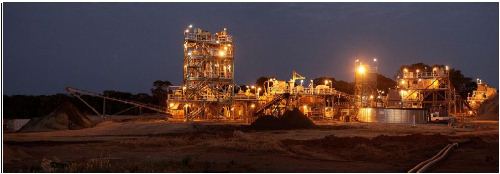
Kipoi HMS plant. Source: Company announcement

The numbers are the result of Tiger achieving two consecutive months of production in excess of nameplate capacity with the plant producing 3,506 and 3,066 tonnes of copper in concentrate for March and April 2012 respectively.

“We now have our focus clearly on growth through exploration success, acquiring quality assets, completing the Definitive Feasibility Study for the solvent-extraction and electro-winning (SXEW) plant, and the continued delivery of production expectations underpinning our business plan,” Tiger Resources managing director Brad Marwood said in the company’s announcement to the Australian Securities Exchange.

The Kipoi project is located 75 kilometres from the city of Lubumbashi and covers an area of 55 square kilometres in the Katanga Province of the DRC.

According to Tiger Resources the project contains a 12km sequence of mineralised Roan sediments that hosts at least five known deposits: Kipoi Central, Kipoi North, Kileba, Judeira and Kaminafitwe.

The company has reported JORC-compliant resources at three of the deposits: Kipoi Central, Kipoi North and Kileba.

The principal deposit is Kipoi Central, which contains a zone of high grade copper mineralisation within a much larger, lower grade global resource.

The company has adopted a staged development approach at the Kipoi project.

Tiger said it would be exploiting the high-grade zone of mineralisation at Kipoi Central during its Stage 1 development phase.

During the three-year operation of Stage 1, Tiger anticipates processing 900,000tpa of 7 per cent copper through the HMS plant with a recovery rate of 55 per cent to produce the equivalent of approximately 35,000tpa of payable copper.

Tiger is currently undertaking a feasibility study to evaluate the economic viability of constructing a SXEW plant (Stage 2), targeted to come on-stream by April 2014.

It is envisaged that ore from Kipoi Central, Kipoi North and Kileba South and the other deposits within the Kipoi project and within the nearby Lupoto project would be processed during the Stage 2 phase.


Matilda strikes alliance with Doral at Keysbrook

THE BOURSE WHISPERER: Matilda Zircon has entered a strategic alliance with leading mineral sands producer Doral over its Keysbrook mineral sands project in Western Australia.

Matilda has struck a binding toll treatment term sheet, short term funding agreement and share subscription agreement with Doral the company said puts it on track to becoming a mineral sands producer.

Construction at Keysbrook is scheduled to begin in late 2012 and first production targeted for late 2013.

Matilda claims the Keysbrook project will make it one of the world’s largest annual producers of leucoxene, an important feedstock for titanium dioxide production.

Based on current resource estimates, Keysbrook will have a mine life of more than eight years.

The toll treatment agreement with Doral will result in Matilda producing approximately 10,000 tonnes of zircon and 70,000 tonnes of leucoxene annually from the Keysbrook project.

Key terms of the toll treatment agreement are:

–    Toll treatment cost of approximately $65 per tonne of wet concentrate;

–    Matilda to contribute an estimated $5 million to $10 million for Doral plant modifications during the construction phase of Keysbrook; and

–    Toll treatment continues for the life of the Keysbrook project.

Doral will also provide a US$4.5 million short-term loan facility to Matilda, ensuring it has sufficient funds to complete a feasibility study at Keysbrook as well as other activities required for the project’s development.

“This agreement is a massive game-changer for Matilda and its shareholders,” Matilda Zircon chairman Mal Randall said in the company’s announcement to the Australian Securities Exchange.

“It means Matilda will only need to build a wet processing plant and not a dry processing plant, effectively saving the company about $15 to $20 million in capital expenditure and in the process slashing the risk profile of the project.

“To secure such a strategic agreement with a company which is as globally respected and as highly experienced as Doral, is a huge vote of confidence in Keysbrook.

“We can now look forward to the imminent completion of the feasibility study, which we are confident will confirm that the economics of the project are extremely robust, and proceed as rapidly as possible towards construction of what will be a world-class mineral sands project.”

Carbon Conscious commences eucalypt planting

THE BOURSE WHISPERER: Carbon forestry project developer Carbon Conscious has welcomed the seasonal rainfall, which has allowed it to commence planting for the 2012 season.

During the 2012 season, 10,000 hectares of mallee eucalypt trees will be planted in the wheatbelt region of New South Wales.


Planting seedlings. Source: Company


The company released profit guidance to the market in January of $3.5 million Net Profit After Tax, which it said it is on track to achieve.

“Under our 2012 contract arrangements, the company will receive revenue in line with our earnings guidance for this financial year,” Carbon Conscious chief executive officer Peter Balsarini said in the company’s announcement to the Australian Securities Exchange.

“Carbon Conscious has received a client payment of approximately $5 million for planting commencement and will receive a further $5 million on completion of planting.

“Rainfall in key planting areas has expedited site preparation and more than 10 million seedlings provided by seven local nurseries are scheduled for delivery over the next eight to 10 weeks.”

In addition to the revenue received at the time of planting, Balsarini said once Carbon Conscious completes this season’s planting it will have secured a 15 year revenue stream.

“At the completion of the 2012 planting program, Carbon Conscious will have approximately 19,000 hectares of plantings under management across Australia and New Zealand,” Balsarini continued.

“Ongoing contract revenue associated with existing projects will exceed $43 million over the next 15 years.”

Carbon Conscious said it has received a number of new client enquiries from organisations looking to meet carbon liabilities arising from the Clean Energy Act 2011.

There has also been much interest from New Zealand companies with liabilities under the New Zealand Emissions Trading Scheme (ETS).

“We are seeing growing interest from a range of sources seeking our internationally compliant carbon credits,” Balsarini said.

“As more countries develop carbon pricing mechanisms, such as South Korea’s new cap-and-trade emissions trading scheme, there is increasing appetite for global carbon offset investments.

“We believe our low-risk, large-scale projects using proven technology will meet these investments and we are investigating additional project sites.

“Our initial expansion into the New South Wales wheatbelt will see approximately 1,000 hectares of mallee eucalypt plantings in 2012 with more land being identified for the 2013 planting season.”

ABM completes Old Pirate study

THE BOURSE WHISPERER: ABM Resources has received the results of the Old Pirate Stage 1 Open Pit Scoping Study recently conducted on the company’s Old Pirate gold deposit located in the Northern Territory.

The Old Pirate deposit is situated on the same project as the company’s multi-million ounce resource at the Buccaneer porphyry gold deposit.

The study has modelled the Stage 1 Old Pirate open pit to contain 832,000 tonnes at 11.5 grams per tonne gold for 308,000 ounces of gold and is based on both Inferred and Indicated Resources Estimations the company announced in April.


Oblique 3D view showing resource model and open pit design. Source: Company announcement

The study found the presence of high-grade coarse free gold at Old Pirate allows for construction of a simple Gravity Processing Plant with savings on capital expenditure and processing compared to conventional cyanide leach processing.

Work is also on-going under a Memorandum of Understanding with Tanami Gold to consider processing Old Pirate material at the Coyote gold mine located 45 kilometres from Old Pirate.

“We are very pleased with the outcomes of the Entech Scoping Study for Old Pirate,” ABM Resources managing director Darren Holden said in the company’s announcement to the Australian Securities Exchange.

“The study presents the potential for a low-cost and highly profitable open pit mining operation.

“Considering that the Scoping Study neither takes into account possible underground development nor is optimised to include known gold-bearing veins outside the resource, we are considering this as a first base case with upside yet to be factored in.

“ABM is currently exploring another three kilometres of prospective strike length of sedimentary horizons at Old Pirate targeting gold bearing vein material.”

ABM pointed out that the Old Pirate Deposit is located on an Exploration Licence and consists of both Inferred and Indicated Resources.

The company is currently trenching extensional veins at Old Pirate and a drilling program will commence shortly.

ABM said that it still needs to conduct further testing, resource definition, design, feasibility studies and environmental work as well as obtaining regulatory approvals for a Mineral Lease before mining can commence. This work is on-going.

Phoenix enlarges tenement holdings

THE BOURSE WHISPERER: Phoenix Gold has reached agreement with a private vendor to purchase a 100 per cent interest in the Kintore gold project in Western Australia.

The Kintore project adjoins the company’s Castle Hill project situated within its extensive land holding on the Zuleika and Kunanalling shear zones northwest of Kalgoorlie.

The Kintore project and comprises three mining leases and four prospecting licences.


Kintore gold project tenements (green) and Phoenix projects. Source: Company announcement


Phoenix said the acquisition is in line with its strategy to re-consolidate landholdings on what it described as two of the most well-endowed shear zones in the WA goldfields.

“The continued consolidation of this region is fundamental to our strategy of developing a significant mid-tier gold developer and producer in the medium term,” Phoenix Gold managing director Jon Price said in the company’s announcement to the Australian Securities Exchange.

“We look forward to completing the technical work at Kintore to deliver a maiden Resource to add to our growing Resource base.

“Kintore becomes part of the large Castle Hill gold system that is now emerging as a significant and very large new gold camp in the WA Goldfields.”

The vendor has agreed to sell the Kintore project to Phoenix for $800,000 in cash and shares comprising:

–    An upfront cash payment of $25,000;

–    A cash payment of $375,000 on completion of a formal sale agreement;

–    1.6 million fully-paid ordinary Phoenix Gold shares (at a deemed price of $0.25); and

–    A $30 per ounce production royalty on ore produced from the Kintore tenements.

Phoenix said it expects to execute and complete a Formal Sale Agreement in the September Quarter of 2012 subject to any shareholder, government and regulatory approvals that may be required.

The Kintore project has been comprehensively drilled over the last five years but a JORC Resource has yet to be estimated.

Phoenix has undertaken a detailed assessment and is in the process of completing all the required logging, down hole survey, re assaying and data validation to enable a maiden Resource estimate to be generated.

The company indicated this is anticipated to be delivered in the September Quarter of this year.

Central Asia strikes deal with Glencore subsidiary

THE BOURSE WHISPERER: Perth-based gold explorer and developer Central Asia Resources has reached an agreement with Kazzinc, a subsidiary of major mining house Glencore, to enable it to sell gold produced from its Dalabai gold project in Kazakhstan.

In addition to the agreement with Kazzinc, Central Asia has also received its own export permit to sell gold from the Kazakhstan Government.

Central Asia said the combination of the agreement with Kazzinc as well as the export permit will enable it to consider and cost all options in determining the most cost-effective and efficient method of selling its gold.

Central Asia recently used its agreement with Kazzinc for its first sale as it allows the sale of gold without the necessity of an export permit.

“Revenue from this sale is expected within ten days,” Central Asia said inits ASX announcement.

“Central Asia will inform the market of the full details of the initial sale in the coming weeks.”

Central Asia has been processing resin at the Dalabai project since February and had recently deposited 500 ounces of gold in the company’s bank vault in Kazakhastan.


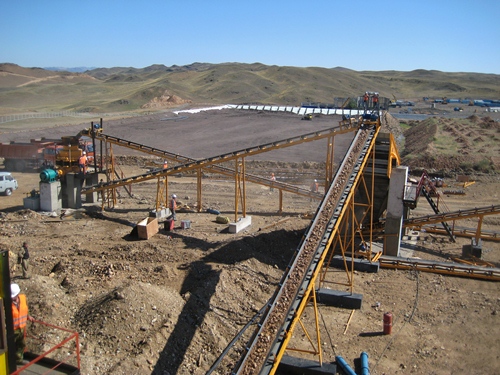
Primary crushed ore being conveyed at Dalabai. Source: Company

The company has also achieved an important milestone in terms of production ramp up at Dalabai where the mine is consistently crushing and stacking in excess of 1,000 tonnes of ore per day.

“Given ore grade and recoveries, this moves the company closer to its preliminary goal of producing 1,000 ounces of gold per month,” Central Asia said.

“This is 50 per cent of Dalabai’s optimal capacity.”

The company indicated it would provide detailed cash costs when Dalabai reaches nameplate production.