Mithril Resources acquires new WA gold project

THE BOURSE WHISPERER: Mithril Resources (ASX: MTH) has signed a Farm-in and Joint Venture Letter Agreement with KalNorth Gold Mines (ASX: KGM).

The deal will result in Mithril earning up to an 80 per cent interest – by completing expenditure of $2 million over 4 years – in the Spargoville gold project, which is located immediately adjacent to the company’s Spargos Reward gold project near Kambalda in the Eastern Goldfields of Western Australia.
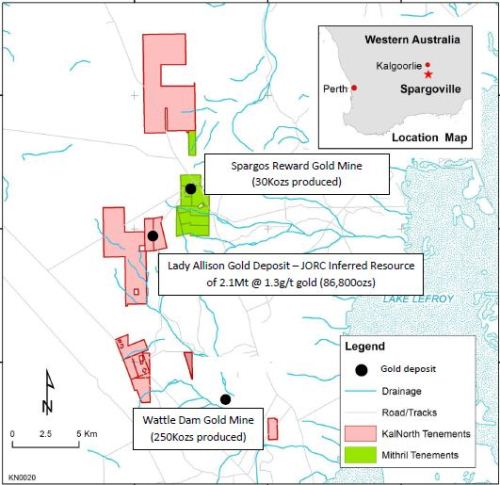
 

Spargoville location plan showing Mithril’s 100 per cent–owned
Spargos Reward gold project (green) and KalNorth’s Spargoville gold
project (red). Source: Company announcement


Mithril recently commenced a 1,300 metre RC drill program to test the extensional potential of the Spargos Reward gold mine at the Spargos Reward gold project with results expected by late January 2013.

Mithril explained the Spargoville gold project is located on the Kunanalling Shear, a regional shear zone that hosts significant gold mineralisation, including  Ramelius Resources’ (ASX: RMS) operating Wattle Dam gold mine (total production of 250,000 ounces gold), and Spargos Reward (total production of 30,000 ounces of gold at 8 grams per tonne from during the 1940’s and early 1980’s).

Mithril considers Spargoville to contain a number of walk-up drill targets, which the company believes offer excellent exploration upside.

These include the Lady Allison gold deposit where a JORC Code-compliant Inferred Resource of 2.1 million tonnes at 1.3g/t gold (86,800ozs) was estimated by KalNorth Gold in late 2011.

The acquisition of Spargoville, in conjunction with Spargos Reward gold project, increases Mithril’s landholding within the area to approximately 75square kilometres, which it claims consolidates its position within the Eastern Goldfields of Western Australia.

“The Spargoville acquisition is significant for a number of reasons,” Mithril Resources managing director David Hutton said in the company’s announcement to the Australian Securities Exchange.

“Not only does it give Mithril access to a number of exciting exploration targets immediately adjacent to our Spargos Reward gold project, the transaction sees the start of a longer term strategic relationship with KalNorth Gold Mines, a rapidly emerging Perth – based gold mining company.

“We see considerable exploration upside at Spargoville and look forward to commencing exploration activities early in the March Quarter next year.”
Silver Stone Resources to acquire OreCorp and all its Ethiopia and Mauritania projects

THE BOURSE WHISPERER: Silver Stone Resources (ASX: SSZ) has entered into an implementation agreement to acquire 100 per cent of the issued capital of unlisted company OreCorp Limited.
 

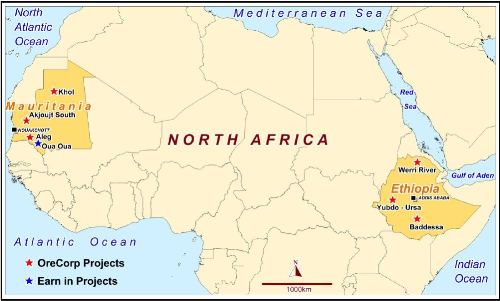
OreCorp holds various interests in gold and base metals projects located in Ethiopia and Mauritania.


Source: Company announcement


OreCorp’s key projects are the Yubdo – Ursa project in Ethiopia, prospective for gold and nickel, chromium, platinum and the Akjoujt South project, prospective for gold-copper in Mauritania.

OreCorp also holds a right to acquire up to a 90 per cent interest in the Oua Oua project in Mauritania, prospective for gold-base metals.

The new entity will emerge with approximately $9 million cash and no debt with a mandate to pursue exploration.

“The Acquisition of OreCorp and its projects are supported by its directors and key stakeholders,” Silver Stone Resources said in it ASX announcement.

“On completion, Silver Stone will become a well-funded gold and base metals exploration company with interests in Ethiopia, Mauritania and Western Australia.”

The deal will also see OreCorp directors join the Silverstone Board, including Craig Williams – former president and CEO of Equinox Minerals – as Chairman and Matthew Yates – former joint managing director of Mantra Resources – as CEO and managing director.

The company’s name will change to “OreCorp Limited”.

Silverstone said OreCorp’s directors unanimously support the terms of the implementation agreement.

AusAmerican identifies new VMS target at Bluebell

THE BOURSE WHISPERER: Australian-American Mining (ASX: AIW) has identified a new copper VMS target on recently-staked ground one kilometre north of the company’s Bluebell mine in Arizona.

The Bluebell North target was identified during the ongoing interpretation of a data package the company acquired in October this year.

The data recovered and interpreted includes:

–    339 soil samples on a 15 to 30 metre by 120 metre grid, 1km north of Bluebell (1990);

–     120m line-spaced magnetic survey covering 5 square kilometres around Bluebell (1989); and

–    Interpretation of EMP survey covering 5sqkm around Bluebell (1989-1990).


Soil sample locations and rock samples (AusAmerican, 2012) on simplified geology. Source: Company announcement


“We are excited by the soil anomaly at Bluebell North as it shows potential for copper mineralisation outside of the mine area,” AusAmerican managing director Richard Holmes said in the company’s announcement to the Australian Securities Exchange.

“We plan to follow-up in the field to confirm the soil anomaly and complete a soil sampling program over a wider area in the first quarter of 2013.”

According to AusAmerican the soil samples demonstrate a 700m long copper anomaly over a threshold of 100 parts per million copper with an average copper grade within the anomaly of 413ppm with a highest value of 1,262ppm.

The anomaly is open towards the south at Bluebell North and sits on the eastern edge of a prominent magnetic ridge, a similar setting to the Bluebell mine.

Bluebell North is sensibly located north of the recent mapping completed by AusAmerican.

The recently acquired data package indicates that the anomaly sits within the Yavapai Schist; host to both the Bluebell and De Soto mines.

AusAmerican will drill the Bluebell open pit target in Q1 2013 and will complete geophysical work over the newly staked ground in Q2 and Q3 in 2013.

Triton Gold signs revised JV in Mozambique

THE BOURSE WHISPERER: Triton Gold (ASX: TON) has signed a revised formal Joint Venture (JV) agreement with Mozambique company Grafex Limitada.

The revised JV follows the completion of extensive due diligence and negotiations undertaken by Triton over the past few months.

Under the original terms of the JV, Triton could earn up to an 80 per cent interest in the Grafex portfolio of projects over a four year period, this has now been reduced to two years.

The revised JV terms have also removed the first earn-in phase which was 25 per cent.

Triton can now earn straight into a stronger position of 49 per cent interest in the project with the exploration expenditure commitment of just $0.5 million.

The total investment required from Triton over this period has also been reduced from $1.5 million down to $1 million in expenditure commitments and cash payments to Grafex, along with the issuance of up to 15 million ordinary Triton shares to Grafex, subject to some escrow provisions and the issuance of 10 million unlisted Triton options.

In addition, Triton now has a five kilometre Area of Interest (AOI) around all of the project licenses, which it said increases its access to the surrounding land previously identified as prospective by aeromagnetic and radiometric data.

“The new Joint Venture terms now give Triton immediate and greater access to projects in a region that is considered highly prospective for graphite discoveries,” Triton Gold managing director Brad Boyle said in the company’s announcement to the Australian Securities Exchange.

“Through a single transaction, Triton now has the opportunity to earn up to 80 per cent of the existing portfolio of tenements with a number of drill targets already defined.

“With the addition of the AOI around the current project, Triton has the ability to increase their substantial landholding and create new opportunities of identifying further drill targets, thus increasing the Company’s probabilities of locating graphite rich areas.

“The new transaction terms allows us to move quickly into exploration, and has saved both time and money.

“For us to have done this on our own, one project at a time would have added a number of years to the timeline as well as additional costs and regulatory hurdles.”

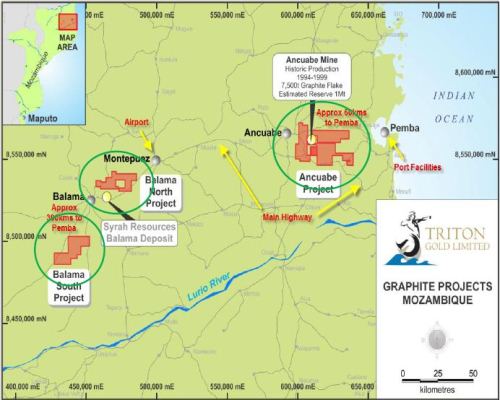
Grafex is the sole beneficial legal holder of five Graphite prospecting licenses in the Cabo Delgado Province of Mozambique, three of which are still under application.


Overview of the five Mozambique License Application areas and approximate AOI in green.


Last month two of the exploration licenses were approved by the Mozambique mines department.

Triton indicated it has been advised the remaining three license applications should be granted in the near future.

This region has been of recent focus for graphite potential in part due the activities and positive results released by ASX-listed company, Syrah Resources (ASX: SYR).

One of the already approved licence areas is situated close to Syrah’s Balama East deposit, which is approximately three kilometres to the South-West of the boundary of Triton’s North Balama project.

Triton Gold said the signing of the Joint Venture agreement along with the granting of Exploration Licences by the Mozambique government allows it to start work in a region already known for its graphite mineralisation.

Although the country is now in the beginnings of the wet season, the company has already committed to a range of preparatory work which will position it for a more expansive exploration campaign early in 2013, including drill testing at several targets.

Sheffield announces maiden HM Resource at Thunderbird

THE BOURSE WHISPERER: Sheffield Resources (ASX: SFX) has announced a maiden mineral resource (Indicated and Inferred) for the Thunderbird prospect at the company’s Dampier heavy mineral sand (HMS) project near Derby in the Kimberley Region of Western Australia.

The Resource has come in at 1.37 billion tonnes at 6.1 per cent heavy minerals (HM) for 83 million tonnes of contained HM.

The resource includes a coherent high-grade core (at 7.5 per cent HM cut-off) of 517 million tonnese at 10.1 per cent HM (Indicated and Inferred) containing 3.6 million tonnes of zircon, 0.8 million tonnes of rutile, 2.2 million tonnes of leucoxene and 15.2 million tonnes of ilmenite.

This zone averages 20m thickness and is considered by the company to represent a good target for initial development studies.

The company claimed in-situ valuable heavy mineral (VHM) grades for this zone of 0.70 per cent zircon, 0.16 per cent rutile, 0.44 per cent leucoxene and 2.9 per cent ilmenite places Thunderbird within the top tier of HMS deposits globally.

“Thunderbird has a large tonnage, high grade resource close to surface – these three qualities position Thunderbird as a globally significant mineral sands deposit,” Sheffield Resources managing director Bruce McQuitty said in the company’s announcement to the Austral8ian Securities Exchange.

“To deliver such a large maiden resource within 15 months of the grant of the tenement is a great achievement by our exploration team and an outstanding result for our shareholders.”

Thunderbird is the first major mineral sands deposit to be discovered in the Canning Basin, which Sheffield believes to be emerging as an important new mineral sands province and is favourably located close to Asian markets.

Sheffield has secured over 4,000 square kilometres within the Canning Basin which it plans to aggressively explore for further large scale deposits.


Location of the Thunderbird Deposit and Sheffield’s tenement holding in the Canning Basin. Source: Company announcement


Thunderbird is one of two HMS occurrences within Sheffield’s Dampier project, located on crown land on the Dampier Peninsula about 60km west of the port at Derby, and 25km north of the sealed Great Northern Hwy joining Derby and Broome.

“The next key milestone, expected in Q1 2013, is results of metallurgical testwork, currently being performed on a six tonne bulk sample from Thunderbird,” McQuitty said.

“Results from this work will pave the way for Scoping Studies to commence in Q2 2013.”

“Importantly, the mineralisation at Thunderbird remains open in all directions.

“Next year’s drilling campaign will target extensions to the deposit and provide an initial test of the Argo deposit, located 12 kilometres to the west.”

Beadell Resources pours first gold at Tucano project in Brazil

THE BOURSE WHISPERER: Beadell Resources (ASX: BDR) has completed its first gold pour at the company’s 100 per cent-owned Tucano gold project in Brazil.

The company said the nine kilogram gold pour was an important phase in the transition of the project to full operations.

First gold bar produced at the Tucano gold project. Source: Company announcement


During the commissioning phase the processing plant has operated at up to 400 tonnes per hour (3.5 million tonnes per annum) equal to the name plate design.

Beadell said the commissioning phase has progressed smoothly and the processing plant is now operating close to 24 hours a day.

 “The first gold pour at Tucano is a major milestone for Beadell as we position ourselves as a large scale low cost gold producer with at least 10 years of open cut mining now in front of us,” Beadell Resource managing director Peter Bowler said in the company’s announcement to the Australian Securities Exchange.

I look forward to updating our CY 2013 production plan early in the New Year, incorporating our ultra, high-grade (30g/t) open pit Duckhead oxide deposit.”
The company’s commissioning team is now working on a modified mill ball charge set up and is confident of exceeding nameplate throughput over the coming weeks.

Previously crushed low-grade stockpiled ore grading one gram per tonne has been fed into the milling circuit to date in lieu of high-grade ROM ore stocks waiting for the crushing circuit to be completed.

The crusher is now complete with high-grade ore of up to 2.5g/t scheduled to be loaded into the circuit over the coming days as soon as the commissioning team concludes their work.

This is the last section of the CIL plant to be handed over to the Beadell operational team.

MacPhersons okays Merrill Crowe plant and Nimbus expansion

THE BOURSE WHISPERER: The Board of MacPhersons Resources (ASX: MRP) has approved the new Merrill Crowe plant and introduced a gravity circuit to the proposed 480,000 tonnes per annum Nimbus Plant expansion at the company’s 100 per cent-owned Nimbus silver-gold-zinc project.

The company has produced  a stream of progressive drilling results highlighting new gold zones at Nimbus, which it considers to have demonstrated the requirement to bring forward the gravity gold/silver circuit to be ready at commissioning to recover free gold and silver.

MacPhersons anticipates the expansion of the plant circuit will allow for commissioning to occur in the first half of 2014.


New Nimbus 480,000tpa silver-gold-zinc plant expansion flowsheet. Source: Company announcement


A zinc/silver flotation circuit will also be added and will be ready for processing sulphide material earlier in the production schedule.

“An ongoing review of our mineral resource and the progressive drilling results has now shown that there will be an early component of gravity recoverable gold and silver from the Nimbus silver superpit,” MacPhersons Resources managing director Morrie Goodz said in the copany’s announcement to the Australian Securities Exchange.

“The earlier introduction of the gravity gold/silver plant and zinc/silver flotation circuits allows us to process ore from our additional gold assets at Boorara and Coolgardie immediately upon commissioning of the plant.

”This means the company will have an earlier diversification into silver, gold and zinc production in FH 2014.”

MacPhersons described the new plant design as larger and more flexible, allowing for early production from gold and zinc streams.

It will also allow for the co-treatment of ores from various sources, including the Boorara (located 2km west of the Nimbus mill) and Coolgardie gold projects.

MacPhersons believes the upgraded plant will be of significant benefit and will allow prompt processing of ore mined from the Nimbus silver superpit, as well as its gold resources.

In 2013, MacPhersons intends to shift its activity focus from exploration to production.

Upgrades to the JORC Classification of resources are ongoing.

The release of mineral resource statement along with the next pit optimisation study is planned for January 2013.

ERO Mining JV granted access to Billa Kalina by Defence Department

THE BOURSE WHISPERER: ERO Mining (ASX: ERO) has been granted a Deed of Access – Exploration by the Defence Department over Exploration Licence 4854.

The Exploration Licence is part of the Billa Kalina project, located in the Olympic Dam region of central South Australia.

The Billa Kalina project is being explored under the terms of a Joint Venture between ERO and Maximus Resources (ASX: MXR).

Under the terms of the JV ERO is earning a 50 per cent interest in the tenements (ELs 4854,4463, and 4899) by spending $3 million over the life of the Agreement.

ERO Mining is the manager and operator of the Joint Venture.

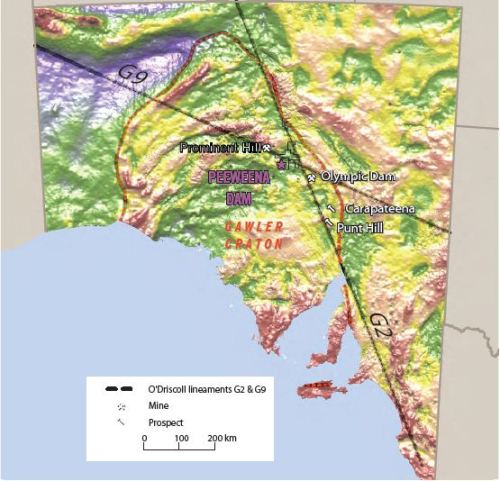
The Billa Kalina project is strategically located 70 kilometres north–northwest of the Olympic Dam copper–gold–uranium (IOCGU) mine, and 45 km east of the more recent discovery and mine development at Prominent Hill.

The project area is situated within the recently defined Restricted Amber Zone of the larger Woomera Prohibited Area (WPA).

ERO indicated on-ground exploration activities are planned to commence in January 2013.

The initial phase of this activity will be a ground gravity survey designed to validate a gravity anomaly at Peeweena Dam, which was first identified by a wide-spaced 7km by 7km region survey completed in the 1970s.


Location of Peeweena Dam gravity anomaly in relation to IOCGU mines. Source: Company announcement


“Confirmation of the Peeweena Dam gravity anomaly would be a highly significant result and justify a follow up deep drilling program to test the anomaly for iron oxide, copper, gold +/- uranium (IOCGU) mineralisation,” ERO Mining said in its ASX announcement.

“The company and our joint venture partner MXR are very pleased to have finally reached an agreement with the Defence Department at Woomera and to be able to recommence exploration at Billa Kalina after an absence of almost four years.”

Corazon Mining gains access to Top Up Rise from traditional owners

THE BOURSE WHISPERER: Corazon Mining (ASX: CZN) has completed a land access agreement with the Tjamu Tjamu (Aboriginal Corporation) RNTBC and Ngaanyatjarra Land Council (Aboriginal Corporation).

The agreement will facilitate the exploration of the company’s recently-acquired Top Up Rise project (TUR) in Western Australia.

The TUR project is located in the Gibson Desert region of north-eastern Western Australia and is considered by Corazon to be prospective for large gold-copper intrusive related deposits, similar in style to Olympic Dam, Prominent Hill and Carapateena.

The company said the signing of the Land Access Agreement is a significant step forward for the development of the TUR project, which includes an exploration licence that was granted in May 2011.

“This access agreement allows the company to seek a Ministerial Access Permit, which will provide authorisation for Corazon’s exploration teams to commence on-ground work within the project area,” Corazon Mining said in its ASX announcement.

“It is expected the current processes will see on-ground heritage clearances for proposed work programs commence in early 2013, with ground geophysics scheduled to be completed in the first quarter of 2013 and drilling to follow late in the first quarter/early in the second quarter 2013.”

“Corazon has secured an option to earn up to 75 per cent of private company Border Exploration, which owns 100 per cent of the TUR project.

The acquisition is conditional on both the granting of a Ministerial Access Permit and Corazon Shareholder approval.

Corazon has engaged an Independent Expert to prepare an Independent Valuation Report for the Top Up Rise Earn-In Agreement with Border.

This report will be included in the Notice of Meeting which the Company expects to put to its Shareholders in the coming weeks; the meeting is planned for January 2013.

Talga Resources signs Swedish port MoU

THE BOURSE WHISPERER: Swedish-focussed explorer Talga Resources (ASX: TLG) has signed a Memorandum of Understanding (MOU) in regards to the development of the company’s graphite assets in Sweden.

Talga has signed a non-binding MOU with the Port of Luleå (PoL) regarding the allocation of port space allowing up to 80,000 tonnes of graphite concentrate or more advanced products to be exported from Sweden.


Location map of Talga’s graphite projects and established transport
infrastructure in northern Sweden. Source: Company announcement


PoL is the sole operator of the public harbour in the north of Sweden.

Talga said it considers the possibility of securing a port as its primary export solution to be a key component of economic studies it is currently conducting on its Nunasvaara graphite project in Sweden’s Kiruna mining district.

“Since commencing exploration and development in Sweden in June this year, Talga has achieved a number of significant operational milestones over a short space of time,” Talga Resources managing director Mark Thompson said in the company’s announcement to the Australian Securities Exchange.

“The selection of the Port of Luleå as our export gateway for the company’s high-grade graphite assets is the right option to achieve our future export objectives.

“If we do not have port access, we will not have a graphite project.

“This MOU therefore represent an important milestone for Talga’s shareholders.”

According to Talga the MOU provides a framework between the parties towards securing a binding Port Terminal Services Access Agreement (PTSAA) in the future and utilising the integrated sea-logistics system at Luleå.

Talga is targeting 2015 for its first production.

Luleå is the largest bulk goods port in Sweden with the annual volume of goods handled exceeding nine million tonnes.

Approximately 700 vessels call at the Port of Luleå every year, many with a loading capacity of more than 55,000 tonnes each.

Commodities handled include coking coal, magnetite, steel and bentonite. The PoL operates year round.