AMMG produces high-purity alumina

THE BOURSE WHISPERER: Australia Minerals and Mining Group (AMMG) (ASX: AKA) claims to have produced over 99.9 per cent of high-purity alumina (HPA).

The company explained it has achieved this using its own unique aluminous clay (kaolin) to alumina processing technology.

AMMG used samples from all four of its South West HPA projects in Western Australia, which the company said proved to be a clean source of aluminous clay for HPA production using its process.

“Our unique technology varies from other aluminous clay to alumina technologies in that it uses substantially less energy; the process uses low temperatures and pressures,” Australia Minerals and Mining Group managing director Ric Dawson said in the company’s announcement to the Australian Securities Exchange.

“This innovative processing technology produces minimal waste and the key reagents are recyclable, therefore, the efficiencies are high.

“The successful testing should now build on the level of interest the company has received to date.

“HPA is a premium high-value product that is used in high-performance electronic applications, such as tablet screens and LED’s.”

AMMG’s 100 per cent-owned South West HPA project is held by its wholly-owned subsidiary Kaolin Resources.
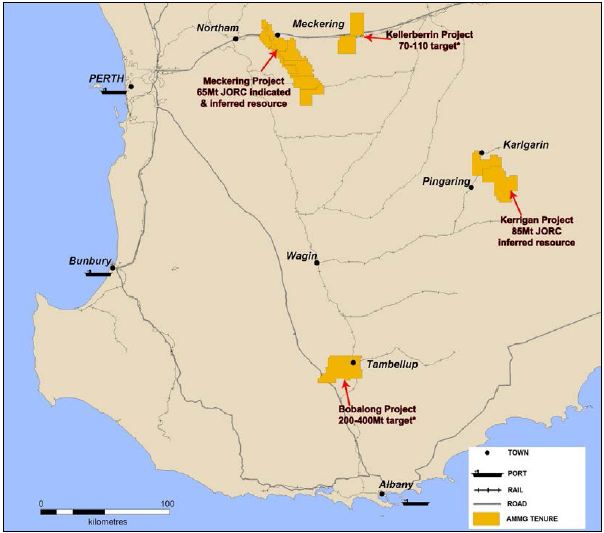
Tenement locations of AMMG’s South West alumina projects. Source: Company announcement

The project consists of one granted exploration licence and nine applications, where the company is targeting aluminous clay in the south west of Western Australia and in the Yilgarn mineral belt: Meckering, Kerrigan, Kellerberrin and Bobalong.

AMMG has delineated two separate resources on its Meckering and Kerrigan aluminous clay projects, totalling 150 million tonnes with screened grades of up to 38 per cent alumina, and an exploration target ranging from 485 million tonnes to 830 million tonnes.

The resource is made up of 85 million tonnes (inferred) at the Kerrigan project and 65 million tonnes (16.77 million tonnes indicated and 48.28 million tonnes inferred) at the Meckering project.

The company indicated it is currently planning its next phase of exploration in order to increase this resource.
International Goldfields to merge US gold company

THE BOURSE WHISPERER: International Goldfields (ASX: IGS) has executed a Definitive Merger Agreement with United States-based Santa Fe Gold Corporation to merge the two companies, resulting in Santa Fe becoming a wholly-owned subsidiary of IGS.

IGS claims the proposed merged entity will be a diversified, well-funded and low cost gold-silver explorer, developer and miner, listed on the ASX and also traded on a major US exchange or on the OTC.

The combination will amalgamate projects located in New Mexico (USA), Arizona (USA) and Brazil.

“We are pleased to have reached this important milestone in the merger process and look forward to completing the transaction in the coming months and building a combined gold company with solid production, yet significant upside.” International Goldfields chief executive officer Travis Schwertfeger said in the company’s announcement to the Australian Securities Exchange.

Schwertfeger’s trumpeting of the new deal was echoed by Santa Fe president and chief executive Pierce Carson.

“The two companies have individually and collectively achieved a number of key advances in recent months, which in our view provides further evidence as to the exciting opportunities being created by this merger,” Carson said.

Both parties estimate the merger will be completed in the second calendar quarter of 2013.

While the regulatory matters related to the merger have been taking shape, IGS indicated both companies have been in discussions with a number potential off take/project financing partners to provide funding to the combined entity.

These discussions are now at an advanced stage and with the signing of the Merger Agreement they are expected to be concluded in the coming weeks.

Global Strategic Metals granted Austrian mining licence

THE BOURSE WHISPERER: Global Strategic Metals (ASX: GSZ) has been granted a mining licence by the Austrian Mining Authority in respect to the company’s 80 per cent-owned Wolfsberg lithium project located in Carinthia, south of Vienna.

The granting of the licence enables the company to comply with its obligation to carry out mining activities on the project within two years of the granting of the original exploration licence.

The Mining Licence permits Global Strategic Metals to carry out mining activity to extract two 500 tonne bulk samples, without having to meet the requirement to complete a second egress (an escape way/drive of approximately 180 metres) as originally stipulated.

Global indicated the variation to the original licence not only provides time saving but also a cost saving of approximately €200,000 in contractor fees which would have been incurred to complete the egress.

Global was also successful in securing a reduction in the bond it is required to pay from €200,000 to €20,000.

Following the granting of the Mining Licence, which the company was able to achieve at a negotiated saving of approximately €430,000, Global has already called for three tenders from local contractors to extract the Bulk Samples.

Once the Bulk Sample exercise is completed, the leases pertaining to the project will be granted to the company permanently.

“The grant of the Mining Licence places the company in an excellent position to advance the project,” Global Strategic Metals chairman Tony Sage said in the company’s announcement to the Australian Securities Exchange.

“The anticipated achievement of absolute lease security will be a significant milestone for the company enabling it to progress with orderly development towards a concentrate and then carbonate production to supply the European lithium market.”

Clancy Exploration to sell JV interests to Gold Fields Australasia

THE BOURSE WHISPERER: Clancy Exploration (ASX: CLY) has agreed to sell the company’s Joint Venture interests in six copper-gold projects in New South Wales to its joint venture partner, Gold Fields Australasia.

Gold Fields Australasia is wholly-owned subsidiary of Gold Fields Limited.

Clancy will receive a total of $1.5 million from a combination of the sale consideration and a placement of shares to a related body corporate of Gold Fields.

Terms of the deal include:

1. The sale consideration will be $1 million in cash which is to be paid immediately upon settlement.

2. The equity component of $500,000 will be received immediately upon settlement of the placement, which is to be done at 3.5c per share – a 75 per cent premium to the current share price of 2c per share.

3. Clancy will retain its 2.5 per cent Net Smelter Return (NSR) royalties on the six projects (in addition to Wellington North), subject to Gold Fields having the right at any time to purchase the NSR’s for $20 million each.

4. Both parties’ pre-emptive rights and the Gold Fields back-in right on the Gobondery project will be terminated.

“Gold Fields and Clancy have been partners in NSW since 2004 and in that time the portfolio and the priorities of each party have evolved,” Clancy Exploration managing director Gordon Barnes said.

“This deal will enable Clancy to focus on generating value from its 100 per cent-owned projects without restriction and the cash and equity component will strengthen the company’s balance sheet and provide capital for ongoing exploration and/or project acquisition.”

Clancy has a minority interest in six joint ventures that Gold Fields is earning, or has earned, an 80 per cent interest in.

Once Gold Fields has earned 80 per cent equity in each of the projects, Clancy is required to either fund its share of the exploration cost, or dilute.

“Clancy’s priority is to fund projects that will generate the most shareholder value,” Barnes said.

“Raising finance to fund a minority JV interest is a difficult proposition.

“We have already been diluted to an NSR on the Wellington North JV and it is quite likely that we would dilute in future on the others.

“Keeping the NSR’s provides cash upside in the event of a future discovery by Gold Fields.

“The Board is currently working through a number of new project opportunities which, if they materialise, we hope would provide better leverage for Clancy shareholders than what is offered by the Gold Fields JV projects.”

Hannans Reward scoping study gives good marks to Rakkurijoki

THE BOURSE WHISPERER: Hannans Reward (ASX: HNR) has received results of a recently completed Scoping Study for the company’s Rakkurijoki iron deposit in Sweden.

According to Hannans the Scoping Study has determined the Rakkurijoki deposit to have the potential to supply iron product over a 12 year mine life, at a premium price, to the European and the Middle East North African (MENA) markets.

The Scoping Study evaluated the practicality of combining a low-cost logistics solution with the least mining, processing, financial and execution risk.

The company has been encouraged by the results of teh scoping study and has confirmed it will be moving to a Pre-feasibility Study (PFS) on the Rakkurijoki deposit.

The PFS will be expanded to include the Rakkurijarvi Iron deposit, located south-west of Rakkurijoki.

The company is now referring to the two deposits collectively as the Rakkuri iron project.

“The results from the Scoping Study are encouraging and we’ll complete a far greater level of analysis during the PFS,” Hannans Reward managing director Damian Hicks said in the company’s announcement to the Australian Securities Exchange.

“In terms of funding the PFS, our plan is to joint venture with a company that has a long history in developing iron ore mines.

“A partner that has an excellent track record in delivering bulk commodity projects within budget and on time.

The company indicated the focus for the Rakkuri project PFS will be on developing strict CapEx and OpEx disciplines, detailed planning, thorough financial analysis, developing a deeper understanding of both the markets for premium quality product in Europe and the MENA region, and the ability of the company to obtain the necessary environmental and social licenses.

The company has also appointed Magnus Arnqvist to the position of non-executive director.

Arnqvist is currently managing director of Kiruna Iron AB, wholly-owned subsidiary of Hannans.

“The Rakkurijoki deposit is a robust iron project with an excellent location and this has been a very thorough Scoping Study,” Arnqvist in the announcement.

“The actual mining process is straight forward, but we must now do more detailed planning during the PFS to fully understand the logistics chain, the processing, the market and the social licenses we need to operate in Kiruna.

“I look forward to continue providing oversight during that process.”

Hodges Resources completes Morupule South scoping study

THE BOURSE WHISPERER: Hodges Resources (ASX: HDG) has completed mine scoping and power integration studies for the company’s Morupule South project in Botswana.

Highlights from the study include:

–    Life of mine ROM production costs for 1.5 million tonnes per annum (Mtpa), 5Mtpa and 5-10Mtpa operations were US$10.18 per Run Of Mine (ROM) tonne, US$10.59 and US$10.96 on an owner operator basis and US$12.90 on a 1.5Mtpa contract mining basis;

–     The project can be developed through a staged process with capital costs ranging from US$55.7 Million for a 1.5Mpta contractor run mine for domestic coal markets up to US$199.6 million for the initial stage of a two stage development mine of 5Mtpa up to 10Mtpa; and

–    An initial operation scenario of 1.5Mtpa from open cast contract mining operations generates Net Present Value of US$384.2 million; and Initial Rate of Return of 29 per cent at current prices.

Hodges has approved feasibility phase studies for an initial start-up development of around 2 to 3Mtpa with a ramp-up to 5Mtpa within 3 to 5 years.

“After extensive evaluation of all the independent studies the Board of Hodges has approved the commencement of feasibility level studies to refine the operational and capital cost estimates associated with a staged development up to 10 million tonnes per annum run of mine coal operation”, Hodges Resources managing director Mark Major said in the company’s announcement to the Australian Securities Exchange.

The studies have also identified areas where Hodges could achieve additional operational and possible capital cost savings.

Hodges said it had now confirmed the potential for a robust project at Morupule South and any further savings will only add more value to the project.

The company said it considered the confirmation of the potential to develop the project through a staged process had a material impact on its attitude towards feasibility.

“Despite having the resources to support this, a run of mine production scenario of 20 million tonnes per annum has not been considered appropriate at this stage until developments are made to the existing rail and port infrastructure,” Major said.

Hodges indicated it will instead focus on the feasibility of an initial stage of operation requiring less capital supporting an operation for the domestic/regional coal markets with a run of mine ranging from 1.5 to 3Mtpa.

Having completed the scoping studies, Hodges said it is confident electricity demand exists to support the integration of the small scale power plant at Morupule South, and in doing so create an immediate market for the mine’s product given its proximity to an existing grid.

“We have a clearer view now on the commercially viable opportunity to develop a mine in a staged and less capital intensive manner, and to deliver product to satisfy Botswana’s emerging and increasing power requirements whilst longer term infrastructure developments are developed in the region,” Major said.

Apollo Minerals signs farm-in JV with Mincor Resources

THE BOURSE WHISPERER: Apollo Minerals (ASX: AON) and Mincor Resources (ASX: MCR) have settled on the terms of an exploration farm-in and joint venture agreement over exploration licence EL4932 in South Australia.
 
Apollo is currently developing an iron ore operation at Commonwealth Hill and is busy exploring the project area for further iron and base metals mineralisation.

The new agreement with Apollo provides it with improved access and infrastructure site selection options for its proposed iron ore development as well as a large, prospective land holding from which the company hopes to expand its iron and base metals interests.


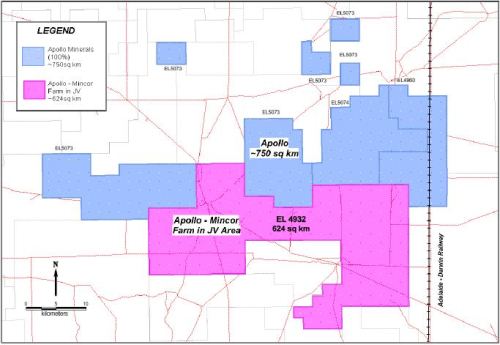
Tenement location plan showing Apollo’s approx. 750sqkm holding and
additional 624sqkm tenement through earn-in agreement. Source: Company
announcement


Under terms of the earn-in agreement, Apollo may earn a 75 per cent interest in exploration licence EL4932 by sole funding exploration totalling $2 million over a three year period.

Apollo has committed to a minimum exploration spend of $250,000 on EL4932 during the first year of the farm-in with Mincor.

At the completion of the farm-in, Mincor may elect to convert its residual 25 per cent interest into a gross production royalty of 3.5 per cent on gold, 2.5 per cent on base metals and 1.5 per cent on all other minerals.

On conversion Apollo would pay Mincor an amount equal to 25 per cent of the total spent on exploration during the farm-in, which is expected to be $500,000.

 “This agreement further strengthens Apollo’s position in what is a highly prospective iron ore and base metals province and is another demonstration of our commitment to develop the minerals potential of the region,” Apollo Minerals chief operating officer Dominic Tisdell said in the company’s announcement to the Australian Securities Exchange.

“Through hard work and careful planning we look forward to sharing the rewards of what is shaping up to be a very promising joint venture.

Winmar finalises 51 per cent earn-in of Hamersley project

THE BOURSE WHISPERER: Winmar Resources (ASX: WFE) has earned a 51 per cent interest in the Hamersley iron ore project.

Once all the necessary paperwork has been attended to the Winmar Exploration Joint Venture will be formed, in respect of the Hamersley project between Winmar and Cazaly Iron, which is a wholly owned subsidiary of Cazaly Resources (ASX: CAZ).

The respective interests of each company in the JV are: Winmar 51 per cent and Cazaly 49 per cent, while Winmar will continue to manage the project.


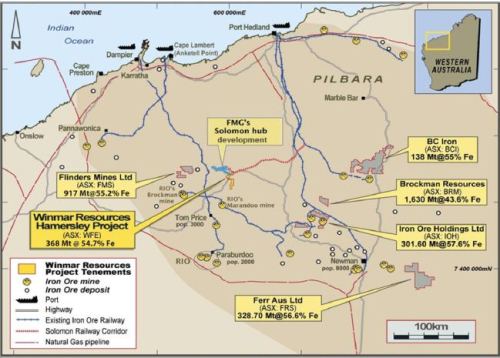
Location of Winmar’s Hamersley iron ore project. Source: Company announcement


“Winmar is delighted to have successfully earned into a beneficial 51 per cent interest in the Hamersley iron ore project, and looks forward to working closely with its joint venture partner to maximise the development potential of the asset,” Winmar Resources said in its ASX announcement.

“The Hamersley project is an advanced exploration target with major exploration upside and development potential.”

The company has conducted a series of works programs at the Hamersley project, designed to advance its development.

These have included a $2.2 million exploration program completed in 2012, which consisted a 20 hole RC drilling program, which culminated in a major Resource upgrade.
 
The current Inferred Mineral Resource estimate for the Hamersley project is 368 million tonnes at 54.7 per cent iron (58 per cent calcined iron), which includes a Channel Iron Deposit zone of 343.3 million tonnes at 55.3 per cent iron (58.7 per cent calcined iron).

Winmar commenced development activities on the project in 2012, which involved advanced metallurgical work, environmental assessments and Native Title negotiations.

The company completed its latest phase of drilling at the project in October 2012, which was a 10 hole RC program, designed to define the extent of shallow high grade mineralisation in the southwest of the project area.

Results from this drilling have yet to be released; however, Winmar indicated it anticipates using them to convert a portion of the Resource to the JORC Indicated category.

Winmar claims the Resource at the Hamersley project remains open in several directions with significant intercepts to the southwest and northeast on the edge of the current drill area.

Kupang Resources JV acquires additional Timor permit

THE BOURSE WHISPERER: Kupang Resources (ASX: KPR) announced to the market the Kupang Joint Venture, in which the company holds a 55 per cent interest, has completed the acquisition of additional land in the Belu District, on the island of Timor in Indonesia.

In November 2012, Kupang entered into a binding term sheet to acquire 95 per cent of the issued share capital of a local Indonesian company, Indo Co, which is the legal and beneficial owner of an area of 926 hectares located in the Belu District and a granted production license.

The parties recently re-structured the acquisition, which resulted in the interest in Indo Co and the subsequent rights to the Production Licence to now being acquired directly by the Kupang JV, rather than Kupang Resources the company.


Location of Kupang project and local infrastructure. Source: Company announcement


“The acquisition of the granted Production Licence by the Kupang Joint Venture is a key step towards the commencement of manganese exports from the Joint Venture’s land position,” Kupang Resources executive director Tony Sage said in the company’s announcement to the Australian Securities Exchange.

“The permit is a crucial milestone in commencing production, as Indonesian law requires such permits to be in place before processing and exports can commence.

“This will now allow finalisation of the permit process.

“Once this permit is granted to the Kupang Joint Venture stockpiling and processing of manganese on the Kupang Joint Venture landholding can commence, with processing to occur utilising the Joint Venture owned processing plant already on site.”

The permit is located approximately 175kms northeast of the Kupang JV current land holding in the district of Kupang.

The JV owns a processing plant situated on its current landholding it claims to be capable of producing 30,000 tonnes of high-grade Manganese lump product per month.

Kupang explained manganese mineralisation is principally found in both the Bobonaro Complex and Ofu Formation.

The company said manganese generally occurs as sedimentary sub-units or sedimentary intercalations in carbonate sequences within the new permit area.

This manganese has been exploited by artisanal miners previously and occurs close to the surface.

Manganese occurrences in the district have been shown to contain high-grades of manganese with low levels of contaminants such as iron, aluminium and phosphorous.

Rio Tinto maintains rail monopoly

THE BOURSE WHISPERER: Rio Tinto (ASX: RIO) has welcomed the Australian Competition Tribunal’s decision that the company should not be required to allow third party users to play with its Hamersley and Robe rail lines train set.

“This is great news,” Rio Tinto iron ore acting chief executive Paul Shannon said in the company’s brief announcement to the Australian Securities Exchange.

“Rio Tinto runs a highly efficient railway that is fully integrated with our port and mine operations.

“This would be severely hindered if third parties were allowed to run trains on our rail network, not to mention the knock-on negative effect on the Western Australian and national economies from creating such inefficiencies.”