Australian Bauxite lodges first bauxite Mining Lease application

THE BOURSE WHISPERER: Australian Bauxite (ABx) (ASX: ABZ) has lodged an Application for a Mining Lease with Mineral Resources Tasmania.

The company has also submitted a Notice of Intent to the Environment Protection Authority.

ABx executed a Term Sheet earlier this year with major Chinese aluminium company, Xinfa Group, which is currently conducting due diligence at the project having already completed a site review.

In consultation with Xinfa, ABx christened the Bald Hill bauxite project as its first mine, the name being derived from the lack of trees on the site.


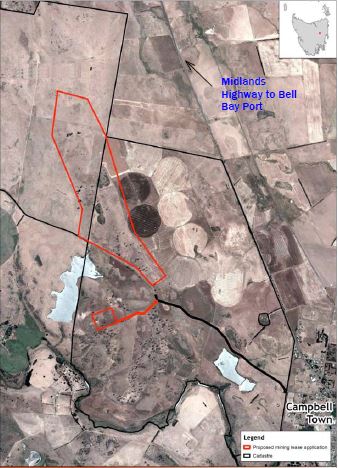
Aerial photo of the mining lease application area (red) and surrounds. Source: Company announcement


ABx’s first mining lease application is over 173 hectares off Macquarie Road, west of Campbell Town in the northern midlands of Tasmania.

“Our first Mining Lease Application has been submitted on schedule and without a hitch,” Australian Bauxite managing director Ian Levy said in the company’s announcement to the Australian Securities Exchange.

“We see the first new bauxite mine in Australia for more than 35 years responsible for creating some 140 to 225 new jobs, generating a total payroll in excess of $9.8 million per annum.

“This will provide a great boost for the local community.”

ABx said a critical aspect to the application process is a Development Proposal and Environmental Management Plan, which the company expects to be submitted mid-2013.

Mining is planned to commence in the second half of 2014.

Trafford Resources enters into Farm-In agreement with Alloy Resources

THE BOURSE WHISPERER: Trafford Resources (ASX: TRF) has struck a Farm-In agreement with Alloy Resources (ASX: AYR) on Trafford’s Lynas Find gold project, located approximately 100 kilometres south of Port Hedland in the West Pilbara region of Western Australia.

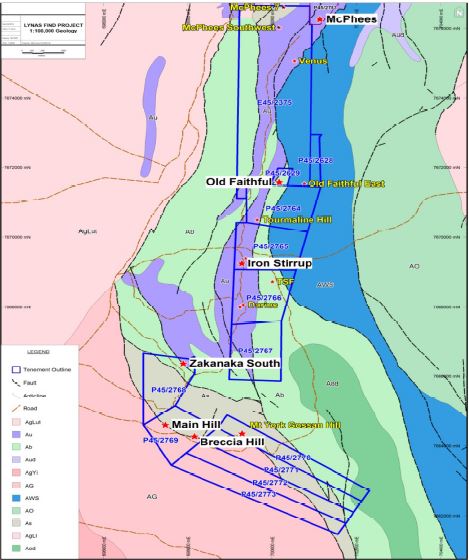
The Lynas Find project comprises twelve Prospecting Licenses and one Exploration License over two contiguous blocks, known as the Iron Stirrup Block and Mount York Block.


Lynas Find project tenements location and local geology. Source: Company announcement


“Trafford is proud to partner with Alloy and looks forward to working together to develop the economic potential of the project,” Trafford Resources said in its ASX announcement.

Under the terms of the agreement Alloy Resources has the right to earn an initial 51 per cent interest in each of the tenements located within the Lynas Find gold project by spending $500,000 within the first 12 months.

This initial expenditure is to include a minimum of 2,000 metres of reverse circulation or diamond drilling.

Alloy will then have the right to earn a further 29 per cent interest by spending an additional $1,000,000 in years two and three.

The agreement is subject to a period of due diligence to be conducted by Alloy.

Once it has completed due diligence to its satisfaction Alloy pay Trafford $50,000 and 10,000,000 fully paid ordinary shares of Alloy, at a deemed issue price equal to the VWAP of Alloy Shares for the 30 days prior to the date of issue.

Bligh Resources delivers scoping study at Bundarra project

THE BOURSE WHISPERER: Bligh Resources (ASX: BGH) has received results of a preliminary scoping study recently completed at the Bundarra gold project in the Leonora region of Western Australia.

Bligh holds a 42.9 per cent interest in SR Mining, which owns 100 per cent of the Bundarra project.

The scoping study was carried out by independent consulting firm, CSA Global, which was commissioned to assess the development potential of the project.

“Bligh is pleased with the results of the initial scoping study at Bundarra, as it confirms that the project has robust economics and the potential to provide significant cash flow over a considerable mine life,” Bligh Resources chief executive officer Robert Benussi said in the company’s announcement to the Australian Securities Exchnage.

“This is the first study that has been conducted over all four deposits at Bundarra, and it outlines the potential for very early stage cash flow generation with $14 million in year one assuming a gold price of $1,600 per ounce, and importantly, the potential to process 2,000 ounces of gold at the base of the Celtic pit providing an immediate revenue stream.”

The Bundarra project consists of four deposits; Celtic, Wonder North, Great Western, and Bluebush.

Bligh proposes to establish a 250,000 tonnes per annum processing plant adjacent to the Wonder North deposit to treat the remnant resources, which the company expects to provide potential process feed of 2.3 million tonnes at 2.2 grams per tonne gold, recovering 156,000 ounces gold.


Oblique view of Wonder North pit shell. Source: Company announcement


Highlights of the study include:

–    Confirmation there is development potential at the assumed gold prices;

–    The scoping study was modelled on existing total JORC resource of 318,000 ounces at 2.1g/t gold, consisting of 136,000 ounces Measured and Indicated and 185,000 ounces Inferred;

–    A mine life of nine years, at 250ktpa process feed;

–    Cash costs for four deposits range from $886 to $1126 per ounce, averaging $1036 per ounce;

–    Recovering grade controlled ore at the base of Celtic pit will provide about one month of mill feed, with $1,175 cash flow/recovered ounce at $1,600 per ounce;

–    Stage One of the Wonder North pit provides the next highest value process feed at $742 cash flow/recovered ounce at $1,600 per ounce; and

–    Significant exploration upside potential in and around existing deposits.

Bligh indicated is upcoming activities at Bundarra would include infill drilling to extend known mineralisation and JORC resource base, further metallurgical test work focused on the Bluebush and Great Western deposits, and advancing the project to feasibility stage.

“The company will now undertake further exploration works given the significant upside potential along strike and at depth across all four deposits,”

“The Board expects to increase the potential resource base and is assessing the optimal plant capacity and associated capital costs.” Benussi said.

BC Iron and Cleveland Mining Alliance sign Brazil MoU

THE BOURSE WHISPERER: BC Iron (ASX: BCI) and Cleveland Mining Company (ASX: CDG) have signed two Memoranda of Understanding (MoU) to earn the rights to acquire up to 80 per cent of three separate iron ore exploration projects in the Brazilian states of Salvador da Bahia and Minas Girais.

The proposed acquisitions constitute the first iron ore projects in Brazil for the Strategic Alliance that was struck between BC Iron and Cleveland in August 2012.


Location plan of proposed MoU projects. Source: Company announcement


The MoU propose a staged earn-in process linked to appropriate levels of exploration and development assessment for each successive stage and are conditional upon the satisfactory completion of long form Option to Purchase Agreements.

Since being formed, the BC Iron/Cleveland alliance has looked at a number of Brazilian iron ore opportunities, ranging from greenfields exploration prospects to producing mines.

“The Cleveland Alliance and these MoU are a natural part of BC Iron’s ‘Three Priorities’ Business Development strategy,” BC Iron managing director Mike Young said in the company’s announcement to the Australian Securities Exchange and possibly his last official duty in the role.

“The deal structure is consistent with our approach to potential growth opportunities in Brazil; that is, the upfront expenditure is relatively small but increases with success and de-risking, and we maintain a tight, commercial relationship with the Vendors, who have the in-country knowledge to assist with approvals and community liaison.

“The main game for BC Iron is, as always, maintaining its focus and operational efforts on the Nullagine JV and considering growth potential in the Pilbara, to maintain positive shareholder return and a strong balance sheet.

“This deal introduces early stage greenfield opportunities into the BC Iron stable which compliments the Pilbara focus appropriately.”

In its release to the ASX BC Iron explained the projects subject to the MoU were selected for further work based on outcropping iron mineralisation, geology, geophysical signatures, community attitude to mining development, and options for port and rail logistics.

The alliance has been targeting itabirite iron mineralisation that is expected to be in the range of 30 – 45 per cent iron, which could then be upgraded to a higher grade product.

This is typical of Brazilian iron ores, which are highly sought after by the international steel industry.

Cove Resources granted Finnish mining concession

THE BOURSE WHISPERER: Cove Resources (ASX: CVE) has had the Koivu titanium project mining concession in Finland granted by the Finnish government department responsible for mining and exploration tenement compliance (Tukes).

The company is now in a community consulting period, which it said is expected to be completed on 27 May.

“This is a significant milestone that the Cove team has been working towards for future mining at the Koivu titanium project,” Cove Resources said in its ASX announcement.


Location of the Koivu project in Europe. Source: Company announcement


Cove acquired the the Koivu titanium project in July 2012, which it said was in line with the company’s strategy to pursue appropriate merger and acquisition opportunities.

Cove considers the project affords it a path to production and a position as a major supplier of titanium pigment feedstock into European markets.

Lower commodity prices: What it could mean for Australia and Investors

THE BOURSE WHISPERER: While not exactly in free fall, global commodity prices have been in a determined slump since around mid-February when they took a sharp fall on concerns about global growth, particularly in the world’s favourite customer, China.

Back that up with a 10 to 15 per cent fall in the price of crude oil, copper, iron ore and gold prices there are, as you would expect to see, some implications for Australia and its investment community, especially if these lower prices are sustained.


Key Commodity Prices: Down 10-15% Since Mid-Feb. Source: Bloomberg, MSWM Research


According to the Portfolio Strategy and Research Group of investment house Morgan Stanley the situation opens major implications for Australia.

The first of these is lower inflation, which Morgan Stanley said was pushing underlying inflation to the low end of the Reserve Bank of Australia’s (RBA) target band.

“Australia’s March quarter Consumer Price Index (CPI) was lower than expected, with core inflation running at 0.4 per cent Quarter on Quarter (QoQ) and 2.4 per cent Year on Year (YoY) (averaging the trimmed mean and weighted median measures),” Morgan Stanley said.

“Lower commodity prices will, other things being equal, lead to a lower CPI. In addition, as the one-off impact from the introduction of the carbon tax drops out in the second half of 2013 (and predominately in 3Q), the headline CPI could slow a further 0.7 per cent and underlying inflation by 0.2 to 0.3 per cent YoY, pushing inflation to the low end of the Reserve Bank’s 2 to 3 per cent YoY target range.”

Morgan Stanley’s second implication for investors is lower capital spending, which it said will be highlighted as resources investment declines in 2014-15.

“Business investment is currently dominated by resources investment, with mining projects representing 60.6 per cent of business investment in the fourth quarter of 2012,” Morgan Stanley said.

The research house used the recent postponement of several key investment projects to highlight the effect the combination of the high Australian Dollar, high local costs and a deteriorating commodity price outlook has already had.

The effect has demonstrated it is not just the junior end of town that is suffering at present with projects scrapped from the drawing boards of major resource companies, with Woodside opting to mothball its James Point Browse LNG project and BHP Billiton pulling the pin on its Olympic Dam and Outer Harbour expansions.

Morgan Stanley analyst Nick Robison has forecast a peak in Engineering and Construction cap-ex in 2013, with cap-ex likely to decline significantly in 2014-15.

“Nick also noted 10 swing projects, including Browse that could alter the outlook,” Morgan Stanley reported.

“In all likelihood, lower commodity prices could pressure more of these projects, further lowering the cap-ex outlook.”

This trend was also outlined in the Chamber of Minerals and Energy of Western Australia’s (CME) recent edition of the WA Resources and Economics Report, prepared in conjunction with KPMG.

The report found the economic contribution of the mining industry in Western Australia is likely to increase as the sector transitions from construction to an operating phase.

The CME said that although there will be an anticipated deceleration in mining investment, this phase will see a significant shift in production levels in coming years – most notably in the bulk commodities and LNG sectors.

This, it said, will result in economic benefit to the State through company profits and additional royalty payments.

“Notwithstanding the softening of prices towards the end of last year, WA and the wider economy continues to benefit from the growth the in resources sector,” CME chief executive Reg Howard-Smith said.

“Ongoing investment and growth is maintaining record levels of employment in WA.”

Morgan Stanley’s third implication for Australian investors was the ramifications of a lower Australian dollar and the effect of further interest rate cuts.


Lower Commodity Prices are Likely to Pressure the Australian Dollar. Source: RBA, MSWM Research


“Commodity prices are one of the key drivers of the Australian dollar,” Morgan Stanley said.

“Whilst the 23 per cent decline in the RBA’s Non-Rural Commodity Price Index (in US dollars) has yet to impact the trade-weighted index (primarily due to weakness in the Japanese Yen), it has begun to impact the AUD/ USD cross-rate.”

Morgan Stanley expressed its concerns a further decline in commodity prices, and an eventual slowdown in capital inflows to fund resources projects, would place more pressure on the Australian Dollar, pushing below parity against the US dollar.

Addressing the Paydirt 2013 South Australian Resources and Energy Investment Conference, the Resources and Engineering Skills Alliance (RESA) chief executive officer Phil de Courcey indicated this was more reality than concern.

De Courcey said the Australian mining sector has lost its cost competitiveness in the past decade due largely to declining cost positions at existing operations, which had combined with capital costs for new projects rising faster than elsewhere.

“In copper and nickel, Australia’s production is now in the most expensive 25 per cent of mines globally, and our iron ore projects are 30 per cent more expensive than the global average based on the capital spend to build a tonne of new capacity,” he told the conference.

“Our skills gaps and labour costs have been key drivers of our deteriorating competitiveness, given that labour is the primary driver of minerals project cost structures.

“Within this environment, it will be critical to generate serious contributions and data as to the debate needed to resolve these confronting issues as the mining industry is the least progressive and least productive industry in Australia.

“It is an industry marked by high capital costs, low commodity prices and a high Australian dollar.”

According to de Courcey it is not too late however, to turn productivity around and for it to contribute significantly to continued growth in Australia’s mining sector long after the current boom in commodity prices and resources investment had peaked.

He went on to say that Australia did have a chance of achieving a future gain in productivity dividend, indicating South Australia particularly could be the state in best position to benefit.

“Mineral exploration expenditure on copper, uranium and iron ore dominate South Australia’s appeal as a major investment destination, accounting for $146 million or 34 per cent of national copper exploration spend and $33 million or almost a quarter at 23 per cent of the national uranium exploration spend,” he said.

“South Australia is also emerging as a major destination for iron ore exploration, attracting the largest share of expenditure for this commodity outside iron ore giant, Western Australia.

“In the energy sector, we have the opportunity to enhance our productivity profile in when and how we deliver on the new shale oil and gas discoveries in the State’s far northeast.

“And we still have Olympic Dam, it is still in production and will be for a very long time. It is still the world’s largest uranium deposit, fourth largest copper deposit and fourth largest gold deposit, and the site of Australia’s largest underground mine.

“It will still employ hundreds of people over the years – but – without some innovative workforce planning, wage and workforce costs will be driven up and that will impact productivity.”

The final concern on Morgan Stanley’s list was a likely rise, albeit a modest one, in real disposable income.

Morgan Stanley said lower commodity prices should flow through into lower consumer goods prices, indicating the ever-confusing price of petrol may be one household staple that punters could end up paying less for, however other materials-intensive product prices could drop as well.

“We estimate that a US$10 per barrel decline in the oil price, if sustained, should lower Australian petrol prices by 4.5 per cent, adding about 0.25 per cent to real disposable income,” Morgan Stanley said.

Elvis has left the building

THE BOURSE WHISPERER: The regular game of musical chairs continues within the boardrooms across the resources industry.

Board and Management changes

Blackthorn Resources (ASX: BTR) has received notice from company chairman Bill Cash of his intention to retire at the company’s AGM, scheduled for 28 November 2013.

Current non-executive director Mike Oppenheimer will become chairman effective at that time.

Blackthorn will also say farewell to managing director Scott Lowe, who has advised of his intention to leave the company before the end of 2013 to pursue the next stage of his career.


Appointment of Director

 
Straits Resources (ASX: SRQ) has appointed Michele Muscillo as a non-executive director.

Muscillo is a non-executive director of ASX-Listed Orbis Gold (ASX: OBS) and is also that company’s chairman of the Audit and Risk Management Committee.

“I am very pleased to welcome Michele to the Board,” Straits Resources managing director Andre Labuschagne said.

“His skills and expertise in corporate transactions, governance and compliance will be a valuable addition to the Board as the turnaround of the company progresses.”

Galaxy Board changes

Lithium producer Galaxy Resources (ASX: GXY) announced that following cost review initiatives, the following directors have decided not to stand for re-election at the company’s Annual General Meeting.

Dr Yuewen Zheng: non-executive director, Shaoqing Wu: non-executive director, Michael Spratt: independent director, Charles Whitfield: executive director

The Galaxy Board is to consist of the following members:

Craig Readhead: non-executive chairman, Iggy Tan: managing director, KC Kwan: independent director, Bob Wanless: independent director, Xiaojian Ren: non-executive director, Anthony Tse: executive director.


Appointment of Non-Executive Director

Fox Resources (ASX: FXR) has appointed a new non-executive director, James Alexander Cooper.

Fox described Cooper a a Queensland-based businessman who has taken leadership roles in the coal and agricultural industries and has been an active participant in the resources sector for many years.

He is also a consultant to various entities controlled by Sam Chong, including Magnetic South Pty Ltd, which is a partner in the Mount Oscar Joint Venture with Fox Resources.


Appointment of Interim President and CEO and new Director

Coventry Resources (ASX: CYY) announced the appointment of Steven Chadwick as Interim President and CEO effective immediately, replacing Mike Naylor who has resigned for medical reasons.
 
Since January 2013 Chadwick has been Coventry’s vice president of operations.

The company has appointed a sub-committee comprising its non-executive directors to oversee the selection of a permanent appointee.

Nick Day, the present (Australian) company secretary has been appointed to the Board as a replacement director for Mike Naylor.


Appointment of Director

Nevada Iron (ASX: NVI) has appointed Taj Singh to the Board as an independent director.

Singh resides in Toronto and currently serves as the vice-president of business development for Timmins Gold Corp, a mid-tier Toronto Stock Exchange-listed company with an operating gold mine in Mexico.

Nevada Iron said Singh is well known in the North American capital markets and will bring additional capability in raising the profile of the company as it progresses to a North American listing.


Management changes

 
Red Gum Resources (ASX: RGX) has advised Ray Shaw has been appointed executive chairman following the resignation of Dr Paul Pearson as managing director.

Red Gum also intends to appoint Michael Easdon as an in-country manager, based in Santiago Chile.

Easdon is a certified geologist with the American Institute of Professional Geologists with over 40 years’ industry experience, including more than 15 years based in Latin America.


Appointment and Resignation of Directors

 
Kangaroo Resources (ASX: KRL) has made three appointments to its board of directors in Ian Ogilvie, Graham Anderson, and Leonard Math effective from 1 May 2013.

They bring a wealth of knowledge and will provide the Company with an invaluable network that will be of great benefit to KRL’s future.

Kangaroo also announced Michael Loh and Amy Pascoe will be appointed as replacement company secretaries.

Kangaroo also advised that Mark O’Keefe, Peter Richards and Darcy Wentworth have each given notice of their intention to resign as a director effective from 1 May 2013.

Ventnor Resources granted Thaduna-Green Dragon Mining Leases

THE BOURSE WHISPERER: Ventnor Resources (ASX: VRX) has been granted Mining Leases and connecting Miscellaneous Licenses for the company’s Thaduna and Green Dragon project by the West Australian Minister for Mines.

The Thaduna/Green Dragon copper project is located in the Doolgunna district of Western Australia, 40 kilometres east of Sandfire Resources’ (ASX: SFR) DeGrussa copper project.


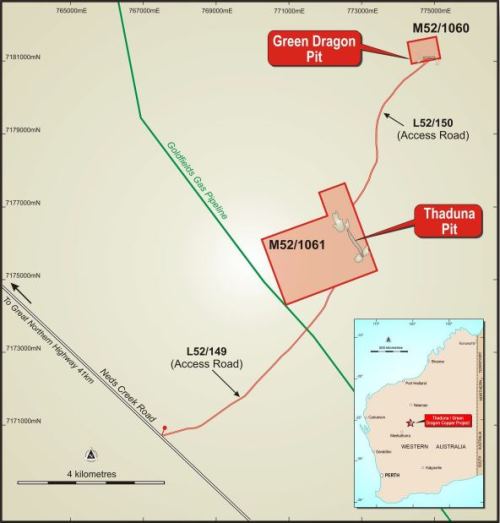
Source: Company announcement


“The granting of the Mining Leases is an important milestone that continues the company’s strong momentum towards a decision to mine the September quarter this year,” Ventnor Resources managing director Bruce Maluish said in the company’s announcement to the Australian Securities Exchange.

“The prompt granting of the Mining Leases and the Miscellaneous Licences has only been possible with the cooperation of the Yugunga-Nya People throughout our negotiations that culminated in a Native Title Agreement being reached in April 2013.

“That agreement was reached in four months since our original meeting, demonstrating the spirit of cooperation on both sides.

“Ventnor looks forward to working with the group as it moves toward the mining phase in the future.”

Mining Lease M52/1061 granted for Thaduna covers the total area of the previous Prospecting Licences P51/1253, 1254 and 1255.
Mining Lease M52/1060 granted for Green Dragon covers the total area of the previous Prospecting Licence P51/1256.

Miscellaneous Licence L52/150 applies to the area which covers the road connecting the Thaduna and Green Dragon copper projects.

Miscellaneous Licence L52/149 applies to the area which covers the road connecting the proposed Thaduna copper project to the Neds Creek road 41km from the Great Northern Highway.

Ventnor said the granted Mining Leases and Miscellaneous Leases will enable it to proceed with the development of the Thaduna/Green Dragon project as planned.
Since April 2011 Ventnor has drilled more than 50,000m at the project in an aggressive exploration program aimed at producing first copper concentrate from Thaduna/Green Dragon in the December Quarter 2014.

A Scoping Study completed in February confirmed the economic and technical viability of the project, producing an average 15,000 tonnes per annum of copper over an anticipated mine life of 10 years.

Quarter Time Wrap

THE BOURSE WHISPERER: The latest Quarterly season has been a flurry of activity and The Roadhouse’s inbox has been strained to capacity. Here’s a random selection of what companies had to say.

Corazon Mining (ASX:CZN)

Corazon commenced exploration at the Top Up Rise (TUR) IOCG project, in the Gibson Desert region of Western Australia, during the quarter in preparation for a maiden drilling program, planned for Q2, 2013.

Subsequent to end of the quarter, the company completed a high-resolution ground gravity survey at the project.

Results included:
Multiple drill targets confirmed;
Target expanded to 10 kilometres by 6 kilometres in area (at plus 4 milligals (mGals) residual);
Gravity range variation of up to 18 mGals;
Large peak residual gravity anomaly of 8 mGals;

Corazon claims TUR to be one of the largest residual gravity anomalies in Australia and is located in a region prospective for iron-oxide copper-gold (IOCG) mineralisation.

Corazon also completed a $3 million capital raising in the quarter, by way of a placement of 68.2 million shares at 2.2 cents per share to raise $1.5 million and a Share Purchase Plan for $600,000 (and shortfall placement for $900,000) also at an issue price of 2.2 cents per share to raise $1.5 million.
 
During the quarter the company also continued progress at its suite of exploration and development opportunities in Canada including; mining/development studies at the Lynn Lake nickel-copper sulphide project, and the identification of the Beaucage Lake gold project as a high-grade gold exploration play via the collation of historical exploration.


Consolidated Tin Mines (ASX: CSD)

In January Consolidated Tin’s major shareholder Snow Peak International Investments (SPI) completed the acquisition of Kagara’s Central Region project for a total consideration of $40 million.

The acquisition was completed via Snow Peak Mining (SPM), a subsidiary of Snow Peak International Investment. Consolidated Tin has a 10 per cent free carry interest in SPM.

The acquisition includes an operating one million tonnes per annum capacity concentrator plus a highly prospective and proven package of copper and base metal assets, and is considered to be of major strategic value for the development of Consolidated Tin’s Mt Garnet tin project, which is located in close proximity to the newly acquired concentrator.

The company also appointed ex-Kagara Regional General Manager, John Banning, as executive general manager to implement the CSD/SPM development plans.

In February the company reported it had identified five new anomalous tin zones at its Mt Garnet project area.

The five zones are; Crisis, Sailor, Never Can Tell, Coolgarra and Top Nettles.

A JORC Resource review at the Mt Garnet tin project is underway and is anticipated to be completed by end Q2 2013.

The company is now in the process of finalising its Pre-Feasibility Study (PFS) for the Mt Garnet tin project based on processing tin ore at the SPM Mt Garnet concentrator.

Based on completion of a positive PFS, it is proposed that a Joint Venture partnership will be formed between the two parties, the terms of which are to be finalised in due course.


Argent Minerals (ASX: ARD)

Subsequent to the end of the quarter Argent Minerals submitted its Environmental Impact Statement for the Kempfield silver project, located near Bathurst in regional New South Wales, to the NSW Department of Planning & Infrastructure.

The company consider this to be a major milestone in the project’s approval process as it marks the commencement of the NSW Government’s assessment phase of the project.

The Kempfield project is classified as a State Significant Development by the NSW Government.

Under the State Significant Development approval process Government agencies will now provide comment for consideration by the Company and incorporation into a final version of the EIS.

The environmental impacts associated with the project have been assessed by twelve specialist consultancies as being; less than the relevant criteria, capable of being offset through licencing, or not significant.

During the quarter, Argent also announced details of a one for two, options entitlement issue to raise additional funds.

Activity at other projects included:

West Wyalong copper-gold project in NSW – further exploration progress was achieved with the identification of four untested porphyry copper gold targets; and

Sunny Corner base and precious metals project in NSW – soil geochemistry analysis identified potential for three shallow gold deposits less than 7km to the north west of the historic VMS silver/polymetallic mine site.


Pioneer Resources (ASX: PIO)

Subsequent to the end of the quarter, Pioneer Resources reported high-grade gold mineralisation from its current phase of drilling at the Acra gold project (100 per cent PIO), located in the Eastern Goldfields, Western Australia.

Highlight results included:

Kalpini South prospect

10m at 6.38g/t from 61m; and

9m at 5.31g/t from 36m.

Assays of preliminary composite samples from the Jubilee East prospect included:

15m at 2.04g/t from 27m;

3m at 6.18g/t from 57m;

6m at 2.35g/t from 33m; and

9m at 1.85g/t from 99m.

The current 100 RC hole, 8,000 metre program is approximately 50 per cent complete and 25 per cent of preliminary assays have been received. Further results will be released in due course.

Golden Ridge nickel project, Eastern Goldfields, Western Australia.

21 line kilometres of detailed fixed loop or moving loop Electromagnetic (EM) surveys were completed and five EM conductor targets (which may include nickel sulphides) have been identified.

Fairwater nickel project, Albany-Fraser Province, Western Australia.

VTEM airborne EM survey was conducted over the FWN001 nickel target and final data expected to be received May 2013. Ground EM surveys will now be conducted to help define drill targets

Pioneer Resources has reserves of approximately $3.4 million and cash receivables of $2.3 million, totalling $5.7 million.

Stonewall Resources subsidiary granted South African mining right

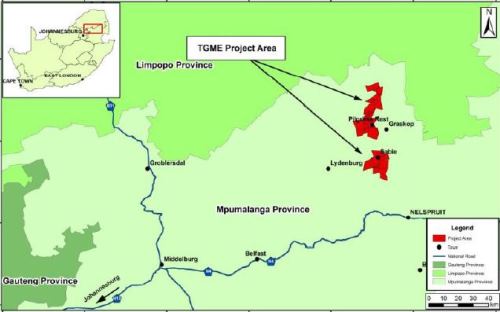
THE BOURSE WHISPERER: Stonewall Resources (ASX: SWJ) announced to the market that its subsidiary company Transvaal Gold Mining Estates Ltd (TGME) has been granted a mining right (MP MR 433) for Glynn’s Lydenburg by the Department of Mineral Resources in South Africa.

TGME has now been granted a total of six prospecting rights and eight mining rights amongst its subsidiaries.


Location of TGME project area. Source: Company announcement


“The granting of this right is another example of Stonewall’s rapid growth,” Stonewall Resources chief executive office Lloyd Birrell said in the company’s announcement to the Australian Securities Exchange.

“The processing of the Glynn’s tailings dam allows us to execute our preferred strategy, which is to commence operations with tailings and/or surface material.

“As a result of this initiative, we will be able to generate short term profits, establish an operational footprint, team and plant, perfect the process flow, and understand the metallurgy.

“This will serve as the ideal platform to ramp up to full scale underground mining in the Sabie region, all achieved at low capex levels.”

Stonewall said the granting of the New Order Mining Right gives it the opportunity to develop a cornerstone project in Sabie.

The Glynn’s project will be managed by the Stonewall management team out of Sabie Mines’ new offices located in the town of Sabie.

The Mining Right area comprises the farms, Grootfontein and Olifantsgeraamte.